









Executive Overview
Official maritime transport data released for June 2026 reveals a complex, bifurcated economic landscape across the Mediterranean island of Corsica. Monthly passenger figures indicate a noticeable softening of tourist arrivals, whereas maritime freight flows experienced double-digit growth, underscoring resilient local consumption and robust commercial supply chain logistics despite broader macroeconomic headwinds.
According to data compiled by the Regional Directorate for the Environment, Planning and Housing (Direction régionale de l’environnement, de l’aménagement et du logement – DREAL Corsica), total ferry passenger movement to and from Corsica reached 451,800 travelers in June 2026. This performance marks a year-on-year contraction of 6.1% compared to the same period in 2025. The metrics, which strictly exclude cruise ship passengers to reflect point-to-point ferry connectivity, were accompanied by a 3.7% decline in accompanied passenger vehicles, which totaled 172,000 units for the month.
+-----------------------------------------------------------------------+
|                 JUNE 2026 CORSICAN MARITIME METRICS                   |
+------------------------------------+----------------------------------+
| Total Ferry Passengers             | 451,800 (-6.1% YoY)              |
| Accompanied Passenger Cars         | 172,000 (-3.7% YoY)              |
| Incoming Maritime Freight          | 208,300 tonnes (+13.1% YoY)      |
| Ro-Ro Cargo Volume                 | ~143,000 tonnes                  |
+------------------------------------+----------------------------------+
In sharp contrast to the decelerating passenger market, Corsica’s maritime freight sector recorded a substantial surge. Incoming goods delivered to the island’s ports jumped by 13.1% year-on-year to 208,300 tonnes. Roll-on/Roll-off (Ro-Ro) trailers accounted for approximately 143,000 tonnes of this volume, highlighting the central role that daily freight sea-bridges play in sustaining the island’s retail, construction, and hospitality supply networks prior to the mid-summer rush.
Market dominance among ferry operators remained heavily consolidated. Private operator Corsica Ferries retained its position as the market leader, carrying roughly 63% of all maritime passengers. Ports on the northern end of the island, led by Bastia, continued to handle the vast majority of cross-strait traffic, while routes connecting to mainland France retained a modest edge over Italian corridors.
Detailed Chronology
The June 2026 performance figures mark a critical transition period for Corsica’s tourism and transport sectors, serving as the traditional gateway to the peak European summer holiday season.
+-----------------------------------------------------------------------+
|                    JUNE 2026 TRAFFIC BREAKDOWN                        |
+-----------------------------------------------------------------------+
| GEOGRAPHIC ORIGIN / DESTINATION                                       |
|   • Mainland France:  258,000 passengers (57%)                        |
|   • Italy:            193,000 passengers (43%)                        |
+-----------------------------------------------------------------------+
| TOP PORT DESTINATION                                                  |
|   • Bastia:           246,000 passengers (55%)                        |
+-----------------------------------------------------------------------+
| OPERATOR MARKET SHARE                                                 |
|   • Corsica Ferries:  282,000 passengers (63%)                        |
|   • Moby Lines:        74,000 passengers (16%)                        |
|   • Corsica Linea:     53,000 passengers (12%)                        |
|   • La Méridionale:    21,000 passengers (5%)                         |
|   • Ichnusa Lines:     19,000 passengers (4%)                         |
+-----------------------------------------------------------------------+
Early Season Expectations vs. Operational Reality
Throughout the first quarter of 2026, regional tourism boards and maritime carriers anticipated steady early-summer demand. However, as shoulder-season travel commenced in late May and stretched into June, booking velocities slowed. The 6.1% drop in passenger volumes reflects wider consumer adjustments across Western Europe, where inflation in core living costs, elevated maritime ticket prices, and competing Mediterranean destinations influenced early summer holiday choices.
The modest 3.7% drop in accompanied private vehicles (172,000 cars) relative to the 6.1% drop in overall passengers indicates a shift toward smaller household travel parties and fewer multi-passenger family groups taking early season trips.
The Freight Decoupling
While holidaymakers scaled back or delayed trips, commercial supply lines experienced the opposite trend. Beginning in late spring, retail inventory rebuilding and industrial deliveries accelerated across Corsica’s primary commercial hubs.
The 13.1% year-on-year increase in incoming freight to 208,300 tonnes was largely driven by a heavy inflow of consumer goods, food products, and raw construction materials needed for ongoing civil engineering projects. Freight movements remained resilient throughout all four weeks of June, indicating that island businesses actively built up inventory ahead of the high season.
Supporting Context & Metrics
The June statistics provide insight into operator positioning, port routing dynamics, and the operational split between public service obligation carriers and commercial market operators.
                       JUNE 2026 PASSENGER MARKET SHARE

       [##########################################        ] Corsica Ferries (63%)
       [##########                                        ] Moby Lines (16%)
       [########                                          ] Corsica Linea (12%)
       [###                                               ] La Méridionale (5%)
       [###                                               ] Ichnusa Lines (4%)
Operator Market Share Breakdown
Five primary maritime carriers operated routes serving Corsica in June 2026:
- Corsica Ferries: The yellow-hulled private carrier maintained its market dominance, carrying approximately 282,000 passengers, representing 63% of total passenger volume. Operating extensive open-access routes primarily out of mainland French ports (Toulon and Nice) as well as Italian ports (Livorno and Savona), the carrier leveraged its high-density fleet model to capture the majority of seasonal tourist traffic.
- Moby Lines: Operating predominantly on Italian routes and cross-strait connections to Sardinia, the Italian carrier carried 74,000 passengers, securing a 16% market share.
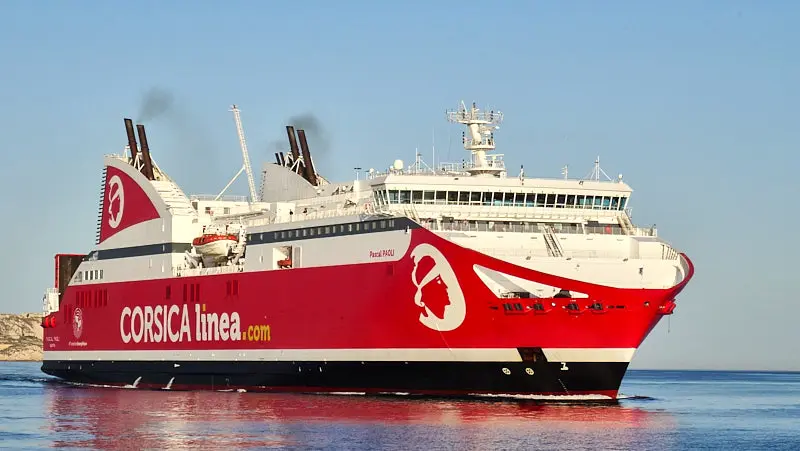
- Corsica Linea: Operating under the Public Service Delegation (Délégation de Service Public – DSP) contract from Marseille alongside commercial weekend lines, the company carried 53,000 passengers, capturing 12% of the overall passenger market while handling a large portion of daily Ro-Ro freight cargo.
- La Méridionale: The historic carrier—now integrated into the CMA CGM Group—carried 21,000 passengers (5% market share), primarily serving the Marseille–Corsica public service routes with a strong operational focus on freight integration.
- Ichnusa Lines: Specializing in short cross-strait routes between Bonifacio in southern Corsica and Santa Teresa Gallura in Sardinia, the operator transported 19,000 passengers, representing 4% of the regional total.
Geographic Corridors and Port Hierarchy
Connectivity between Corsica and mainland France comprised 57% of overall passenger volumes, moving 258,000 travelers. Routes linking Corsica with Italy (including mainland Italian ports and cross-strait connections with Sardinia) accounted for the remaining 43%, or 193,000 passengers. Italian routes remain highly sensitive to summer tourism fluctuations, while French mainland corridors maintain a higher baseline of year-round essential travel alongside tourist flows.
                GEOGRAPHIC ROUTE DISTRIBUTION & PORT DOMINANCE

     Mainland France Connections                       Bastia Port Share
            [57% / 258k]                                 [55% / 246k]
                 |                                             |
  +--------------+--------------+               +--------------+--------------+
  |                             |               |                             |
France                        Italy          Bastia                      All Other
Mainland                      Routes          Port                       Island Ports
 [57%]                        [43%]          [55%]                         [45%]
From an infrastructure perspective, the northern port of Bastia solidified its position as Corsica’s primary maritime gateway. Bastia handled approximately 246,000 passengers in June, representing 55% of all sea arrivals and departures on the island. Bastia’s geographic proximity to Northern Italy and direct highways to southern Corsica make it the primary choice for both high-speed passenger ferries and heavy Ro-Ro cargo shipments.
Freight Profile: Ro-Ro Dominance
The inbound freight total of 208,300 tonnes highlights the island’s reliance on maritime logistics. Out of this total, 143,000 tonnes comprised Roll-on/Roll-off (Ro-Ro) trailers. Ro-Ro shipping remains vital to Corsica’s economy because it allows driver-accompanied trucks and un-accompanied trailers to roll directly off ferries onto island roads, delivering perishable food, consumer merchandise, and medical supplies without container-handling delays.
Official Statements & Industry Perspectives
Industry analysts and transport officials point to several economic factors shaping these divergent passenger and freight trends.
Regional transport authorities within the Office des Transports de la Corse (OTC) note that the drop in June passenger volumes must be viewed through the lens of changing European holiday patterns.
"While a 6.1% year-on-year drop in June passenger traffic requires close observation, it reflects a broader normalization of Mediterranean tourism flows," noted a senior regional transport analyst. "Consumers are facing tighter disposable incomes across key source markets in France, Germany, and Italy. Consequently, we are seeing travelers shorten their stays or shift their trips directly into the peak July-August window."
Maritime economists also highlight the impact of rising operational costs on ferry ticket pricing. The expansion of the European Union Emissions Trading System (EU ETS) to maritime transport—which requires shipping lines to purchase carbon allowances for voyages to and from European ports—has added operational surcharges.
"Ferry lines operating in the Western Mediterranean are managing higher bunker fuel costs and carbon compliance expenses," stated a maritime logistics specialist. "These cost pressures inevitably feed through to passenger fares, particularly on non-subsidized commercial routes, creating a price ceiling that deters some price-sensitive travelers during shoulder months."
Addressing the strong freight performance, logistics sector representatives emphasized the underlying strength of Corsica’s local economy.
"A 13.1% growth in inbound freight demonstrates that internal island demand remains strong," stated a logistics manager based in Bastia. "Island businesses were actively restocking across June, supported by ongoing construction activity and preparation for summer hospitality operations. The freight transport framework—anchored by daily Public Service Delegation (DSP) sailings—continues to operate efficiently."
Future Outlook
As Corsica moves deeper into the 2026 summer season, maritime operators and regional policymakers are monitoring several strategic variables that could influence transport performance through the second half of the year.
+-----------------------------------------------------------------------+
|                    STRATEGIC MARITIME CHALLENGES                      |
+-----------------------------------------------------------------------+
| 1. High-Season Recovery  | Monitoring July/August booking recovery to  |
|                          | offset June passenger volume drops.         |
|                          |                                            |
| 2. Decarbonization Mandates | Adapting fleets to EU ETS regulations,   |
|                          | LNG adoption, and shore-power connections. |
|                          |                                            |
| 3. Freight Resilience    | Managing balanced trade flows as internal  |
|                          | construction and retail demand expand.     |
+-----------------------------------------------------------------------+
High-Season Booking Adjustments
Carriers are focusing on late-booking trends for July and August. With June recording lower passenger numbers, operators like Corsica Ferries and Moby Lines have adjusted dynamic pricing algorithms to stimulate last-minute bookings from mainland France and Northern Italy. Initial forward-booking projections suggest that peak-summer demand may recover lost ground, as domestic travelers opt for regional Mediterranean road trips over long-haul international flights.
Decarbonization and Infrastructure Investment
The June performance data arrives amid broader structural changes across Western Mediterranean shipping networks. Regional authorities and port commissions are accelerating infrastructure upgrades aimed at decarbonizing maritime transport:
- Shore-side Electricity (Cold Ironing): Major investment programs are underway at the ports of Bastia and Ajaccio to allow berthed vessels to plug into grid power, turning off onboard auxiliary diesel generators to reduce portside emissions.
- Fleet Modernization: Both public service operators and commercial lines are introducing dual-fuel vessels capable of running on Liquefied Natural Gas (LNG) and bio-blend fuels. CMA CGM’s backing of La Méridionale is expected to accelerate fleet renewal efforts, focusing on lower-emission Ro-Pax (passenger and freight) vessels.
- Port Expansion Planning: The high concentration of traffic at Bastia (55% of all island ferry passengers) continues to drive debate surrounding the proposed Carbonite port expansion project or alternative northern logistics hubs to relieve urban congestion in downtown Bastia.
Strategic Balance
The June 2026 traffic figures demonstrate the structural duality of Corsica’s maritime connections. While passenger volumes remain vulnerable to broader European economic trends and consumer sentiment, the island’s freight backbone remains vital and resilient. Maritime carriers will need to balance commercial passenger pricing strategies with reliable freight transport to ensure stable connectivity and supply chain performance across the Mediterranean.