The global maritime sector is undergoing its most profound disruption since the transition from sail to steam. Driven by stringent International Maritime Organization (IMO) decarbonization mandates and the European Union’s FuelEU Maritime regulations, shipowners can no longer rely on standardized, fossil-fuel-reliant vessel designs. In this high-stakes environment, shipbuilding yards are being forced to choose between two paths: clinging to legacy manufacturing paradigms or embracing highly complex, unproven engineering concepts.
For RMK Marine, a premier shipyard group based in Turkey and a subsidiary of the industrial conglomerate Koç Holding, this market transition has become a primary catalyst for growth. Operating from a combined footprint of 160,000 square meters across Tuzla and Yalova, RMK Marine has carved out a unique position in the global market by balancing decades of industrial experience with a highly adaptive, technology-neutral approach to alternative marine propulsion.
Rather than committing to a single green fuel or propulsion system, RMK Marine’s strategy centers on concurrent competency across multiple cutting-edge technologies. The shipyard’s current order book and recent deliveries span the entire spectrum of maritime decarbonization: wind-assisted propulsion, liquefied natural gas (LNG) and bio-LNG bunkering, and methanol-ready dual-fuel systems.
Furthermore, the company is executing a major capital investment strategy designed to split its operations. By transitioning its superyacht division to a dedicated, state-of-the-art facility in Yalova under the "RMK Yachts" brand by 2027, RMK Marine is optimizing its Tuzla facilities to focus exclusively on high-complexity commercial and naval defense projects. This restructuring not only increases overall capacity but also insulates the yard against the cyclical nature of individual maritime sectors.
Detailed Chronology
RMK Marine’s current position as a pioneer in green shipbuilding is the result of a deliberate, decades-long evolution. The yard’s trajectory highlights how a traditional regional shipbuilder can systematically build the technical capabilities required to execute world-first engineering projects.
[1978: Founded in Haliç] ──> [1984: Relocation to Tuzla] ──> [1997: Acquired by Koç Holding]
                                                                     │
[2027: Yalova Yard Fully Operational] <── [2025: Neoliner Delivered] <── [2009: North Sea Giant Delivery]
1978 – Founding in the Golden Horn: The shipyard was established in the historic Haliç (Golden Horn) district of Istanbul. In its early years, the yard focused on constructing steel, aluminum, and composite vessels, establishing a foundational capability in working with diverse materials.
1984 – The Tuzla Migration: To accommodate larger vessels and modern industrial workflows, the yard relocated to Tuzla, Istanbul’s premier shipbuilding hub. This move allowed the company to scale its infrastructure and target larger commercial contracts.
1997 – Acquisition by Koç Holding: Turkey’s largest industrial conglomerate, Koç Holding, acquired the shipyard. This acquisition provided RMK Marine with the financial stability, corporate governance, and research and development resources of a global conglomerate, paving the way for highly complex defense and commercial bids.
2009 – The North Sea Giant Milestone: RMK Marine delivered the North Sea Giant, one of the most advanced and complex multipurpose offshore construction vessels (MOCVs) ever built. The project served as a proof-of-concept for the yard’s ability to integrate sophisticated dynamic positioning, diesel-electric propulsion, and heavy-lift subsea crane systems.
Naval and Coast Guard Expansion: Parallel to its commercial growth, the yard secured critical defense contracts, culminating in the delivery of four search and rescue (SAR) vessels for the Turkish Coast Guard. This work instilled rigorous quality control and systems-integration standards across the yard’s workforce.
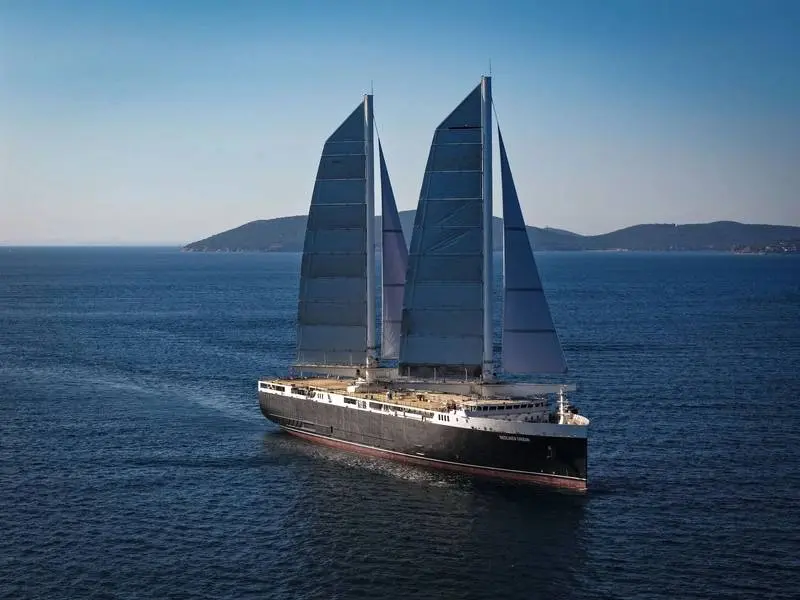
2025 – The Neoliner Origin Delivery: RMK Marine completed and delivered the Neoliner Origin, the world’s first custom-built sailing Roll-on/Roll-off (Ro-Ro) vessel. The delivery marked RMK Marine’s official entry into utility-scale wind propulsion.
2026 – Launch of T. Tarabya: Scheduled for September 2026, the launch of this 12,000-dwt chemical/oil tanker will mark another milestone in the yard’s commercial tanker portfolio, showcasing advanced methanol-ready propulsion integration.
2027 – The Dual-Facility Future: In the first quarter of 2027, RMK Marine will begin relocating its yacht division to the newly developed RMK Yachts Yalova Shipyard. By the end of 2027, both the Tuzla commercial/naval yard and the Yalova yacht yard are scheduled to reach full operational capacity, establishing a highly specialized, dual-site operational model.
Supporting Context & Metrics
To understand the scale of RMK Marine’s industrial pivot, it is necessary to examine the physical capacities of its facilities alongside the technical specifications of its highly diversified vessel portfolio.
Shipyard Capacity and Capital Restructuring
Currently, RMK Marine operates within a 160,000 m² footprint across Tuzla and Yalova, with the capability to construct vessels up to 200 meters in length and 28,000 deadweight tonnage (DWT).
The ongoing capital investment program addresses a classic shipbuilding bottleneck: the competing spatial and labor demands of commercial shipbuilding, naval defense projects, and bespoke superyacht construction.
Metric / Feature
Tuzla Facility (Post-2027)
Yalova Facility (RMK Yachts – Post-2027)
Primary Focus
Commercial & Naval Vessels
Megayachts & Superyachts
Max Vessel Length
Up to 200 meters
Specialized for Custom Yacht Hull Sizes
Max Deadweight
28,000 DWT
N/A (Volume/GT Focused)
Strategic Advantage
High-throughput industrial fabrication
Ultra-high-finish outfitting & specialized craft
By separating these operations, RMK Marine prevents the industrial, high-intensity workflows of commercial and military fabrication from disrupting the meticulous, dust-free, and highly customized environments required for world-class yacht outfitting.
Technical Profiles of Key Decarbonization Projects
The shipyard’s current order book serves as a real-world case study in maritime technology diversification. Rather than waiting for the industry to settle on a single alternative fuel, RMK Marine is actively building hulls for four distinct propulsion paradigms.
RMK Marine has emerged as an early mover in utility-scale wind propulsion, demonstrating that sail systems are viable for both Ro-Ro and containerized cargo routes.
Neoliner Origin (Delivered 2025): Built for French operator Neoline Armateurs, this 136-meter vessel is designed for transoceanic routes, specifically navigating the challenging conditions of the North Atlantic.
Cargo Capacity: 5,000 tons at design draft, configured to carry approximately 500 vehicles or 265 Twenty-Foot Equivalent Units (TEU).
Propulsion System: Two folding solid sail rigs providing a massive 3,000 m² of sail area. These rigs can be lowered to clear bridge clearances.
Environmental Impact: By utilizing wind as its primary propulsive force, supplemented by automated weather-routing software and sensor arrays, the vessel reduces fossil-fuel consumption by over 80% and slashes greenhouse gas (GHG) emissions by up to 90% compared to equivalent conventional vessels on the same route.
MIARAKA (Delivery scheduled for Q2 2027): Developed in collaboration with Windcoop and Zéphyr & Borée, this 91.3-meter vessel represents the transition of wind technology into the container sector. It won the prestigious "Sustainable Ship Design" award at the Breakbulk Green World Awards 2026.
Cargo Capacity: 210 TEU, including 40 specialized refrigerated container (reefer) connections, with a total cargo capacity of 2,500 tons.
Propulsion System: Three specialized CWS wing sails totaling 1,050 m² of sail area, paired with a 1,200-kW four-stroke Anglo Belgian Corporation (ABC) main engine driving a Berg controllable-pitch propeller.
Operational Route: Scheduled for the Marseille-Madagascar trade lane, where the wind-assist system is projected to reduce carbon emissions by up to 60% compared to conventional operations.
2. Supporting the Transitional Fuel Infrastructure: Celsius
While wind provides direct propulsion, the global fleet still requires liquid and gaseous fuels. RMK Marine is addressing this by building the infrastructure vessels needed to transport and distribute transitional fuels.
Celsius (Under Construction): A 112.76-meter LNG and bio-LNG bunker tanker designed by Swedish naval architects FKAB and developed in partnership with Sirius Shipping and Gasum Group.
Capacity: 7,800 cubic meters of liquefied gas.
Key Technology: Equipped with a high-capacity 27.7-MW gas combustion unit (GCU). This allows the vessel to perform complex cooling-down and warming-up operations for the fuel and cargo tanks of the ships it services.
Decarbonization Impact:Celsius is fully compatible with bio-LNG. When utilizing 100% renewable bio-LNG, the vessel enables lifecycle greenhouse gas reductions of up to 90% compared to traditional marine gas oil, offering a drop-in decarbonization pathway for LNG-fueled fleets.
3. Future-Proofed Liquid Fuel Tankers: T. Florya & T. Tarabya
For shipowners hesitant to commit to alternative fuels today due to supply chain uncertainty, RMK Marine offers "future-proofed" conventional hulls designed for seamless retrofitting.
T. Florya & T. Tarabya (Under Construction/Delivery): Two 12,000-dwt chemical and oil tankers built for Turkish operator Ditaş Tankers. Designed by Delta Marine, these 125-meter vessels focus on high safety standards and cargo flexibility.
Methanol-Ready Design: The defining feature of these tankers is their "methanol-ready" structural and mechanical design. The main engines are engineered to be converted to dual-fuel methanol operation at a later date with minimal structural modification.
Strategic Rationale: This design protects the shipowner’s capital investment. As green methanol bunkering infrastructure matures and carbon pricing mechanisms make fossil fuels more expensive, these vessels can be rapidly retrofitted to comply with tightening regulatory frameworks.
Official Statements
The leadership at RMK Marine views these projects not as isolated engineering challenges, but as part of a coherent strategy to position the Turkish shipbuilding sector at the forefront of the global energy transition.
Dr. Utku Alanç, CEO of RMK Marine, emphasizes the historic significance of the Neoliner Origin project:
"As the only shipyard in Türkiye to realize the wind-powered sailing Ro-Ro vessel project, we are honored to deliver the world’s first sailing Ro-Ro vessel — an exemplary achievement on a global scale."
This statement highlights RMK Marine’s role in proving that wind-assisted propulsion is no longer a theoretical concept but a viable, commercial-scale reality. Dr. Alanç views the expansion into containerized wind propulsion with the MIARAKA as a logical step in this evolution:
"Maritime transportation is the cornerstone of global trade and an essential part of logistics. Therefore, developing innovative solutions to minimize environmental impact is of utmost significance."
Regarding the construction of the Celsius LNG/bio-LNG bunker tanker, Dr. Alanç connects technical innovation directly with corporate and environmental responsibility:
"At RMK Marine, innovation goes hand in hand with responsibility. The adoption of alternative fuels reflects our commitment to shaping a cleaner future for maritime transport."
These statements show a clear shift in the shipyard’s positioning. Rather than operating merely as a contract manufacturer executing external designs, RMK Marine is actively collaborating with technology providers, naval architects, and forward-looking shipowners to co-develop new maritime technologies.
Future Outlook
The next decade will decide which shipyards survive the transition to zero-emission shipping. RMK Marine’s forward-looking strategy positions it to capitalize on several key market drivers.
                       ┌── Q1 2027: Begin relocation to Yalova
                       │
RMK Marine Timeline ───┼── Mid-2027: Complete split (Tuzla: Commercial/Naval | Yalova: Yachts)
                       │
                       └── Post-2027: Scale high-complexity green commercial projects
The 2027 Yard Separation and Capacity Boost
The planned relocation of the yacht division to the RMK Yachts Yalova Shipyard, beginning in Q1 2027 and reaching full operational capacity by the end of that year, is a critical step for the company.
By removing yacht construction from the Tuzla facility, RMK Marine will free up prime slipway space and engineering resources. This dedicated capacity will allow the Tuzla yard to take on more high-value, complex commercial projects—such as additional wind-assisted cargo vessels, dual-fuel tankers, and specialized naval defense craft.
Concurrently, the new Yalova facility will allow "RMK Yachts" to scale its presence in the megayacht market, offering ultra-modern, eco-friendly superyacht designs that increasingly incorporate hybrid and full-electric propulsion systems.
Navigating Fuel Uncertainty with Technology Neutrality
The greatest challenge facing shipowners today is fuel uncertainty. Committing to a single fuel—whether ammonia, methanol, hydrogen, or LNG—carries immense financial risk if the global supply chain fails to deliver that fuel at scale or if future regulations penalize its lifecycle emissions.
RMK Marine’s diversified portfolio shields the yard from this volatility. By building competence across wind, LNG/bio-LNG, methanol-ready, and electric technologies, the yard ensures it can accommodate whichever energy pathway eventually gains market dominance.
While other yards focus on mass-producing standard, fossil-fuel-burning bulkers and tankers, RMK Marine’s focus on highly specialized, low-carbon vessels positions it as a key partner for forward-looking operators. As international regulations tighten, the demand for ships that have never been built before will only grow. RMK Marine has proven that it has both the technical expertise and the modern infrastructure required to build them.