









Executive Overview
While the surface of the global ocean often appears as a continuous, rolling expanse of blue, its thermal reality is radically different. Beneath the waves lies a fluid biosphere characterized by extreme thermal extremes: from the sub-zero brine pools and polar abysses of Antarctica, hovering dangerously close to freezing, to shallow tropical coastlines baking under 100-degree Fahrenheit suns, and further down to superheated hydrothermal vents spewing mineral-rich water at temperatures exceeding 600°F.
Unlike terrestrial mammals or birds, which possess internal metabolic heating mechanisms or behavioral lifelines like shelter and shade, marine organisms face a profound physical constraint. Water is roughly 24 times more thermally conductive than air, meaning heat is rapidly leached from an animal’s body, or conversely, absorbed with punishing efficiency. To survive across these violent thermal gradients, marine life has relied on millions of years of evolutionary experimentation.
Thermoregulation—the suite of physiological and anatomical strategies used to manage internal body temperatures—is quite literally the difference between life and death across the world’s oceans. As global climate change accelerates, triggering historic marine heatwaves, expanding dead zones, and devastating coral reefs, understanding these biological survival mechanisms has never been more urgent. These remarkable adaptations not only highlight the resilience of marine life but also serve as a stark baseline for how much stress these ecosystems can endure before biological limits are catastrophically breached.
Detailed Chronology: Milestones in Marine Thermal Evolution and Discovery
The study of how ocean life manages extreme temperatures is rooted in a rich history of physiological discovery and technological evolution. Tracing these milestones reveals how science unlocked the secrets of marine survival.
- 1928: The Discovery of the Pale Abyssal Ghost
Danish and Norwegian marine expeditions operating in the freezing waters of the Southern Ocean pull up an astonishing biological anomaly: the Antarctic icefish. Unlike any other known vertebrate, these creatures possess completely translucent, milky-white blood. Initial laboratory analyses reveal the shocking truth: they carry zero red blood cells and lack hemoglobin entirely, forcing scientists to rethink the absolute physiological prerequisites of vertebrate life. - The Mid-20th Century: Unraveling the "Wonderful Net"
As commercial fisheries expand and marine physiology matures as a discipline, researchers dissecting apex predators like the bluefin tuna discover a dense, highly specialized vascular network known as the rete mirabile (the "wonderful net"). This anatomical marvel proves that fish are not universally cold-blooded (ectothermic); certain pelagic hunters can regionally conserve metabolic heat, maintaining elevated muscle and brain temperatures while navigating icy depths. - Late 20th Century: Hydrothermal Vent Explorations
The submersible Alvin and other deep-sea research vessels pierce the perpetual darkness of the deep ocean floor, discovering hydrothermal vent ecosystems in 1977. Scientists are stunned to find thriving colonies of eight-foot-long giant tubeworms (Riftia pachyptila) living mere inches from mineral-laden fluids hot enough to melt lead, fundamentally altering our understanding of the thermal thresholds for complex life. - The Molecular Era (1990s–2000s): Decoding Biological Antifreeze
Biochemists isolate and sequence Antifreeze Glycoproteins (AFGPs) in Antarctic notothenioids. This breakthrough explains how fish living in sub-zero polar waters prevent lethal ice crystal nucleation within their cellular cytoplasm and extracellular fluids, functioning much like automotive coolant in a sub-zero engine. - 2025–2026: Modern Discoveries and the Climate Alarm
Cutting-edge genomic sequencing confirms that certain Asian noodlefishes have completely lost their myoglobin and hemoglobin genes, mirroring the evolutionary path of Antarctic icefish. Simultaneously, marine biologists sound the alarm: while these evolutionary marvels are profound, the velocity of modern anthropogenic ocean warming is outpacing the evolutionary timescales that built them.
Supporting Context & Metrics: The Physics and Physiology of Thermal Survival
To appreciate the marvel of marine thermoregulation, one must examine the specific physical mechanisms that allow diverse species to cheat the thermodynamic rules of the sea.
1. Countercurrent Heat Exchange and Gigantothermy in Leatherback Sea Turtles
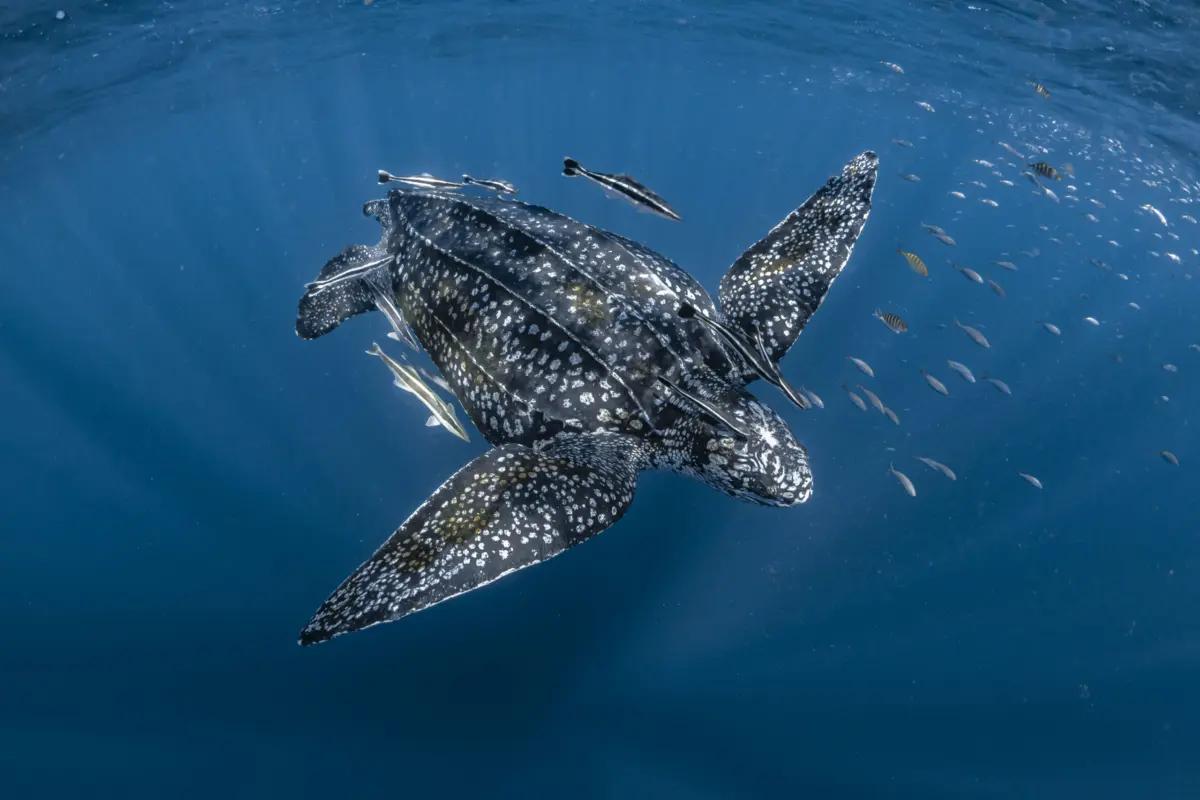
Leatherback sea turtles (Dermochelys coriacea) routinely dive into deep, near-freezing waters to hunt for jellyfish, yet maintain core body temperatures significantly warmer than their environment. They achieve this through two primary adaptations:
- Countercurrent Heat Exchange: Arteries carrying warm oxygenated blood from the heart are positioned directly adjacent to veins returning cold blood from the flippers. Heat from the arterial blood transfers directly into the venous blood via thermal conduction, warming it before it reaches vital internal organs.
- Gigantothermy: As the largest sea turtles on Earth, leatherbacks benefit from a low surface-area-to-volume ratio. Combined with a thick layer of oily, insulating brown adipose tissue and a leathery, lipid-rich carapace, they act as massive thermal batteries, retaining metabolic heat with high efficiency.
2. Regional Endothermy in Bluefin Tuna
While the vast majority of fish are ectothermic—meaning their internal temperature matches the ambient water—certain pelagic apex predators like the bluefin tuna utilize regional endothermy. By employing their rete mirabile, tuna trap metabolic heat generated by their swimming muscles. This allows them to maintain elevated temperatures in their swimming musculature, brain, and eyes. Consequently, they enjoy faster muscle contraction rates, sharper vision, and heightened reflexes, giving them a decisive predatory edge when hunting swift prey in cold, deep waters.
3. Molecular Antifreeze in Polar Teleosts
In the freezing waters of the Arctic and Antarctic, where ambient temperatures drop below the freezing point of standard seawater (-1.9°C or 28.6°F), unprotected fish would instantly turn to ice. Antarctic notothenioids (such as the Antarctic toothfish and icefish) avoid this fate by synthesizing Antifreeze Glycoproteins (AFGPs). These specialized proteins bind to microscopic ice crystals the moment they begin to form, physically inhibiting their growth and preventing cellular rupture.
4. Extreme Thermal Tolerance at Hydrothermal Vents
At the other end of the thermal spectrum, vent-dwelling organisms like Riftia pachyptila and specialized zoarcid fish operate under conditions of extreme stress. Vent fluids can reach up to 660°F (350°C), though mixing with cold deep-sea water creates steep thermal gradients. Giant tubeworms position themselves precisely within these gradients, utilizing symbiotic chemosynthetic bacteria housed in their bodies to convert toxic hydrogen sulfide into organic energy, bypassing traditional solar-driven food webs entirely.
Official Statements and Expert Perspectives
Marine conservationists and physiological ecologists emphasize that while these adaptations are testaments to evolutionary genius, they are not infinite shields against anthropogenic climate disruption.
"When we look at creatures like the Antarctic icefish or the leatherback sea turtle, we are witnessing millions of years of master-class evolutionary engineering," notes a leading marine ecologist specializing in polar systems. "However, evolution operates on geological timescales. The rate at which we are currently pumping heat into the global ocean leaves these animals dangerously exposed. Adaptations designed to handle natural environmental fluctuations cannot simply pivot overnight to keep pace with modern marine heatwaves."
Conservation organizations and policy advocates stress that physiological resilience has a hard ceiling.
"The climate crisis in our ocean is not a distant threat looming on the horizon—it is actively unfolding beneath the surface," states a senior marine policy advocate. "From coral bleaching events triggered by thermal stress to the disruption of deep-water habitats, marine life is telling us loud and clear that the system is breaking down. Thermoregulation can keep an animal alive through a cold snap or a seasonal shift, but it cannot protect ecosystems from systemic, human-driven overheating."
Future Outlook: The Anthropocene and Marine Resilience
As global greenhouse gas emissions continue to trap excess heat—with more than 90% of excess planetary heat being absorbed by the world’s oceans—the future of marine thermoregulation hangs in the balance.
Marine heatwaves are becoming longer, more frequent, and more intense. These localized thermal anomalies push ectotherms and even regionally endothermic species past their critical thermal maxima. When water temperatures spike beyond an organism’s physiological capacity, metabolic rates skyrocket, oxygen demands outpace supply, cellular proteins denature, and catastrophic die-offs ensue.
Furthermore, thermal stress does not occur in a vacuum. It interacts synergistically with ocean acidification, deoxygenation (expanding oxygen minimum zones), and overfishing, creating a compounding crisis for marine biodiversity. For deep-sea vent communities, warming baseline temperatures driven by climate change could disrupt the delicate thermal gradients upon which vent fauna depend. For polar species, the shrinking polar ice caps threaten to eliminate the cold-water refugia they require to survive.
Ultimately, while the evolutionary marvels of countercurrent heat exchange, biological antifreeze, and red-blood-cell-free respiration showcase the extraordinary adaptability of life, they cannot substitute for urgent climate mitigation. Protecting these species requires aggressive, immediate reductions in global carbon emissions to stabilize ocean temperatures and preserve the fragile habitats that sustain life on Earth.
The climate crisis is here, and it will only get worse without immediate action. Join us in calling for our elected leaders to take action to mitigate climate change now.