The pristine waters of the Mediterranean off the coast of Monaco once again played host to the vanguard of sustainable maritime engineering during the 13th annual Monaco Energy Boat Challenge (MEBC). Organized by the prestigious Yacht Club de Monaco (YCM) and running from July 8 through July 11, the event has firmly established itself as the global crucible for zero-emission marine propulsion. Bringing together university prodigies competing in the Energy and AI classes alongside industry heavyweights in the SeaLab and Open Sea categories, the MEBC acts as a living laboratory where theoretical concepts transform into high-performance marine realities.
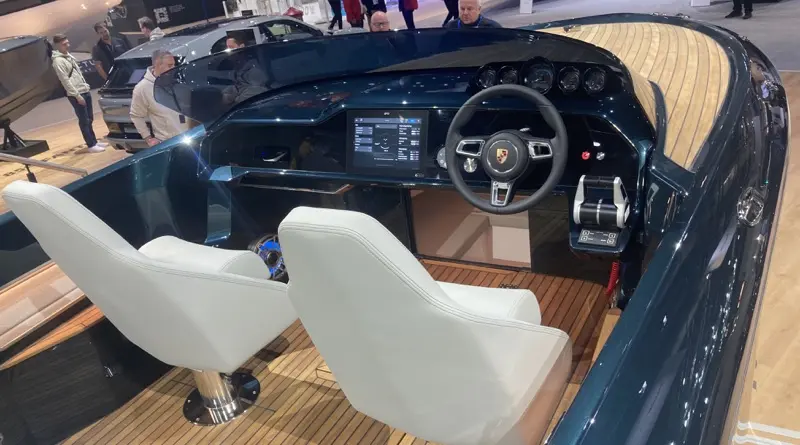
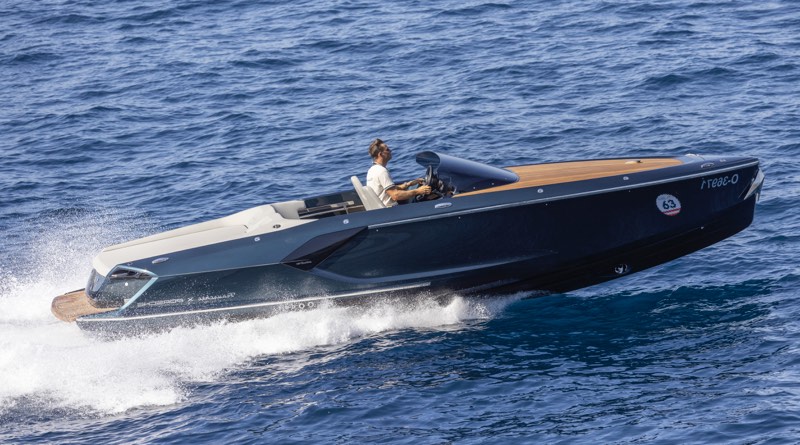
Yet, amid the collegiate ingenuity and technological experimentation, it was the commercial sphere that delivered the headline-grabbing spectacle. Stepping up to the starting line of the fiercely contested YCM Speed Record, the high-profile collaborative venture between historic Austrian boatbuilder Frauscher Bootswerft and German automotive titan Porsche achieved what many in the marine industry previously thought impossible. Piloted by Bastien Bonnet, the newly unveiled Frauscher X Porsche 797 Spectre shattered the elusive 50-knot ceiling, clocking an astonishing average speed of 51.05 knots (94.54 km/h / 58.75 mph) across the historic 500-meter sprint.
In doing so, the craft eclipsed the record set just twelve months prior by its stablemate, the Frauscher-Porsche 850 Fantom. This monumental achievement is not merely a numerical milestone; it represents a paradigm shift in naval architecture, proving conclusively that electric marine propulsion can equal—and frequently surpass—the raw performance metrics of traditional internal combustion engines without compromising luxury, range, or aesthetic prestige.
Detailed Chronology: From Concept to Record-Breaking Triumph
The genesis of the Frauscher X Porsche partnership dates back to 2022, though the institutional roots of both companies run deeply parallel. Founded in 1927 by Engelbert Frauscher, Frauscher Bootswerft began as a humble builder of wooden sailboats on the lakes of Austria before transitioning into gasoline-powered runabouts and, crucially, introducing its first electric vessels as early as 1955. Meanwhile, Porsche, founded in 1931 by Ferdinand Porsche, evolved into a global symbol of automotive performance and luxury engineering.
Though the two brands had previously collaborated in 2016 on a fossil-fueled project—the Frauscher Demon—their modern electric alliance was born from an informal executive conversation. While discussing Porsche’s developmental plans for its upcoming all-electric Macan SUV, leadership from both sides posed a transformative question: Could the advanced high-voltage powertrain of a luxury electric sports utility vehicle be successfully integrated into a marine hull?
Frauscher seized the opportunity. Developing an initial prototype with astonishing speed, the boatyard presented the concept to the Porsche board of directors. The resulting synergy led to the 2024 debut of the Frauscher X Porsche 850 Fantom Air. While the Fantom was an immense commercial and critical success—securing numerous accolades, including the prestigious Gussies International Electric Boat Awards, and setting the 2025 Monaco speed record at 49.84 knots—it relied on an existing, modified hull architecture adapted to house the electric motor and battery packs.
Recognizing the innate limitations of retrofitting an internal combustion hull for electric components, the engineering teams resolved to build upon a completely clean sheet. The culmination of this effort was the Frauscher 797 Spectre, officially unveiled to the public in January 2026 at the Boot Düsseldorf boat show.
Bred specifically for competition and peak open-water performance, the 797 Spectre was brought to the 2026 Monaco Energy Boat Challenge with high expectations. The racing community and industry insiders buzzed with speculation regarding whether the vessel could crack the 50-knot barrier. On the sun-drenched waters of Monaco, answering that question fell to pilot Bastien Bonnet. Blasting off from the starting line just outside the YCM breakwaters, Bonnet executed two flawless timed runs along the 500-meter coastal course—a historic track mirroring the world’s very first international powerboat race held in 1904. With a blistering final average time of just 38.2 seconds, the 797 Spectre crossed the timing markers at 51.05 knots, permanently rewriting the history books of electric mobility.
Supporting Context & Metrics: The Anatomy of a Record-Breaker
To fully grasp the magnitude of the 797 Spectre’s performance, one must examine the rigorous parameters of the YCM Speed Record and the sophisticated engineering choices that separate the Spectre from its predecessor, the 850 Fantom.
The Course and Competition Mechanics
The YCM Speed Record is designed to test the absolute velocity limits of production electric boats (Open Sea Class) and experimental craft (SeaLab Class). Competitors launch from a stationary start outside the YCM breakwaters, accelerating along the iconic Monaco shoreline toward a visible marker positioned precisely 500 meters away. To eliminate variables such as tidal currents, wind direction, and surface chop, rules dictate that boats must complete two consecutive legs—one outbound and one inbound. The official speed is calculated using the average time of both runs.
Clean-Sheet Design vs. Retrofit Engineering
The core differentiator between the 850 Fantom and the newer 797 Spectre lies in their foundational design philosophies:
The 850 Fantom: Utilized a classic Frauscher combustion-engine hull geometry. While heavily reinforced with custom structural stringers to evenly distribute the unique weight distribution of heavy battery packs, it remained, fundamentally, an adapted platform.
The 797 Spectre: Conceived from the ground up on a blank sheet of paper. This approach allowed master naval architect Harry Miesbauer and veteran designer Stefan Iverwin to optimize every square millimeter of the vessel around the precise physical footprint, center of gravity, and thermal management requirements of the Porsche high-voltage battery architecture.
Technical Specifications & Performance Metrics
Metric Category
Frauscher-Porsche 850 Fantom (2025 Record)
Frauscher X Porsche 797 Spectre (2026 Record)
Length Overall
~8.5 meters
~7.97 meters (Shorter & Lighter)
Powertrain Origin
Porsche Macan Electric Drive
Porsche Macan Electric Drive (Optimized)
Hull Philosophy
Modified Combustion Hull
Clean-Sheet Electric-Specific Hull
Top Speed Achieved
49.84 knots (92.3 km/h / 57.35 mph)
51.05 knots (94.54 km/h / 58.75 mph)
500m Average Time
N/A
38.2 seconds
The integration of naval architecture and automotive pedigree required an all-star design team. Harry Miesbauer, whose storied career includes designing high-performance racing yachts for the Volvo Ocean Race and America’s Cup campaigns (such as Amer Sports One), brought unmatched hydrodynamic expertise to the project. Reflecting on his transition from sailing yachts to high-performance motorboats—a journey initiated by Frauscher in 2012—Miesbauer emphasized the critical importance of weight distribution in electric marine craft:
"The main thing with hull design is to know the weight of all of the parts, and then address the most important aspect—the centre of gravity. That is what makes the boat ride properly and with the optimum efficiency… With the Spectre, we had a blank sheet. We could address everything and have it as we wanted from the first sketches."
Complementing Miesbauer’s hydrodynamic mastery is Stefan Iverwin, whose career began in the legendary Porsche Design Studio before spending a decade anchoring Frauscher’s in-house styling team. Iverwin was tasked with fusing automotive visual cues with traditional nautical aesthetics. The result is a striking exterior profile characterized by aggressive air intakes and outtakes that serve a dual purpose: efficiently cooling the high-capacity lithium-ion battery banks while doubling down as dynamic, speed-accentuating design lines that wrap fluidly around the stern.
Official Statements: Perspectives from Leadership
The historic breakthrough in Monaco elicited profound reactions from the executives and master craftsmen behind the project, underscoring the cultural and technological alignment between the two family-driven enterprises.
Stefan Frauscher, Managing Director of Frauscher Bootswerft, highlighted the collaborative synergy between the Austrian boatyard and German automotive engineers:
"Breaking the record we set only last year is an exceptional achievement by the entire team. The 797 Spectre impressively demonstrates the potential created by the consistent joint development of the boat, hull, and electric powertrain."
Frauscher further noted that while the company has historically partnered with marine-specific propulsion specialists—including Torqeedo, Molabo, and Evoy—the alliance with Porsche marks their first venture utilizing an automotive-grade high-voltage powertrain, setting a completely new benchmark for marine electrification.
From an engineering perspective, Harry Miesbauer pointed out that the psychological barrier broken by the Spectre will fundamentally alter consumer perceptions of electric mobility on the water:
"People will say, ‘I didn’t know you could have the same performance, maybe even better, with an electric boat, that you have with a combustion boat.’"
Stefan Iverwin echoed this sentiment, emphasizing that emotional resonance remains the ultimate metric of luxury design:
"For me, the best thing that can happen is if someone sees the boat and just has a gut reaction of ‘I love this boat, I want this boat.’ They also find reasons why it makes sense to decide for the boat, but I want that emotion, that feeling, saying ‘I love how it looks, I love how it feels when I drive it, I love how it performs.’"
Future Outlook: The Horizon of Zero-Emission Maritime Luxury
The shattering of the 50-knot barrier by the Frauscher X Porsche 797 Spectre at the 2026 Monaco Energy Boat Challenge signals a watershed moment for the luxury marine sector. For decades, electric watercraft were pigeonholed as slow, range-limited displacement boats suitable only for inland lakes with strict combustion-engine bans. Events like the MEBC, paired with commercial flagship projects of this caliber, are systematically dismantling those antiquated stereotypes.
The success of the 797 Spectre points toward an imminent future where high-performance electric day-cruisers and sports boats are no longer niche experiments, but the preferred choice for discerning yacht owners operating in sensitive coastal ecosystems, marine sanctuaries, and exclusive Mediterranean ports. As automotive-grade battery densities continue to improve, charging infrastructure expands across European and North American marinas, and clean-sheet naval architecture matures, the technologies validated in the waters of Monaco will inexorably filter down to production lines worldwide.
By proving that zero-emission propulsion can deliver blistering speed, breathtaking aesthetics, and uncompromised structural integrity, Frauscher and Porsche have not merely set a speed record—they have charted the definitive course for the future of maritime luxury.