The intersection of recreational fishing and electric mobility has reached a compelling new milestone. For years, the clean, silent, and vibration-free operation of electric motors has drawn anglers seeking a stealthy approach to untouched waters. Now, ePropulsion—a recognized global leader in marine electric propulsion systems—has taken its acclaimed eLite architecture and heavily customized it for one of the fastest-growing segments in modern outdoor recreation: kayak fishing.
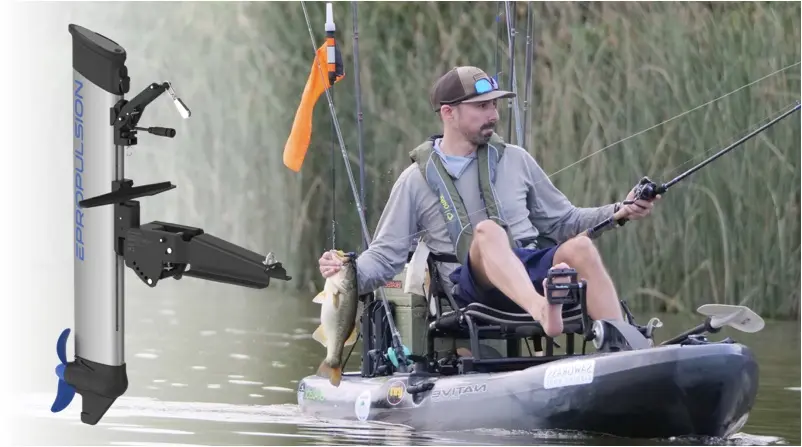
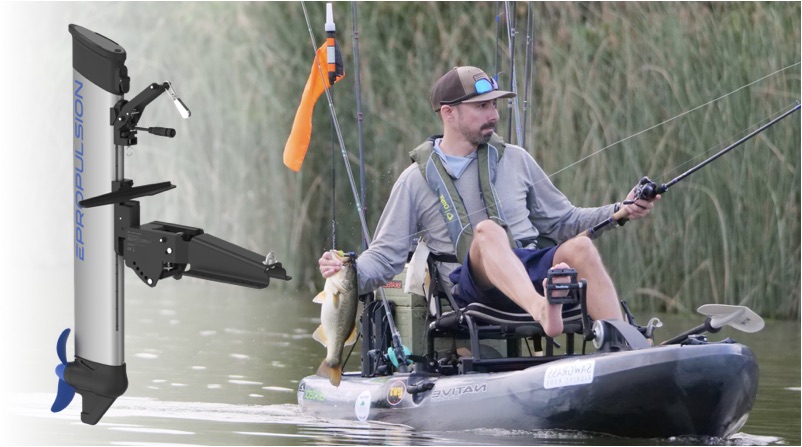
The result of this engineering endeavor is the new kLite 750, a purpose-built, "rudder-style" electric outboard engineered explicitly to solve the traditional pain points of motorized kayaking. Weighing in at under 15 pounds (6.8 kg) total, the kLite 750 integrates its propulsion motor, steering mechanism, and a high-capacity 378-watt-hour battery into a single, cohesive, wide, tapered shaft. By eliminating external transoms, heavy external battery boxes, and complicated wiring nests, ePropulsion has effectively removed the clutter that has historically frustrated kayak anglers.
Unveiled following a wave of industry acclaim for its prototype at ICAST—the world’s largest sportfishing trade show—the kLite 750 represents more than just a product launch. It highlights a broader industrial shift: specialized, low-wattage electric mobility is rapidly maturing to serve niche recreational sub-sectors. With the North American kayak fishing market valued between $500 million and $600 million, and dedicated electric propulsion systems carving out a lucrative $50 million to $70 million slice of that pie, the launch of the kLite 750 positions ePropulsion at the vanguard of a high-growth blue-water economy.
Detailed Chronology: From Academic Startup to Global Propulsion Powerhouse
To fully understand the engineering pedigree behind the kLite 750, it is necessary to examine the trajectory of ePropulsion itself. The company’s story is rooted in rigorous academic research and a shared vision for sustainable maritime transport.
2012–2014: The Genesis and Breakthrough at METStrade
ePropulsion was founded in 2012 by current CEO Danny Tao, alongside a cohort of students, graduates, faculty members, and advisers from the prestigious Hong Kong University of Science and Technology (HKUST). United by a common goal to displace internal combustion engines on the water with clean alternatives, the founding team spent two years in research and development, focusing heavily on efficient motor topologies.
In 2014, the startup made its international debut at METStrade—the world’s largest trade exhibition of marine equipment, materials, and systems—held annually in Amsterdam. There, ePropulsion introduced its maiden product: the Spirit 1.0. Utilizing a pioneering brushless, direct-drive technology that had no direct market rival at the time, the Spirit 1.0 established a new baseline for low-power electric outboards. It proved that electric outboards could deliver reliable, torque-rich performance without the noise, emissions, or maintenance overhead of legacy petrol-powered equivalents.
Expanding the Low-Power Portfolio
Building upon the success of the Spirit series, ePropulsion systematically expanded its footprint in the low-power sector (spanning 1 to 6 kilowatts, roughly equivalent to 3 to 10 horsepower). The company earned an international reputation for high build quality, reliability, and cost-efficiency. This range soon encompassed versatile solutions tailored for small dinghies, tenders, aluminum runabouts, sailing catamarans, and even commercial workboats and passenger ferries up to 12 meters (40 feet) in length.
2022–2023: Scaling Up into Inboards and High-Power Outboards
As the global marine sector accelerated its transition away from fossil fuels, ePropulsion scaled its technological architecture to address larger commercial and recreational vessels:
The H-Series Inboards (2022): Aimed squarely at boatbuilders and the commercial marine market, the H-Series introduced modular, zero-emission propulsion systems ranging from 60 to 250 kilowatts (approximately 80 to 350 horsepower). These systems were engineered to drive displacement vessels and yachts ranging from 60 to 100 feet (18 to 30 meters).
The I-Series Inboards: Developed to bridge the gap between small craft and large yachts, this line offered lower-power inboard configurations (10 to 40 kilowatts / 15 to 55 horsepower). The I-Series found natural homes aboard sailboats, day boats, narrowboats, and inland canal cruisers.
The X-Series Outboards (2023): Bringing high-output electric power to transom-mounted applications, the X-Series introduced robust outboard options rated at 12, 20, and 40 kilowatts (roughly 16, 30, and 55 horsepower), delivering high torque and advanced digital integration.
Supporting Energy Ecosystems: The eSSA Architecture
Hardware is only as reliable as its energy storage. To complement its expanding motor lineup, ePropulsion developed proprietary lithium iron phosphate (LiFePO4 or LFP) battery families—specifically the E-Series and G-Series. These chemistries were selected for their exceptional energy density, extended cycle life, and inherent thermal stability, which is paramount in marine environments.
Furthermore, the company integrated its proprietary ePropulsion Smart System Architecture (eSSA). This modular framework allows for the safe, plug-and-play interconnection of all system components—motors, throttles, battery banks, and displays—drastically reducing installation complexity and wiring vulnerabilities.
2024–Present: The eLite Revolution and the Birth of the kLite
In 2024, ePropulsion launched the eLite, a lightweight, highly compact rudder-style outboard designed primarily for tenders, dinghies, and small recreational craft. The market response was immediate and overwhelming. Capitalizing on this compact design philosophy, ePropulsion engineers recognized an opportunity to adapt the platform for kayak anglers. Following extensive prototyping and field testing—including a highly successful debut at ICAST—the company officially introduced the kLite 750, cementing its reach into specialized recreational angling.
Supporting Context & Metrics: Inside the kLite 750
The kayak fishing market operates under a unique set of constraints. Anglers must manage platform stability, weight distribution, spatial economy, and energy endurance, all while operating in shallow, wind-swept, or current-heavy waters. The kLite 750 was engineered from the hull up to address these exact variables.
Integrated "Rudder-Style" Design
Traditional trolling motors for kayaks often require a complex array of components: a bow- or transom-mounted motor, heavy-duty mounting brackets, a separate deep-cycle marine battery secured inside the hull, long-run power cables, and a separate hand or foot steering system.
The kLite 750 streamlines this entire ecosystem. Operating as a "rudder-style" electric outboard, the wide and structurally tapered shaft serves a triple purpose:
Steering & Control: The shaft acts directly as the rudder blade, translating hand- or foot-pedal inputs into immediate lateral control.
Propulsion House: It houses the core electric motor submerged at the base, ensuring direct, efficient thrust vectoring.
Energy Storage: The integrated 378-watt-hour lithium battery is embedded directly within the system’s architecture, eliminating the need to run cables through the kayak’s scupper holes or store a separate battery box.
With the entire system tipping the scales at under 15 lbs (6.8 kg), a single user can transport, mount, and rig the motor with minimal physical strain.
Multi-Mode Power Profiles
Recognizing that kayak anglers face rapidly shifting environmental conditions, ePropulsion equipped the kLite 750 with three distinct operational modes, easily toggled via an intuitive switch:
Go Mode: Delivers 500 watts of continuous power (roughly equivalent to 0.75 horsepower). This is the primary cruising profile, optimized for steady, energy-efficient transit across open water to reach distant fishing grounds.
Sport Burst: Unlocks the full 750 watts of output (approximately 1 horsepower) for up to 60 seconds. This high-torque burst mode is specifically engineered to help anglers punch through heavy wind-driven rips, battle stiff tidal currents, or safely navigate minor rapids.
Fish Mode: Tailored for the precise moment the angler arrives at the target zone. Fish Mode dials down power delivery to offer hyper-responsive, low-end micro-control. This allows anglers to silently maintain position against a breeze or creep along a weed line without spooking wary gamefish like bass, redfish, or trout.
Official Statements and Industry Reception
The commercial unveiling of the kLite 750 has drawn strong praise from industry leaders who recognize the strategic importance of the kayak fishing demographic.
"When we showed our original prototype at ICAST, the interest was substantial," stated Tom Watson, President of ePropulsion Americas. "The eLite has already been revolutionary for tenders and small craft, and we are confident that the kLite is going to take kayak anglers to new and exciting places."
Watson’s optimism is backed by hard economic data. According to statistics compiled by the American Sportfishing Association (ASA), more than 2.5 million anglers across the United States regularly fish from kayaks. This vibrant sub-sector commands an estimated retail market valuation between $500 million and $600 million (€440 million to €525 million).
Furthermore, data from market intelligence firm Ken Research indicates that specialized electric propulsion systems designed specifically for kayaks account for roughly 10% of that total expenditure, translating to an annual market segment valued between $50 million and $70 million. By delivering a lightweight, premium-grade solution tailored precisely to this demographic, ePropulsion is well-positioned to capture significant market share in a high-margin sector.
Future Outlook: The Electric Transition on Inland and Coastal Waters
The introduction of the kLite 750 serves as a microcosm of a much larger industrial evolution. For over a century, recreational and commercial boating was inextricably linked to the internal combustion engine—bringing with it the inevitable baggage of fossil fuel spills, toxic exhaust emissions, acoustic noise pollution, and high maintenance overheads.
Today, market forces and ecological imperatives are rewriting those rules. ePropulsion’s trajectory—growing from an academic startup in Hong Kong into a diversified, multi-national marine propulsion leader—demonstrates that the market demand for clean marine power is not a passing trend, but a permanent structural transition.
As battery energy densities continue to climb, motor efficiencies improve, and modular architectures like eSSA become the industry standard, the friction points of electrification are disappearing. Whether supplying high-voltage 250kW inboard systems for commercial catamarans or sub-15-pound integrated electric rudders for solo kayak anglers, ePropulsion is systematically removing the barriers to zero-emission mobility on the water.
For the modern kayak angler, the kLite 750 is more than just a piece of gear; it is an invitation to travel farther, fish longer, and operate quietly within fragile aquatic ecosystems. As waterways around the globe face increasing regulatory scrutiny regarding noise and emissions, innovations like the kLite ensure that the future of fishing remains as pristine and silent as the waters we seek to explore.