









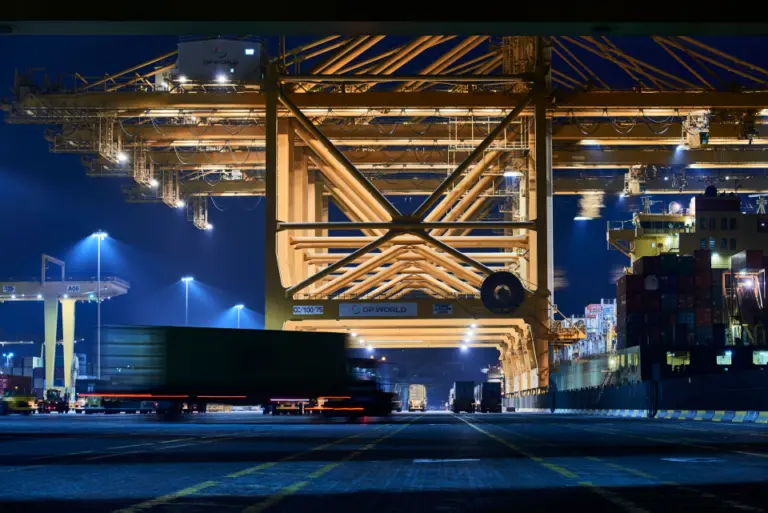
DUBAI, UNITED ARAB EMIRATES — In a clear demonstration of the shifting dynamics within Middle Eastern supply chains, global trade enabler DP World has announced a significant operational milestone. The company’s integrated road and rail network has successfully moved over 500,000 Twenty-Foot Equivalent Units (TEUs) across the Gulf Cooperation Council (GCC) region since March of this year.
This achievement underscores the rapidly expanding footprint of DP World’s inland logistics infrastructure. As international shipping lines, cargo owners, and manufacturers face persistent maritime volatility and navigate complex regional trade routes, the company’s multimodal network has emerged as a crucial alternative for moving goods swiftly, securely, and predictably across the Arabian Peninsula.
Executive Overview: Redefining Regional Trade Resilience
The modern supply chain landscape is undergoing a structural evolution. Disruptions across key global maritime choke points—ranging from security challenges in the Red Sea to congestion at major transshipment hubs—have forced logistics operators to rethink traditional routing strategies. In the GCC, a region traditionally reliant on direct maritime import and export through a handful of coastal mega-ports, the demand for robust, agile inland alternatives has never been more urgent.
DP World’s recent operational data reveals a profound pivot toward multimodal integration. By seamlessly connecting deep-water ports with high-capacity road corridors and developing rail-ready infrastructure, the company has effectively bridged the gap between maritime and terrestrial freight. Moving half a million TEUs overland in a matter of months is not merely a quantitative benchmark; it is a structural validation of the company’s multi-year strategy to build an interconnected logistics ecosystem that extends far beyond traditional terminal gates.
At the core of this expansion is an aggressive scaling of fleet capacity, infrastructural investments in bonded corridors, and strategic asset placement—such as the newly unveiled inland container depot in Dubai. Together, these initiatives have transformed DP World from a port operator into a comprehensive, end-to-end supply chain architect within the GCC.
Detailed Chronology: Building the GCC Inland Network
The journey toward surpassing the 500,000 TEU milestone has been marked by a series of targeted infrastructural investments and operational rollouts designed to eliminate bottlenecks and compress transit times across the Arabian Gulf.
Scaling Up Fleet and Daily Movements
To support the soaring demand for cross-border and domestic freight capacity, DP World dramatically expanded its physical footprint on the region’s highways. The company recently integrated 700 new heavy-duty trucks into its existing fleet. This substantial addition has elevated the network’s daily operational capacity to approximately 3,000 truck movements per day. These vehicles operate across sophisticated, optimized corridors, ensuring that high-value cargo, raw materials, and consumer goods move seamlessly between key industrial zones, distribution centers, and border checkpoints.
Establishing Fast-Track Bonded Corridors
Recognizing that customs clearance and border friction represent some of the most persistent delays in international trade, DP World engineered a series of fast-track bonded corridors. In recent months, the company successfully launched dedicated corridors linking the UAE’s east coast gateways directly to the flagship Jebel Ali Port.
Simultaneously, a vital bonded corridor was established from Sohar in the Sultanate of Oman. These corridors allow cargo to transit across national borders under customs seal, bypassing traditional administrative hurdles and significantly reducing lead times for cargo owners.
Integrating Red Sea Routing Options
To provide shippers with maximum routing flexibility in response to shifting maritime conditions, DP World leveraged its regional assets to offer alternative entry points. This includes the strategic utilization of Red Sea routing options via the South Container Terminal at Jeddah Islamic Port in Saudi Arabia. By integrating Red Sea maritime entry points with onward overland distribution channels, DP World created a resilient dual-coast strategy, ensuring that supply chains remain operational even when specific maritime lanes face disruption.
Expanding Inland Storage: The Al Awir Empty Container Depot
The most recent capstone in this infrastructural expansion is the opening of a massive 100,000-square-meter inland empty container depot in Al Awir, Dubai. Strategically situated with direct access to Emirates Road, the facility links major logistics and industrial zones across the UAE.
Designed to alleviate congestion at Jebel Ali Port, the depot adds substantial empty container storage and release capacity. It handles 20-, 40-, and 45-foot empty containers, offering a suite of value-added services including rigorous structural inspections, condition reporting, and comprehensive shipping line inventory management. Crucially, the Al Awir site has been engineered to support future rail-based container movements, positioning it as a pivotal node for the upcoming Etihad Rail network.
Supporting Context & Metrics: The Anatomy of a Logistics Powerhouse
To fully appreciate the significance of the 500,000 TEU milestone, one must examine the metrics and macro-environmental factors driving modern GCC trade.
The Rise of Multimodalism in the GCC
The Gulf Cooperation Council represents one of the world’s most dynamic economic zones, driven by ambitious national transformations such as Saudi Arabia’s Vision 2030 and the UAE’s Operation 300bn. These economic blueprints demand frictionless supply chains capable of supporting rapid industrialization, manufacturing growth, and surging e-commerce consumption.
However, historical reliance on single-mode transport left regional supply chains vulnerable to external shocks. DP World’s multimodal strategy addresses this vulnerability by fusing maritime capabilities with an extensive, high-velocity overland network.
Key Performance Indicators (KPIs) of the DP World GCC Network:
- Total Overland Volume: Exceeded 500,000 TEUs moved via road and rail since March.
- Daily Truck Movements: Scaled to approximately 3,000 movements per day following the introduction of 700 new vehicles.
- Depot Footprint: 100,000 square meters of newly operational inland storage capacity at Al Awir, Dubai.
- Container Specifications Handled: Full service capabilities for 20-foot, 40-foot, and 45-foot units.
- Strategic Gateways Connected: Direct links spanning east coast UAE ports, Jebel Ali, Sohar (Oman), and Jeddah Islamic Port (Saudi Arabia).
By decentralizing storage and creating multiple entry and exit vectors, DP World has effectively insulated its client base from localized port congestion and maritime delays.
Official Statements: Leadership Perspectives
The leadership behind DP World GCC emphasizes that this milestone is the direct result of a forward-thinking operational strategy designed around customer agility and network resilience.
Ahmad Yousef Al-Hassan, CEO and Managing Director of DP World GCC, highlighted the strategic importance of the overland achievement:
"Moving half a million TEUs overland shows the scale, resilience, and flexibility of our network beyond the terminal gates. Our extensive inland logistics capabilities give shipping lines and cargo owners more routing options and more certainty in how they move goods through the region, helping them adapt quickly when conditions change."
Al-Hassan’s comments reflect a broader industry truth: modern logistics success is no longer defined solely by port efficiency, but by the seamless orchestration of the entire journey from origin to destination.
Echoing this sentiment, Raveen Guliani, Chief Operating Officer – Logistics at DP World GCC, focused on the operational efficiencies brought about by asset placement, particularly regarding the Al Awir facility:
"By moving empty container storage and handling closer to customers, we can reduce unnecessary movements to the port and make it easier for shipping lines and logistics companies to access and reposition equipment. It is another way we are connecting our port services, logistics capability, and inland infrastructure into one integrated solution to make cargo flows more efficient."
Guliani’s remarks point to a critical cost-saving and environmental benefit: minimizing empty truck miles (deadheading) not only lowers operational expenses for carriers but also significantly reduces the carbon footprint associated with urban and inter-emirate freight movement.
Future Outlook: The Horizon of Regional Logistics
As DP World looks to the future, the 500,000 TEU milestone serves as a springboard for even greater infrastructural integration. The logistics sector within the GCC is standing on the precipice of a rail revolution, spearheaded by regional rail megaprojects like Etihad Rail in the UAE and the broader GCC railway network.
Preparing for the Rail Era
The strategic location of the Al Awir empty container depot—with its direct access to major arterial highways and future-proofed design—signals DP World’s readiness for the integration of heavy freight rail. As rail networks come online to connect major industrial hubs across national borders, inland depots like Al Awir will serve as vital intermodal interchange points, shifting bulk container movements off highways and onto high-capacity rail lines. This transition will further compress transit times, lower logistics costs, and enhance the environmental sustainability of regional supply chains.
Expanding the Bonded Corridor Network
Furthermore, DP World plans to deepen its network of fast-track bonded corridors. By working closely with regional customs authorities, the company aims to digitalize and streamline border compliance further, reducing documentation friction to near-zero levels. This will enable near-real-time visibility and tracking for cargo owners, instilling unprecedented levels of trust and predictability into Middle Eastern trade.
Conclusion
In an era defined by global supply chain volatility, DP World’s performance in the GCC offers a masterclass in operational adaptability. By combining world-class maritime terminals with a rapidly scaling inland road network, strategic bonded corridors, and advanced empty container infrastructure, DP World has redefined what is possible in regional logistics. Surpassing 500,000 TEUs is not just a celebration of past performance; it is a clear signal that the future of GCC trade is integrated, resilient, and multi-modal.