










Executive Overview
In a significant strategic evolution of its product portfolio, JetBlue has announced the introduction of BlueFirst, a dedicated domestic first-class product designed to bridge the substantial gap between its standard economy seating and its acclaimed long-haul Mint luxury cabins. For years, the carrier has built its reputation on offering a consistent, single-class economy experience across its short- and medium-haul network, supplemented only by the lie-flat luxury of Mint on select transcontinental, Caribbean, and transatlantic routes. With the debut of BlueFirst, JetBlue is fundamentally altering its cabin architecture, bringing a true front-of-the-plane experience to domestic corridors that have historically lacked a premium alternative.
Scheduled for booking this fall, with the inaugural aircraft entering service before the end of the year, BlueFirst introduces a comprehensive suite of passenger-centric upgrades. These range from bespoke, ergonomically engineered seating and next-generation in-flight entertainment to innovative digital ordering systems and elevated culinary offerings. By eliminating the middle seat in the premium cabin, integrating advanced connectivity options, and bundling priority airport perks with a generous checked-baggage allowance, JetBlue is positioning BlueFirst to compete directly with the legacy domestic first-class products offered by major U.S. network carriers.
As the airline prepares to roll out this new service across its extensive network—potentially reshaping the passenger experience on heavily traveled routes connecting the U.S. mainland to key leisure and business destinations, including its robust Caribbean network—industry analysts are watching closely. While specific route deployments and fare premiums remain under wraps, BlueFirst marks a watershed moment for JetBlue, signaling a maturation of its business model and a concerted effort to capture higher-yielding traffic across a much broader portion of its domestic network.
Detailed Chronology: The Evolution of JetBlue’s Cabin Strategy
To fully understand the significance of the BlueFirst rollout, it is necessary to examine how JetBlue has approached cabin segmentation over its history. Since its founding, JetBlue disrupted the U.S. aviation market by championing a "one-class-is-best" philosophy, providing leather seating, live television, and generous legroom to every passenger on board. However, as the competitive landscape shifted and corporate travelers, high-net-worth leisure flyers, and frequent-flyer loyalists increasingly demanded elevated products on high-density long-haul routes, the airline was forced to adapt.
The Mint Revolution and the Pre-BlueFirst Era
The first major crack in JetBlue’s single-class armor came with the introduction of Mint in 2014. Initially launched on prized transcontinental routes between New York (JFK) and Los Angeles (LAX) as well as San Francisco (SFO), Mint revolutionized domestic premium travel. Featuring private suites with sliding doors, lie-flat beds, artisanal dining, and craft cocktails, Mint proved that a low-cost carrier could successfully out-compete legacy airlines in the premium market. Over the subsequent decade, JetBlue expanded Mint to select Caribbean destinations and eventually transatlantic routes to London and Paris.
Yet, a glaring structural limitation remained: if a passenger flew JetBlue on a route where Mint was not deployed—such as a shorter domestic hop or regional connection—they were relegated to the standard Core (economy) experience, even if they were willing to pay for a front-of-the-plane upgrade. While competitors like Delta Air Lines, United Airlines, and American Airlines offered domestic first-class configurations across nearly their entire narrowbody fleets, JetBlue’s short- and medium-haul fleet offered only "Even More Space" seats, which provided extra legroom but no alterations to the seat structure, service, or baggage privileges.
The Genesis of BlueFirst
Recognizing the revenue leakage and missed loyalty opportunities presented by this operational gap, JetBlue’s executive leadership initiated development on an intermediate premium product. Codenamed and ultimately christened as BlueFirst, the project was designed to capture the lucrative domestic business and upscale leisure traveler without compromising the operational efficiencies required of a modern carrier.

- Development Phase: Behind the scenes, JetBlue partnered with prominent design and manufacturing firms, including mattress innovator Tuft & Needle, to engineer a seat that maximized passenger comfort within the physical constraints of a narrowbody aircraft cabin.
- Technological Integration: Simultaneously, the airline’s digital product teams worked to integrate new capabilities into its proprietary Blueprint in-flight entertainment platform, laying the groundwork for features like seatback ordering and custom cocktail creation.
- Announcement and Rollout Timeline: The formal unveiling of BlueFirst sets the stage for its commercial debut. Tickets will become available for purchase in the autumn, with the first retrofitted or newly delivered aircraft slated to carry paying BlueFirst customers before the conclusion of the year.
Supporting Context & Metrics: Inside the BlueFirst Experience
The introduction of BlueFirst is not merely a rebranding exercise; it represents a comprehensive overhaul of the passenger journey, encompassing pre-flight logistics, cabin environment, dining, and digital engagement.
1. The Seat and Cabin Architecture
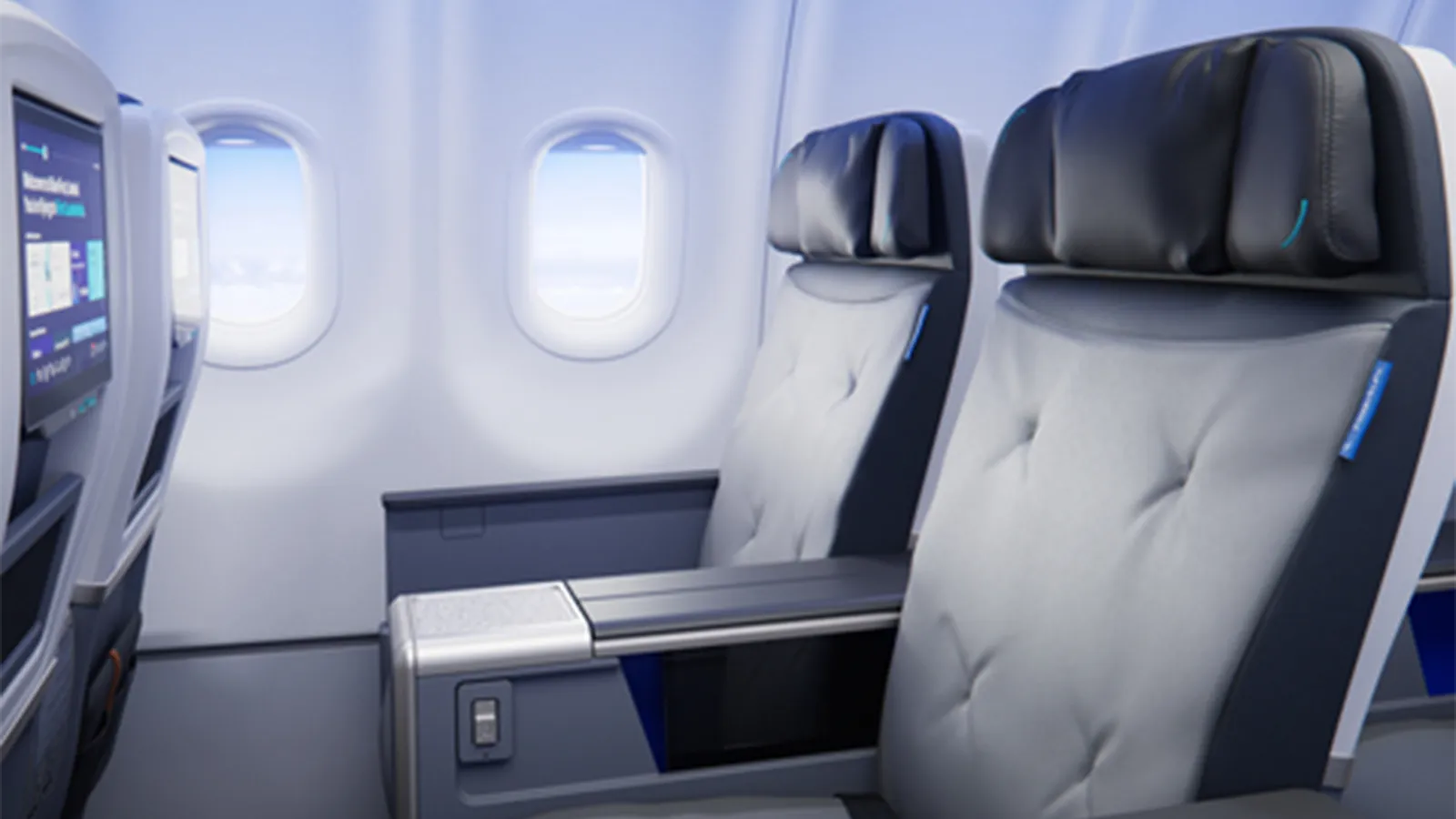
At the heart of the product is the physical seating arrangement. BlueFirst cabins will adopt a two-by-two (2-2) seating configuration, completely eliminating the dreaded middle seat and ensuring that every passenger enjoys either a window or an aisle.
- Ergonomics & Cushioning: Developed in collaboration with Tuft & Needle, the seats incorporate the brand’s proprietary T&N Flex foam. This material is specifically engineered to provide targeted support and superior pressure relief during flight, addressing a common complaint regarding the rigid padding often found in domestic first-class seats.
- Dimensions & Recline: BlueFirst passengers will benefit from 5 inches of recline and up to 7 inches of additional legroom compared to standard JetBlue Main cabin seats.
- Comparison: While it falls short of the fully flat-bed luxury of the Mint product, the seat specifications place BlueFirst squarely in line with—and in some aspects ahead of—traditional domestic first-class products found on rival carriers.
2. Next-Generation Technology and Connectivity
JetBlue has long prided itself on its technological leadership in the skies, and BlueFirst pushes this envelope further by introducing several industry-first or advanced digital capabilities:
- In-Flight Entertainment (IFE): Every BlueFirst seat features a high-definition 13.3-inch seatback entertainment screen powered by JetBlue’s state-of-the-art Blueprint platform.
- Bluetooth Audio: Recognizing the ubiquitous shift toward wireless listening, the entertainment systems include native Bluetooth connectivity, allowing passengers to pair their own wireless headphones directly with the screen.
- Power Options: Comprehensive power infrastructure is built into every seat, offering USB-A, USB-C, and standard 110-volt AC outlets to ensure all personal electronic devices remain charged.
- Wi-Fi Connectivity: JetBlue’s renowned, complimentary high-speed Fly-Fi internet will remain fully included for BlueFirst passengers, providing seamless, gate-to-gate internet access.
- Sleep Amenities: On overnight or red-eye operations, travelers will receive specialized sleep kits and premium blankets.
3. Digital Hospitality: Seatback Ordering and "Mixologist Mode"
One of the most innovative aspects of the BlueFirst product is its reimagining of the service flow between the flight crew and the passenger.
- Seatback Ordering: Rather than waiting for the traditional beverage cart or flagging down a flight attendant, BlueFirst passengers can browse, select, and order food and drinks directly from their 13.3-inch seatback screen. Orders are transmitted directly to the crew’s devices, streamlining service delivery.
- Mixologist Mode: Expanding upon the digital ordering interface, JetBlue is introducing Mixologist Mode. This interactive software feature allows passengers to act as virtual mixologists, building customized cocktails by selecting specific base spirits, mixers, and flavor profiles directly on the screen. The custom order is then fulfilled by the flight crew, adding a bespoke, high-touch element to the premium cabin experience.
4. Culinary Program: FirstFare
Catering to the elevated expectations of premium travelers, JetBlue is launching a dedicated meal program titled FirstFare.
- Bento-Style Dining: On flights spanning 899 miles or longer, passengers will be served a thoughtfully curated bento-style meal featuring a primary entrée, a complementary side, and a dessert. Anticipated menu selections include creative options such as sweet or savory crêpes, alongside sesame noodles paired with either beef or tofu.
- Snack Portfolio: Throughout the flight, premium snacks will be circulated, featuring rotating selections from artisanal and niche brands including Sockerbit, Tosi, Wholesome Bakery, Pop Daddy Snacks, and Cape Cod Chips.
- Beverage Program: The drink menu has been curated with equal attention to detail, featuring wines hand-selected by esteemed New York wine retailer Parcelle, specialty coffees from Cometeer and Joe Coffee, and a variety of teas from Smith Teamaker.
5. Airport Privileges and Baggage Allowances
The BlueFirst experience begins long before boarding commences. JetBlue has bundled a robust suite of priority airport services and baggage waivers into the fare:
- Airport Processing: Passengers holding BlueFirst tickets receive Group 1 priority boarding, dedicated overhead bin space allocation, priority check-in counters, and access to expedited security lanes at more than 30 airports across the network.
- Baggage Allowances: BlueFirst and BlueFirst Flex tickets include two free checked bags, priority baggage handling and delivery upon arrival, and complete waiver of change or cancellation fees. For families or business travelers checking multiple bags, this policy represents significant tangible value that offsets a portion of the fare differential.
Official Statements and Industry Perspective
While JetBlue has kept detailed rollout schedules and specific route economics close to the vest, the strategic rationale behind BlueFirst is clear to aviation industry observers. Company executives have long acknowledged that the airline’s lack of a domestic first-class product created a ceiling on passenger yield, particularly among corporate travel managers and high-tier loyalty program members who demand consistent cabin options across all legs of a multi-segment journey.
Aviation economists note that introducing a middle-seat-free cabin on narrowbody aircraft allows airlines to maximize revenue per available seat mile (RASM) on routes where economy yields are compressed. By targeting the space between its basic economy offerings and its luxury Mint product, JetBlue is diversifying its revenue streams.
Furthermore, loyalty program strategists emphasize that BlueFirst will bolster JetBlue’s TrueBlue frequent-flyer program. By providing members with more opportunities to redeem points for upgraded seating or earn elite-qualifying benefits within a domestic first-class framework, JetBlue can enhance customer stickiness in highly competitive hub markets like New York, Boston, Fort Lauderdale, and Orlando.
Future Outlook: Implications for Travelers and the Network
The impending debut of BlueFirst raises several intriguing questions regarding JetBlue’s network strategy and future fleet utilization.
Network Implications: The Caribbean Connection
While transcontinental routes have historically been the battleground for domestic luxury, JetBlue’s unique network positioning highlights another prime candidate for BlueFirst: the Caribbean and Latin America. JetBlue operates one of the most extensive networks of any U.S. carrier into the Caribbean, connecting major northeastern and southern gateways to island destinations.
Currently, travelers heading to the Caribbean on non-Mint aircraft must settle for standard economy seating, regardless of flight duration. The deployment of BlueFirst on these routes could transform the leisure travel market to the region, offering vacationers a comfortable, premium option complete with priority airport treatment and checked baggage allowances for tropical getaways.
The Road Ahead
As JetBlue prepares to open bookings for BlueFirst this fall and introduce the first retrofitted aircraft to its active fleet later this year, the ultimate success of the product will hinge on two primary factors:
- Route Selection: How quickly and strategically JetBlue deploys the cabin across high-demand business and leisure corridors.
- Pricing Strategy: The fare premium attached to BlueFirst relative to standard economy and competitor offerings.
For the modern air traveler, however, the value proposition is immediately transparent. Whether seeking enhanced workspace ergonomics, superior seatback entertainment with Bluetooth pairing, digital cocktail customization, or simply the luxury of a wider seat without a middle neighbor, BlueFirst expands JetBlue’s service footprint into a realm previously occupied solely by legacy carriers. As the aviation industry watches this rollout unfold, JetBlue’s bold pivot promises to inject a fresh wave of competition and innovation into the domestic first-class market.