For decades, the standard soundtrack of tranquil lakes, calm bays, and coastal inlets has been accompanied by the unmistakable drone, smell, and smoke of small internal-combustion outboard engines. While larger marine vessels have seen incremental shifts toward alternative propulsion, the tender and dinghy market—the literal workhorses of recreational boating—has remained largely tethered to fossil fuels.
Joe Grez set out to change that narrative. An experienced consumer product developer holding a degree in physics and a robust portfolio of U.S. patents, Grez found himself confronting the realities of gas-powered boating in 2008. While out fishing on a dinghy with his young granddaughter, he was legally required to affix a mandatory carbon monoxide warning label to the transom. The warning prompted a deeper realization: the microscopic exhaust plumes, unburned hydrocarbons, and pungent fumes were hanging directly in the breathing zone of the child sitting just feet away.
That moment of paternal and environmental awareness sparked a multi-year engineering journey. Eschewing the conventional wisdom that small outboards had to be noisy, dirty, and difficult to maintain, Grez assembled a world-class design team. Drawing on centuries of combined expertise in electromechanical device technology and high-volume consumer goods—including background experience with major brands like L’Oréal and Sonicare electric toothbrushes—the team set out to reimagine portable marine propulsion from the ground up.
The result of this meticulous R&D phase was the 2017 launch of the EP Carry electric outboard. Proven over an astonishing 73,000 hours of cumulative customer use across a vast array of vessels and extreme environmental conditions, the platform established a reputation for reliability. Founder Joe Grez personally logged over 800 nautical miles (approx. 920 miles / 1,500 kilometers) on challenging Salish 100 cruises and solar-powered micro-cruiser expeditions, pushing the hardware to its absolute limits.
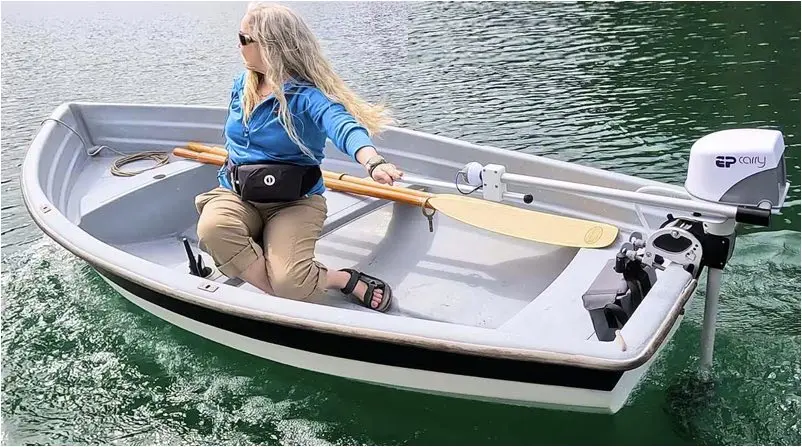
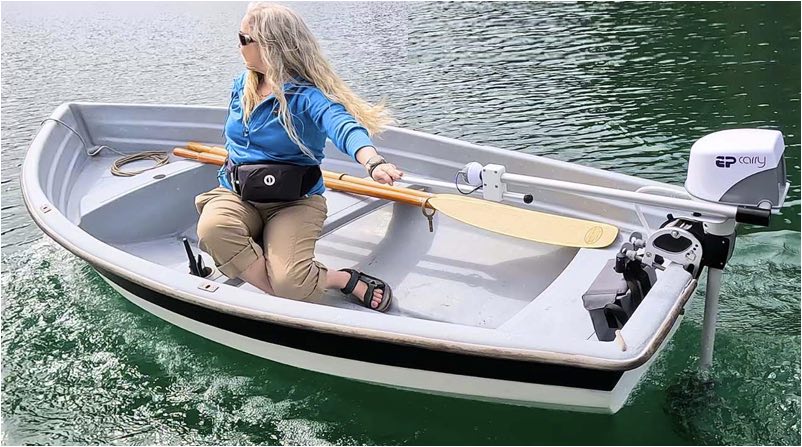
Now, building upon this bedrock of field-tested endurance, the company is introducing the EP Carry Gen2. Retaining the ultra-lightweight, patented design architecture that made its predecessor a favorite among sailors and cruisers, the Gen2 introduces substantial upgrades. Enhanced performance metrics, advanced lithium iron phosphate (LFP) battery integrations, wireless smartphone connectivity, and structural refinements make the Gen2 a masterclass in modern, eco-friendly marine engineering. Designed to propel vessels up to 19 feet (5.8 meters) in length and weighing up to 1,000 pounds (455 kilograms), the Gen2 represents a generational leap forward for lightweight electric propulsion.
Detailed Chronology: From a Grandfather’s Concern to Gen2
Understanding the trajectory of the EP Carry requires examining the deliberate, iterative steps taken by its creators. The journey from a regulatory warning label to a cutting-edge second-generation propulsion system highlights a commitment to human-centric design and technological refinement.
Phase 1: The Catalyst (2008)
The genesis of the EP Carry was entirely organic. In 2008, Joe Grez was preparing his dinghy for a fishing excursion with his granddaughter. Confronted with a mandatory CO2 hazard label, Grez began analyzing the physical dynamics of small two-stroke and four-stroke outboard engines. Idling at docks or trolling at low speeds, small gas outboards notoriously suffer from incomplete combustion, emitting dense clouds of exhaust particulates that linger directly above the water’s surface—precisely where children, pets, and passengers sit. Recognizing that existing electric options on the market were often clunky, overly heavy, or unreliable, Grez recognized an opening for a consumer-focused, frictionless electric alternative.
Phase 2: Assembling the Brain Trust and Prototyping (2008–2016)
Rather than approaching the project from a purely traditional marine engineering perspective, Grez tapped into the world of high-volume precision consumer electronics. He curated a multidisciplinary team whose collective experience spanned hundreds of years in electromechanical innovation. By borrowing design methodologies from high-reliability consumer products—such as the acoustic-vibration mechanisms of Sonicare toothbrushes and the rigorous durability standards of L’Oréal beauty care devices—the team focused on creating a sealed, highly efficient, and ergonomic drive train. Every gram of weight and every millimeter of clearance was scrutinized to ensure the final product would be truly portable.
Phase 3: Market Introduction and Real-World Trial (2017)
Following years of prototyping and patent development, the original EP Carry debuted in 2017. Unlike products launched solely on marketing hype, the EP Carry was subjected to grueling, real-world trials by everyday boaters. Over the ensuing years, hundreds of customers accumulated more than 73,000 hours of operational time. The motor was tested in saltwater, freshwater, freezing northern latitudes, and sun-drenched tropical anchorages. Simultaneously, Joe Grez pushed the endurance envelope personally, navigating over 800 nautical miles across demanding Pacific Northwest waterways during Salish 100 events, relying solely on solar-supplemented charging regimens.
Phase 4: The Gen2 Evolution (Present)
Armed with nearly a decade of telemetry, customer feedback, and leaps in electrochemical storage technology, the engineering team went back to the drawing board to craft the Gen2. While keeping the core weight and structural envelope identical to the original, the Gen2 integrates smart-device connectivity, a power-boosting controller architecture, an upgraded LFP battery ecosystem, and modular rigging options designed to accommodate a broader spectrum of tenders, dinghies, and small sailboats.
Supporting Context & Metrics: Under the Hood of the Gen2
At first glance, the EP Carry Gen2 maintains the sleek, unobtrusive profile that users loved about the Gen1. However, beneath its rugged exterior lies a completely modernized power, control, and monitoring matrix.
Power, Thrust, and Efficiency
The Gen2 preserves the remarkable featherlight weight of its predecessor, tipping the scales at a mere 14 lbs (6.4 kg). The baseline continuous power output matches the Gen1 at 220 watts; however, the integration of a newly engineered controller system unlocks a 22% performance boost, allowing the motor to surge up to 280 watts when extra momentum is required against headwinds or tidal currents.
Performance benchmarks, gathered through rigorous testing on a standard 9-foot (2.75-meter) rowing dinghy paired with the integrated 24V LFP battery system (288 Watt-hours of energy storage), demonstrate exceptional operational versatility:
Half Power (Cruising): Delivers a steady runtime of 140 minutes, achieving a comfortable cruising speed of 3.4 knots (3.9 mph / 6.3 km/h).
Full Power: Provides a 70-minute runtime at a brisk 4 knots (4.6 mph / 7.4 km/h).
Boost Mode: Unlocks peak performance for 50 minutes, pushing the dinghy to 4.2 knots (4.8 mph / 7.8 km/h).
Battery Flexibility and Advanced LFP Chemistry
Energy storage is the lifeblood of any electric vehicle, and the EP Carry Gen2 leverages state-of-the-art Lithium Iron Phosphate (LFP) chemistry. LFP batteries are celebrated within the energy storage industry for their superior thermal stability, safety profile, resistance to degradation, and exceptionally long cycle lives compared to traditional lithium-ion formulations.
The EP Carry Gen2 Complete Integrated Package includes a proprietary 24V LFP battery with 288 Wh capacity. For boaters requiring extended range, the system allows for the seamless addition of a secondary battery to double the cruising distance. Furthermore, the Gen2 motor is engineered with open architecture adaptability: users can purchase the motor independently and pair it with off-the-shelf 12V, 24V, or 36V LFP batteries sourced from third-party manufacturers. Depending on the vessel hull design and battery configuration, cruising ranges at full throttle can exceed 20 miles (32 km) on a single charge.
Mechanical Refinements and Smart Connectivity
The Gen2 introduces a suite of hardware and software upgrades designed to simplify operation:
Wireless Monitoring: Both the proprietary EP Carry battery and most compatible off-the-shelf units now feature built-in wireless monitors. These interface effortlessly with the Gen2’s optional wireless Bluetooth battery monitor app, allowing operators to track real-time charge levels directly on their smartphones.
Firmware Updates: The smartphone interface also enables over-the-air, wireless firmware updates, ensuring the motor’s internal logic remains optimized as new software features are released.
Ergonomics and Rigging: The Gen2 features both long and short shaft options, a dedicated transom adjustment system for hulls with severe transoms, and a choice between a patented automatic-release pivot clamp module or a traditional tilt-latch fitting. The tiller handle is now fully detachable, and an optional extension kit is available for helmsmen who need to sit further forward in the boat. A remote throttle kit is also supported.
Security and Durability: A new snap-lock battery connector ensures rapid, weather-resistant, and robust cable attachment. Additionally, an integrated security lock prevents theft when leaving the motor unattended at public dinghy docks.
Official Statements and Industry Perspective
The philosophy driving the EP Carry brand has always centered on quiet, emission-free accessibility on the water. In technical briefings accompanying the launch of the Gen2, the engineering team emphasized that the goal was never to chase raw horsepower numbers meant for heavy speedboats, but rather to perfect the micro-mobility segment of marine travel.
"When you spend hours on the water with your family, the last thing you want is the intrusion of toxic fumes, deafening engine noise, and heavy equipment that strains your back," notes design literature from the EP Carry development group. "With the Gen2, we took everything our community learned over 73,000 hours of harsh marine testing and supercharged it with smarter electronics, better battery efficiencies, and unmatched adaptability."
Industry analysts have noted that the Gen2’s unique electronically impact-protected propeller—capable of safely driving vessels up to 1,000 pounds (455 kg) and 19 feet (5.8 m) in length—fills a critical gap in the market. While large-scale electric inboards and high-power outboards command significant market headlines, the lightweight tender market has historically suffered from a lack of polished, highly integrated engineering. By prioritizing user-friendly features like magnetic safety keys, buoyant soft-sided carry cases, and simple snap-lock connections, EP Carry continues to bridge the gap between complex marine technology and effortless weekend recreation.
Future Outlook: The Horizon for Clean Marine Micro-Mobility
As global regulatory frameworks tighten around internal combustion engines—particularly two-stroke motors operating in sensitive inland lakes, national parks, and coastal marine sanctuaries—the demand for clean, lightweight electric alternatives is poised for exponential growth.
The EP Carry Gen2 is positioned at the vanguard of this transition. Its reliance on LFP battery technology not only guarantees long-term durability and safety, but also aligns perfectly with the burgeoning market for decentralized, renewable energy integration. Because the system can be fully replenished via a standard 5-hour AC wall charger or easily paired with portable solar panels, it offers total energy independence. Joe Grez’s annual tradition of completing 100-nautical-mile cruises using only two small, lightweight onboard solar panels demonstrates that zero-emission, off-grid marine micro-cruising is not a distant sci-fi fantasy—it is a functional, reliable reality today.
Looking ahead, the convergence of smart-device integration, declining costs in advanced chemistry energy storage, and relentless user-driven mechanical refinement ensures that the way we move small boats has changed forever. The smoke and noise of yesterday’s tenders are rapidly giving way to the silent, efficient, and clean wake of the next generation.