





Executive Overview
In a monumental development that underscores the accelerating global transition toward sustainable maritime logistics, the Port of Shanghai has shattered records by completing the world’s largest single biomass methanol bunkering operation. Executed between August 15 and August 16, the landmark procedure involved the delivery of 8,016 metric tonnes of domestically produced, eco-friendly biomass methanol to the CMA CGM OSIRIS—a massive 13,000-TEU methanol dual-fuel container vessel operated by the esteemed CMA CGM Group.
Carried out by SIPG Energy, a specialized subsidiary of the Shanghai International Port (Group) Co., Ltd. (SIPG), this historic feat not only sets a definitive benchmark for Chinese ports but also more than doubles the previous global high-water mark of 3,643 tonnes, which was remarkably established by the very same SIPG team just months prior in March.
This accomplishment is far more than a statistical triumph; it is a watershed moment for the international shipping industry. It proves that the large-scale adoption of alternative, low-carbon marine fuels is no longer a distant decarbonization aspiration, but an operational reality unfolding today. By orchestrating a complex, cross-regional supply chain that bridged production facilities in inland Jilin Province with maritime transshipment hubs and the bustling terminals of Shanghai, the port authorities, energy providers, and shipping lines have demonstrated a masterclass in modern logistical coordination. As international regulatory bodies tighten environmental constraints and shipping lines aggressively pursue net-zero carbon targets, the Port of Shanghai’s latest achievement cements its status as an indispensable global leader in green maritime infrastructure.
Detailed Chronology: Executing the Record-Breaking Operation
The flawless execution of the 8,016-tonne biomass methanol bunkering operation was the result of meticulous planning, cross-sector collaboration, and rigorous real-time coordination. Spanning two intense days from August 15 to August 16, the operation required the seamless synchronization of port authorities, pilot stations, vessel operators, and specialized fueling crews.
Phase 1: Mobilization and Supply Chain Integration
The logistical genesis of this record-breaking event began weeks prior, anchored by a sophisticated, multi-modal supply chain. The vast majority of the biomass methanol utilized in the bunkering was sourced from Shanghai Electric’s pioneering Taonan Project, situated in Jilin Province in northeastern China.
Transporting thousands of tonnes of specialized chemical fuel from inland production plants to a coastal megaport requires an extraordinary degree of logistical precision. The biomass methanol was first dispatched via heavy-duty road transport from Taonan to the port city of Dalian. Once consolidated in Dalian, the fuel was loaded onto maritime carriers for onward shipment down the coast to designated storage facilities in Shanghai. This intricate journey established a robust, cross-regional trade corridor linking northern industrial production with eastern maritime consumption, proving the viability of China’s domestic green energy distribution networks.
Phase 2: Berthing and Safety Protocols
Upon the arrival of the CMA CGM OSIRIS at the Port of Shanghai, local maritime authorities enacted a comprehensive suite of safety and operational frameworks. Under the direct guidance of regional port regulators, a coalition of stakeholders—including the local pilot station and Fuxing Shipping Service Co., Ltd.—mobilized to manage the vessel’s movements.

Every minute of the berthing and unberthing process was calculated to mitigate risk and optimize efficiency. Specialized teams established strict on-site monitoring perimeters, deployed advanced emergency response protocols, and executed precise navigational plans tailored to the handling of alternative marine fuels. Because methanol possesses distinct chemical properties compared to conventional heavy fuel oil (HFO) or marine gas oil (MGO), these safety protocols required specialized training and absolute procedural adherence from all personnel involved.
Phase 3: Ship-to-Ship Transfer via the Hai Gang Zhi Yuan
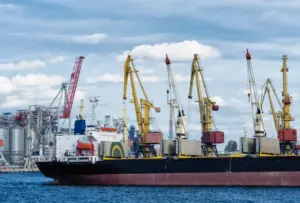
The physical transfer of the fuel took place via ship-to-ship (STS) bunkering, utilizing the Hai Gang Zhi Yuan—a state-of-the-art vessel that holds the distinction of being China’s first dedicated methanol bunkering ship, operated directly by SIPG Energy.
Positioned expertly alongside the towering hull of the 13,000-TEU CMA CGM OSIRIS, the Hai Gang Zhi Yuan executed the transfer with clinical precision. Over the course of the multi-day operation, the vessel pumped the 8,016 tonnes of biomass methanol smoothly into the container ship’s dual-fuel tanks. By leveraging SIPG’s unmatched capacity to integrate port resources and coordinate complex marine services, the transfer was completed without a single safety incident or operational delay, establishing a new global standard for high-volume green fuel delivery.
Supporting Context & Metrics: The Mechanics of Green Shipping
To fully grasp the magnitude of SIPG Energy’s achievement, one must examine the broader context of the global transition to alternative marine fuels and the specific metrics governing the Port of Shanghai’s recent performance.
The Methanol Revolution in Maritime Logistics
For decades, the global merchant fleet has relied almost exclusively on heavy petroleum-derived bunker fuels. However, under mounting pressure from the International Maritime Organization (IMO) to dramatically reduce greenhouse gas (GHG) emissions—targeting net-zero emissions by or around 2050—shipping lines have increasingly turned to dual-fuel architectures capable of running on liquefied natural gas (LNG), ammonia, and, most notably, green methanol.
Green methanol—encompassing both e-methanol (produced via captured carbon dioxide and green hydrogen) and biomass methanol (derived from organic waste materials)—is widely regarded as one of the most promising near- to medium-term solutions for maritime decarbonization. When combusted, it emits significantly lower sulfur oxides ($SO_x$), nitrogen oxides ($NO_x$), and particulate matter, while offering a dramatic reduction in well-to-wake carbon dioxide equivalent emissions, particularly when produced from sustainable biomass feedstocks.
Breaking Previous Records
The jump from historical operational capacities to an 8,016-tonne single-lift bunkering operation represents an exponential leap forward:
- March 2026 Milestone: The previous global benchmark was set by the same SIPG operational team at 3,643 tonnes of biomass methanol.
- August 2026 Milestone: The new record of 8,016 tonnes more than doubles the previous global high, demonstrating that Shanghai possesses the infrastructure, tank capacity, and pumping rates required to service the world’s largest ultra-large container vessels (ULCVs) in a single port call.
- Synergy with Cargo Operations: This green milestone coincides with a period of staggering overall operational output for the port. In recent operational cycles, Shanghai Port smashed daily handling records by processing an incredible 203,881 TEUs, proving that environmental sustainability and high-speed commercial productivity can go hand in hand.
Official Statements and Industry Collaboration
The success of the August 2026 bunkering operation was widely celebrated across the maritime and energy sectors, highlighting the power of strategic public-private partnerships and cross-industry synchronization.
Industry leaders emphasized that the operation was not merely a commercial transaction, but a collaborative blueprint for the future of global shipping. Representatives from SIPG Energy noted that the achievement was made possible by the unwavering guidance of port regulatory authorities and the tireless cooperation of specialized service providers.
In joint statements released following the completion of the bunkering, key stakeholders underscored the importance of ecosystem-wide integration. Executives from SIPG pointed out that scaling up green shipping cannot be accomplished in a vacuum; it requires ports, energy producers, shipping lines, and logistics providers to operate as a cohesive, synchronized unit.
The successful transport of fuel from the Taonan Project in Jilin through Dalian to Shanghai served as a prime example of this collaborative ethos. Shanghai Electric, the primary producer behind the biomass methanol supply chain, expressed immense pride in seeing regional renewable energy assets directly power trans-oceanic mega-ships. Meanwhile, representatives for the CMA CGM Group lauded the efficiency of the Port of Shanghai, noting that reliable, large-scale green bunkering infrastructure is the single most critical factor enabling ocean carriers to deploy their growing fleets of alternative-fuel vessels on major international trade routes without incurring prohibitive scheduling delays.
Future Outlook: Paving the Way for Global Decarbonization
As the dust settles on this historic bunkering event, the maritime community is already looking toward the horizon. The milestone achieved at the Port of Shanghai on August 16 is not intended to be a one-off anomaly, but rather the foundational building block for a permanent, high-volume green fuel service network.
Scaling Up the Value Chain
Looking forward, SIPG Energy and its primary industrial partners have announced their intention to significantly deepen their cooperation across the entire green shipping sector. The immediate strategic priority is the further development and institutionalization of a resilient biomass methanol supply chain.
By refining the multi-modal logistics corridor that links northern production bases with eastern bunkering terminals, SIPG aims to ensure the regular, large-scale, and high-quality provision of green marine fuel services. This will involve expanding dedicated storage tank farms at the port, increasing the operational fleet of specialized bunkering vessels like the Hai Gang Zhi Yuan, and securing long-term offtake agreements with green chemical producers across China.
Global Implications for Bunkering Hubs
The Port of Shanghai’s triumph serves as a powerful message to competing international maritime hubs. As major shipping alliances increasingly route their green-fueled vessels along key Asia-Europe and trans-Pacific loops, port competitiveness will no longer be measured solely by crane productivity and container turnaround times, but equally by the availability, safety, and scale of alternative fuel bunkering infrastructure.
By successfully executing an 8,016-tonne biomass methanol bunkering operation, Shanghai has positioned itself at the vanguard of the green maritime economy. It has provided the global shipping industry with a working proof-of-concept: that complex, multi-regional green supply chains can be successfully integrated, regulated, and executed at a scale capable of meeting the demands of the world’s largest container fleets. As other global ports watch closely, Shanghai’s historic achievement sets a formidable new standard, signaling that the era of sustainable, zero-carbon shipping is rapidly transitioning from ambition to execution.