




By Global Infrastructure & Maritime Correspondent
Published: August 21, 2026
Executive Overview
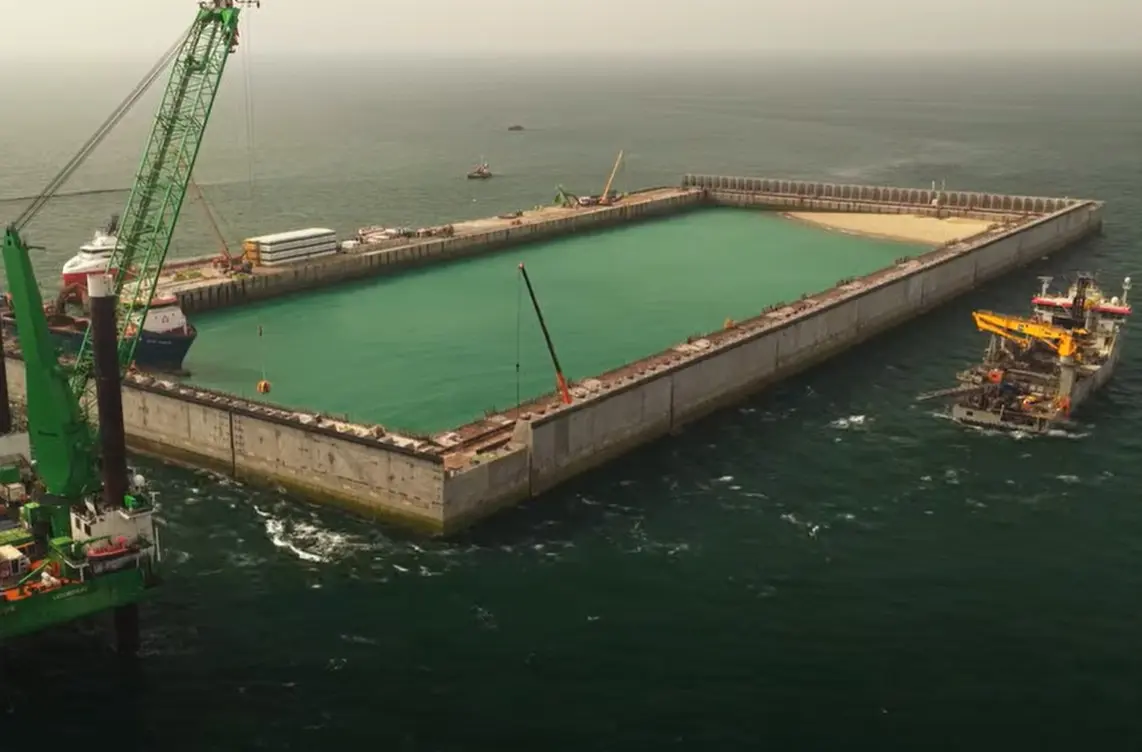
In a monumental achievement for marine engineering, renewable energy, and coastal infrastructure, TM EDISON—the specialized joint venture comprising industry titans DEME and Jan De Nul—has successfully installed the 23rd and final concrete caisson for the Princess Elisabeth Island. This milestone marks the definitive completion of the foundational outer perimeter for the globe’s very first artificial energy island.
Commissioned by Belgium’s high-voltage transmission system operator, Elia, this pioneering project redefines the limits of offshore construction. Located approximately 45 kilometers off the Belgian coast in the North Sea, the Princess Elisabeth Island is not merely a structural marvel; it is a critical nexus for Europe’s green energy transition. Designed to act as an offshore electricity hub, the island will safely aggregate power generated by Belgium’s second offshore wind zone, integrate upcoming international interconnectors with the United Kingdom, and channel gigawatts of clean electricity directly into the onshore mainland grid.
With all 23 massive hollow concrete blocks—each weighing an astronomical 22,000 tons—now securely positioned on the North Sea bed, the project transitions from heavy marine civil works into its next intricate phase: internal sand infilling, stabilization, and the subsequent construction of the high-voltage electrical infrastructure required to power millions of homes and businesses.
Detailed Chronology: From Concept to the Final Offshore Placement
The realization of the Princess Elisabeth Island is the culmination of years of rigorous planning, massive logistical synchronization, and unprecedented maritime engineering feats.
The Genesis and Fabrication Phase
Long before the first stone was laid on the seabed, the project demanded specialized industrial preparation. The backbone of the island’s defensive perimeter consists of 23 enormous reinforced concrete caissons. These colossal structures were meticulously manufactured in Vlissingen, Netherlands, within purpose-built dry docks and manufacturing yards.
Constructing caissons of this magnitude requires absolute precision. Each unit had to be engineered to withstand the hyper-aggressive marine environment of the North Sea, characterized by ferocious wave action, high tidal currents, and deep hydrostatic pressure. The construction phase in Vlissingen involved pouring hundreds of thousands of tons of high-grade marine concrete around dense steel-reinforcement skeletons, ensuring structural integrity that is designed to endure for generations.
Transport and Marine Logistics
Once cured, the transport of the 22,000-ton caissons from Vlissingen to the designated offshore location in the North Sea became an engineering logistical campaign in its own right. Because towing objects of this weight and scale across open, unpredictable coastal waters presents immense hydrodynamic challenges, the operation required a fleet of specialized heavy-lift vessels, high-capacity tugboats, and precise GPS-guided positioning systems.
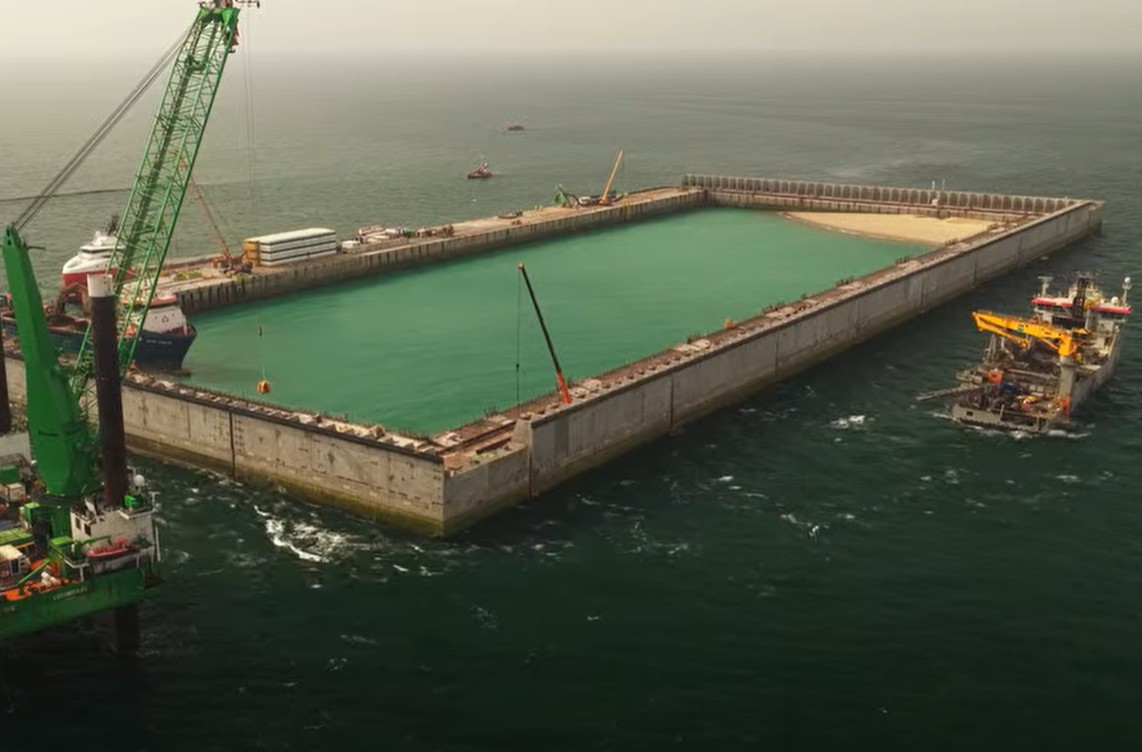
Upon arrival at the site, positioning the caissons required meteorological windows with minimal wave heights and slack water currents. Working with millimeter-level accuracy, the TM EDISON consortium guided each caisson into its exact engineered slot within the defensive ring, ballasting them with water and aggregate to anchor them securely to the prepared seabed foundation.
The placement of the final, 23rd caisson on August 21, 2026, officially closed the perimeter, creating a sheltered lagoon-like basin ready for the massive land-reclamation phase that will turn an empty ring into a solid, multi-hectare industrial platform.
Supporting Context & Technical Metrics
To truly grasp the magnitude of the Princess Elisabeth Island project, one must examine the raw engineering scale and the strategic geopolitical context in which it operates.
Key Metrics and Technical Specifications
- Project Owner: Elia (Belgium transmission system operator)
- Contractor: TM EDISON (Joint venture between DEME and Jan De Nul)
- Location: North Sea, approximately 45 km off the Belgian coastline
- Total Caissons: 23 reinforced concrete units
- Caisson Weight: Approximately 22,000 metric tons per unit
- Manufacturing Hub: Vlissingen, The Netherlands
- Core Function: Offshore electricity transmission hub, wind-zone aggregator, and international interconnector terminal
Geopolitical and Energy Security Significance
Europe’s aggressive decarbonization targets, reinforced by the European Green Deal and various regional energy pacts, demand unprecedented expansions in offshore wind capacity. Belgium’s Princess Elisabeth Island serves as a blueprint for future North Sea infrastructure.
Traditional offshore wind farms transmit power individually to the mainland via long, vulnerable high-voltage alternating current (HVAC) or direct current (HVDC) cables. As wind farms move further offshore to capture stronger, more consistent winds, these direct point-to-point connections become increasingly inefficient and costly.
The Princess Elisabeth Island solves this bottleneck by acting as an artificial central substation. It collects energy from the upcoming Princess Elisabeth wind zone—boasting a capacity of roughly 3.5 gigawatts—converts it, and transmits it efficiently over long distances. Furthermore, by housing infrastructure for hybrid interconnectors, the island will facilitate power trading between Belgium and the United Kingdom, boosting regional energy security and balancing out intermittent wind generation across national borders.
Environmental Integration and Nature-Inclusive Design
One of the most remarkable dimensions of the Princess Elisabeth Island project is its proactive approach to marine ecology. Historically, large-scale industrial marine construction has been viewed with skepticism by environmentalists due to potential disruptions to benthic habitats and local marine life. However, Elia and the TM EDISON consortium turned the island’s protective infrastructure into an ecological opportunity through nature-inclusive design (NID).
Artificial Reefs and Biodiversity Enhancement
Surrounding the heavy rock armor and the base of the concrete caissons, specialized rock structures have been installed. These structures were engineered not just for wave dissipation and coastal protection, but explicitly to act as habitats for marine flora and fauna.
During the construction phase, conservation scientists and marine biologists collaborated with engineers to seed these rock foundations with young oysters. Oysters act as ecosystem engineers; they filter water, improve water clarity, and provide structural substrate and shelter for fish, crustaceans, and other marine organisms. Over time, these installations are expected to evolve into thriving artificial reefs, transforming a static civil engineering asset into a biodiversity hotspot within the heavily fished and industrialized North Sea.
Official Statements and Industry Perspectives
The successful installation of the final caisson drew widespread acclaim from industry leaders, corporate executives, and environmental stakeholders alike.
Eldin Ganic, reporting on the breaking milestones of the project, emphasized the complexity of orchestrating such a massive marine operation in one of the world’s busiest shipping lanes.
Representatives from DEME and Jan De Nul—operating synergistically under the TM EDISON banner—highlighted the collaborative spirit that drove the project forward through global supply chain pressures, inflationary hurdles, and severe offshore weather windows.
"The completion of the caisson installation phase is a proud moment for every engineer, captain, welder, and scientist involved in TM EDISON," noted a senior project spokesperson. "We have pushed the boundaries of what is possible in maritime construction, proving that complex land reclamation and heavy offshore installation can be executed safely, on schedule, and in harmony with the marine environment."
Elia leadership reinforced that the island is a cornerstone for Belgium’s industrial future. By providing the physical foundation for the energy transition, the project guarantees that heavy industries, commercial enterprises, and residential consumers will have access to stable, predictable, and green electricity for decades to come.
Future Outlook: The Road Ahead for Princess Elisabeth Island
With the 23 caissons now locked into their permanent positions, the narrative of the Princess Elisabeth Island shifts rapidly from structural civil engineering to advanced electro-mechanical outfitting.
Phase Two: Sand Infilling and Platform Stabilization
The immediate next step involves filling the interior cavity of the 23-caisson ring with millions of tons of dredged sand. Dredging vessels will pump sediment into the enclosure, gradually raising the seabed level above the high-tide mark. Once filled, the interior will be compacted, leveled, and stabilized to create a robust, load-bearing landmass capable of supporting heavy electrical transformers, high-voltage switchyards, and crew quarters.
Electrical Infrastructure and Grid Integration
Following the land-reclamation phase, specialized contractors will begin installing the complex high-voltage direct current (HVDC) and alternating current (AC) equipment. This phase will transform the barren island into an intelligent, highly automated offshore power station.
Looking further into the late 2020s and early 2030s, the island will begin receiving its first tranches of offshore wind energy, routing power seamlessly to the Belgian mainland at Zeebrugge. Additionally, the groundwork laid by this project opens the door for future multi-use energy islands across the North Sea basin, potentially linking wind farms across the UK, Netherlands, Germany, and Scandinavia into a unified European "supergrid."
Conclusion
The placement of the final caisson by DEME and Jan De Nul is much more than a routine engineering checkbox; it is a profound testament to human ingenuity in the face of nature’s most formidable elements. The Princess Elisabeth Island stands ready to anchor Europe’s renewable energy ambitions, proving that large-scale industrial progress and ecological enhancement can successfully coexist in the blue economy of the 21st century.