








Executive Overview
In a dramatic and precisely coordinated maritime operation, a cruise passenger experiencing a severe medical emergency was successfully airlifted from Royal Caribbean International’s Ovation of the Seas on August 8, 2026. The high-stakes rescue took place approximately 52 nautical miles northwest of Tofino, British Columbia, as the massive Quantum-class vessel journeyed through Pacific waters toward the picturesque landscapes of Alaska.
The complex operation required the seamless collaboration of international maritime resources, drawing on the rapid response capabilities of the Joint Rescue Coordination Centre (JRCC) in Victoria, British Columbia. Royal Caribbean’s shipboard officers and medical staff worked in tandem with the Royal Canadian Air Force, deploying both fixed-wing search-and-rescue aircraft and specialized long-range helicopters to execute the mid-ocean hoist.
While cruise ship medical centers are remarkably well-equipped—often featuring advanced diagnostics, intensive care units, and professional physicians and nurses—certain critical emergencies transcend onboard capabilities. This incident highlights the intricate protocols, split-second decisions, and multi-agency cooperation necessary to save lives in remote maritime environments. Despite the disruption, Ovation of the Seas successfully maintained its scheduled itinerary, delivering its passengers to their final destinations while the evacuated guest received crucial, land-based medical care.
Detailed Chronology: From Shipboard Crisis to Coastal Hospital
The unfolding of events on August 8, 2026, reads like a masterclass in modern maritime emergency management. Understanding the timeline underscores the urgency and precision required when every minute matters at sea.
The Emergency Declaration and Tactical Speed Increase
At approximately 5:30 p.m. local time, the tranquil atmosphere aboard the 168,666 gross-ton Ovation of the Seas was interrupted by an announcement from the ship’s captain. An unidentified passenger had suffered a critical medical emergency requiring advanced intervention beyond the ship’s onboard hospital facilities.
At the time of the call, the vessel was navigating waters roughly 52 nautical miles northwest of Tofino, BC. Passengers traveling onboard later recounted the sudden shift in the ship’s operations on online forums such as Reddit. According to eyewitness accounts, Ovation of the Seas was cruising at a comfortable pace of roughly 11 knots per hour. Following the captain’s announcement, the bridge ordered a significant acceleration, doubling the ship’s speed to 22 knots. This aggressive tactical maneuver was executed to shrink the distance between the moving vessel and the designated rendezvous point established by Canadian rescue coordinators.
Air Support Arrival and Scene Assessment
While the cruise ship sprinted toward the coordinates, the Joint Rescue Coordination Centre (JRCC) in Victoria mobilized a comprehensive air response. They dispatched a high-endurance CC-295 Kingfisher fixed-wing search-and-rescue aircraft alongside a CH-149 Cormorant helicopter, Canada’s premier long-range search-and-rescue platform.
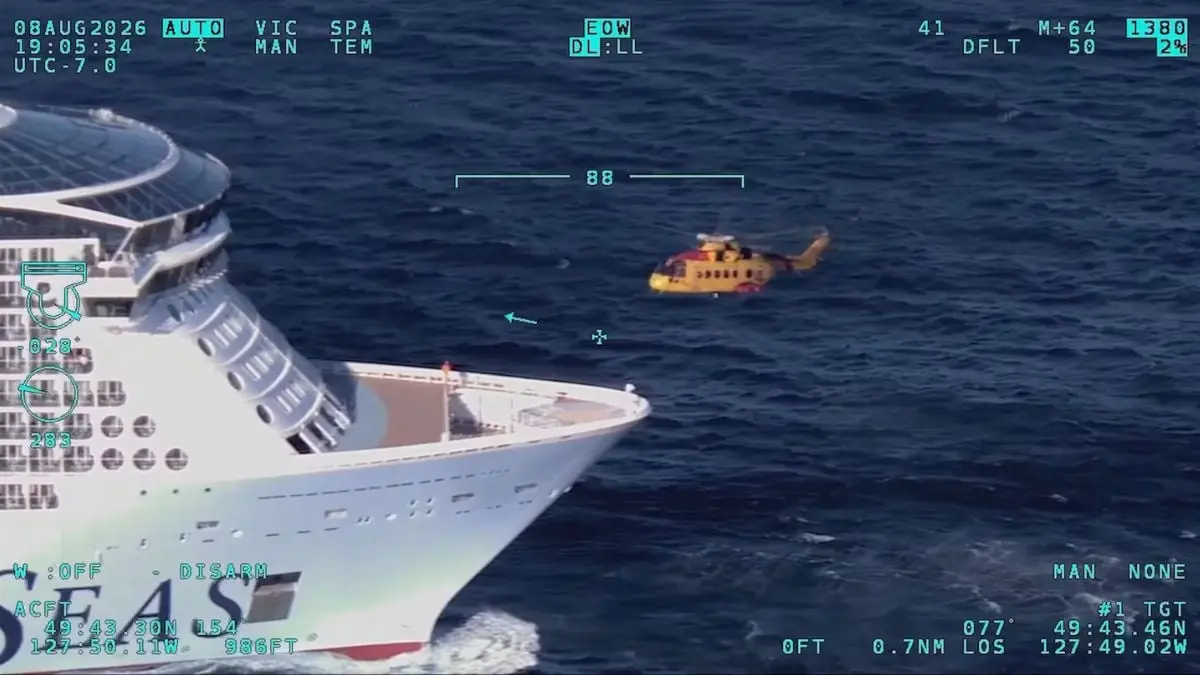
The CC-295 Kingfisher arrived on the scene first, establishing visual contact with the cruise ship around 7:30 p.m.—just two hours after the initial emergency call. The Kingfisher crew immediately assumed the role of on-scene coordinator, communicating directly with the bridge of Ovation of the Seas to assess wind conditions, evaluate deck clearance, and determine the safest approach vectors for the incoming helicopter.
The Hoist Operation
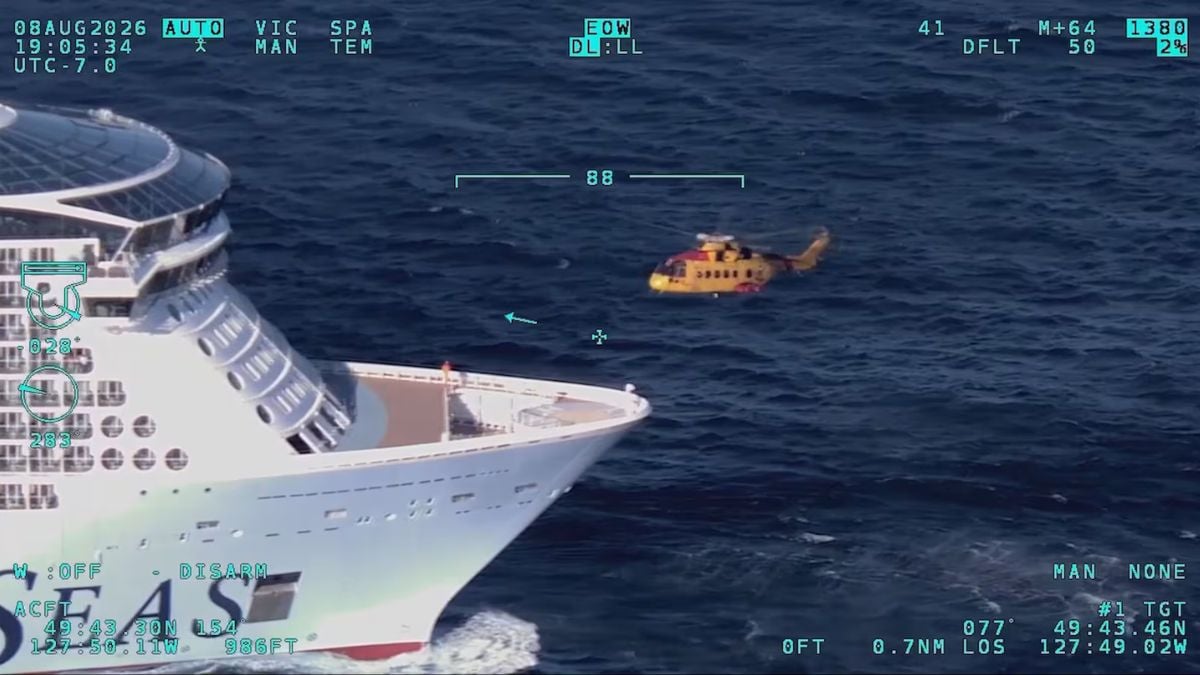
With the Kingfisher circling overhead to manage airspace and communications, the CH-149 Cormorant helicopter arrived. The seasoned flight crew evaluated the ship’s rolling deck and forward momentum. Operating a helicopter above a moving cruise ship requires immense precision, as downdrafts from the massive rotor blades interact with the ship’s superstructure and ocean winds.
Once Ovation of the Seas established a steady heading and speed, search-and-rescue technicians (SAR techs) were successfully lowered from the hovering Cormorant directly onto the vessel’s open deck.
Upon touchdown, the elite rescue specialists boarded the ship, where the passenger had already been stabilized by the onboard medical staff. Following a rapid clinical assessment, the patient was prepared for the precarious vertical transfer. In adherence to search-and-rescue protocols for severe medical scenarios involving family units, the patient’s spouse was also hoisted into the aircraft. Together, the patient, the spouse, and the SAR technicians were safely winched back up into the cabin of the CH-149 Cormorant.
Transfer and Continuation of Voyage
With all personnel safely secured aboard the rescue helicopter, the aircraft broke away from the cruise ship and set a direct course for a hospital in Victoria, British Columbia, where specialized trauma and critical care units were standing by.
Meanwhile, Ovation of the Seas adjusted its speed back to normal cruising operations and resumed its voyage northward. The vessel experienced no structural delays or missed port calls that compromised the structural integrity of its advertised itinerary, illustrating the minimal impact these emergency operations have on the broader passenger experience when handled with absolute efficiency.
Supporting Context & Metrics
To fully appreciate the scope of this operation, it is necessary to examine the physical scale of the vessel involved, the geographical challenges of the Pacific Northwest, and the broader context of cruise ship medical evacuations.
Vessel Profile: Ovation of the Seas
- Class: Quantum-Class
- Gross Tonnage: 168,666 GT
- Passenger Capacity: ~4,905 (double occupancy) up to 4,180 max
- Homeports & Itineraries: Primarily deployed in Alaska during the summer season and Australia/Asia during the winter months.
- Significance: Known for its cutting-edge engineering, the ship features state-of-the-art stabilizers and advanced navigation systems, which assist considerably during emergency rendezvous and deck operations.
Geographical Challenges of the Pacific Northwest
The waters off the coast of Vancouver Island and Tofino are notoriously rugged. Characterized by volatile weather patterns, heavy swells, frigid water temperatures, and unpredictable coastal winds, executing a hoist operation in this region demands exceptional skill from aircrews. The Canadian Armed Forces operating out of Victoria and Comox routinely train for these exact maritime environments, ensuring that rescue assets can deploy rapidly across hundreds of miles of open ocean.
The Economics and Logistics of Medevacs
A medical evacuation (medevac) of this magnitude incurs substantial operational costs, heavily subsidized by public safety infrastructure in countries like Canada and the United States. However, cruise lines maintain rigorous internal protocols to mitigate these risks:
- Onboard Triage: Ship medical centers are staffed by certified emergency physicians and critical care nurses capable of performing life-saving stabilization.
- Telemedicine Integration: Cruise lines maintain 24/7 satellite links with land-based medical experts at corporate headquarters and specialized medical institutions.
- Liability and Insurance: Passengers are strongly advised to carry comprehensive travel and medical insurance that covers emergency evacuations, which can easily cost tens of thousands of dollars out-of-pocket when utilizing military-grade aircraft and specialized coast guard resources.
Official Statements and Industry Perspectives
While official medical bulletins regarding the anonymous passenger remain private due to patient confidentiality laws and privacy regulations (such as PIPEDA and HIPAA equivalents), transportation authorities and cruise industry analysts have commented on the operational success of the mission.
The Joint Rescue Coordination Centre in Victoria praised the crew of Ovation of the Seas for their prompt cooperation. By immediately increasing speed, clearing the designated deck space, and maintaining transparent communication with the arriving Kingfisher and Cormorant aircrews, the ship’s captain and deck officers shaved precious minutes off the total response time.
Royal Caribbean International issued a brief statement acknowledging the incident, prioritizing the health and privacy of the guest, and expressing gratitude to the Canadian Armed Forces and the Joint Rescue Coordination Centre for their swift, professional intervention.
Independent maritime analysts noted that while medical evacuations are statistically rare relative to the millions of passengers who cruise safely each year, they serve as an essential safety net. As the demographics of cruisers skew older and ships grow larger, the frequency of pre-existing conditions flaring up at sea remains a constant reality, necessitating robust partnerships between private cruise corporations and public military rescue services.
Future Outlook & Industry Trends
As the global cruise industry continues to expand into remote, pristine wilderness regions—most notably the rugged corridors of Alaska, Norway, and Antarctica—the infrastructure surrounding emergency medical response is evolving.
1. Enhanced Onboard Diagnostics
Cruise lines are increasingly investing in telemedicine technology, artificial intelligence-assisted diagnostics, and expanded onboard laboratory testing equipment. By improving the diagnostic accuracy onboard, ships can better determine whether a mid-ocean evacuation is genuinely required or if the patient can be stabilized until the next scheduled port of call.
2. Strategic Terminal Developments
The timing of this incident coincides with major infrastructure investments in the region. Just months prior to this event, Royal Caribbean celebrated the grand opening of its brand-new cruise terminal in Seward, Alaska, in June 2026. This terminal marked the first time Ovation of the Seas formally homeported in Seward, signaling a permanent deepening of Royal Caribbean’s footprint in the Pacific Northwest corridor. As regional traffic increases, local search-and-rescue agencies and cruise operators continue to refine communication protocols to ensure seamless emergency response frameworks.
3. A Legacy of Inter-Agency Cooperation
Incidents like the August 8 rescue mirror similar high-profile operations from previous seasons. For instance, in August 2025, a joint rescue mission successfully airlifted two guests from the Ruby Princess through the cooperative efforts of the US Coast Guard, the Royal Canadian Air Force, and the Canadian Coast Guard. Similarly, in April 2026, a 78-year-old man was dramatically airlifted from Celebrity Solstice off the coast of Oahu via a joint operation between Celebrity Cruises, the US Coast Guard, and the US Navy.
These recurring events prove that safety at sea is a collaborative global effort. Whether operating off the coast of Hawaii, the Inside Passage of Alaska, or the turbulent waters near Tofino, the cruise industry relies on an unyielding network of brave aircrews, dedicated medical professionals, and highly trained maritime officers.
As Ovation of the Seas safely concluded its 7-night voyage on August 14, 2026, at the Seward terminal, the lingering takeaway from the journey was not just the breathtaking glaciers and coastal wildlife, but the remarkable human coordination that ensured a fellow traveler received a second chance at life. The cruise community at large continues to extend its collective well-wishes to the passenger for a smooth and complete recovery.