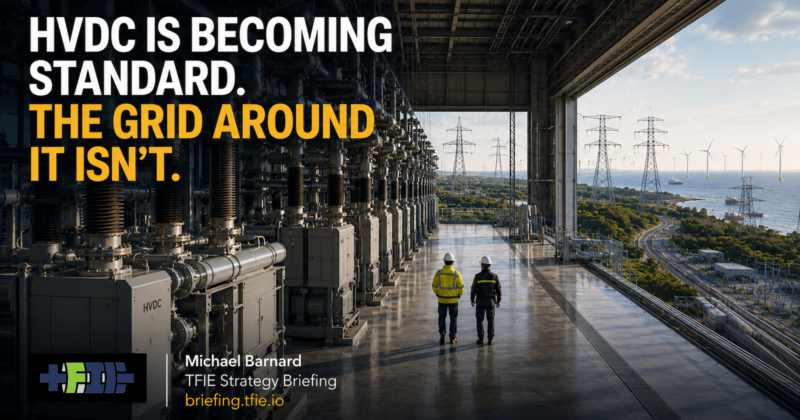
High-voltage direct current (HVDC) transmission has quietly shed its historical reputation as a niche, high-cost specialty technology reserved exclusively for record-breaking subsea cables, massive remote hydro projects, or particularly thorny grid isolation issues. For decades, deploying HVDC meant embarking on an expensive, bespoke engineering odyssey where virtually every converter station, cable specification, and control interface was custom-built from the ground up.
That paradigm is rapidly vanishing. According to insights shared by Cornelis Plet, Chief Technology Officer of Grid Systems Integration at GE Vernova, during a recent Redefining Energy conversation, HVDC is quickly cementing its place as a standard tool in the modern transmission planner’s toolkit. The primary driver of this transformation is physical and electrical standardization. Manufacturers, cable makers, and developers are increasingly coalescing around repeatable, modular building blocks—most notably 2 GW, 525 kV configurations in Europe, alongside larger 3 GW iterations emerging across North America and India.
Yet, while the manufacturing bottleneck for high-power hardware is finally beginning to ease, a much more complex and stubborn set of challenges has taken its place. The broader electrical ecosystem surrounding these standardized converters is not standardizing nearly as fast. As conventional thermal and nuclear generators retire and are replaced by inverter-based renewable sources like wind and solar, power systems are undergoing a structural metamorphosis. Transmission grids can no longer simply function as passive high-voltage highways moving bulk power from point A to point B; they must actively participate in real-time grid stability.
This evolution brings three critical friction points to the forefront:
Control Standardization: While grid-forming controls are increasingly demanded by system operators, there is still no single, globally coherent definition or standard for how these complex software-driven controls should behave.
Interoperability and Multi-Vendor Grids: As regional networks transition from simple point-to-point links toward meshed, multi-terminal HVDC grids, making equipment from competing manufacturers seamlessly interoperate—without launching custom, multi-million-dollar integration projects—remains a daunting hurdle.
Institutional and Planning Gaps: Advanced hardware cannot override fragmented regulatory frameworks. While Europe has forged multinational institutions to tackle regional grid planning, North America and other regions continue to struggle with cross-border cost allocation, conflicting regulatory jurisdictions, and a severe shortage of specialized high-voltage power engineers.
Detailed Chronology & Evolution of Transmission Technology
To understand why the current transition to HVDC standardization is so pivotal, one must look back at how transmission system development evolved over the past century.
The Era of the Custom Engineering Project (Late 20th Century to Early 2010s)
For decades, alternating current (AC) dominated bulk power transmission because transformers made it easy to step voltages up and down. However, AC transmission suffers from high capacitive losses over long distances, making it economically and physically unfeasible for multi-hundred-mile undersea or underground runs. HVDC emerged as the sole solution for these edge cases, utilizing Line-Commutated Converters (LCC) and later Voltage-Source Converters (VSC).
Because these projects were rare—perhaps a handful commissioned globally in any given decade—every single installation was treated as a unique prototype. Utilities and engineering, procurement, and construction (EPC) firms spent years negotiating custom specifications for valve designs, transformer impedances, and control software. Economies of scale were virtually non-existent, leaving supply chains vulnerable to component shortages and massive cost overruns.
The Pivot to Modular Building Blocks (Mid-2010s to Present)
The explosive growth of offshore wind farms and remote utility-scale solar installations forced a reevaluation. To avoid multi-year project delays, the industry needed repeatability. In Europe, market pressures and collaborative research initiatives—such as the landmark PROMOTioN (Progress on Meshed HVDC Offshore Transmission Networks) program, previously led by Cornelis Plet—paved the way for functional standardization.
Today, the European market has largely converged around a repeatable 2 GW, 525 kV bipolar HVDC building block. By establishing common footprints, standardized converter configurations, and predictable cable diameters, component suppliers can finally invest in automated factories and dedicated production lines. Transformer factories, cable extruders, and power electronics fabricators can now build around a recognized product family rather than starting from scratch for every new tender. Meanwhile, other power-hungry markets are scaling even larger, with 3 GW configurations gaining traction in the United States and India to handle unprecedented volumes of renewable generation.
The Shift to Meshed Grids and Multi-Vendor Ecosystems (The Horizon)
Having conquered the point-to-point transmission challenge, the industry is now staring down the next evolutionary phase: meshed, multi-terminal HVDC grids. In a meshed topology, power can flow dynamically across multiple paths, rerouting around outages much like the internet handles data packets.
However, achieving a true multi-vendor meshed grid requires converters built by Supplier A to communicate fluidly, share fault-clearing duties, and coordinate control responses with equipment built by Supplier B. This is where the historical practice of locking into a single vendor’s proprietary ecosystem clashes with the long-term needs of grid operators.
Supporting Context & Technical Metrics
The transition from rotating synchronous machines to power-electronics-dominated grids introduces deep technical complexities that hardware standardization alone cannot solve.
The Power Electronics Revolution and Grid Stability
Traditional grids relied on the physical inertia of massive rotating turbine generators (coal, gas, hydro, and nuclear) spinning in synchronous lockstep at 50 Hz or 60 Hz. This physical inertia provided a natural buffer against sudden frequency drops when plants tripped offline.
Modern wind turbines, utility-scale solar arrays, and battery energy storage systems connect to the grid via power electronic inverters. These sources are inherently "inverter-based" and lack intrinsic rotating mass. To maintain system stability, HVDC converter stations must increasingly incorporate grid-forming (GFM) controls. Unlike "grid-following" converters—which simply inject current into an existing AC voltage waveform—grid-forming converters act as virtual voltage sources, establishing their own local frequency and voltage references to stabilize weak grids.
While hardware manufacturers are mass-producing standardized converter hardware, software and control requirements remain fragmented. There is currently no unified global standard defining how grid-forming HVDC controls must behave under fault conditions.
Different transmission system operators (TSOs) write unique local grid codes. One region might require a specific dynamic voltage support response during a fault, while a neighboring jurisdiction mandates an entirely different transient reaction. Consequently, vendors must maintain multiple software variations, and utilities face grueling compliance verification processes.
Official Statements & Industry Perspectives
In his comprehensive analysis on Redefining Energy, Cornelis Plet offered an unvarnished assessment of where the transmission sector stands today:
"HVDC is moving into the normal transmission planner’s toolbox rather than sitting off to the side as an exotic developer proposal."
Plet emphasized that the physical standardization happening across Europe—specifically the 2 GW, 525 kV benchmark—is a monumental achievement for supply chain efficiency. By stabilizing the physical building blocks, factories can invest with confidence. However, he issued a strong caution regarding the software and institutional layers resting on top of that hardware:
"The electrical system around those increasingly standard boxes is not standardizing nearly as quickly… The harder constraints are moving toward system architecture, interoperability, planning and project execution across institutional boundaries."
Addressing the technical friction of multi-vendor environments, Plet noted that moving beyond point-to-point links requires confronting proprietary barriers:
"A converter station from one supplier talking to another supplier’s equipment is not simply a matter of agreeing on voltage and power. Control modes, protection behavior, interfaces and intellectual property all come into it."
Furthermore, Plet highlighted a human capital bottleneck that rarely makes mainstream headlines: the acute shortage of experienced power systems engineers.
"Standard designs can cut engineering hours per project and AI may automate some work, but an inverter-dominated grid still needs people who understand control, protection, high voltage and how the pieces behave together."
Future Outlook: Overcoming the Institutional Bottleneck
As the clean energy transition accelerates through the late 2020s and into the 2030s, the debate over grid expansion is shifting from a manufacturing narrative to a governance and architectural challenge.
Resolving the North American Planning Gap
While Europe has established centralized planning bodies and cross-border regulatory frameworks—such as ENTSO-E (European Network of Transmission System Operators for Electricity)—to coordinate multi-country transmission corridors, North America remains heavily fractured. Regional Transmission Organizations (RTOs), Independent System Operators (ISOs), and state-level utility commissions often operate in isolation.
Constructing a massive HVDC spine across North America requires aligning dozens of utility territories, reconciling conflicting cost-allocation formulas, and proving systemic benefits to states that may not host the physical transmission lines. Until regulatory bodies modernize inter-regional planning and establish equitable cost-sharing mechanisms, even the most advanced 3 GW HVDC converters will sit stalled in administrative backlogs.
The Workforce Imperative
Solving the engineering talent deficit will require concerted investments in academic power engineering programs, specialized vocational training, and industry-wide collaboration. As grids transition into complex cyber-physical systems governed by power electronics and advanced control algorithms, the industry cannot rely solely on legacy electrical engineering curricula. Training the next generation of engineers to design, protect, and operate multi-vendor HVDC grids is just as critical as casting copper cables and manufacturing converter valves.
Conclusion
The success of modern HVDC technology is no longer in doubt. The hardware works at gigawatt scale, manufacturing capacity is scaling up, and standardized building blocks are proving their worth in the field. The defining challenge of the next decade will be bridging the gap between exceptional hardware and cohesive grid architecture. By harmonizing global grid-forming control codes, fostering multi-vendor interoperability, streamlining inter-regional planning frameworks, and cultivating a new cadre of power systems engineers, the global energy sector can finally unlock the full, frictionless potential of the HVDC revolution.