








Executive Overview
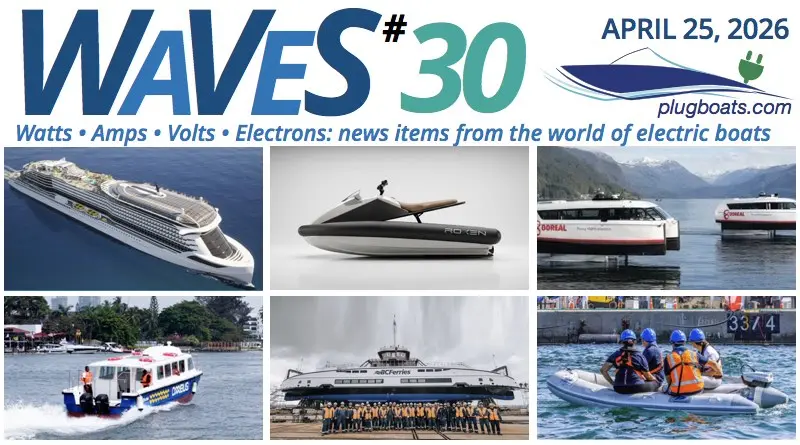
The global transition toward zero-emission marine mobility has officially transitioned from a futuristic concept into an aggressive, industrial-scale reality. In this landmark thirtieth installment of Plugboats WAVES (Watts, Amps, Volts, Electrons), the breadth of maritime electrification spans continents, sectors, and vessel classes—proving that electric propulsion is no longer limited to small recreational lakes or isolated pilot projects.
From municipal mass transit in the deep fjords of Norway and the bustling coastal waterways of British Columbia to high-performance international watersports, massive commercial shipyards, and emerging transit networks in West Africa, electric marine technology is scaling rapidly. Major milestones detailed in this edition include Norway’s Boreal ordering the world’s largest fleet of electric hydrofoiling ferries; the launch of British Columbia’s tenth Island Class hybrid ferry; serial production milestones for lightweight personal watercraft; and conceptual blueprints for the world’s first fully electric, large-scale cruise ship.
As shoreside charging infrastructure catches up with manufacturing capabilities, the maritime sector is demonstrating that decarbonization is not only environmentally imperative, but operationally and economically viable today.
Detailed Chronology: Key Developments in WAVES #30
1. British Columbia Expands Hybrid Fleet with the Launch of Island K’asa
Canada’s largest ferry operator, BC Ferries—which oversees a massive network of 37 vessels across 25 routes, carrying more than 22 million passengers and 8 million vehicles annually—has reached a major fleet-renewal milestone. Netherlands-based shipbuilder Damen has officially launched the tenth vessel in the operator’s Island Class: the Island K’asa.

Named using the Kwak’wala word for "otter" by the Wei Wai Kum nation, the vessel serves as a cultural and ecological reminder of life’s interconnectedness. These modern hybrid ferries utilize a blend of advanced battery systems and diesel-hybrid technology, engineered to transition to fully electric operation as shoreside high-power charging infrastructure becomes available along British Columbia’s rugged 1,000-kilometer coastline. The new additions dramatically increase passenger and vehicle capacity on regional routes while systematically replacing aging, inefficient tonnage.
2. ePropulsion and SailGP Renew Global Partnership Through 2027
On the competitive front, electric motor manufacturer ePropulsion and the elite international sailing championship SailGP have officially extended their technical partnership through the end of the 2027 season. Since 2021, ePropulsion has supplied the high-reliability electric outboards and propulsion systems powering SailGP’s fleet of small craft and on-water support vessels.
This ongoing collaboration underpins SailGP’s aggressive on-water transition plans and broader corporate climate goals, demonstrating that electric propulsion can withstand the punishing, demanding real-world operational conditions of top-tier international sporting events.
3. Boreal Orders 20 Candela P-12 Electric "Flying Ferries" in Norway
In what stands as the largest commercial order for electric passenger vessels to date, Norwegian public transport titan Boreal has purchased twenty Candela P-12 electric hydrofoil vessels from Swedish innovator Candela. While Norway has electrified roughly 99% of its new passenger car sales, electrifying high-speed maritime passenger transport across deep fjords and a 100,000-kilometer coastline has historically been stymied by the weight, range, and speed limitations of conventional electric ferries.

The Candela P-12 overcomes these hurdles using computer-controlled hydrofoils that lift the hull entirely out of the water at speeds exceeding 18 knots. This dramatic reduction in hydrodynamic drag cuts energy consumption by roughly 80%. Capable of cruising at 25 knots with a 40-nautical-mile range, the P-12 can rapidly recharge in just one hour using standard DC fast chargers—completely bypassing the need for expensive, dedicated megawatt-scale shoreside charging infrastructure. The first two vessels will be delivered in 2027, with the remainder rolling out in annual batches through 2030.
4. Roxen Innovations Initiates Serial Production for Electric Watercraft
Sweden’s Roxen Innovations has officially brought its lightweight electric personal watercraft into serial production. Following the successful CE-Marking of its proprietary battery system in 2025 and adherence to strict European recreational craft directives, the company has locked in a 2026 production target of 200 units, with initial allocations already spoken for via pre-orders.
Weighing a mere 60 kilograms, the craft’s ultra-light hull can easily be mounted on a vehicle roof rack and launched from any shoreline. Powered by a 22 kW (approx. 30 hp) electric motor and a swappable 5.25 kWh battery pack, the watercraft achieves speeds up to 30 knots (55 km/h), providing a quiet, zero-emission alternative to traditional fossil-fuel personal watercraft.
5. Meyer Werft Unveils Concept for World’s First Fully Electric Cruise Ship
German shipbuilding giant Meyer Werft—responsible for constructing 61 massive cruise liners over the past few decades for industry heavyweights like Disney and Carnival—has unveiled a groundbreaking concept study named Vision. Presented at the Seatrade Cruise Global conference in Miami, the 275-meter (900-foot) vessel is designed to accommodate 1,856 passengers and boasts a Gross Tonnage exceeding 82,000.

Powered by massive battery systems supplied by Corvus Energy, Vision is engineered to slash greenhouse gas emissions by up to 95%. Beyond environmental metrics, the removal of traditional exhaust funnels and gas-treatment machinery opens up expansive, unobstructed sun deck views while dramatically reducing interior noise and vibration for passengers.
6. Explomar and Caverton Accelerate Electric Ferries in Lagos, Nigeria
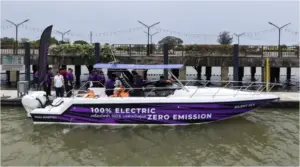
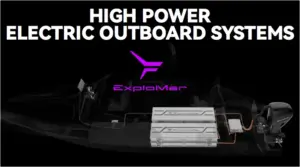
Following the expansion of the E1 electric speedboat racing series to Lagos, Nigeria, the region’s commercial maritime sector is rapidly pivoting toward electrification. China’s Explomar has secured a landmark order to supply 20 electric propulsion systems and a "5S energy station" to support a burgeoning urban ferry initiative.
This contract follows a rigorous two-year development and testing phase of a prototype ferry built by Caverton Offshore Support Group. The Omibus EV 2.0 utilizes twin 225 kW (300 hp) electric motors, offering a combined output of 450 kW (600 hp) to bypass chronic road congestion across Lagos’s extensive, underutilized waterways.
Supporting Context, Metrics & Technological Innovations
The initiatives featured in WAVES #30 highlight several converging technological breakthroughs reshaping the marine industry:

- Hydrofoiling Efficiency: Traditional displacement hulls push water aside, creating exponential drag at high speeds. Candela’s hydrofoil technology proves that lifting a vessel above the water plane reduces energy requirements by up to 80%, unlocking high-speed electric cruising ranges previously thought impossible.
- Charging Infrastructure Agility: While large commercial ferries often demand heavy, grid-taxing megawatt charging systems, innovations like the Candela P-12 leverage standard DC fast-charging standards. This compatibility drastically lowers implementation costs for municipal transit operators.
- Scalable Power Densities: From Roxen’s 5.25 kWh swappable personal watercraft batteries to Corvus Energy’s multi-megawatt marine energy storage solutions for cruise liners, modular battery chemistries are maturing to meet the vastly different demands of recreational and commercial markets.
- Weight Management: In lightweight craft, such as Roxen’s 60 kg composite hulls, minimizing structural mass directly translates into extended battery range and superior performance metrics.
Official Statements & Industry Perspectives
The leaders driving these maritime advancements emphasize both the urgency of decarbonization and the readiness of the technology:
-
Nicolas Jimenez, President and CEO of BC Ferries:
"Launching the final Island Class vessel is an important step in renewing our fleet and strengthening service for coastal communities. Aging ships are replaced with these more spacious, modern, and efficient hybrids. That’s essential to keeping ferry service reliable for the people and communities who depend on it every day."
-
Danny Tao, Co-founder and CEO of ePropulsion:

"SailGP continues to set the standard for high-performance, purpose-driven sport, and we’re proud to be continuing our partnership. Working together has already delivered meaningful progress, and we’re excited to build on that momentum."
-
Nikolai Knudsmoen Utheim, CEO of Boreal:
"Candela P-12 is the only electric passenger vessel that combines longer range with high speed without requiring extensive charging infrastructure… With this fleet, Boreal wants to take the next step—accelerating zero-emission high-speed travel along the Norwegian coast and helping bring electric vessels to new markets beyond Norway."
-
Magnus Sundstedt, Co-founder and CEO of Roxen Innovations:

"With investments secured and production now underway, we are entering the next phase of our journey. The interest we are seeing confirms that the market is ready for a lighter and smarter electric alternative."
-
Tim Krug, Meyer Werft Concept Development Group:
"We asked ourselves how we can use innovation to reduce CO₂ and contribute to decarbonization—not in 50 years, but much sooner… The technology is available today and we could deliver the first ship in 2031 if it were ordered this year."
-
Olabode Makanjuola, CEO of Caverton Offshore Support Group:

"The future of Nigeria’s waterways is electric. Cities like Lagos are defined by water, yet millions of residents remain trapped in road congestion while vast waterway networks lie underutilised."
Future Outlook
The trajectory of electric boating outlined in Plugboats WAVES #30 points to a transformative decade ahead. As European ports prepare to support up to one hundred shoreside charging hubs by 2030, concepts like Meyer Werft’s Vision cruise ship shift from theoretical studies to order-book realities. Simultaneously, the rapid deployment of hydrofoiling commuter ferries in Norway, hybrid connectors in British Columbia, and modular electric transit systems in West Africa prove that clean maritime tech is universally adaptable.
The convergence of advanced composite materials, intelligent flight-control software, high-density battery packs, and scalable manufacturing indicates that the global maritime sector has turned an irreversible corner. Fossil-fuel dominance on the water is steadily giving way to an efficient, quiet, and zero-emission future.