











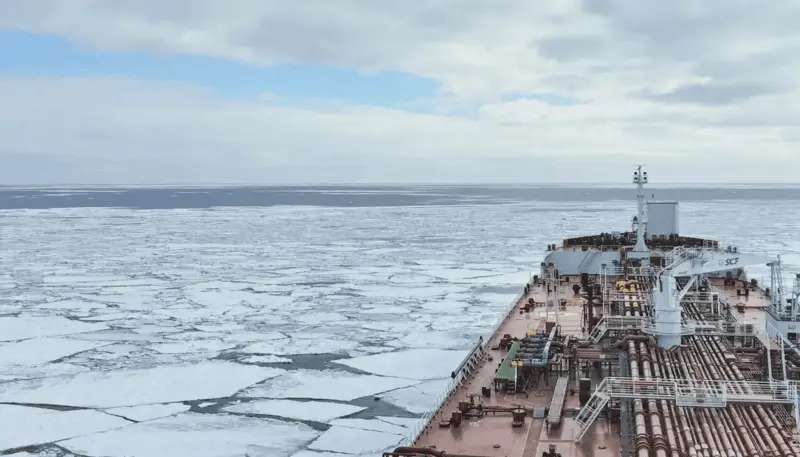
Executive Overview
A high-stakes maritime maneuver unfolding along Russia’s Northern Sea Route (NSR) has intensified international concerns over the safety of Arctic shipping. The Dakar, a 22-year-old product tanker blacklisted by the European Union, is currently undertaking an unusual, highly risky late-season voyage through the icy waters of the Far North. Carrying a cargo of methyl tert-butyl ether (MTBE)—a volatile and highly water-soluble gasoline additive—the vessel’s westward transit highlights a hazardous trend: Russia’s escalating reliance on aging, lower-specification "shadow fleet" vessels to bypass Western sanctions, even at the cost of potential ecological catastrophe.
As Western sanctions tighten their grip on Russian energy exports, Moscow has increasingly turned to the NSR as a sovereign, Western-intervention-free transit corridor linking Russian ports with Asian markets. However, the deployment of the Dakar—a vessel that is far from an Arctic-specialist tanker—signifies a dangerous shift. Rather than utilizing purpose-built, highly reinforced Arc4 or Arc7 ice-class vessels, operators are sending older, marginally protected, and structurally fatigued ships into some of the most treacherous waters on Earth.
With the summer navigation window rapidly closing and seasonal pack ice reclaiming the Arctic shipping lanes, the Dakar’s voyage underscores the systemic regulatory, environmental, and geopolitical challenges defining the modern maritime landscape.

+-----------------------------------------------------------------------------------------+
|                                THE VOYAGE OF THE DAKAR                                  |
|                                                                                         |
|  [August 2026]              [September 2026]             [October 2026]                 |
|  Cargo loaded in China ---> STS Transfer off Yeosu ----> Entering Northern Sea Route     |
|  (MTBE Chemical)            (Transferred to Dakar)       (Heading West through Arctic)  |
+-----------------------------------------------------------------------------------------+
Detailed Chronology: The Journey of the Dakar
The voyage of the Dakar is a masterclass in the complex logistics of the global shadow fleet, utilizing ship-to-ship (STS) transfers and flag-hopping to obscure the origin and destination of sensitive cargoes.
       [China] (Initial Loading)
          │
          ▼
     (Yellow Sea)
          │
          ▼
   [Yeosu, S. Korea] (STS Transfer to Dakar)
          │
          ▼
   [Sea of Japan / East Sea]
          │
          ▼
   [Bering Strait] (Entry to Arctic)
          │
          ▼
   [Northern Sea Route] (Westward Transit in Ice)
Origin and Ship-to-Ship Transfer
The journey began in August 2026, when the MTBE cargo was initially loaded onto a primary transport vessel at a port in China. Rather than sailing directly to its final destination, this initial vessel transited to the waters off Yeosu, South Korea—a notorious hotspot for ship-to-ship cargo transfers designed to obfuscate supply chains.
In September, the cargo was transferred via STS to the Dakar. By utilizing an STS transfer in international waters adjacent to South Korea, the cargo’s operators effectively disrupted the direct paper trail connecting the Chinese origin to the sanctioned tanker, a common tactic deployed by shadow fleet managers to evade compliance checks by maritime insurers and financial institutions.
Transiting the Northern Sea Route
Following the cargo transfer, the Dakar charted a course north, passing through the Bering Strait and entering the eastern gateway of the Northern Sea Route. According to vessel tracking data, the tanker is currently heading west along Russia’s rugged Arctic coastline.

The timing of this transit is highly precarious. While September represents the annual sea ice minimum—making it the most favorable window for Arctic navigation—October brings rapidly deteriorating conditions. As daylight hours diminish and temperatures plunge, young ice begins to form across key choke points like the Laptev and East Siberian Seas. For a vessel of the Dakar’s age and specifications, navigating these waters in late autumn carries an elevated risk of becoming beset in ice or suffering structural damage.
Vessel Profile and Sanctions History
Built in 2004, the Dakar is a 21,300-deadweight ton (dwt) oil and chemical products tanker. Over its 22-year operational lifespan, the vessel has frequently changed names, registered owners, and flag states—classic indicators of a vessel operating within the shadow economy to escape regulatory scrutiny.
In July 2026, the European Union formally sanctioned the Dakar as part of its ongoing efforts to curb Russia’s illicit energy trade. The EU’s sanctions designation specifically cited the vessel’s involvement in transporting Russian crude oil, petroleum products, or mineral products, alongside its systematic use of "irregular or high-risk shipping practices," such as disabling its Automatic Identification System (AIS) transponders and falsifying digital location data.
Furthermore, Ukraine’s sanctions database has flagged the Dakar as a key asset in Russia’s parallel export network, noting its frequent calls at Russian terminals along the Kola Peninsula earlier this year.
Supporting Context & Metrics: The Rise of the Arctic Shadow Fleet
The Dakar is not an isolated actor; rather, it represents the vanguard of a broader, highly troubling influx of substandard tonnage into the Arctic Circle. Data compiled by the environmental advocacy group Bellona reveals a dramatic surge in shadow-fleet traffic along the Northern Sea Route.
Quantitative Shift in NSR Traffic
Between the start of the 2026 summer-autumn navigation season and mid-September, Bellona identified 50 shadow-fleet oil and chemical tankers operating on the NSR. This represents a substantial increase from the 38 vessels logged during the entirety of the 2025 season.
Shadow-Fleet Tankers on the NSR:
2025 Season:  ██████████████████████████████ 38 Vessels
2026 Season*: ████████████████████████████████████████ 50 Vessels
*Data up to mid-September 2026
The physical characteristics of these vessels raise severe safety concerns:
- Advanced Age: Of the 50 tankers tracked in 2026, 33 were at least 15 years old—an age at which structural fatigue, hull corrosion, and mechanical failures become significantly more prevalent.
- Inadequate Ice Protection: Perhaps most alarming, 26 of these vessels possessed an ice class of Ice3 or lower, or carried no ice-class certification whatsoever.
Ice-Class Discrepancies and Structural Risks
In maritime engineering, ice classes are critical indicators of a ship’s ability to safely navigate ice-strewn waters. Purpose-built Arctic vessels are designed to Arc4, Arc5, or higher standards, featuring reinforced hulls, specialized steel alloys that resist cold-brittleness, and upgraded propulsion systems capable of clearing ice blocks.
| Ice Class | Capability Description | Suitability for Arctic Operations |
|---|---|---|
| Arc7 to Arc5 | Heavily reinforced hull; capable of independent navigation in moderate to thick first-year ice. | Excellent (Purpose-built for Arctic) |
| Arc4 | Moderate reinforcement; can navigate in light ice with or without icebreaker assistance. | Acceptable (Standard for summer-autumn NSR) |
| Ice3 / Ice2 / Ice1 | Light reinforcement; designed primarily for freezing Baltic ports or thin winter ice. | Marginal / High Risk (Unsuitable for late-season Arctic) |
| No Ice Class | Standard hull; no reinforcement against ice impact. | Extreme Risk (Highly dangerous in freezing waters) |
The Dakar possesses a basic, low-tier ice-class designation according to S&P Global databases. While this technically distinguishes it from entirely unreinforced, non-ice-class tankers, it sits far below the safety threshold required for standard Arctic operations. In the event of a sudden freeze-up or an unexpected encounter with multi-year pack ice, a vessel with the Dakar‘s limited structural reinforcement is highly vulnerable to hull breaches.
The Danger of MTBE Cargo
The environmental risk is compounded by the nature of the Dakar‘s cargo. Methyl tert-butyl ether (MTBE) is an organic compound primarily used as a gasoline additive to raise octane levels and reduce engine knocking.
Unlike heavy crude oil, which floats on the surface and can theoretically be contained with booms, MTBE is highly soluble in water. If a hull breach were to occur:
- The chemical would rapidly dissolve and disperse into the water column.
- It is highly resistant to biodegradation, particularly in near-freezing temperatures.
- Spilled MTBE would contaminate vast swaths of the pristine Arctic marine ecosystem, posing acute toxicity risks to local fisheries, marine mammals, and indigenous communities relying on these waters for subsistence.
- Conventional oil spill response equipment (booms, skimmers) is entirely ineffective against dissolved chemical agents like MTBE.
Regulatory Gaps and Official Perspectives
The expanding presence of substandard vessels in the Arctic highlights a widening gap between international maritime safety standards and unilateral Russian regulatory oversight.
                  ┌──────────────────────────────┐
                  │  International Sanctions     │
                  │  (EU / US / UK Price Cap)    │
                  └──────────────┬───────────────┘
                                 │
                    Forces Russia to utilize:
                                 │
                                 ▼
                  ┌──────────────────────────────┐
                  │  The Shadow Fleet            │
                  │  - Aging hulls / Low-spec    │
                  │  - Non-Western insurance     │
                  └──────────────┬───────────────┘
                                 │
                    Pushes operations into:
                                 │
                                 ▼
                  ┌──────────────────────────────┐
                  │  Northern Sea Route (NSR)    │
                  │  - Loosened Russian rules    │
                  │  - Severe environmental risk │
                  └──────────────────────────────┘
Russian NSR Administration Policies
Under domestic Russian law, the Northern Sea Route Administration (NSRA) governs all maritime traffic along the route. Formally, NSRA regulations permit vessels with lower ice classes to transit the NSR during the summer-autumn navigation window (typically July 1 to November 15). However, these permissions are subject to prevailing ice conditions, geographic location, and prescribed navigation methods (e.g., mandatory icebreaker escort in high-risk zones).
Critics argue that Moscow is systematically lowering its enforcement standards to maintain the economic viability of the NSR. Facing an urgent need to redirect oil and chemical exports to friendly Asian nations, Russian authorities have repeatedly granted transit permits to marginal vessels.
A stark warning occurred during the 2025 season, when the non-ice-class Suezmax tanker Lynx became trapped in heavy pack ice near 72 degrees north while carrying Russian crude to China. The vessel was forced to drift for several days in a highly precarious state before icebreaker assistance could reach it, demonstrating that the NSRA’s calculated risks can easily backfire.
European Union and Western Sanctions Enforcement
The EU’s decision to sanction the Dakar in July 2026 reflects a broader strategy to disrupt the logistical underpinnings of Russia’s shadow fleet. By blacklisting specific hulls, Western regulators aim to deny these vessels access to European ports, maritime services, and Western-dominated Protection and Indemnity (P&I) insurance clubs.
However, the effectiveness of these sanctions is severely tested along the Northern Sea Route. Because the NSR lies entirely within Russia’s Exclusive Economic Zone (EEZ) and territorial waters, Western coastal states have no jurisdiction to intercept or inspect transiting vessels. Furthermore, shadow-fleet operators increasingly rely on non-Western insurers—often backed by Russian or domestic sovereign guarantees—rendering Western financial penalties toothless once a vessel enters the Arctic corridor.
Environmental Watchdogs Sound the Alarm
Environmental groups and maritime safety organizations are watching the Dakar’s voyage with growing apprehension. Representatives from Bellona have repeatedly warned that the combination of aging hulls, inadequate ice reinforcement, and lack of specialized crew training on shadow-fleet tankers is a recipe for an unprecedented environmental disaster.
"The Arctic is one of the most hostile, remote, and ecologically fragile environments on the planet," a Bellona representative stated. "If a vessel like the Dakar suffers a major hull breach or engine failure in the middle of the East Siberian Sea, there is virtually no salvage or oil-spill-response infrastructure available to mitigate the damage. A spill under these conditions would be permanent, devastating, and impossible to clean up."
Future Outlook: The Dangerous New Normal in the Arctic
The voyage of the Dakar is not merely an anomalous late-season run; it is a harbinger of a highly militarized and commercialized Arctic that operates outside the boundaries of international maritime norms.
Escalating Environmental Hazards
As Russia continues to prioritize export volumes over ecological safety, the average age of vessels transiting the NSR is projected to rise. The physical reality of climate change—which has led to a steady decline in summer sea-ice extent—has created a false sense of security among shipping operators.
While the Arctic is indeed seeing more open water in August and September, the region remains prone to sudden, violent storms, extreme cold, shifting pack ice, and localized freezing. Sending 20-plus-year-old tankers with minimal ice protection into these unpredictable conditions guarantees that the statistical probability of a catastrophic structural failure will continue to climb.
Geopolitical Cleavage and the "Arctic Highway"
The growing utilization of the NSR by shadow-fleet tankers cements a deeper geopolitical reality: the decoupling of Russian maritime trade from Western regulatory frameworks. Russia and China are actively collaborating to develop the "Polar Silk Road," investing in joint port infrastructure, icebreaker construction, and transshipment hubs.
       WESTERN SHIPPING CORRIDORS             RUSSIAN COLD-WAR CORRIDOR
   ┌────────────────────────────────┐     ┌────────────────────────────────┐
   │ • Strict environmental audits  │     │ • Unilateral Russian oversight │
   │ • Western P&I insurance        │  vs │ • Shadow-fleet utilization     │
   │ • Adherence to IMO Polar Code  │     │ • Sovereignty-backed insurance │
   │ • Port-state control oversight │     │ • Sanctions-evasion priority   │
   └────────────────────────────────┘     └────────────────────────────────┘
This alternative logistics network is intentionally insulated from Western sanctions, G7 price caps, and international environmental oversight. By establishing a parallel maritime corridor where safety standards are compromised in favor of geopolitical expediency, Russia is creating a dangerous precedent. The international community may find itself powerless to prevent a massive environmental disaster in the Arctic, yet left to inherit the global ecological fallout.
As the Dakar continues its lonely, perilous journey westward through the freezing Arctic twilight, it serves as a stark reminder of the cost of geopolitical confrontation. The quest to bypass economic sanctions has successfully carved out a new, lawless frontier in the Far North—one where a single patch of hidden ice could trigger an ecological crisis of historic proportions.


