








Executive Overview
At first glance, the mechanical heart of a vessel appears deceptively familiar. Like its automotive counterpart, a standard internal combustion marine engine converts liquid fuel into controlled detonations, driving a shaft or propeller to generate thrust. Yet, this surface-level similarity masks a vastly different engineering reality. Marine powerplants operate in one of the most hostile environments imaginable—surrounded by corrosive saltwater, subjected to relentless thermal cycling, and forced to labor under a continuous, heavy load against the unyielding resistance of water.
Understanding the intricacies of how marine engines function is not merely an academic exercise for mechanically minded skippers; it is a critical safety competency. Every boat engine, whether a compact outboard bolted to a transom or a high-torque inboard rumbling deep within a hull, speaks a mechanical language. Recognizing early warning signs—a subtle shift in exhaust tone, a minor fluctuation in water pressure, or a faint vibration through the deck—separates a minor preventative adjustment from a catastrophic offshore breakdown.
This comprehensive analysis explores the engineering principles governing marine propulsion, details the mechanical divergences between inboard and outboard systems, examines the fragile dependency of raw-water cooling configurations, and outlines the protocols required to maintain reliability when miles from the safety of the harbor.
Detailed Chronology and Evolution of Marine Propulsion
The journey from oar-powered galleys to modern high-output marine propulsion represents centuries of relentless engineering evolution. To understand contemporary marine power, one must trace the chronological milestones that transformed the industry:
- The Steam Era (Late 18th to Late 19th Century): Early steam-powered vessels relied on external combustion engines driving paddlewheels and, eventually, Archimedean screw propellers. These massive, coal-guzzling plants required dedicated engineering crews and introduced the fundamental challenge of marine corrosion caused by boiling and condensing untreated water.
- The Advent of the Internal Combustion Engine (Late 19th to Early 20th Century): The invention of the Otto and Diesel cycles revolutionized watercraft. Suddenly, engines could be made compact, lightweight, and fuel-efficient. Early marine gasoline engines were often modified automotive blocks, which immediately highlighted the vulnerability of standard metal alloys to saltwater corrosion.
- The Birth of the Outboard (1907): The introduction of the commercial outboard motor by inventors like Ole Evinrude changed small-craft navigation forever. By combining the powerhead, driveshaft, and propeller into a single, portable, transom-mounted unit, boatbuilders opened recreational boating to the masses.
- The Rise of Modern Diesel and Electronic Fuel Injection (Late 20th Century to Present): As vessels grew larger and offshore cruising became more demanding, diesel engines dominated inboard applications due to their superior torque, fuel economy, and safety advantages over volatile gasoline. Concurrently, the integration of electronic control units (ECUs), computerized diagnostics, and closed-loop cooling systems transformed marine engines into high-tech, precision-engineered powerhouses capable of self-monitoring operational parameters in real time.
The Core Mechanics of Combustion and Load Dynamics
The Four-Stroke Marine Cycle
At its foundational level, the vast majority of modern gasoline and diesel marine engines operate on the classic four-stroke principle:
- Intake Stroke: The piston descends within the cylinder, creating a partial vacuum that draws a precise mixture of air and fuel (in gas engines) or pure air (in direct-injection diesels) through the open intake valve.
- Compression Stroke: The intake valve closes, and the ascending piston compresses the fuel-air charge, exponentially increasing its temperature and pressure.
- Power Stroke: Near top-dead-center, a spark plug ignites the mixture (or injected diesel auto-ignites under extreme heat and pressure). The resulting controlled explosion forces the piston downward with immense force, rotating the crankshaft.
- Exhaust Stroke: The exhaust valve opens as the piston ascends once more, sweeping spent combustion gases out of the cylinder and into the exhaust manifold, clearing the chamber for the next cycle.
The Brutal Reality of Sustained Load
Unlike a modern automobile engine—which frequently cruises at low throttle loads on flat highways, coasting downhill or idling at stoplights—a marine engine operates under a virtually constant, heavy load. Water is roughly 800 times denser than air. Pushing a hull through this dense medium requires uninterrupted, high-torque output.
When a car accelerates, the engine revs freely until cruising speed is reached, after which load drops significantly. Conversely, a boat’s engine must constantly fight hydrodynamic drag. This sustained high-load profile means internal components, including bearings, rings, valves, and cooling passages, experience elevated thermal and mechanical stress profiles throughout their operational lifespan. Consequently, material selection, lubrication standards, and thermal management are vastly more stringent in marine engineering than in automotive applications.
Outboard vs. Inboard: Architectural and Mechanical Divergences
Marine propulsion architecture generally falls into two primary categories: outboard and inboard systems. Each layout is engineered to address specific hull designs, performance requirements, and operational environments.
Outboard Motors
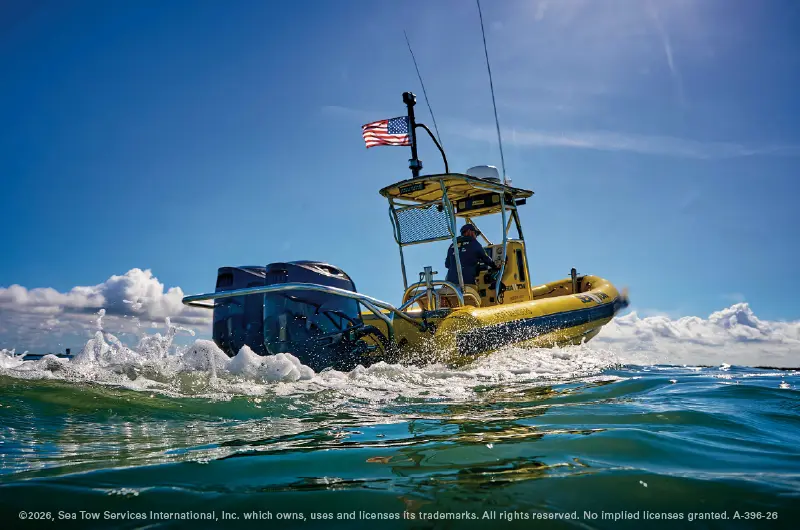
Outboard motors are self-contained modular units attached directly to the vessel’s transom. The entire assembly—comprising the powerhead (engine block), driveshaft housing, gearbox, and propeller—pivots as a single unit to provide both thrust and steering vectoring.
- Mechanical Pathway: Combustion occurs in the powerhead situated above the waterline. Power is transmitted vertically down a driveshaft through a transmission/gearcase in the lower unit, turning the propeller shaft and driving the blades to push water backward.
- Serviceability Advantages: Because the entire mechanical assembly hangs outside the hull, access for routine maintenance, servicing, and total replacement is exceptionally straightforward. If a powerhead fails catastrophically, the motor can often be unbolted and swapped entirely.
Inboard Engines
Inboard engines are permanently mounted within the vessel’s hull, typically near the center of gravity to optimize balance and handling.
- Mechanical Pathway: Unlike the vertical power transfer of outboards, inboards transfer power horizontally. The engine connects to a rigid transmission, which steps down gear ratios and couples to a driveshaft. This shaft exits the hull through a watertight shaft seal and packing box, spinning a submerged propeller positioned directly beneath the hull. Steering is managed independently via an external rudder.
- Operational Characteristics: Inboards are the undisputed standard for large cruisers, sportfishing yachts, and specialized towboats. They deliver massive low-end torque, handle severe offshore sea states with exceptional stability, and maintain a protected underwater profile. However, their enclosed nature requires rigorous pre-start ventilation protocols to purge potential fuel vapors from the bilge, and mechanical access can be tight and physically demanding.
The Lifeline of Marine Engineering: Cooling Systems
The single greatest point of architectural divergence between automotive and marine engineering lies in thermal regulation. While cars rely on closed-loop radiator systems cooled by ambient air passing through a grille, marine engines exist in an ocean of infinite coolant, yet face unique thermal vulnerabilities.
Raw-Water vs. Closed Cooling Systems
- Raw-Water Cooling: Many smaller outboards and older marine engines utilize raw-water cooling, drawing water directly from the surrounding body of water via an impeller pump, circulating it through the engine block’s cooling jackets, and expelling it out the exhaust. While remarkably efficient, this exposes internal engine passages directly to silt, sand, marine growth, and corrosive saltwater.
- Closed-Loop (Heat Exchanger) Cooling: Modern high-performance inboards and larger outboards utilize a freshwater closed-loop system akin to an automobile, where a water-glycol mixture circulates through the engine. This internal fluid passes through a heat exchanger, where ambient raw water absorbs and carries away the excess heat before being discharged overboard. This isolates corrosive elements from delicate engine blocks.
The Mechanics of Overheating
When marine cooling systems fail, catastrophic damage can occur within minutes. Primary failure points include:
- Impeller Degradation: Flexible rubber impellers wear out, shed vanes, or burn up if run dry even momentarily.
- Raw-Water Intake Blockage: Plastic bags, jellyfish, silt, or marine barnacles can occlude hull strainers or through-hull fittings.
- Thermostat Failure: Corroded thermostats stick closed, trapping coolant inside the block.
Why Marine Engines Fail on the Water
Despite meticulous engineering, marine environments are unforgiving, and mechanical failures remain a leading cause of on-water distress calls. Understanding the root causes allows mariners to implement preventative strategies.
Common Failure Vectors
- Fuel Starvation and Contamination: Ethanol-blended fuels attract moisture, leading to phase separation, varnish buildup in carburetors, and clogged fuel injectors. Furthermore, sediment stirred up in rough seas can instantly choke primary fuel filters.
- Electrical System Corrosion: Saltwater is an exceptional electrolyte. Unprotected wiring connections, oxidized battery terminals, and failing starter solenoids frequently succumb to galvanic corrosion.
- Lubrication Breakdown: Dilution of engine oil by unburned fuel (often caused by excessive idling or cold running) degrades lubricating films, accelerating bearing and cylinder wall wear.
- Ignition and Sensor Faults: Modern computerized engines rely heavily on delicate sensors (Crankshaft Position, Knock, MAP sensors). A single compromised sensor harness can trigger "limp mode" or completely shut down the powerplant.
The Escalation of Offshore Risk
When a mechanical failure occurs within sight of the dock, it is an inconvenience; when it happens offshore, it represents a severe safety crisis. Offshore operations exponentially increase engine strain due to:
- Pitch and Roll Dynamics: Vessel movement continuously shifts fluid levels in oil pans and fuel tanks, occasionally starving oil pickups or ingesting sludge.
- Thermal Shock: Cold ocean spray hitting a hot exhaust manifold or engine block causes rapid metallurgical contraction.
- Constant Load Fluctuations: As a vessel climbs and descends steep ocean swells, the propeller alternately bites deep into solid water and breaks the surface, causing massive, instantaneous RPM spikes followed by sudden, heavy drag loads.
Comprehensive Maintenance Protocols for Engine Longevity
Proactive maintenance is the absolute bedrock of reliable marine operation. Skimping on service intervals is a false economy that invariably results in costly towing bills and compromised safety.
Essential Preventative Maintenance Checklist
- Routine Oil and Filter Changes: Change engine oil and filters at manufacturer-specified intervals—typically every 100 hours of operation or at least once per season—to remove acidic combustion byproducts and abrasive particulate matter.
- Cooling System Inspection: Replace raw-water impellers annually. Inspect heat exchangers, flush internal passages, and verify sacrificial zinc anodes are replaced before galvanic corrosion attacks critical housing components.
- Fuel System Management: Utilize marine-grade fuel stabilizers, install water-separating fuel filters, and inspect fuel lines for cracking, softening, or permeability.
- Battery and Electrical Maintenance: Keep battery terminals clean, tight, and coated with protective dielectric grease. Ensure batteries are secured firmly in ventilated boxes to withstand pounding seas.
- Seasonal Preservation (Winterization and Spring Commissioning): Proper winterization—including fogging cylinders, draining raw-water systems, and adding antifreeze—prevents freeze-fracturing and internal oxidation during the off-season. Conversely, a thorough spring shakedown cruise validates that all systems operate correctly before venturing far from port.
Professional Perspectives and Operational Readiness
Industry professionals emphasize that mechanical comprehension must be paired with operational prudence. While troubleshooting skills allow a skipper to clear a clogged fuel filter or replace a blown fuse in calm waters, mechanical knowledge can never fully substitute for external support when conditions deteriorate.
Official Statements and Industry Insights
"The marine environment is completely unforgiving of deferred maintenance," notes leading maritime safety analysts. "A car engine that stalls simply rolls to the shoulder of a highway. A marine engine that fails offshore leaves the vessel entirely at the mercy of wind, tide, and breaking seas. Knowing your engine’s limits is as important as knowing its horsepower."
Emergency response organizations echo this sentiment, stressing that the transition from a mechanical hiccup to a life-threatening maritime emergency often happens with terrifying speed.
"When propulsion is lost in heavy weather, the priority shifts instantly from engineering troubleshooting to vessel stabilization and crew safety," maritime rescue coordinators advise. "Skippers must recognize when an issue exceeds their ability to repair on-site. Establishing a reliable backup plan—such as an active, professional on-water towing membership—ensures that assistance is deployed before a challenging situation becomes a disaster."
Future Outlook: The Next Generation of Marine Propulsion
As the marine industry looks toward the horizon, engine technology is undergoing a profound transformation driven by environmental regulations, efficiency demands, and digital innovation.
- Hybrid and Electric Propulsion: Quiet, zero-emission electric and hybrid marine drives are rapidly moving from niche applications to mainstream adoption, particularly in inland waterways, sensitive ecosystems, and docking-assist systems.
- Advanced Telematics and Predictive Diagnostics: Next-generation marine powerplants feature cloud-connected telematics that stream real-time engine health data directly to manufacturers and owners. Predictive algorithms can flag failing fuel pumps, abnormal exhaust temperatures, or declining compression ratios long before the operator notices a physical symptom.
- Alternative Fuels: Development in hydrotreated vegetable oil (HVO), hydrogen combustion, and advanced synthetic fuels promise to drastically reduce the carbon footprint of heavy commercial and recreational marine transport without sacrificing the raw, sustained torque required for offshore cruising.
Ultimately, while the materials and digital interfaces of marine engines will continue to evolve, the fundamental physics of combustion, hydrodynamic load, and thermal management will remain unchanged. For the modern mariner, mastering the mechanics of marine propulsion—and respecting the limits of machinery on the water—will always be the defining hallmark of a safe and confident skipper.