











Executive Overview
When a fatal collision occurs on an American roadway, the immediate public and media response almost invariably focuses on individual culpability. Investigators, journalists, and onlookers dissect the minutiae of human error: What was the driver doing? Was the pedestrian distracted? Did the cyclist run a light? Who made the fatal mistake?
For decades, this laser-like focus on individual behavior has obscured a much larger, systemic reality. Urban planning advocates, transportation safety researchers, and progressive municipal leaders are increasingly arguing that a fatal traffic crash is rarely just an isolated human error; rather, it is a profound failure of the surface transport system itself. More crucially, it is a failure that is often entirely predictable.
In other high-risk industries, such as commercial aviation or rail transit, a catastrophic failure triggers a rigorous, standardized investigative protocol designed to uncover systemic flaws, rewrite safety manuals, and overhaul engineering practices. When a plane crashes, the industry does not simply clean up the runway, study the wreckage, and resume normal flights the next day. Yet, for decades, this has been the standard operating procedure for our streets. We clear the intersection, restore the asphalt, conduct a traffic study, and return the hazardous environment to "normal," waiting idly for the next tragedy to occur.
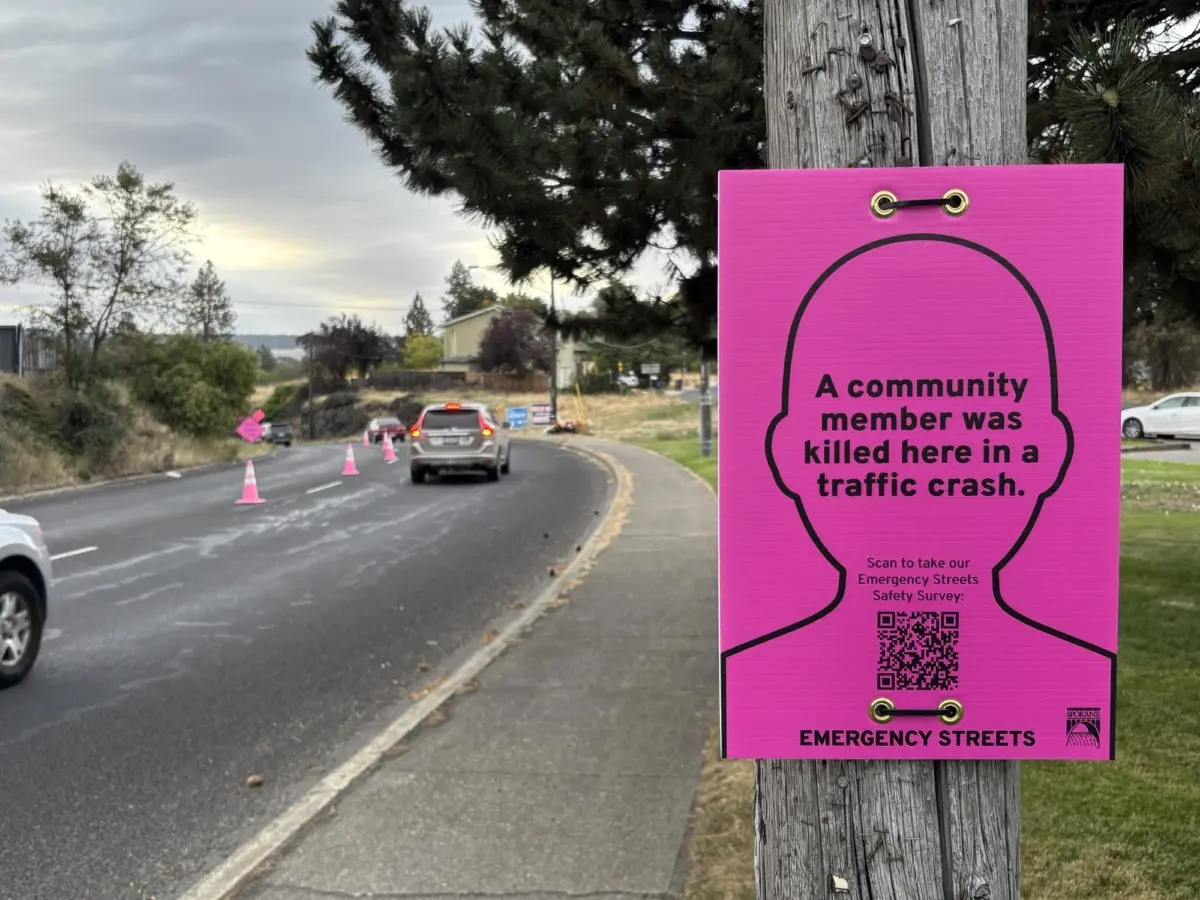
Enter Emergency Streets—a paradigm-shifting initiative designed to interrupt this cycle of institutional complacency. Conceptualized by urban transport researchers and recently brought into real-world municipal practice in Spokane, Washington, the Emergency Streets protocol proposes a radical intervention: following a fatal crash, the city temporarily alters the streetscape to meaningfully reduce kinetic energy. It replaces passive analysis with active, highly visible intervention, treating the tragedy not as a closed case, but as a diagnostic catalyst for systemic reform.
The underlying premise of Emergency Streets is that municipalities already possess the knowledge needed to save lives. Urban planners understand the direct, exponential relationship between vehicle speed and crash severity. They know that local accessibility does not require maximizing vehicle velocity, and that modern multi-modal tools—from e-bikes to micro-mobility devices and altered traffic patterns—can provide efficient movement without sacrificing human life.
By refusing to immediately return a fatal-crash site to its previous condition, Emergency Streets aims to disrupt the institutional routines, legal habits, and design assumptions that quietly reproduce unsafe street conditions across America. The orange cones and temporary treatments eventually disappear, but the structural lessons, policy shifts, and altered public expectations left in their wake may fundamentally transform how cities design their transportation networks.
Detailed Chronology: From Academic Theory to Municipal Reality
The journey of Emergency Streets from an abstract theoretical proposition to an active municipal protocol illustrates the growing frustration urban centers face regarding persistent traffic fatalities. For years, the framework existed primarily in academic circles and transit advocacy forums as a thought experiment: What if a fatal crash became a legal and procedural mandate not to return a street to normal?
The Institutional Status Quo
To understand the significance of the shift, one must examine how American street design became so inherently lethal. Over the past century, transport planning in the United States has institutionalized speed and vehicle throughput as core design metrics. These priorities are baked into the physical DNA of our cities through:
- Overly generous turning radii that encourage fast vehicle sweeps;
- Excessive lane widths and multiple travel lanes that invite speeding;
- Compromised sight distances optimized for cars rather than human eyes;
- Signal timings that prioritize continuous vehicular progression;
- Slip lanes that blind drivers to crossing pedestrians;
- Inadequate pedestrian crossing windows;
- Automobile Level of Service (LoS) metrics that treat human delay as the ultimate design failure.
No single one of these practices created our modern safety crisis. Collectively, however, they have engineered a system that treats pedestrian and cyclist injuries as the acceptable collateral damage of fast-moving vehicular traffic. When the system fails and a life is lost, the institutional response is designed to insulate the status quo. Traffic engineers study the site, log the statistics, and occasionally tweak a signal phase, leaving the underlying high-speed geometry intact.
The Spokane Pilot: Breaking the Mold
Spokane, Washington, became the crucible that tested whether this academic critique could be translated into actual municipal governance. Facing mounting concerns over roadway fatalities, the city officially adopted an Emergency Streets pilot protocol, moving beyond theoretical debate into operational reality following a fatal motorcycle crash.
The implementation of Spokane’s first intervention marked a watershed moment in American municipal traffic engineering. The significance of the deployment extended far beyond the physical presence of temporary cones, jersey barriers, or striping. Instead, Spokane established a binding institutional response: the occurrence of a qualifying fatal crash legally and operationally triggers the immediate development and deployment of a temporary traffic-management plan.
This swift activation serves several distinct psychological and procedural purposes:
- Bypassing Paralysis: It circumvents the notoriously slow, risk-averse habits of traditional traffic engineering departments, which are often prone to endless study loops and over-engineering.
- Providing Political Cover: It grants local decision-makers and elected officials the necessary administrative cover to withstand public pressure and pushback when implementing uncomfortable or controversial street changes.
- Tying Error to Correction: By deploying interventions swiftly, the city maintains a direct temporal and conceptual link between the traffic violence and the immediate corrective action.
- Habit Modification: It forces drivers to navigate a altered, slower environment for a non-trivial yet non-disruptive period, allowing human behavior to adapt to safer speeds.
Once the temporary treatment period concludes, the municipality faces a mandatory fork in the road: it must formally decide whether to extend the intervention, revert the street to its dangerous baseline, or transition toward permanent, capital-intensive infrastructure changes.
Supporting Context & Metrics: Evaluating the Impact
Measuring the success of an initiative as multifaceted as Emergency Streets requires looking far beyond simple traffic counts. Researchers and municipal evaluators assess the impact across three distinct, interconnected dimensions: Physical & Behavioral Change, Institutional Change, and Public Expectations.
+--------------------------------------------------------------------------+
                      EMERGENCY STREETS EVALUATION FRAMEWORK
+------------------------------------+-------------------------------------+
| DIMENSION                          | KEY METRICS & INDICATORS            |
+------------------------------------+-------------------------------------+
| 1. Physical & Behavioral Change    | - Vehicle speed reductions          |
|    (Kinetic Energy Mitigation)     | - Decreases in hard-braking         |
|                                    | - Changes in driver compliance      |
|                                    | - GIS/mobility data tracking        |
+------------------------------------+-------------------------------------+
| 2. Institutional Change            | - Shifting professional standards   |
|    (Organizational Culture)        | - Inter-agency collaboration        |
|                                    | - Altered capital funding flows     |
|                                    | - Permanent design standard updates |
+------------------------------------+-------------------------------------+
| 3. Public Expectations             | - Redefining street purpose         |
|    (Community Discourse)           | - Acceptance of safety-first models |
|                                    | - Public demand for accessibility   |
+------------------------------------+-------------------------------------+
1. Physical and Behavioral Change (Kinetic Energy)
The most immediate and tangible metrics are tied directly to physics. Because kinetic energy scales exponentially with speed ($KE = frac12mv^2$), even marginal reductions in vehicle velocity yield dramatic drops in survivability for pedestrians and cyclists struck by cars.
- Speed Observations: Did average and 85th-percentile speeds decline through the intervention zone?
- Deceleration Patterns: Were instances of aggressive acceleration and hard-braking reduced?
- Spatial Behavior: How did drivers, cyclists, and pedestrians interact within the modified right-of-way?
Utilizing advanced GIS mapping, speed-board telemetry, and aggregate mobility data, evaluators can paint a precise picture of how physical street alterations successfully bleed kinetic energy out of a known danger zone.
2. Institutional Change and the "Institutional Trace"
Perhaps the most ambitious goal of Emergency Streets is transforming how municipal governments think and operate. An institutional trace is the evidence that the spirit, data, and methodology of the Emergency Streets intervention persist long after the temporary physical barriers are cleared away.
This trace rarely manifests as an immediate, sweeping bureaucratic overhaul. Instead, it appears in subtle yet profound ways:
- Shifted professional understandings among traffic engineers and city planners regarding what constitutes "safe" geometry.
- Altered organizational routines that break down silos between public health departments, transit agencies, and departments of transportation.
- New inter-departmental relationships that challenge the traditional dominance of automobile-first engineering standards.
- Long-term modifications to municipal approval processes, capital improvement budgeting, and the criteria used to allocate transportation funding.
Crucially, evaluators do not assume that institutional success must always result in permanent physical infrastructure at that exact crash site. Even a "null" or uneven physical outcome provides invaluable data, illuminating the legal, procedural, or bureaucratic bottlenecks that prevent rapid-response safety measures from influencing long-term capital planning.
3. Public Expectations and Cultural Shift
Streets are public spaces, and their safety relies heavily on social norms and community expectations. Emergency Streets actively engages the public by transforming a tragedy into a community-wide conversation: What is a street actually for? What level of traffic violence is acceptable in a civilized society?
When cities transparently explain why a street is being temporarily altered in the wake of a fatality, it educates residents on the systemic nature of road safety. Over time, this shifts public discourse away from victim-blaming and toward an expectation that municipal governments will proactively design streets to protect human life.
Official Statements and Expert Perspectives
The rollout of the Spokane pilot and the broader theoretical framework of Emergency Streets have drawn commentary from urban planners, public health officials, and municipal administrators nationwide.
Dr. Elena Vance, a leading urban mobility researcher who helped conceptualize the framework, emphasized that the initiative is fundamentally about breaking historical inertia.
"For a century, our default response to a fatal traffic collision has been collective amnesia," Dr. Vance noted in a recent urban planning symposium. "We mourn, we investigate the driver, we fix the guardrail, and we invite the exact same high-speed danger back onto the asphalt. Emergency Streets forces the system to pause. It creates an institutional speed bump, giving cities a fleeting window to ask what the crash reveals about our broader design failures before normal routines swallow the tragedy whole."
Spokane municipal leaders involved in the pilot deployment highlighted the political utility of the protocol in navigating community resistance to traffic-calming measures.
"When you propose traffic calming during a routine planning meeting, you face months of public pushback from motorists worried about a two-minute delay," explained a senior Spokane transportation planner speaking on condition of anonymity. "When you deploy an emergency intervention directly tied to a fatal incident, you change the conversation. You are no longer talking about hypothetical convenience; you are talking about immediate, life-saving accountability. It gives leaders the backing to take bold action."
Safety advocates have similarly praised the initiative for shifting accountability upward from the individual road user to the systemic level.
"Road deaths are not inevitable accidents; they are design choices," said Marcus Sterling, executive director of the National Safe Streets Coalition. "When a city adopts a protocol like Emergency Streets, it stops treating traffic fatalities as weather events—acts of God that we simply must endure. It acknowledges that municipal engineers hold the power to shape human behavior through physical design, and it demands responsibility when those designs fail."
Future Outlook: What Remains After the Cones Are Gone?
The true measure of Emergency Streets will not be found in the temporary orange cones, the short-term speed reductions recorded during a pilot week, or the initial media coverage of a municipal rollout. The cones, by design, are ephemeral. They are meant to be removed, reconfigured, or replaced.
The vital question facing cities adopting this protocol is simple: What remains after the cones are gone?
If an Emergency Streets deployment successfully alters professional practices, hardwires new inter-agency relationships, shifts public expectations around acceptable risk, and redirects capital investment toward human-centric street design, then the initiative has achieved something monumental. It will have leveraged a specific, localized tragedy as an opportunity for the transportation system to learn from its own flaws—and fundamentally change its trajectory.
As urbanization accelerates and cities worldwide grapple with climate goals, Vision Zero commitments, and the urgent need for equitable public space, traditional traffic engineering is no longer fit for purpose. Protocols like Emergency Streets offer a vital blueprint for the future: a way to pierce through bureaucratic inertia, confront the lethal geometry of our built environment, and ensure that every life lost on our roadways translates into lasting, systemic salvation for those who travel them next.


