




Executive Overview
A critical safety deficit exists at the intersection of American commerce and emergency response. Three years after a tragic shipboard fire at Port Newark claimed the lives of two veteran firefighters, a comprehensive investigation by the Government Accountability Office (GAO) warns that the United States remains profoundly underprepared to manage major shipboard fires. The federal watchdog’s report, GAO-26-108533, exposes systemic vulnerabilities across the nation’s ports, characterized by fragmented command structures, severe training deficits, delayed emergency plans, and a rapidly evolving fleet of alternative-fuel vessels that current maritime regulations are entirely unequipped to handle.
Unlike typical structural emergencies on land, a shipboard fire represents a highly complex, multi-jurisdictional crisis. When a vessel catches fire at a U.S. port, authority and operational responsibilities are instantly fractured. The U.S. Coast Guard is tasked with coordinating the federal response, yet they do not physically fight the fires. That dangerous duty falls squarely upon local municipal fire departments. These land-based firefighters are frequently forced to board unfamiliar vessels, navigate labyrinthine steel layouts, and confront hazardous cargo without adequate shipboard experience, specialized equipment, or coordinated tactical plans.
Compounding these structural challenges is an alarming regulatory lag. As the global shipping industry pivots toward green energy—deploying battery-powered ships and alternative-fuel vessels—the safety frameworks designed to mitigate maritime disasters remain anchored in the past. With nearshore marine fires occurring at a rate of nearly ninety incidents per year, the GAO’s findings serve as an urgent warning for Congress, the Coast Guard, and port authorities nationwide.
                       U.S. PORT FIRE RESPONSE CHALLENGES

      +-----------------------------------------------------------------+
      |                      JURISDICTIONAL GAP                         |
      |                                                                 |
      |   U.S. COAST GUARD                     LOCAL FIRE DEPARTMENTS   |
      |   (Federal Coordinator)                (Physical Tactical Duty) |
      |   * Manages waterway safety            * Board unfamiliar hulls  |
      |   * Coordinates resources              * Confront confined spaces|
      |   * Lacks direct tactical duty         * Often lack marine drills|
      +-----------------------------------+-----------------------------+
                                          |
                                          v
      +-----------------------------------------------------------------+
      |                     OPERATIONAL BOTTLENECKS                     |
      |                                                                 |
      |   * Financial Hesitation ("Wait and See" on VRP Activation)     |
      |   * Limited Port Access for Hands-On Local Firefighter Training  |
      |   * Regulatory Gaps for Modern Lithium-Ion & Alternative Fuels  |
      +-----------------------------------------------------------------+
Detailed Chronology
The vulnerabilities detailed in the GAO report are not theoretical; they are written in the losses of recent maritime disasters. To understand the depth of the crisis, one must trace the timeline of operational failures, regulatory oversights, and the escalating frequency of nearshore incidents over the past decade.
A Decade of Nearshore Incidents (2015–2025)
Between 2015 and 2025, the U.S. Coast Guard recorded 886 nearshore marine fires across the United States. While many were contained before escalating into catastrophes, 206 of these incidents—nearly one-quarter of the total—resulted in severe outcomes, including loss of life, severe personal injury, total vessel loss, or direct property damage exceeding $200,000. This high rate of severe outcomes underscores a persistent truth: when a ship fire escapes initial containment, the mechanisms to control it frequently fail.
The Port Newark Tragedy (July 2023)
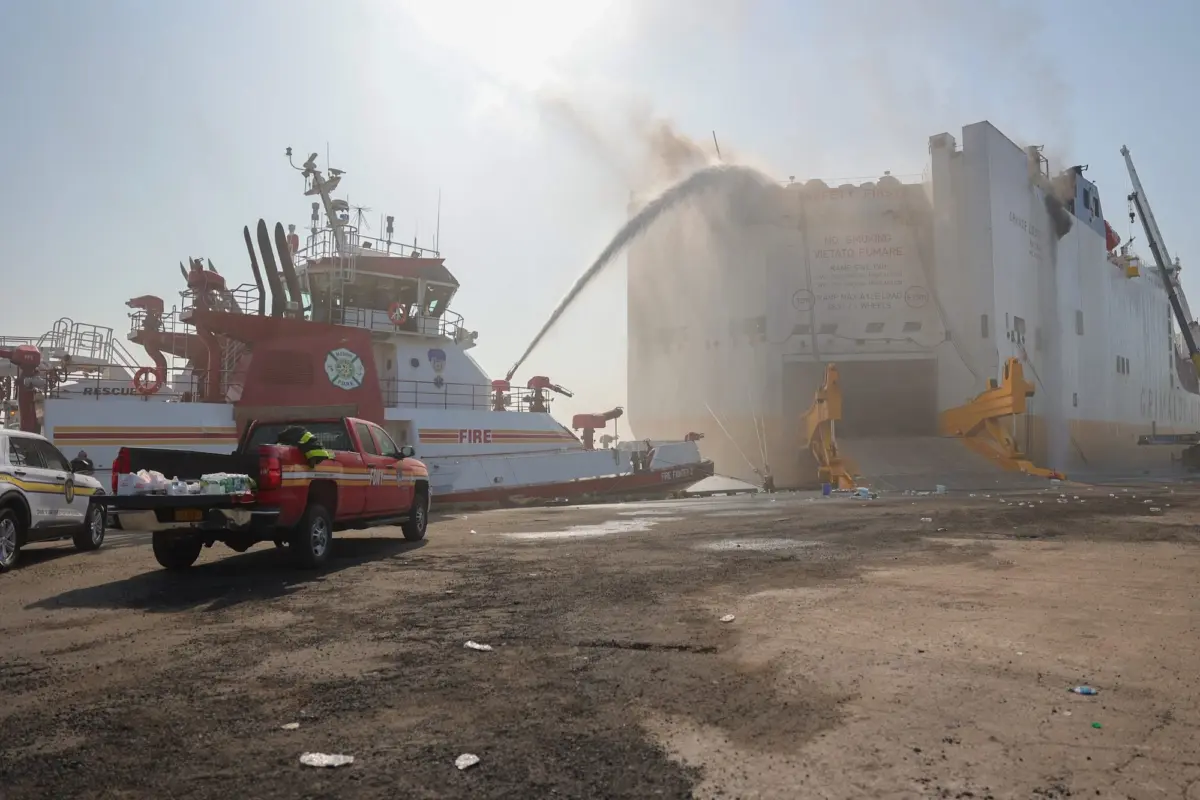
On the night of July 5, 2023, the Italian-flagged Grande Costa D’Avorio, a massive roll-on/roll-off (Ro-Ro) cargo ship carrying thousands of vehicles, caught fire while loading cargo at Port Newark, New Jersey.
Timeline of the Grande Costa D’Avorio Fire (July 2023)
[00:00] Fire Ignites on Upper Decks -> Local Fire Departments Dispatched
[+01:30] Land-Based Firefighters Board Vessel -> Extreme Smoke & Disorientation
[+02:00] Firefighters Augusto Acabou & Wayne Brooks Jr. Trapped/Killed
[+08:00] Vessel Response Plan (VRP) Officially Activated (8-Hour Delay)
[Day 5] Fire Finally Extinguished ($23 Million in Direct Damage)
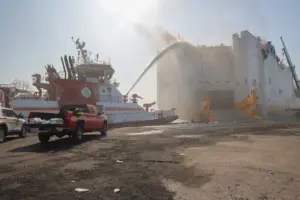
Local land-based firefighters responded immediately, boarding a vessel that was essentially a multi-story floating parking garage constructed of thick steel plates. Within minutes, responders became disoriented in the pitch-black, toxic smoke. The ship’s complex internal layout, combined with intense thermal feedback from burning vehicles, trapped several responders.
Newark firefighters Augusto Acabou and Wayne Brooks Jr. lost their lives, and several others suffered debilitating injuries. The fire raged for five days, requiring an extensive multi-agency effort to extinguish, and ultimately caused an estimated $23 million in damage.
The Dawn of the Alternative Fuel Crisis (2025)
The risks associated with modern vessel designs and new propulsion technologies became even more apparent in early 2025 with the disaster of the car carrier Morning Midas in the North Pacific. Carrying a massive cargo of vehicles, including electric models, the ship suffered an uncontrollable cargo fire.
The fire burned relentlessly for three weeks, defying all onboard suppression efforts and commercial salvage attempts. The vessel ultimately sank. The Morning Midas incident highlighted a dangerous reality: when lithium-ion batteries undergo thermal runaway at sea, traditional marine firefighting strategies are largely ineffective.
Supporting Context & Metrics
The GAO report relies on data that highlights the growing disconnect between the shipping industry’s rapid modernization and the stagnant capabilities of municipal emergency responders.
The Statistics of Severity
A closer examination of the 886 nearshore fires reported to the Coast Guard reveals that maritime fires are far more destructive than equivalent land-based structural fires:
| Metric | Figure | Percentage / Context |
|---|---|---|
| Total Nearshore Fires (2015–2025) | 886 | 100% |
| Severe Incidents | 206 | 23.2% (Resulted in death, injury, >$200k damage, or total loss) |
| Average Annual Nearshore Fires | ~88 | Occurring across major U.S. shipping hubs |
| Grande Costa D’Avorio Direct Damage | $23,000,000 | Excluding long-term port disruption costs |
The high severity rate of these fires is directly tied to the unique physics of shipboard incidents. Steel decks conduct heat rapidly, spreading fires vertically and horizontally. Dense smoke accumulates quickly in unventilated holds, and the application of water to extinguish a fire risks destabilizing the vessel, threatening to capsize the ship and block critical shipping channels.
                  THE SPREADING THREAT OF SHIPBOARD FIRES

        [Steel Decks]       --> Conduct heat vertically and horizontally.
        [Confined Holds]    --> Accumulate toxic, pitch-black smoke.
        [Water Application] --> Risks destabilizing and capsizing the vessel.
The "Wait and See" Financial Dilemma
One of the most damning findings of the GAO report is the systemic delay in activating Vessel Response Plans (VRPs). Under federal law, commercial vessels must maintain VRPs that contractually secure the services of commercial Salvage and Marine Firefighting (SMFF) providers.
However, shipowners and operators frequently hesitate to activate these plans. The GAO identified a pervasive "wait and see" attitude driven by financial concerns. Mobilizing specialized commercial salvage tugs, high-capacity foam systems, and marine firefighting specialists is incredibly expensive.
Hoping to resolve the fire using onboard crew or free municipal services, vessel operators delay VRP activation. In the case of the Grande Costa D’Avorio, the VRP was not activated until eight hours after the fire broke out, long after municipal firefighters had boarded the vessel and suffered casualties. The Coast Guard’s investigation concluded that earlier activation could have contained the fire much sooner, potentially saving lives and saving millions of dollars in property damage.
The Exponential Rise of Battery Propulsion
The transition to green energy in the maritime sector is accelerating at a pace that has outstripped federal safety regulations. The GAO highlighted the explosive growth of battery-powered vessels worldwide:
            GROWTH OF BATTERY-POWERED VESSELS (GLOBAL FLEET)

  2017 [142 Ships]
  2024 [1,006 Ships]   =======> (608% Increase)
  2027 [2,590 Ships]   =======> (Projected, including 1,584 on order)
Lithium-ion batteries present unique challenges for marine safety. When these batteries suffer physical damage, manufacturing defects, or electrical overcharging, they can enter thermal runaway—a rapid, self-sustaining chemical reaction that generates extreme temperatures, releases highly toxic gases (including hydrogen fluoride), and produces fires that cannot be extinguished by starving them of oxygen.
Current shipboard fire suppression systems, designed for oil or wood fires, are often ineffective against battery fires, which require massive amounts of water applied directly to the battery casing over hours or even days.
Official Statements & Agency Responses
The release of the GAO report has drawn sharp reactions from federal oversight bodies, local emergency services, and maritime safety organizations.
The Training Disconnect
A core focus of the GAO’s investigation was the severe lack of preparation among the first responders expected to board burning vessels. The Coast Guard’s investigation into the Grande Costa D’Avorio tragedy revealed that the last shipboard firefighting training exercise offered to the responding Newark firefighters had occurred nine years prior to the accident. Out of the dozens of firefighters who rushed to the scene that night, only one had attended that training.
The GAO interviewed Coast Guard officials across six key operational sectors, who unanimously agreed that local firefighters desperately need hands-on, realistic training, including physical vessel tours and joint drills. However, fire chiefs explained that arranging these exercises is incredibly difficult:
"We face a brick wall when trying to arrange training on commercial vessels. These ships operate on razor-thin margins and tight port schedules. They have limited time in port, and we cannot legally board a foreign-flagged vessel for training without the express, voluntary approval of the shipowner—approval that is rarely granted due to liability and schedule concerns."
— U.S. Port City Fire Chief (quoted anonymously in GAO findings)
The GAO’s Five Recommendations to the Coast Guard
To address these systemic vulnerabilities, the GAO issued five distinct recommendations to the U.S. Coast Guard, aimed at improving operational coordination and training:
- Designate Specialized Field Personnel: Assign specific marine firefighting coordination duties to designated personnel within each Coast Guard sector to serve as direct liaisons with local fire departments.
- Facilitate Local Firefighter Training: Create a standardized program to work with port authorities and vessel owners to arrange physical vessel tours and realistic shipboard drills for municipal firefighters.
- Establish a Lesson-Sharing System: Build a centralized, national database to compile, analyze, and share lessons learned and best practices from past maritime fire incidents.
- Clarify VRP Activation Timelines: Issue explicit, binding guidance on exactly when vessel operators must activate their Vessel Response Plans, removing the ambiguity that leads to costly delays.
- Expand Tank Vessel Regulations: Issue new regulations requiring tank vessels to prepare comprehensive response plans covering worst-case hazardous-substance discharges, rather than just oil spills.
Department of Homeland Security Response
The Department of Homeland Security (DHS), which oversees the U.S. Coast Guard, formally responded to the watchdog’s report, stating that it concurred with all five recommendations. The Coast Guard has committed to developing actionable implementation plans to address these gaps, though officials noted that systemic changes will require sustained funding and cooperation from private industry stakeholders.
Future Outlook
The findings of the GAO report highlight a clear reality: the safety frameworks protecting American ports are lagging behind the scale and complexity of modern maritime commerce. Addressing these challenges requires structural reforms in both emergency operations and federal legislation.
                  A DUAL PATH FORWARD FOR PORT SAFETY

         LEGISLATIVE REFORMS             OPERATIONAL REFORMS
      +------------------------+      +------------------------+
      | Amend Federal Law      |      | Standardize Hands-On   |
      | * Mandate VRPs for     |      |   Shipboard Drills     |
      |   Alternative-Fuel     |      |                        |
      |   Nontank Vessels      |      | Create National        |
      |                        |      |   Knowledge-Sharing    |
      | Regulate Tankers for   |      |   Database             |
      |   Hazardous-Substance  |      |                        |
      |   Worst-Case Scenarios |      | Enforce Strict VRP     |
      |                        |      |   Activation Windows   |
      +------------------------+      +------------------------+
Legislative Reform and the Alternative-Fuel Gap
Perhaps the most critical challenge is the legislative gap surrounding alternative-fuel vessels. Under current federal law, the Coast Guard’s authority to mandate Vessel Response Plans is tied to legacy definitions of cargo and vessel types.
Specifically, current statutes limit the Coast Guard’s ability to require nontank vessels using alternative fuels—including battery-powered passenger ferries, hybrid tugs, and LNG-fueled container ships—to maintain comprehensive response plans covering hazardous-substance emergencies.
These laws were drafted decades ago, long before lithium-ion batteries and alternative chemical propulsion systems became viable. To close this loophole, the GAO has formally recommended that Congress amend federal maritime law, giving the Coast Guard the statutory authority to mandate worst-case hazardous-substance discharge plans for all modern, alternative-fuel vessels.
The Role of the National Task Force
In January 2024, partly in response to the Port Newark disaster, the Coast Guard established the National Salvage and Marine Firefighting Task Force. While the task force has made progress by developing online training modules and digital informational tools, the GAO pointed out that as of September, the group had still not developed any concrete guidance or framework for a hands-on, practical exercise program.
Online training is a useful tool, but it cannot replace the physical experience of navigating a dark, smoke-filled steel companionway or managing the complex weight distribution challenges of a listing ship.
Conclusion
As U.S. ports handle larger volumes of cargo and welcome increasingly complex, alternative-fuel vessels, the safety of both the surrounding communities and the emergency responders depends on a coordinated, well-trained response system.
The GAO’s report shows that the current system relies too heavily on luck and the courage of local firefighters. Without clear federal mandates for hands-on training, strict timelines for activating emergency plans, and updated laws to address alternative-fuel risks, the nation’s ports remain vulnerable to the next major maritime disaster.