











Executive Overview
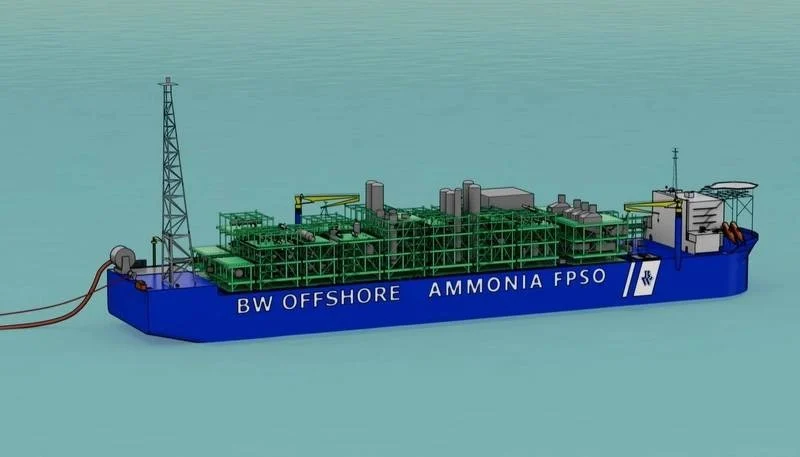
In a significant advancement for the global energy transition, marine infrastructure specialist BW Offshore and engineering giant McDermott have secured Approval in Principle (AiP) from the classification society DNV for their joint blue ammonia Floating Production, Storage, and Offloading (FPSO) concept. This regulatory milestone validates the technical feasibility of producing low-carbon ammonia directly at offshore gas fields, bypassing the traditional onshore bottlenecks of land acquisition, complex permitting, and extensive pipeline infrastructure.
The innovative FPSO concept is designed to process up to 3 million cubic meters of natural gas per day, converting it into more than 1 million tonnes of low-carbon "blue" ammonia annually. By integrating advanced carbon capture and storage (CCS) technologies directly into the offshore production flow, the vessel is engineered to capture and compress up to 99% of the carbon dioxide ($CO_2$) generated during the synthesis process. The captured $CO_2$ can then be reinjected into depleted offshore reservoirs for permanent geological sequestration, resulting in an exceptionally low carbon footprint of approximately 0.5 tonnes of $CO_2$ per tonne of ammonia produced.
As the maritime shipping industry and global power generation sectors face intensifying pressure to decarbonize, the BW Offshore-McDermott concept offers a scalable, decentralized solution to unlock "stranded" or infrastructure-constrained offshore gas reserves. This concept transforms these underutilized assets into highly transportable, low-carbon fuels destined for international markets.

Detailed Chronology
[February] Concept Unveiled -> [Engineering & Risk Assessment] -> [DNV Evaluation] -> [Approval in Principle (AiP) Granted] -> [Future: FEED & Commercialization]The development of the blue ammonia FPSO has progressed rapidly through a series of key milestones:
February: The Concept Unveiled
BW Offshore and McDermott first introduced their joint blue ammonia FPSO design to the public. The partnership combined BW Offshore’s extensive experience in managing and operating floating production systems with McDermott’s deep expertise in engineering, procurement, construction, and installation (EPCI), particularly in onshore ammonia synthesis and complex gas processing.
Spring–Summer: Engineering & Risk Assessment
Following the initial unveiling, engineering teams from both companies engaged in rigorous design optimization. The primary challenge lay in adapting complex chemical synthesis processes—traditionally reserved for massive, stable onshore industrial complexes—to fit within the confined, dynamic marine environment of an FPSO hull and deck. This phase focused on deck layout optimization, weight distribution, marine motion analysis, and hazardous area classification.
Late Summer: DNV Evaluation
The finalized conceptual design was submitted to DNV for independent, risk-based assessment. DNV’s evaluation scrutinized the integration of the steam methane reforming (SMR) or autothermal reforming (ATR) units, the Haber-Bosch synthesis loop, the carbon capture and compression systems, and the refrigerated ammonia storage tanks within the vessel’s hull. Safety systems, gas dispersion models, and emergency shutdown protocols were analyzed to ensure compliance with stringent offshore maritime codes.

Current Milestone: Approval in Principle (AiP) Granted
DNV officially granted the Approval in Principle. This milestone serves as an independent validation that the design is fundamentally sound, poses no unmanageable regulatory or safety risks, and is ready to proceed to the next stages of engineering, including Front-End Engineering Design (FEED) and eventual classification.
Supporting Context & Metrics
To appreciate the disruptive potential of the blue ammonia FPSO, it is essential to analyze the underlying chemical processes, the engineering constraints of floating facilities, and the macroeconomic drivers of the low-carbon transition.
The Blue Ammonia Value Chain
Ammonia ($NH_3$) is highly valued not only as a critical precursor for fertilizers but also as an efficient hydrogen carrier and a zero-carbon fuel in its own right. Because ammonia contains no carbon atoms, burning it produces only nitrogen and water.
However, conventional "grey" ammonia production is highly carbon-intensive, relying on natural gas steam reforming without carbon abatement, which emits roughly 1.8 to 2.6 tonnes of $CO_2$ for every tonne of ammonia produced.
[Offshore Natural Gas]
       │
       ▼
[Reforming (ATR/SMR)] ───► [Hydrogen (H2)] + [CO2 (99% Captured & Sequestered)]
                                 │
                                 ▼
                         [Haber-Bosch Loop] ◄─── [Nitrogen (N2) from Air]
                                 │
                                 ▼
                         [Blue Ammonia (NH3)]
"Blue" ammonia decouples this production from high emissions by capturing the process $CO_2$. The BW Offshore and McDermott design achieves this by integrating a high-efficiency carbon capture unit directly downstream of the gas reforming stage.
| Metric | Value |
|---|---|
| Natural Gas Processing Capacity | Up to 3,000,000 $m^3$ / day |
| Annual Blue Ammonia Output | > 1,000,000 tonnes / year |
| Carbon Capture Efficiency | Up to 99% of process $CO_2$ captured |
| Estimated Carbon Intensity | ~0.5 tonnes $CO_2$ per tonne of $NH_3$ |
| Storage Technology | Refrigerated tanks in the FPSO hull |
| Export Method | Direct offloading to refrigerated LPG/ammonia carriers |
Overcoming the Onshore Bottleneck
Traditional onshore blue ammonia projects often face severe development bottlenecks, including:
- Permitting and Land Acquisition: Securing coastal land for chemical plants and export terminals can take years and draw intense local opposition.
- Pipeline Infrastructure: Transporting natural gas to the plant, and captured $CO_2$ from the plant to a geological storage site, requires hundreds of miles of pipelines, compounding environmental and financial hurdles.
- Geological Sequestration Proximity: Onshore plants are rarely located directly above ideal $CO_2$ storage reservoirs, requiring complex cross-border or interstate transport networks.
The offshore FPSO concept bypasses these challenges entirely. By locating the production facility directly above or adjacent to an offshore gas field and a suitable geological sequestration site, the entire value chain is localized.
The natural gas goes straight from the wellhead to the FPSO; the synthesized ammonia is stored in the hull and offloaded directly to gas carriers; and the captured $CO_2$ is piped directly down into the seabed for permanent storage.
+-------------------------------------------------------------+
|                     Blue Ammonia FPSO                       |
|                                                             |
|  +------------------+  +------------------+  +-----------+  |
|  |  Gas Reforming   |  |   Carbon Capture |  | Ammonia   |  |
|  |  & H2 Production |  |   & Compression  |  | Synthesis |  |
|  +--------+---------+  +--------+---------+  +-----+-----+  |
|           |                     |                  |        |
+-----------|---------------------|------------------|--------+
            ▲                     ▼                  ▼
    [Offshore Well]        [Subsea Reservoir]   [Gas Carrier]
    (Gas Extraction)        (CO2 Storage)        (Export)
Engineering Challenges of Floating Synthesis
While conceptually elegant, moving a chemical synthesis plant to a floating vessel presents significant engineering hurdles:
- Marine Motion and Liquid Sloshing: Traditional chemical distillation and separation columns rely on gravity and vertical alignment. On an FPSO, wave-induced roll, pitch, and heave can disrupt the internal fluid dynamics of reforming and synthesis columns. McDermott’s engineering contribution includes utilizing motion-insensitive column internals and packing designs to maintain process efficiency in rough seas.
- Space and Weight Constraints: Onshore plants spread across dozens of acres. On an FPSO, the footprint is limited to a deck roughly 300 meters long and 50 meters wide. This requires extreme process intensification, compact heat exchangers, and modular construction.
- Ammonia Toxicity and Safety: Ammonia is a highly toxic gas at ambient conditions. Managing potential leaks on a crowded offshore vessel requires sophisticated safety systems, including automated water-deluge systems for vapor absorption, advanced gas detection arrays, and specialized evacuation protocols.
Official Statements
The granting of the AiP has been met with strong optimism from the leadership of the participating organizations, highlighting the strategic alignment of the project with broader global decarbonization objectives.
In a joint statement, BW Offshore emphasized the strategic necessity of the project:
"This marks an important milestone in the development of our floating low-carbon ammonia solution and supports our ambition to become a leading provider of offshore low-carbon energy production solutions. Demand for low-carbon fuels is increasing, driven by decarbonization efforts in sectors such as shipping and power generation.
Offshore blue ammonia production can help meet this demand by pairing infrastructure-constrained gas resources with efficient production and export logistics, creating a secure and competitive long-term ammonia supply while unlocking value from offshore gas resources."
Industry analysts point out that for BW Offshore, this move represents a calculated diversification strategy. As the traditional oil-focused FPSO market matures, transitioning their core competency in offshore floating production to clean energy vectors like blue ammonia positions the company to remain relevant in a net-zero economy.
Similarly, for McDermott, applying their onshore ammonia design experience to a marine application demonstrates the crossover potential of established petrochemical engineering to the clean energy space.
Future Outlook
With the DNV Approval in Principle secured, the path toward commercialization moves into its next critical phases.
Front-End Engineering Design (FEED) and Partnership Formation
BW Offshore is now actively engaging with international oil and gas developers, national oil companies (NOCs), and clean energy investment funds to form consortia for specific pilot projects. The goal is to secure a host gas field and a committed off-taker, which will trigger the commencement of a detailed FEED study.
Target Regions for Deployment
Several geographic regions are prime candidates for the deployment of the first blue ammonia FPSO:
- The North Sea: With its mature regulatory framework, extensive carbon storage licensing systems, and proximity to European industrial hubs, the North Sea is a strong contender.
- Offshore Australia: Australia possesses massive stranded gas reserves and is geographically positioned to supply the rapidly growing low-carbon fuel markets of Japan and South Korea.
- The Gulf of Guinea and Southeast Asia: These regions contain numerous infrastructure-constrained gas fields that are currently uneconomical to develop via traditional pipelines but could be unlocked using a floating solution.
Market Adoption Drivers
The commercial viability of the concept will ultimately be driven by the demand side of the low-carbon fuel market.
Two sectors are expected to lead this demand:
                  ┌──► Maritime Shipping (Direct Zero-Carbon Fuel)
                  │
Low-Carbon Ammonia│
                  │
└──► Power Generation (Co-firing in Coal Plants)- Maritime Shipping: The International Maritime Organization (IMO) has set ambitious targets to reach net-zero greenhouse gas emissions from international shipping by or around 2050. Ammonia is widely regarded as one of the most promising zero-carbon marine fuels for deep-sea vessels.
- Power Generation: Countries like Japan and South Korea have integrated ammonia co-firing into their national energy strategies. By mixing up to 20% (and eventually 50% or more) blue ammonia with coal in existing thermal power plants, these nations can significantly reduce their carbon emissions without retiring costly power generation infrastructure prematurely.
While challenges remain—particularly regarding the high capital expenditure (CAPEX) of building the first-of-a-kind vessel and establishing global regulatory frameworks for offshore ammonia storage—the DNV approval represents a critical step forward. By proving that a high-capacity, near-zero-emission chemical plant can safely operate at sea, BW Offshore and McDermott have laid the groundwork for a new asset class in the global energy transition.


