









Executive Overview
For decades, Poland was synonymous with coal. As the heavy industrial anchor of Central Europe, the nation relied on domestic coal seams to power its economy, maintaining a deeply entrenched reputation as one of the European Union’s most carbon-intensive power grids. Yet, a quiet structural revolution is rewriting this narrative. Poland’s transition away from coal is no longer a distant theoretical goal; it is happening at a pace that is vastly outpacing conventional expectations.
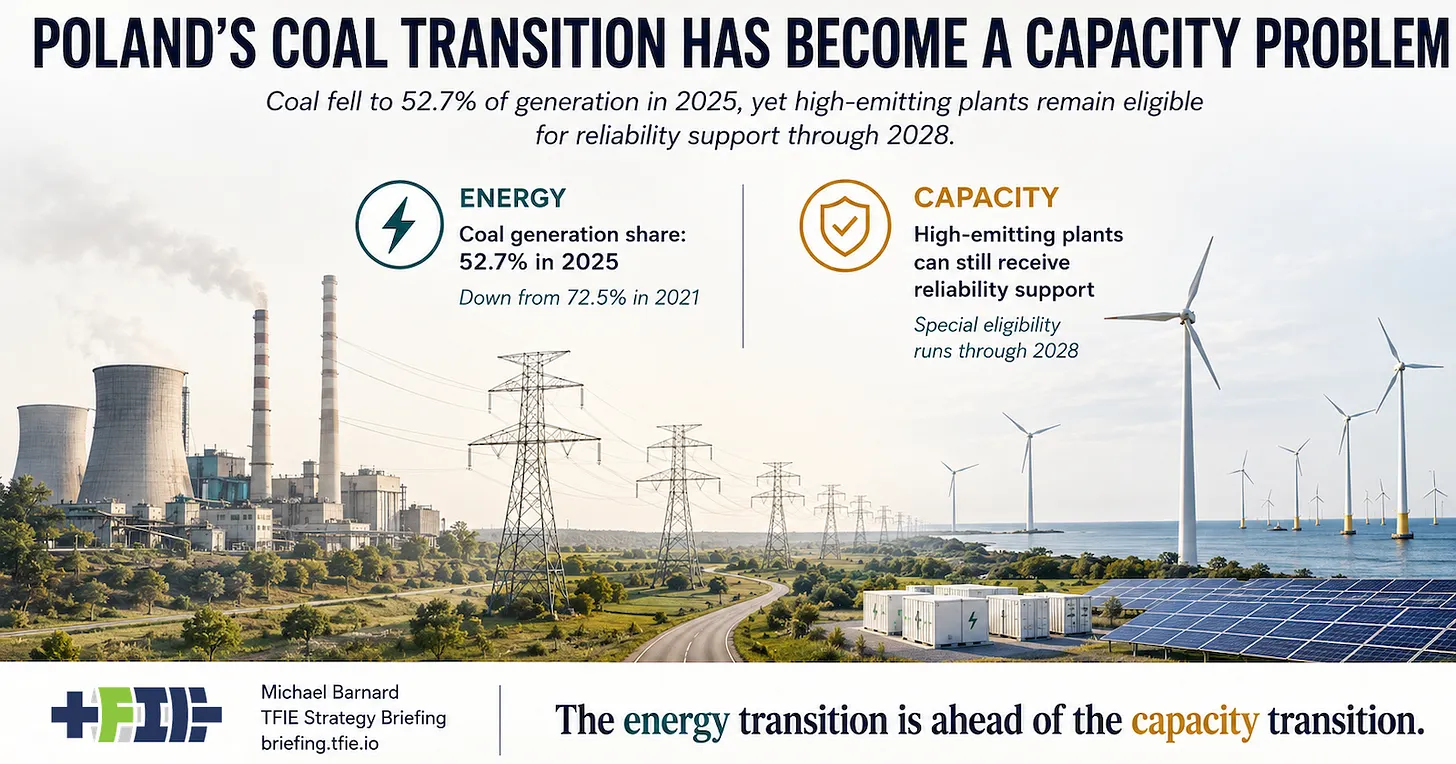
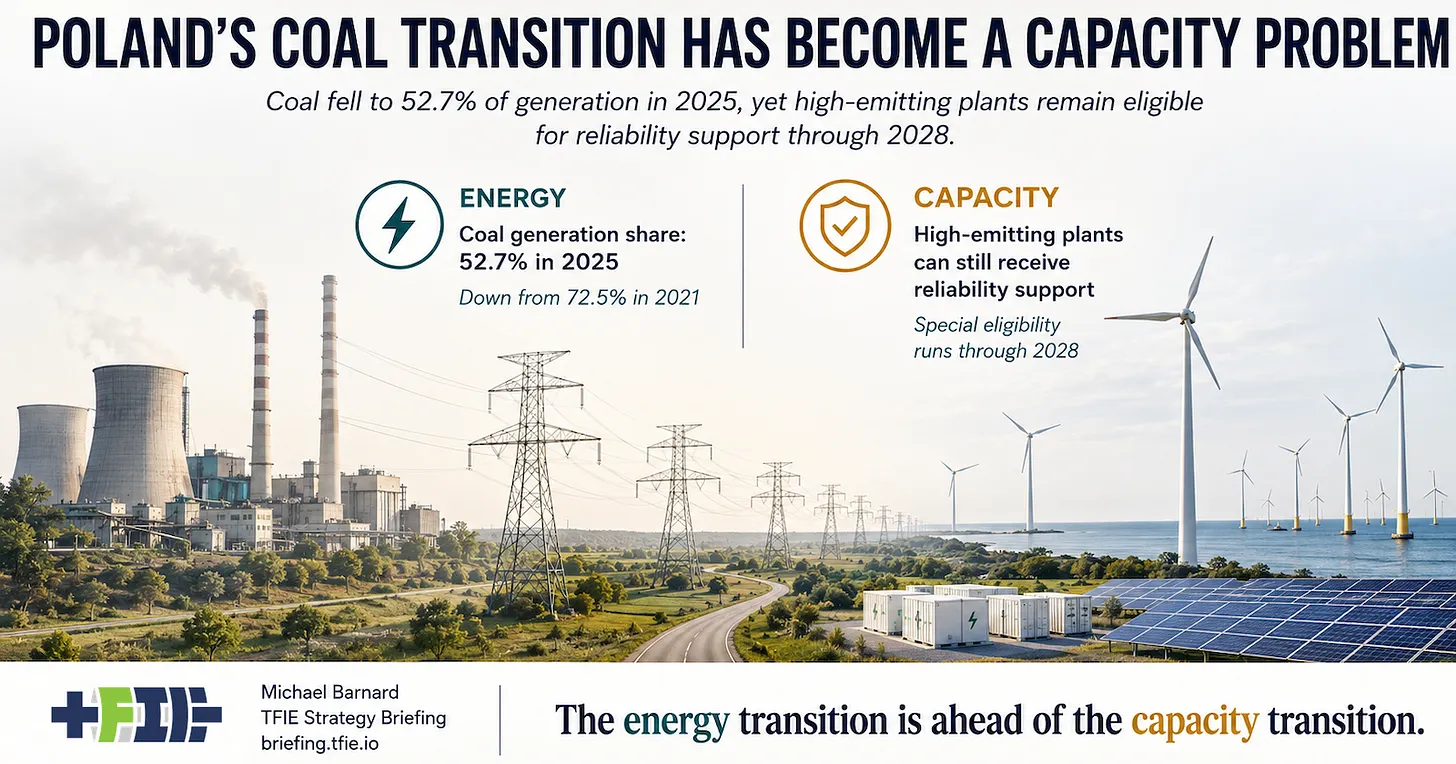
In 2021, coal accounted for an imposing 72.5% of Poland’s total electricity generation. By the close of 2025, that figure had plummeted to 52.7%, while renewable energy sources surged to capture 31.4% of the market. Milestones that once seemed out of reach are now falling regularly: coal supplied less than half of the country’s monthly power generation in five separate months, and in June 2025, renewables outpaced coal over a full month for the very first time.
However, beneath this triumphant headline of decarbonization lies a complex, systemic paradox. While coal’s share of annual energy generation is in freefall, its footprint within the country’s capacity planning remains stubbornly entrenched. Poland is still paying billions to keep high-emitting, aging coal plants online. This dichotomy highlights a fundamental tension in modern grid management: the sharp distinction between producing energy (measured in megawatt-hours) and securing grid reliability (measured in dependable megawatts).
As renewable energy scales up, it is displacing coal down the merit order faster than the broader power system can absorb. Consequently, Poland faces a two-front challenge. The first act—removing coal from the energy mix—is well underway. The second and far more difficult act—removing coal from the underlying power system without compromising grid stability—will test the limits of infrastructure, storage, and market design.
Detailed Chronology: The Acceleration of the Polish Transition
To understand how quickly the Polish energy landscape is transforming, one must examine the compressed timeline of recent structural shifts.
The Baseline (2021)
At the dawn of the decade, Poland’s power system was dominated by legacy infrastructure. Over 72% of the nation’s electricity relied directly on coal-fired stations. Emissions were high, economic pressure from EU carbon pricing was mounting, and the state-controlled energy sector was deeply reliant on domestic mining unions. Renewable energy, aside from a nascent onshore wind sector, played a marginal role in daily grid operations.
The Turning Point (2024–2025)
The years 2024 and 2025 marked an inflection point where policy targets collided with rapid technological deployment. Renewable energy sources—specifically a wave of new solar installations and expanded onshore wind farms—began eroding coal’s dominance on a monthly basis. By 2025, coal generation had dropped by nearly 20 percentage points compared to 2021.

Crucially, this period also exposed the transitional bridge being built by natural gas. In both 2024 and 2025, gas recorded the largest incremental increase in generation share among fossil fuels. By 2025, Poland produced 24.4 TWh of electricity from gas, closely matching or exceeding key renewable benchmarks such as onshore wind (23.8 TWh) and solar (20.3 TWh). This proves that Poland’s immediate decarbonization pathway is not a direct, 1:1 leap from coal to zero-carbon resources, but rather a hybrid transition defined by renewables coupled with flexible gas.
The Offshore Frontier (Mid-2026)
The transition shifted from land to sea in July 2026, when Poland’s first offshore wind farm, Baltic Power, successfully delivered its initial electricity to the national grid. Representing a massive leap in utility-scale renewable infrastructure, the project—when fully commissioned—will boast 1.2 GW of capacity and generate roughly 4 TWh annually. This single project accounts for about 3% of present total Polish electricity demand, signaling the arrival of heavy-duty, marine-based clean energy generation.
Supporting Context & Metrics: Energy Versus Capacity
To grasp why Poland continues to support coal despite its shrinking output, analysts must separate the metrics of energy from the metrics of capacity.
The Energy Metric (MWh / TWh)
Energy generation tracks the total volume of electricity produced over time. As solar and wind installations proliferate, they pump massive amounts of low-marginal-cost energy into the grid, depressing wholesale prices during peak generation hours and squeezing coal plants out of the market. Because coal-fired power stations cost money to idle and fuel, running them fewer hours per year makes them economically unviable as pure energy producers.
The Capacity Metric (MW)
Reliability, however, is an entirely different calculus. Grid operators do not simply ask how much energy is produced over a year; they must guarantee that enough dependable megawatts (MW) are available during the system’s most stressed hours. These are periods defined by simultaneous challenges:
- Peak winter or summer demand.
- Protracted periods of weak wind and zero solar output ("dunkelflaute").
- Constrained cross-border power imports.
- Multiple concurrent technical failures across traditional or transmission assets.
During these critical hours, a coal plant can operate at a fraction of its annual capacity factor, losing money as an everyday market participant, yet functioning as vital insurance against grid failure.
The Capacity Market and Regulatory Exemptions
This tension is vividly illustrated by Poland’s capacity market mechanisms. In a supplementary auction held in September 2026 for the 2026 delivery year, the Polish system contracted 7.58 GW of capacity obligations. Notably, high-emitting plants exceeding the standard threshold of 550 kg of $CO_2$ per MWh were permitted to participate under a special European derogation.
Similar auctions remain planned for subsequent delivery years, even as this specific European exemption framework approaches its expiration at the end of 2028. This is not necessarily a contradictory energy policy; rather, it reflects a structural lag. The energy transition—driven by rapid private and corporate capital pouring into renewables—has moved significantly faster than the capacity transition, which requires deliberate, capital-intensive deployment of grids, storage, and balancing assets.
The Curse of Abundance: Curtailment and Flexibility
The mismatch between rapid renewable growth and inflexible grid infrastructure is already causing acute system friction. In 2025, Poland was forced to curtail 1.4 TWh of renewable electricity—double the amount curtailed in 2024.

Crucially, this curtailment was driven primarily by system balancing constraints rather than physical grid bottlenecks. During exceptionally sunny or windy intervals, the Polish grid produces more low-cost electricity than its legacy system can absorb or route efficiently. Yet, a few hours later, that same grid may face severe generation deficits, underscoring why policymakers hesitate to pull the plug on standby coal capacity.
Official Statements and Expert Analysis
Energy economists and system strategists point out that adding another solar farm or wind turbine does not magically solve the dual problems of excess generation and reliability deficits.
According to deep-dive industry analyses, such as those published by TFIE Strategy Briefing, Poland’s legacy coal fleet was engineered to be the electricity system itself. The plants were designed to provide inertia, frequency response, voltage control, and baseline power all in one centralized package. Dismantling this architecture requires building an entirely new, highly sophisticated mesh of distributed generation, advanced high-voltage transmission grids, utility-scale battery storage, flexible industrial demand, modernized district heating, and smart electric vehicle charging infrastructure capable of vehicle-to-grid integration.
International bodies recognize the momentum of this transformation while sounding notes of caution regarding system integration. The International Energy Agency (IEA) projects that Polish renewable generation will expand at an average annual rate of roughly 13% through 2030. Under these projections, renewables are expected to surpass coal on an annual generation basis by 2028, capturing an estimated 53% of the country’s total electricity mix by the end of the decade. Conversely, coal generation is slated to decline by roughly 11% annually, while natural gas continues its steady upward trajectory as a transitional balancing fuel.
Future Outlook: The Hard Second Act
As Poland navigates the remainder of the decade, energy stakeholders and market observers must monitor two distinct, parallel numbers:
- Coal’s Share of Annual Generation: This metric reflects the aggressive march of renewables and the declining economic viability of fossil fuels in everyday wholesale markets. It tells us how far clean energy has come.
- Contracted Coal Capacity: This metric reveals how much thermal backup the Polish state believes it needs to survive its harshest, most vulnerable operating hours. It tells us whether structural alternatives are arriving quickly enough.
Getting coal out of the energy mix is a historic achievement, driven by market forces, carbon pricing, and the unstoppable cost declines of solar and wind technologies. However, getting coal entirely out of the power system is the harder second act.
Ultimately, Poland’s energy future hinges on whether transmission lines, storage systems, demand-side flexibility, and cross-border interconnectors can be deployed fast enough to provide the ironclad reliability currently guaranteed by legacy coal. Until that comprehensive infrastructure mesh is fully realized, the ghost of coal will continue to haunt the Polish grid—not as a dominant supplier of everyday power, but as the indispensable insurance policy keeping the lights on.