











Executive Overview
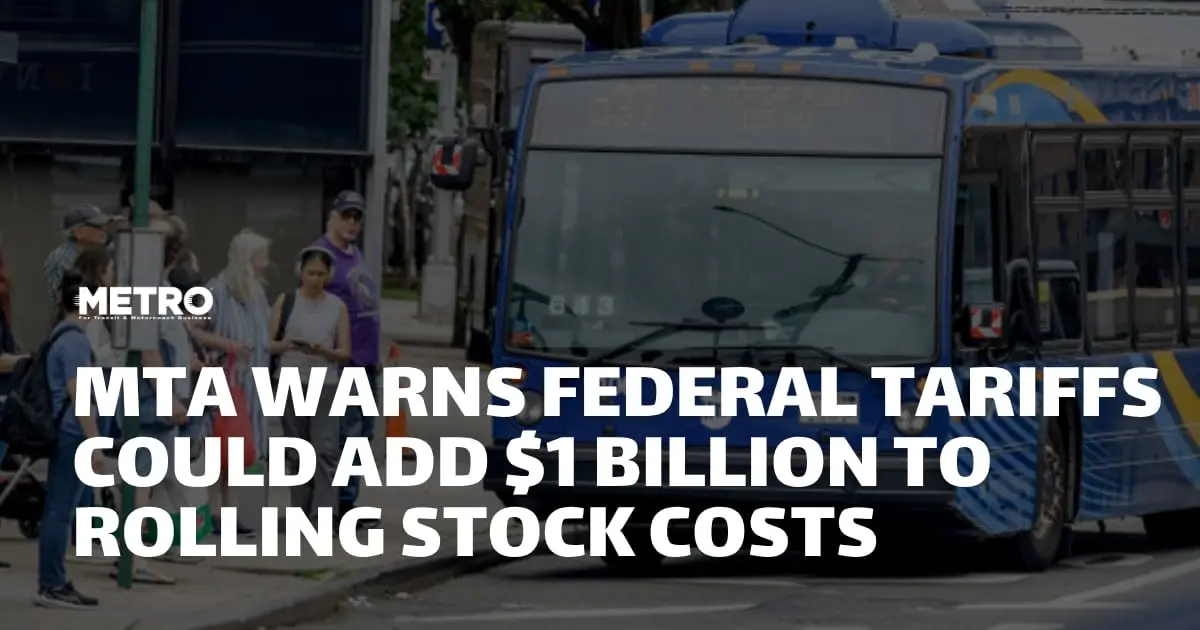
In a high-stakes appeal to federal trade leadership, New York Governor Kathy Hochul is officially pressing for targeted tariff exemptions on transit rolling stock acquisitions. The intervention comes in direct response to a comprehensive, internal fiscal analysis conducted by the Metropolitan Transportation Authority (MTA). This report reveals that sweeping federal tariff policies could artificially inflate the cost of the agency’s multi-billion-dollar transit fleet upgrades by an astronomical $1 billion.
The financial collision between federal trade policy and regional transit infrastructure financing threatens to derail one of the most ambitious capital improvement projects in North American history. The MTA has locked in a staggering $23 billion commitment toward procuring thousands of cutting-edge subway cars, regional commuter railcars, and zero-emission buses. Governor Hochul’s formal letters to U.S. Commerce Secretary Howard Lutnick and U.S. Trade Representative Jamieson Greer seek to carve out a specialized regulatory waiver. Without this relief, the MTA warns that billions of dollars in taxpayer-backed capital spending will be diverted away from direct transit enhancements to cover surging import-related duties.
At the heart of the controversy is a complex manufacturing reality: while major transit vehicles are assembled domestically, modern passenger railcars depend on highly specialized, precision-engineered global components that currently have no viable domestic substitutes. As ridership numbers rebound and shatter historical post-pandemic records across New York City’s subways, buses, and commuter railroads, state leaders argue that penalizing vital infrastructure components with heavy tariffs is counterproductive. It directly undercuts federal and state goals of modernizing public transit, bolstering domestic manufacturing ecosystems, and encouraging sustainable urban mobility.
Detailed Chronology of the Tariff Crisis and Policy Response
To fully understand the gravity of Governor Hochul’s intervention, it is essential to trace the precise sequence of events that brought the MTA’s capital budgeting process into direct conflict with national trade enforcement mechanisms.
The Genesis of the 2025–2029 Capital Plan Commitments
Over the past several years, the MTA has grappled with an aging fleet of legacy vehicles, some of which have exceeded their structural service life by decades. To reverse decades of deferred maintenance and lay the groundwork for expanded regional connectivity, transit planners devised the comprehensive 2025–2029 Capital Plan. This master blueprint allocated $23 billion specifically for generational fleet replacements. The plan aims to systematically replace deteriorating subway models, expand the Long Island Rail Road (LIRR) and Metro-North fleets, and transition the MTA’s massive bus enterprise to sustainable alternatives.
The Internal Fiscal Discovery
As part of routine project accounting and cost-projection modeling for upcoming rolling stock contract phases, MTA financial analysts evaluated the cascading impacts of existing and proposed federal tariff structures. The resulting internal audit laid bare an alarming projection: broad-based import duties on specialized manufacturing inputs would drive up the final acquisition costs of the agency’s planned fleet upgrades by an estimated $1 billion.
Rather than absorbing these hyper-inflated costs or quietly cutting back on vehicle orders, agency leadership elevated the findings to the executive chamber in Albany. The realization that federal trade policies could unilaterally wipe out a significant portion of New York’s capital purchasing power triggered immediate administrative alarm.
Executive Escalation: Letters to Washington
Armed with the MTA’s empirical impact assessment, Governor Hochul escalated the issue to the highest levels of federal trade and commerce administration. In formal correspondence addressed directly to U.S. Commerce Secretary Howard Lutnick and U.S. Trade Representative Jamieson Greer, Hochul laid out the existential threat the tariffs pose to New York’s transit infrastructure. The governor framed the request not as a challenge to national trade objectives, but as a pragmatic, common-sense adjustment necessary to protect local infrastructure investments, maintain fiscal discipline, and safeguard thousands of domestic manufacturing jobs tied to the production lines.
Supporting Context & Metrics: Decoding the $1 Billion Impact
To comprehend the true scale of a $1 billion cost overrun, one must examine the specific mechanics of modern railcar manufacturing and the alternative investments that these funds could otherwise secure for millions of daily commuters.
The R211 Case Study: Balancing Domestic Assembly with Global Supply Chains
The MTA frequently points to its flagship R211 subway car procurement as a prime example of the paradox inherent in modern transit manufacturing. The R211 cars—which currently service various lettered subway lines and the historic Staten Island Railway—are assembled across domestic facilities located in Nebraska and Yonkers, New York.
From a strict compliance standpoint, these vehicles easily meet high domestic content thresholds, with more than 75% of their total components manufactured within the United States. However, the modern heavy railcar is an extraordinarily complex, computer-controlled machine requiring specialized subsystems. These include advanced propulsion control modules, high-precision braking technology, specialized safety interlocks, and state-of-the-art communication arrays. For many of these critical components, there are simply no commercial domestic manufacturing alternatives capable of matching the necessary scale, technical specifications, or rigorous safety certifications. Consequently, importing these indispensable sub-components exposes the entire project pipeline to steep tariffs.
Quantifying the Lost Opportunity Cost
To contextualize what a $1 billion tariff penalty truly means for New York commuters, the MTA translated the potential financial loss into tangible, highly coveted transit assets. If the agency is forced to pay an extra $1 billion due to tariff policies, that capital will be entirely absorbed by administrative surcharges rather than translating into physical infrastructure.
According to MTA programmatic estimates, that $1 billion could alternatively fund:
- The complete acquisition of most planned Metro-North passenger coaches, drastically expanding seating capacity and service frequency across northern suburban corridors.
- 150 brand-new M9-A railcars designated for the Long Island Rail Road, providing commuters with modern amenities, improved reliability, and enhanced ADA compliance.
- Nearly 1,000 advanced transit buses, accelerating the MTA’s push toward a modernized, zero-emission surface fleet.
- More than 250 heavy-duty subway cars, directly replacing aging rolling stock on some of the busiest high-capacity routes in the system, including the heavily congested 1, 2, 3, 4, 5, and 6 subway lines.
| Asset Class | Alternative Procurement Equivalent to $1 Billion Tariff Cost |
|---|---|
| Metro-North Coaches | Majority of planned regional passenger coach fleet upgrades |
| Long Island Rail Road | 150 brand-new, high-capacity M9-A railcars |
| Surface Transit | Nearly 1,000 modern, accessible city buses |
| New York City Subway | More than 250 modern subway cars (1, 2, 3, 4, 5, 6 lines) |
Official Statements and Stakeholder Perspectives
The debate surrounding the proposed tariff exemptions has drawn pointed commentary from key transit executives, state officials, and labor advocates who view the issue through the dual lenses of fiscal responsibility and workforce development.
MTA Leadership Emphasizes Ridership Realities
Addressing the urgency of the capital investments, MTA Chair and CEO Janno Lieber emphasized that the agency’s modernization schedule cannot afford artificial delays or financial drains.
"As the MTA keeps breaking ridership records, our investments in the next generation of rolling stock become more important than ever," stated MTA Chair and CEO Janno Lieber. "New subways, buses and railcars are needed to give our riders the service they deserve."
Lieber’s remarks underscore a fundamental operational truth: post-pandemic ridership recovery has placed immense strain on existing fleets. With daily turnstile swipes regularly exceeding pre-crisis thresholds on numerous lines, mechanical reliability is paramount. Every dollar diverted to tariffs is a dollar stripped from preventative maintenance, station accessibility upgrades, and signal modernization.
Protecting the Domestic Manufacturing Workforce
Jessie Lazarus, MTA Rolling Stock Program Chief, broadened the scope of the debate during a recent briefing, arguing that the consequences of these tariffs extend far beyond the balance sheets of municipal transit authorities. Lazarus highlighted the symbiotic relationship between rolling stock procurement and blue-collar American manufacturing jobs.
"An investment in rolling stock is more than just an investment in a more modern, comfortable ride. It’s an investment in American workers," Lazarus noted. "The MTA is committed to securing maximum value from our capital program, and that means speaking honestly and candidly about the impact of policies that dilute New York’s spending power."
Lazarus’s assessment sheds light on a delicate policy contradiction. While federal tariffs aim to protect domestic industries, blanket enforcement on specialized parts used by domestic manufacturers—such as those operating assembly plants in Yonkers and Nebraska—inadvertently drives up costs for the very factories the policies were designed to champion. By shrinking the MTA’s purchasing power, the tariffs risk depressing order volumes, which could ultimately stall production lines and threaten manufacturing employment across the supply chain.
Governor Hochul’s Strategic Position
Governor Kathy Hochul’s administration has consistently framed the ongoing infrastructure renaissance as the cornerstone of New York’s economic vitality. By taking direct action and petitioning the U.S. Department of Commerce and the Office of the United States Trade Representative, Hochul is seeking a pragmatic middle ground. Her administration contends that strategic tariff exemptions for public transit rolling stock components will not undermine national trade protections; rather, they will prevent unnecessary financial burdens on public agencies that provide essential services to millions of everyday citizens.
Future Outlook: Navigating the 2025–2029 Capital Horizon
As the federal government evaluates Governor Hochul’s formal request for tariff exemptions, the immediate future of the MTA’s 2025–2029 capital plan hangs in the balance. Several critical milestones will dictate how this fiscal showdown unfolds in the months ahead.
Regulatory Review and Federal Diplomacy
The ball is now firmly in the court of Commerce Secretary Howard Lutnick and U.S. Trade Representative Jamieson Greer. Federal trade officials face the complex task of weighing localized municipal infrastructure costs against broader national economic and trade strategies. Historically, granting targeted exemptions for public infrastructure and mass transit has precedent, particularly when domestic supply chains cannot fulfill specialized technical requirements. However, navigating the bureaucratic and political landscape of trade enforcement requires sustained bipartisan advocacy from New York’s congressional delegation, who are expected to echo Governor Hochul’s appeals in Washington.
Contingency Planning within the MTA
Should federal officials deny or stall the requested exemptions, the MTA will be forced to make difficult budgetary adjustments. Agency planners would likely have to evaluate several unpalatable options:
- Scope Reduction: Scaling back the total volume of new subway cars, commuter railcars, and buses ordered under the current capital plan.
- Capital Reprioritization: Diverting funds from other critical infrastructure buckets—such as station rehabilitations, accessibility (ADA) compliance projects, or structural bridge and tunnel repairs—to cover the $1 billion shortfall.
- Debt Financing: Issuing additional debt bonds, which would drive up long-term debt-service ratios and place an even heavier financial burden on future operating budgets.
The Broader National Precedent
Beyond the borders of New York State, the outcome of Governor Hochul’s petition will be closely watched by transit authorities and municipal leaders across the United States. Major metropolitan systems in cities like Chicago, San Francisco, Boston, and Washington, D.C., face similar structural challenges as they modernize aging fleets under existing tariff regimes. A successful waiver for the MTA could establish a vital national regulatory pathway, offering relief to public transit agencies nationwide and ensuring that federal trade policy acts in harmony—rather than at cross-purposes—with the nation’s critical infrastructure goals.
As the MTA continues to break ridership records and push forward with its generational fleet upgrade, the resolution of this tariff dispute will determine whether New York’s transit future is forged efficiently or weighed down by an avoidable billion-dollar tax on mobility.


