








Executive Overview
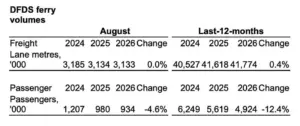
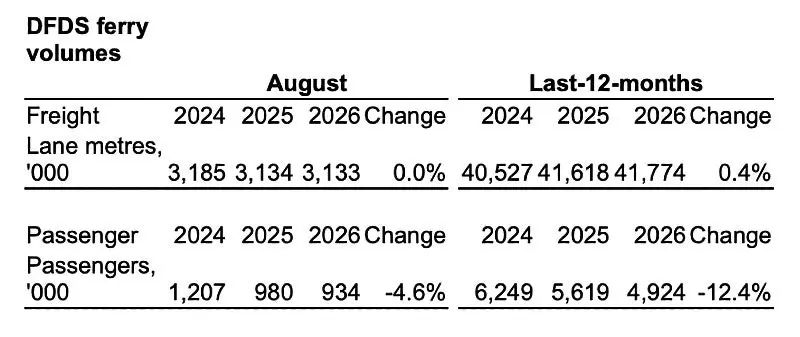
Danish international shipping and logistics giant DFDS A/S released its operational performance update for August 2026, delivering a nuanced picture of resilience amidst regional economic fragmentation and shifting consumer demand patterns. The headline figures reveal a total freight volume of 3.1 million lane metres carried across the company’s extensive maritime network in August 2026—a figure perfectly flat (0.0% change) compared to the corresponding period in August 2025.
While the top-line freight capacity utilization appears static, the underlying regional performance highlights significant geographical polarization. Robust growth across North Sea trade corridors and an exceptional surge in the Strait of Gibraltar were offset by volume contractions across the Baltic Sea, the Mediterranean, and the pivotal English Channel routes.
Simultaneously, the ferry operator’s passenger division faced acute pressures during one of the traditionally peak months of European summer travel. Total passenger transport dropped by 4.6% year-on-year, declining to 934,000 passengers in August 2026. This contraction was predominantly driven by a softening in Dover Strait cross-Channel traffic, reflecting broader structural shifts and decreased consumer discretionary spending across the wider ferry market.

On a trailing twelve-month (LTM) basis ending August 2026, total carried freight volumes reached 41.8 million lane metres, marking a slight reported increase of 0.4%. However, when adjusted for structural route adjustments, asset reallocations, and network realignments, organic freight volumes contracted by 0.5%. The passenger segment painted a more severe trailing picture, with total LTM passenger volumes dropping 12.4% to 4.9 million (a 5.3% decline on an adjusted organic basis).
================================================================================
                        DFDS August 2026 Operational Summary
================================================================================
Metric                      August 2026      August 2025     YoY Change (Reported)
--------------------------------------------------------------------------------
Freight (Lane Metres)       3.1 Million      3.1 Million          0.0%
Passengers                  934,000          979,000             -4.6%

LTM Performance             LTM 2025-2026    LTM 2024-2025   Reported   Adjusted*
--------------------------------------------------------------------------------
Freight (Lane Metres)       41.8 Million     41.6 Million        +0.4%      -0.5%
Passengers                  4.9 Million      5.6 Million        -12.4%      -5.3%
================================================================================
*Adjusted for structural route realignments and network capacity changes.
Detailed Chronology & August Operational Performance
The August 2026 operational dataset provides a clear indicator of how geopolitical shifts, macroeconomic headwinds, and localized trade recalibrations are influencing European freight and passenger shipping networks.
 August 2025                        LTM Trailing Period                    August 2026
 [ Baseline ] ------------------> [ Route Restructuring ] -------------> [ Dual Metrics ]
 Freight: 3.1M Lane M.            Freight: 41.8M (+0.4% / -0.5% adj)     Freight: 3.1M (Flat)
 Passengers: ~979K                Passengers: 4.9M (-12.4% / -5.3% adj)  Passengers: 934K (-4.6%)
The Freight Volume Dynamics
Throughout August 2026, DFDS operated in an environment characterized by uneven industrial production across the European continent. Total reported volume of 3.1 million lane metres reflects an operational equilibrium where gains in specific high-growth trade corridors offset contractions in traditional industrial heartlands.
- North Sea Resilience: Across the majority of DFDS’s North Sea network—connecting the United Kingdom with Scandinavia, Germany, the Netherlands, and Belgium—freight volumes maintained an upward trajectory. This growth was underpinned by sustained industrial supply chain activity and resilient automotive and food/beverage logistics flows between northern European markets and the UK.
- Strait of Gibraltar Surge: The highest relative growth in the DFDS network occurred in the Strait of Gibraltar corridor. Volumes in this region expanded significantly above August 2025 levels, driven by increasing nearshoring trends, rapid growth in Moroccan manufacturing and agricultural exports, and enhanced logistics integration between North Africa and Southern Europe.
- Mediterranean Softness: Mediterranean routes posted a slight overall decrease in freight traffic. Company analysis indicates that this performance was primarily driven by a localized volume decline on a single key trade route, rather than a broad systemic downturn across the entire Mediterranean basin.
- Baltic Sea Contraction: Freight movement in the Baltic Sea experienced a measurable year-on-year drop. Lower domestic demand in northern Baltic economies, coupled with ongoing geopolitical adjustments to trade flows in Northern Europe, continued to weigh heavily on roll-on/roll-off (Ro-Ro) ferry capacity in the region.
- English Channel Shortfall: The short-sea English Channel routes saw freight volumes decline in August. Freight movements across the English Channel matched the performance of the wider cross-Channel transport sector, which has faced operational slowdowns and reduced cross-border freight velocity.
Passenger Operations and Seasonal Trends
August is traditionally a high-revenue, peak-volume month for DFDS’s passenger division, driven by summer holidays across Western Europe. However, the operational figures highlight a challenging landscape:
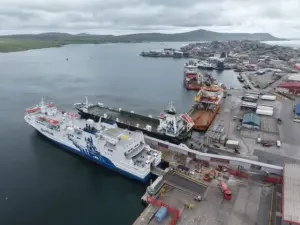
- Monthly Decline: Total passenger volume dropped by 4.6% to 934,000, down from approximately 979,000 passengers in August 2025.
- Dover Strait Weakness: The primary catalyst for this drop was a marked reduction in cross-Channel traffic along the Dover Strait (Dover–Calais and Dover–Dunkerque).
- Macro Market Alignment: The contraction on the Dover Strait aligns with the trajectory observed across the entire cross-Channel passenger industry. Rising international flight availability, economic pressure on consumer discretionary budgets in the UK and Northern Europe, and ongoing operational frictions at Channel ports contributed to a general contraction in cross-border motorist travel.
Supporting Context & Regional Metrics Breakdown
To fully contextualize DFDS’s August 2026 performance, it is necessary to examine the broader macroeconomic, operational, and structural forces impacting each operating region.
                       REGIONAL FREIGHT PERFORMANCE MATRIX
+-----------------------+------------------------+------------------------------------+
| Region                | Freight Volume Trend   | Key Market Drivers                 |
+-----------------------+------------------------+------------------------------------+
| North Sea             | Moderate Expansion     | UK-Nordic industrial trade, Ro-Ro  |
| Strait of Gibraltar   | Strong Expansion       | Moroccan nearshoring & agro-export |
| Mediterranean         | Slight Decline         | Targeted route-level realignment   |
| Baltic Sea            | Contraction            | Economic weakness & trade shifts   |
| English Channel       | Contraction            | Cross-Channel market slump         |
+-----------------------+------------------------+------------------------------------+
The North Sea: Operational Pillar
The North Sea remains the core anchor of DFDS’s business model. Industrial trade between the UK and Northern Europe demonstrated steady momentum, benefiting from stable long-term charter agreements and integrated logistics solution offerings. High vessel utilization on routes connecting Immingham and Felixstowe to Dutch, German, and Scandinavian ports helped buffer the company against localized downturns elsewhere in Europe.
The Gibraltar Expansion Strategy
The strong performance in the Strait of Gibraltar illustrates the strategic impact of DFDS’s recent expansion into Southern European and North African trade corridors. As European companies increasingly adopt "nearshoring" strategies to de-risk supply chains from Far East disruptions, Morocco has emerged as a key industrial hub for automotive components, textiles, and agricultural goods. DFDS’s strategically scaled ferry connections across the Strait of Gibraltar have captured a growing share of this high-margin Ro-Ro freight volume.
The Baltic Sea and Mediterranean Realignment
- Baltic Sea: The region continues to navigate structural adjustments following the broader geopolitical realignments of Northern European trade. Weak construction activity and subdued manufacturing in Northern Europe reduced demand for raw material transport and trailer shipping, forcing operators to tightly manage vessel deployment and lane capacity.
- Mediterranean: The slight decline across Mediterranean operations was characterized by route-specific anomalies rather than structural market failure. DFDS has actively engaged in route optimization in this region, fine-tuning vessel schedules and capacity allocations to align with dynamic trade patterns between Turkey, Italy, and France.
The Channel Challenge and Border Logistics
The short-sea cross-Channel corridor remains one of the most operationally volatile segments in European shipping. Both freight hauliers and private tourist traffic encountered structural friction throughout August 2026. The 4.6% passenger decline reflects both reduced consumer demand for short-break driving holidays and systemic market contraction. Increased regulatory checks, infrastructure upgrades, and preparing logistics networks for full implementation of EU entry-exit systems have impacted vessel turnarounds and cross-Channel velocity.
Official Statements & Executive Perspectives
Reflecting on the operational figures for August 2026, DFDS executive leadership emphasized the strategic importance of network diversification and active capacity management in maintaining flat year-on-year freight levels during an uncertain macroeconomic period.
"Our performance in August underscores the inherent strength of DFDS’s balanced geographical footprint," stated a senior DFDS operational representative during the performance commentary. "While macro-economic pressures and shifting consumer patterns created targeted headwinds in the English Channel and the Baltic Sea, our strategic investments in the Strait of Gibraltar and the steady resilience of our core North Sea networks ensured that our overall freight volumes remained robust and stable year-on-year."
Addressing the ongoing contraction in passenger transport, company executives noted that network realignments and targeted yield management remain central to the group’s strategy.
"The passenger figures for August reflect a wider market cooling in cross-Channel traffic, where consumer spending caution has impacted leisure travel volumes," the executive added. "Over the trailing 12-month period, our reported passenger figures also reflect deliberate structural realignments within our network. Our priority remains on optimizing route economics, driving operational efficiencies, and delivering high-quality service across our key leisure and commercial corridors."
Future Outlook & Industry Context
As DFDS moves into the final quarter of 2026, the company faces a complex matrix of macroeconomic indicators, regulatory shifts, and structural developments across the maritime logistics landscape.
================================================================================
                    Key Operational Metrics: Short-Term vs. LTM
================================================================================

Freight Volume Trend (Lane Metres)
  Aug 2026 YoY:  [ 0.0% ] (Flat - 3.1M)
  LTM Reported:  [+0.4%] (Growth - 41.8M)
  LTM Adjusted:  [-0.5%] (Slight Contraction)

Passenger Volume Trend
  Aug 2026 YoY:  [-4.6%] (Contraction - 934K)
  LTM Reported:  [-12.4%] (Structural Realignment - 4.9M)
  LTM Adjusted:  [-5.3%] (Organic Softening)
================================================================================
Macroeconomic and Trade Corridor Dynamics
- European Industrial Recovery: The trajectory of DFDS’s freight division through late 2026 and early 2027 will depend heavily on the pace of industrial recovery in Western Europe, particularly in Germany and the UK. Any re-acceleration of industrial output is expected to translate into volume growth for North Sea Ro-Ro routes.
- Expansion in North Africa: The strong performance in the Strait of Gibraltar points toward sustained long-term growth along the North Africa–Europe trade corridor. Continued foreign direct investment in Moroccan industrial zones suggests that this region will serve as a growing driver of freight volume for DFDS.
- Cross-Channel Operational Adaptation: The Channel route remains subject to ongoing market dynamics. Success in this corridor will depend on operators’ ability to manage border control transitions efficiently while offering competitive transit times for commercial freight forwarders.
Decarbonization and Regulatory Mandates
Beyond immediate volume dynamics, DFDS’s long-term operational outlook is tied to its fleet renewal and decarbonization strategy:
- Emissions Trading System (EU ETS): The integration of maritime shipping into the European Union Emissions Trading System continues to impact operational cost structures across all European ferry operators.
- Green Corridor Investments: DFDS remains committed to transitioning its core routes to green corridors, investing in methanol-powered and battery-electric Ro-Ro vessels. Managing the capital expenditure required for fleet decarbonization while maintaining stable operating margins will remain a key strategic focus.
Strategic Summary
DFDS’s operational metrics for August 2026 illustrate a mature, geographically diversified business navigating a fragmented market landscape. By balancing structural declines in cross-Channel passenger travel and Baltic freight contraction against expansion in the North Sea and the Strait of Gibraltar, the group has demonstrated operational stability. As global supply chains continue to reconfigure, DFDS’s focus on flexible network routing, cost management, and strategic market expansion positions it to respond effectively to shifting trade patterns across Europe and adjacent markets.