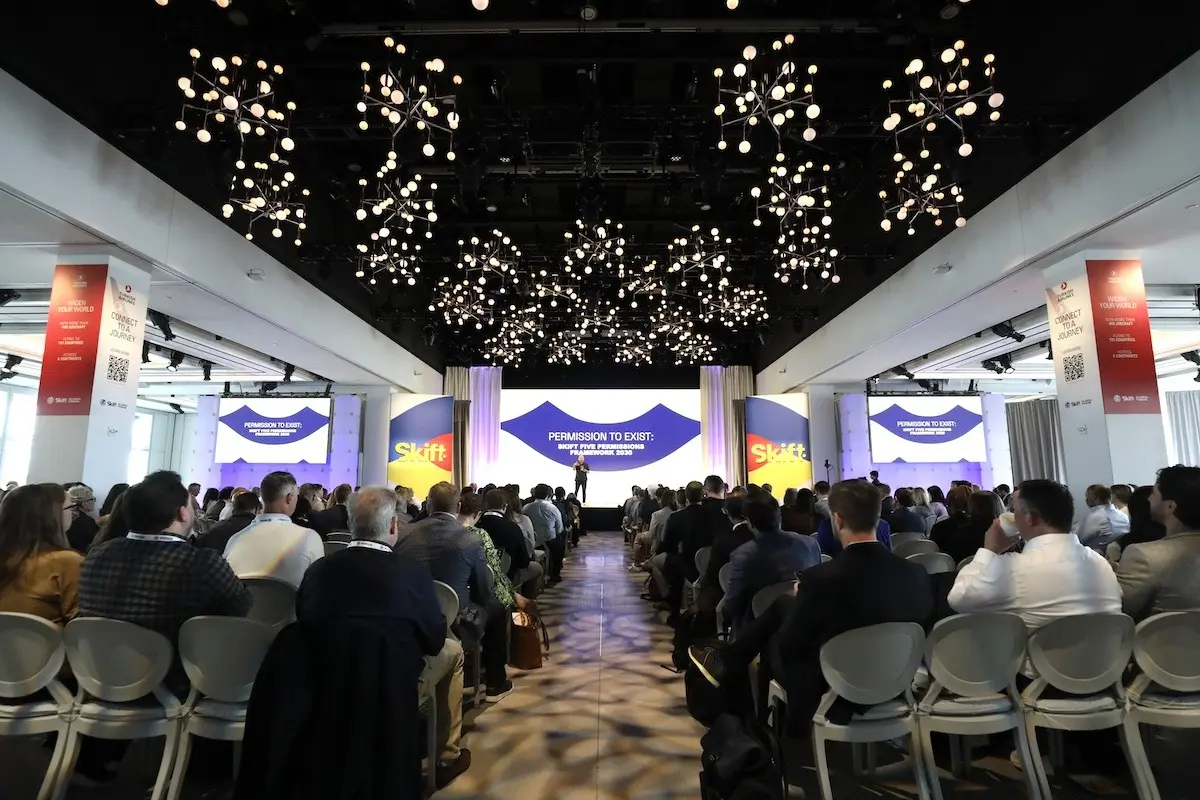
As executives converge for the Skift Global Forum 2026, the global travel industry finds itself standing at a complex and unforgiving crossroads. Every major travel leader—from legacy hospitality giants and dominant Online Travel Agencies (OTAs) to agile venture-backed startups and commercial aviation executives—is actively recalibrating their operational models. Yet, beneath the veneer of post-pandemic recovery and record-setting gross bookings, an urgent, existential question looms large: Are industry leaders making these strategic adjustments for the correct decade, or are they merely optimizing for a paradigm that is rapidly dissolving?
According to the Skift Research State of Travel 2026 report, the foundational pillars of the industry are undergoing a tectonic shift. Traditional travel demand patterns, legacy distribution pipelines, and deeply entrenched technology stacks are fragmenting. Assumptions that reliably predicted consumer behavior, yield management, and inventory distribution over the past twenty years no longer apply.
Two central, compounding tensions are driving this high-stakes environment:
The Shape vs. Scale Paradox: While the global travel market continues to expand in overall financial volume, its structural shape is mutating at an unprecedented pace.
The Trust-Technology Gap: Artificial intelligence and automated discovery tools are evolving at a velocity that far outstrips consumer and corporate trust in actually completing transactions through these mediums.
Every session, panel, and keynote at the Skift Global Forum is anchored around a consequential, hard-hitting decision that top travel executives are forced to make today. However, the industry is not monolithic. Incumbents, challengers, and private equity investors approach these inflection points from conflicting angles, creating rich operational friction. As Skift Research notes, "There are four layers to the travel stack: consumers, commerce, operations, and experiences. Every travel company will be challenged to prove its future relevance in each layer, based on whether its brand provides enough value to avoid being replaced."
Detailed Chronology: The Evolution of Disruption Leading to 2026
To understand the gravity of the choices facing travel executives today, it is necessary to examine how the industry arrived at this volatile juncture over the past several years:
The Post-Pandemic Rebound (2022–2023): The immediate post-lockdown era was defined by "revenge travel." Pent-up consumer demand drove massive volumes across all sectors, allowing airlines and hotels to effortlessly push through price hikes. During this period, AI in travel was largely viewed as a novelty, accounting for a mere 10% of total travel startup funding in 2023. Legacy systems focused on returning to pre-2019 operational capacity.
The Margin Squeeze and Tech Acceleration (2024–2025): As macroeconomic pressures began to catch up with global consumers, inflation bit into lower- and middle-income segments. Simultaneously, generative AI leapfrogged from experimental chatbots to autonomous agent architectures. By mid-2025, venture capital sentiment shifted dramatically: AI-enabled companies commanded a staggering 45% of total travel startup funding. Legacy brands realized that internal efficiency—rather than top-line AI-driven booking demand—was the primary driver of their initial Return on Investment (ROI).
The Structural Split (2026 and Beyond): Today, the industry faces an acute divergence. High-income affluent travelers continue to float luxury balance sheets, while price-sensitive consumers trade down or cancel entirely. Concurrently, inbound international travel volumes to major markets like the United States have drastically lagged behind domestic recovery, forcing a wholesale rewriting of global route networks and capital allocation strategies.
Supporting Context & Metrics: The Five Core Dilemmas
The 2026 forum is structured around five critical dilemmas currently fracturing boardrooms across the travel ecosystem.
1. Incumbency or Reinvention: Follow the Establishment or the Challenger?
For established travel brands, internal automation has proven effective at trimming overhead. For instance, Airbnb successfully slashed its customer support cost per booking by roughly 16% in a single year through targeted AI deployments. Yet, when it comes to generating new booking demand from autonomous AI agents, enterprise ROI remains conspicuously low.
Conversely, venture capital continues to heavily back greenfield challengers wagering on a complete rewrite of the consumer booking journey. Established giants like Booking Holdings and Expedia retain massive cash reserves and deeply entrenched distribution dominance. Airbnb is executing a high-stakes gamble to rebuild its core architecture as an AI-native company while its legacy operations fund the transition.
The Core Tension: Can legacy players scale through the AI shift using incremental updates, or will their legacy technology stacks anchor them down while nimble, AI-native startups capture the next generation of travelers? Notably, referral traffic from autonomous AI agents currently drives fewer than 1% of total room nights at Booking.com, illustrating the vast chasm between hype and realized commercial volume.
2. The Funnel and The Agent: What’s the Right Pathway Today?
Discovery behavior has fundamentally shifted from traditional search-scroll-compare methodologies to conversational ask-shortlist-decide workflows. According to Skift Research, nearly one-third (30%) of travelers now report "extensive" use of AI for trip planning—a metric that has more than doubled (rising 17 percentage points) in a single year.
However, consumer trust in actually transacting through AI platforms lags drastically behind. Direct brand channels and traditional OTAs remain the most trusted environments, and overall traveler sentiment regarding AI booking comfort remains net negative.
[Traditional Search & Compare] ---> Eroding Trust in Legacy Funnels
[Conversational AI Discovery]  ---> Rapid Adoption (30% usage), but Low Transaction Trust (<2% willingness to let AI book)
This dynamic creates a perilous Catch-22 for hospitality and travel brands. AI systems curate shortlists exclusively from brands whose data structures they can read and interpret. Brands that fail to optimize their data architectures for machine readability risk becoming entirely invisible unless requested explicitly by name. Yet, optimizing solely for AI aggregation cedes direct control over brand presentation and customer relationship ownership. Protecting the direct funnel preserves brand equity, but risks missing out on the conversational discovery revolution altogether. Data indicates that only 6% of hotels currently appear in AI-generated search results, and a mere 2% of leisure travelers are willing to let AI complete a booking on their behalf.
3. Premium or Volume: Where’s the Risk When the Two Fall out of Balance?
The modern travel economy is propped up by the resilient spending habits of affluent travelers. Premium revenue has become the ultimate financial cushion for commercial aviation and hospitality. For example, Delta Air Lines reported a 7% increase in premium revenue while its main cabin revenue declined. Major U.S. carriers, including American and United, are actively retrofitting aircraft to allocate roughly half of their cabin space to premium seating—a segment that yields materially higher profit margins. In Q4 2025, Delta’s premium cabins officially surpassed economy revenue for the first time in company history.
Simultaneously, however, price-sensitive consumers are feeling the pinch. Skift Research data indicates that 62% of global travelers plan to adjust or cancel their travel plans due to escalating costs. Relying exclusively on premiumization raises financial floors during economic downturns, but it drastically shrinks the customer base required to maintain baseline aircraft and hotel occupancy when profit margins contract. Premiumization represents the most reliable revenue narrative in contemporary travel, but it is ultimately a high-stakes bet on the persistence of global income inequality.
4. Human or Machine: How Do Brands Decide When the Guest Still Needs a Person?
Hospitality brands universally grapple with headcount optimization: How many operational roles can be eliminated through AI-driven automation without eroding the human touchpoints that guests explicitly demand?
The corporate instinct is to treat labor exclusively as a cost center. If high-paying guests are willing to pay a premium for human-centric service, luxury brands can justify the frontline headcount. However, applying this logic uniformly across market segments introduces severe long-term hazards. If personalized human service transforms into an exclusive luxury item accessible only to the ultra-wealthy, mid-market and budget brands risk forfeiting their core competitive differentiators—differentiators that cannot be easily rebuilt once frontline staff have been excised.
The Labor Disconnect: While venture capital and internal tech budgets aggressively flow toward reservations and operational efficiency, the travel industry simultaneously suffers from a severe labor shortage precisely where the human touch is most indispensable.
5. Certainty or Speed: Which Is the Right Bet?
Global macroeconomic volatility punishes hesitation, yet acting without complete data invites catastrophic capital misallocation. Consider the geographical shifts in demand: U.S. domestic travel held steady at 2019 real-dollar levels, while inbound international volume dropped by 5.5%. This rapid re-routing of global tourism flows occurred faster than most corporate strategic frameworks could adapt.
For global airlines and multinational hotel groups, shifting geopolitical landscapes require quarter-to-quarter plan resets. Waiting for absolute market certainty means executing strategies long after competitive windows have slammed shut. Conversely, committing capital early based on volatile data risks severe missteps. Forecasters recently pushed out full U.S. inbound tourism recovery projections from 2025 to 2029 in a single downward revision, highlighting the treacherous nature of long-range forecasting in the mid-2020s.
Official Statements and Industry Insights
The discussions animating the Skift Global Forum reflect a deep industry-wide awakening. Leaders are increasingly vocal about the necessity of organizational agility over traditional forecasting.
"There are four layers to the travel stack: consumers, commerce, operations, and experiences. Every travel company will be challenged to prove its future relevance in each layer, based on whether its brand provides enough value to avoid being replaced."
— Skift Research, State of Travel 2026
Industry veterans emphasize that the traditional playbooks used to navigate previous decades of economic expansion are fundamentally obsolete. Whether examining Brian Chesky’s architectural overhaul of Airbnb into an AI-native ecosystem or legacy legacy carriers reallocating 100% of seat growth to premium cabins, the consensus in the leadership suites is clear: incrementalism is no longer a viable growth strategy.
Future Outlook: Building for the Next Decade
As delegates prepare to leave the Skift Global Forum, the underlying mandate is clear: Are you defending the architecture of the last decade, or are you actively constructing the infrastructure for the next one?
The travel industry has successfully recalibrated its immediate operations, but the structural shifts are accelerating. Demand vectors continue to pivot—moving from international to domestic markets, shifting geographically from traditional Western hubs toward South America and Asia, migrating from economy to premium cabins, and transitioning from traditional search engines to autonomous AI agents.
Companies that survive and dominate the remainder of the 2020s will not be those that successfully forecast every macroeconomic tremor, but those that design flexible, resilient business models capable of absorbing friction. By understanding how incumbent giants defend their scale, how challengers bet against traditional distribution monopolies, and how hospitality leaders navigate operational volatility, executives leave with a clearer perspective on their own organizational standing.
The ground beneath the travel industry will continue to shift. The definitive test for leaders is whether they possess the strategic courage to move with it.