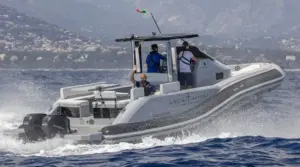
The global transition toward sustainable maritime transport has reached a critical juncture, propelled by rapid advancements in battery chemistry, hydrofoil engineering, smart energy management, and even advanced nuclear physics. Far from being a fringe movement confined to quiet inland lakes, zero-emission marine technology is aggressively reshaping municipal mass transit, commercial harbor operations, recreational boating, and the ultra-luxury superyacht sector.
In this edition of Plugboats WAVES (Watts, Amps, Volts, Electrons), we examine six landmark developments driving this transformation. From multi-year municipal trials proving the astonishing energy efficiency of electric ferries in Norway, to the expansion of flying hydrofoil commuter networks in Tasmania, the marine sector is proving that decarbonization is not merely an environmental imperative—it is an operational upgrade.
Concurrently, technological breakthroughs in marine-grade solar composites, specialized harbor clean-up vessels, high-speed coastal charging infrastructure, and revolutionary subcritical thorium microreactors are removing historical barriers to electrification. Together, these developments signal the dawn of an era where global waterways serve as the backbone of clean, high-frequency, and scalable urban and regional mobility.
The past several months have witnessed a flurry of commercial deployments, regulatory milestones, and technological breakthroughs across the global electric boating landscape.
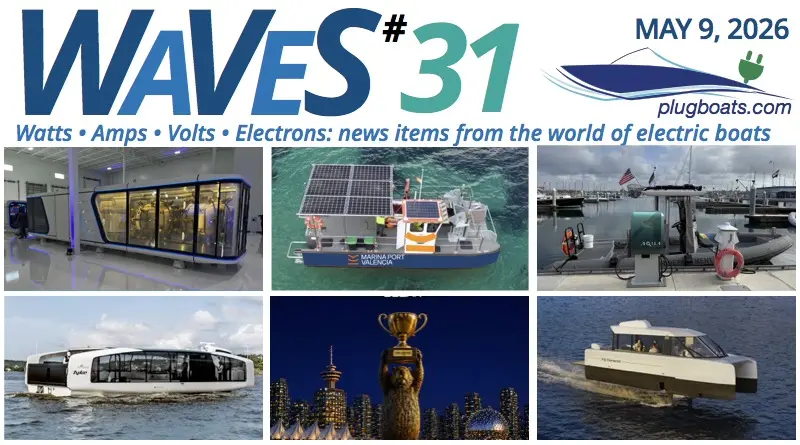
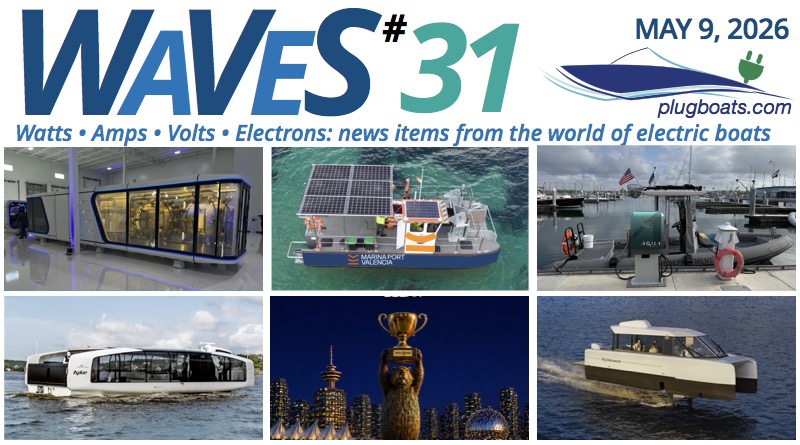
April 2024 – July 2025 (The Hyke Trial): The fully electric, 50-passenger Hyke F-15 Shuttle completed a rigorous 14-month public transport trial on a 225-metre river crossing in Fredrikstad, Norway. Operating within the municipal transit network, the vessel carried over 41,000 passengers with high frequency and exceptional reliability.
Late April 2026 (Beaver’s Den Innovation Victory): British Columbia-based marine solar innovator Open Waters Solar captured top honors at the inaugural "Beaver’s Den" competition held at Vancouver Science World, beating out 25 pre-Series A startups with its durable, walkably coated marine solar deck technology, SolaDek.
May 2026 (Global Infrastructure & Vessel Expansion):
Vessev announced its second Australian hydrofoil network, partnering with Fly Derwent to bring clean energy commuter ferries to Hobart, Tasmania, following its earlier deployment in Perth.
Marina Port Valencia in Spain welcomed the "NetBoat" CatClean 75, an advanced electric clean-up catamaran designed to capture floating waste, skim hydrocarbons, and oxygenate the water.
Aqua superPower commissioned a high-speed DC marine fast charger at Marina Park in Newport Beach, California, significantly bolstering the charging corridor for Southern California’s growing electric recreational and municipal fleets.
Mid-2026 (Nuclear Marine Breakthrough): Following discussions at the World Yachting Summit in Monaco, the viability of nuclear-powered superyachts gained traction as energy innovators like AMPERA—partnering with Scorpio Tankers—pioneered subcritical thorium microreactor designs tailored for maritime propulsion.
Supporting Context & Metrics: The Numbers Driving Marine Electrification
To understand the viability of modern electric marine systems, one must look closely at the underlying performance metrics. The industry has moved well past experimental concepts into hard, quantifiable operational superiority.
Energy Efficiency and Power Draw
The Hyke F-15 Shuttle demonstrated that fully electric urban water transport requires up to 88 per cent less energy than comparable diesel-powered vessels of the same size. Remarkably, its power consumption during daily operations is roughly equivalent to running five household hair dryers. This staggering reduction in energy demand highlights how poorly optimized traditional combustion engines are for short-run, high-frequency urban ferry applications.
Hydrofoil Range and Speed Dynamics
In the realm of hydrofoils, New Zealand-based Vessev continues to redefine performance benchmarks.
The VS–9 model is a 29-foot vessel capable of carrying 10 passengers. It achieves a remarkable cruising speed of 25 knots with a maximum range of 50 nautical miles on a single charge.
The larger VS–12 model, measuring 37 feet, scales passenger capacity up to 30 individuals, making it commercially viable for municipal commuter routes.
Environmental Cleanup Capacity
In Spain, the NetBoat CatClean 75 deployed at Marina Port Valencia measures 7.5 meters in length with a 2.5-meter beam. It boasts a hydrocarbon retention capacity of up to 2,000 litres and can clean approximately 8.89 square kilometers per hour. Powered by integrated solar panels alongside an onboard battery bank, the vessel can operate continuously for up to 16 hours a day in complete silence.
Fast-Charging Infrastructure
Aqua superPower’s newly deployed station at Newport Beach, California, delivers up to 24 kW of power using the international CCS standard. Designed specifically to withstand corrosive marine environments, the charger provides safe, brand-agnostic power to everything from leisure craft to municipal workboats, such as the Vita electric workboat operated by the Newport Beach Harbor Department.
Official Statements and Industry Insights
Key stakeholders across the maritime, municipal, and clean-tech sectors have emphasized that the transition to electric waterborne transport is fundamentally reshaping how cities utilize their natural geography.
Rethinking Urban Planning Through Waterways
Halvor Vislie, CEO of Hyke, underscored the broader implications of the Fredrikstad municipal trial:
"The project shows that our urban waters can be used much more efficiently. Instead of digging tunnels or building bridges, which are hugely costly, electric ferries can quickly be deployed to shuttle large numbers of passengers. It’s time to rethink urban planning by putting waterways at the centre. Together with Fredrikstad Municipality, we’ve demonstrated that the Hyke F-15 can operate as part of everyday public transport — efficiently, quietly and with strong passenger acceptance."
Tasmania’s Renewable Commuter Vision
Cameron McCulloch, Principal of Fly Derwent and a clean energy executive with nearly two decades of experience, highlighted the synergy between hydrofoil technology and regional clean energy grids:
"From the very beginning this project has been about demonstrating how Tasmania’s renewable energy focus can translate into sustainable transport leadership. This technology unlocks affordable, river-based commuter and tourism transport in Hobart without the need for large-scale infrastructure changes. That’s what excites me most — not just the boats themselves, but everything they make possible in Hobart and beyond."
Marinas as Environmental Stewards
Patrick Reynés, CEO of Marina Port Valencia, framed the adoption of autonomous, electric cleanup vessels as an ethical and operational necessity:
"NetBoat isn’t just a cleaning tool, but a statement of intent about the marina model we want to build for the future. It is part of a broader roadmap centred around innovation, decarbonization and active conservation of the Mediterranean."
Democratizing Marine Charging
Scott Canning, US VP Business Development for Aqua superPower, spoke on the infrastructure milestones achieved in Southern California:
"This installation represents a gamechanger for Southern California’s boating community. Newport Beach is a gateway to pristine coastal waters, and by bringing our fast-charging infrastructure here, we’re not just powering electric boats—we’re fuelling a sustainable future for marine electrification. Our brand-agnostic technology supports every major electric boat manufacturer, making the switch to e-boating seamless and accessible for all."
Future Outlook: The Horizon of Marine Propulsion
Looking ahead, the trajectory of electric boating points toward rapid scaling, regional network expansions, and the radical reimagining of high-end long-range vessels.
Scaling Urban Ferries and Foil Networks
With the completion of its successful 14-month pilot, Hyke is actively scaling its manufacturing operations and forming strategic joint ventures with major Scandinavian transport operators. Meanwhile, Vessev’s hydrofoil networks are set to transform aquatic transit in Perth and Hobart, with the first VS–9 models slated to arrive in Tasmania by early 2027, followed swiftly by the larger VS–12 fleet. These networks prove that water-based public transit can bypass highway congestion entirely without requiring multi-billion-dollar civil engineering projects.
Material Science and Autonomous Maintenance
Innovations like Open Waters Solar’s SolaDek—which secured top prize at the Beaver’s Den startup competition—demonstrate that future marine vessels will increasingly generate their own auxiliary power seamlessly. By embedding durable, walkably coated solar panels directly into the deck architecture, boat builders can extend range and reduce reliance on shore-based charging during extended trips. Similarly, deployment of autonomous, solar-assisted cleanup vessels like Marina Port Valencia’s NetBoat ensures that commercial marinas can maintain pristine environmental conditions around the clock without adding to local acoustic or air pollution.
The Nuclear Horizon for Superyachts
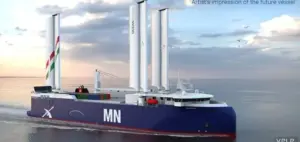
Perhaps the most speculative yet technologically plausible frontier lies in the domain of superyachts and large commercial tankers. Historically, the immense displacement and power demands of superyachts have made all-electric propulsion impractical using battery storage alone. However, the emergence of subcritical thorium microreactors, such as the architecture developed by AMPERA in partnership with Scorpio Tankers, could fundamentally alter maritime engineering.
Unlike conventional critical reactors that maintain a self-sustaining fission chain reaction, AMPERA’s design operates in a subcritical regime:
The reactor core cannot sustain fission on its own.
External neutron generators continuously supply the neutron flux necessary to breed thorium into uranium-233 and drive the reaction.
If power needs to be cut, the external neutron generators are simply switched off, causing the reaction to cease instantly with zero risk of runaway thermal events or days-long cooldown transients.
While nuclear-powered superyachts and floating power barges are still in development, this subcritical architecture removes the historic safety, control, and regulatory hurdles that have kept atomic energy out of civilian marine applications.
Conclusion
From a five-hairdryer energy footprint on a Norwegian river ferry to the high-speed grace of hydrofoils in Tasmania, clean marine technology has matured from an ambitious concept into an unstoppable global movement. Supported by robust fast-charging networks, resilient marine solar materials, intelligent harbor management tools, and visionary propulsion concepts, the future of boating is undeniably electric.