






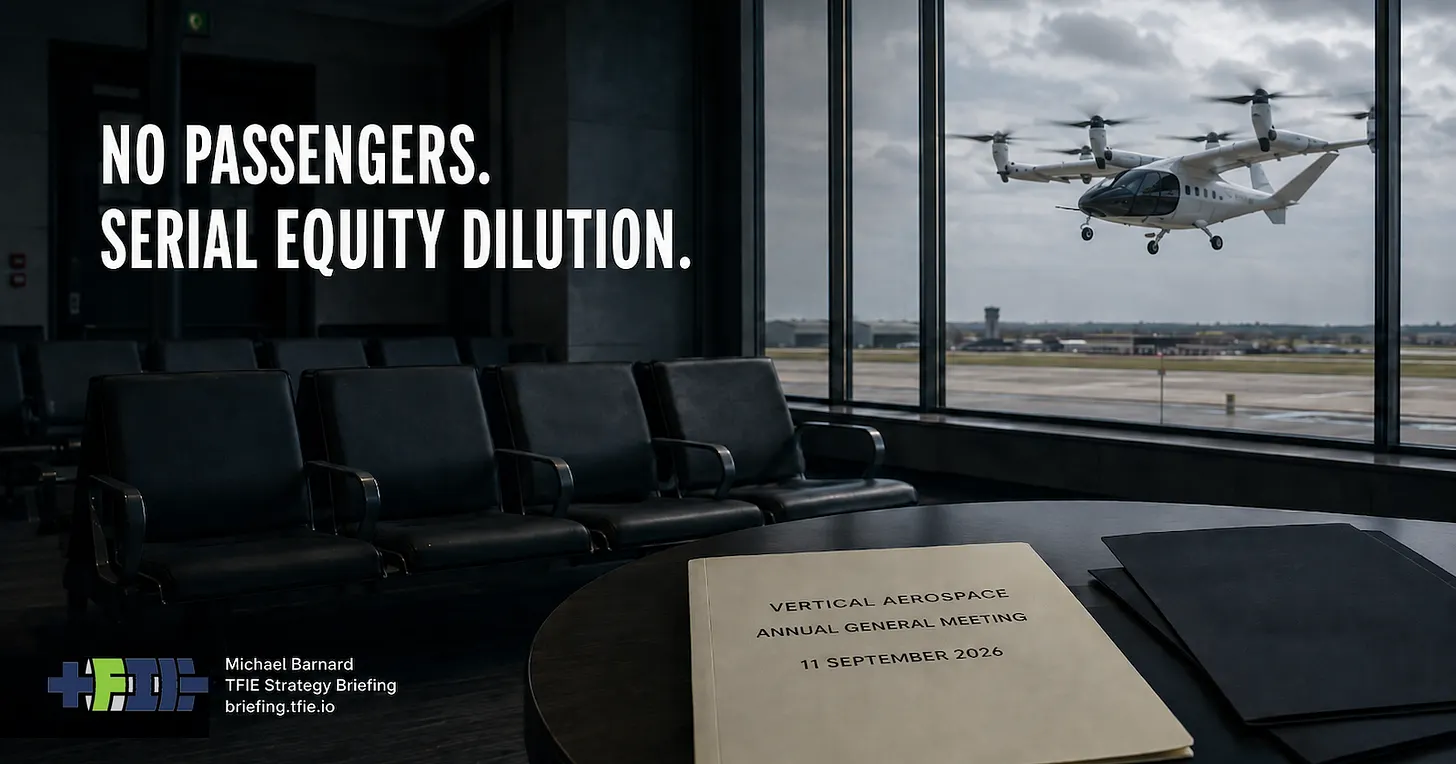
The aerospace sector has long been defined by the tension between technical ambition and commercial viability. Few contemporary ventures encapsulate this historic dichotomy quite as starkly as Vertical Aerospace. At the July Farnborough International Airshow, the company achieved a critical technical triumph, executing successful, highly publicized piloted transitions between vertical take-off and wingborne flight before live audiences. For an industry accustomed to protracted development cycles and skepticism, witnessing a powered-lift electric vertical takeoff and landing (eVTOL) aircraft cleanly execute these complex aerodynamic phases is undeniable proof of real engineering progress.
Yet, this triumph of physics highlights a deeper, unresolved challenge: the chasm separating technical execution from commercial reality. Five years after Vertical’s initial public offering on the New York Stock Exchange (NYSE) in late 2021, the firm remains pre-revenue, targeting commercial certification around 2029. Crucially, its journey toward the finish line continues to be fueled almost entirely by outside capital injections rather than organic, customer-driven cash flows.
While Farnborough successfully reduced technical uncertainty by proving that Vertical’s aircraft can fly as intended, it did little to address commercial uncertainty. The airshow demonstrations did not put paying passengers into routine service, establish scalable commercial utilization, or prove that passenger revenue can sustainably support the sprawling operational and infrastructural ecosystem required for modern urban air mobility (UAM). As Vertical approaches its annual general meetings and navigates ongoing stock exchange compliance hurdles, the core question facing the advanced air mobility (AAM) sector remains unchanged: Can developers build a mass passenger market large enough to justify the immense capital expenditure required to get these aircraft off the ground?
Detailed Chronology: From the 2021 SPAC Debut to the 2026 Farnborough Milestone
To understand Vertical’s current market position, it is necessary to trace the financial and operational trajectory that brought the company from its initial public market debut to the skies above Farnborough.
Late 2021: The SPAC Debut and Initial Capital Projections
Vertical Aerospace entered public markets in November 2021 via a high-profile business combination with Broadstone Acquisition Corp., a special purpose acquisition company (SPAC). At the time of the listing, company leadership presented a straightforward financial proposition to investors: approximately $300 million in transaction proceeds—supplemented by convertible senior secured notes—comfortably exceeded the roughly $250 million the firm projected spending to achieve type certification and scale commercial production.
In the ebullient market climate of 2021, this capital cushion was widely viewed as sufficient to bridge the gap between prototype development and commercialization. However, aerospace research and development is notoriously unforgiving. Timelines routinely slip, regulatory scrutiny expands alongside technological complexity, and development budgets balloon.
2024: Navigating Exchange Compliance and Capital Restructuring
As development progressed through the ensuing years, the initial $300 million funding buffer proved inadequate. By 2024, Vertical faced mounting financial pressure compounded by macroeconomic headwinds, inflationary pressures, and tightening capital markets.

During this period, the company’s common stock dipped below the critical $1 minimum closing price threshold mandated by the New York Stock Exchange. Under NYSE rules, companies falling below this threshold face formal delisting procedures unless they restore compliance within designated cure periods. To address this deficiency and maintain its public listing, Vertical’s leadership sought and received shareholder approval to implement a one-for-ten reverse share split in September 2024.

This financial engineering maneuver temporarily restored nominal share price compliance, but it underscored a growing reliance on complex capital structures. Over time, Vertical moved away from the simple equity narrative of 2021, increasingly leaning on a sophisticated mix of common equity, convertible securities, preferred capital, and committed financing facilities to sustain operations.
July–September 2026: Farnborough Triumphs and Continued Fundraising
The summer of 2026 brought a mix of high-stakes technical triumphs and ongoing financial maneuvers. In July, Vertical’s presence at the Farnborough International Airshow marked a watershed engineering moment. For consecutive days, the company publicly demonstrated piloted transitions between vertical lift and horizontal wingborne flight. This maneuver is widely considered the ultimate technical bottleneck for eVTOL aircraft, proving stability across the entire flight envelope.
Yet, almost immediately following these demonstrations, financial reality reasserted itself. In August 2026, Vertical announced another approximately $100 million in new financing. According to the company’s H1 2026 business update released shortly thereafter, this capital infusion, alongside anticipated facility draws and existing cash reserves, provided an estimated 12 months of operational runway. Funds were earmarked for ongoing certification activities, manufacturing readiness, and hybrid-electric powertrain development.
As the company convened its annual general meeting on September 11, 2026, its stock price once again tested the NYSE’s $1 threshold. While this date did not represent an immediate guillotine-style delisting deadline—owing to the exchange’s multi-step cure architecture—it served as a powerful reminder of the relentless capital demands facing pre-revenue aerospace developers.
Supporting Context & Metrics: The Economics of eVTOL vs. Regional Aviation
The challenges facing Vertical Aerospace are not isolated anomalies; they reflect structural realities inherent to the entire advanced air mobility sector. Analysts tracking the electrification of flight have long warned of a fundamental mismatch between how traditional aerospace markets operate and how eVTOL startups attempt to manufacture demand.
Creating Markets vs. Serving Existing Routes
In traditional regional aviation, new aircraft programmes—even those experiencing technical hiccups, certification delays, or budget overruns—enjoy a distinct structural advantage: they target established customers. Airlines, passenger networks, air traffic control protocols, and physical airport infrastructure already exist. When a manufacturer designs a new turboprop or regional jet, it is plugging into a pre-existing multi-billion-dollar commercial machinery.
Conversely, urban and premium eVTOL developers like Vertical are attempting a much heavier lift. They are not merely building an aircraft; they are trying to invent an entirely new mass passenger market from scratch. This requires simultaneously proving out:
- The Aircraft: Achieving regulatory certification for radically novel aerodynamic and propulsion architectures.
- The Market: Demonstrating that a sufficient volume of premium-paying passengers exists to support high-frequency urban routes.
- The Operations: Establishing efficient fleet management, pilot training pipelines, and maintenance schedules.
- The Infrastructure: Securing urban real estate for vertiports, high-capacity charging grids, and local municipal approvals.
Each of these pillars requires massive capital outlays. Consequently, while individual milestones—such as hover tests, piloted flights, factory unveilings, and conditional airline pre-orders—generate waves of positive PR and valuation bumps, they do little to solve the underlying commercial unit economics.

The Dilution Trap and Capital Architecture
Because passenger revenue remains years away, eVTOL developers must continually return to the capital markets to fund operations. As seen in Vertical’s evolution from its 2021 SPAC listing to its 2026 capital raises, financing architectures inevitably grow more complex over time.
Early investors holding common equity frequently face substantial dilution as companies issue convertible notes, preferred shares, and warrant packages to attract risk-tolerant institutional backers. While securing ongoing financing is a testament to management’s ability to keep the lights on—proof that the company has options and is not facing imminent collapse—it fundamentally alters the risk-reward profile for common shareholders. Until an eVTOL program successfully makes the transition from investor financing to customer financing, equity holders will bear the brunt of capital dilution necessary to reach the certification finish line.
Official Statements and Industry Perspectives
Leadership at Vertical Aerospace has consistently emphasized the rigorous nature of their engineering program and the monumental scale of regulatory compliance. Speaking around the Farnborough Airshow, executives pointed to the flawless execution of transition flight as tangible proof that the company’s proprietary technology is maturing on schedule toward its targeted 2029 certification window.
Industry observers, however, maintain a healthy separation between applause for engineering teams and scrutiny of financial ledgers. Independent strategic analyses, such as those published by TFIE Strategy Briefings and sector commentators, repeatedly highlight the divergence between technical milestones and commercial viability.
Market analysts emphasize that while the public relations machinery surrounding airshows thrives on dramatic flight demonstrations, the ultimate metric for success is not how gracefully an aircraft transitions from hover to forward flight, but whether its operating cost per seat-mile can compete with ground-based alternatives and legacy helicopters. Until commercial utilization metrics are tested in the wild, executive optimism must be weighed against the hard arithmetic of cash burn rates and share price dilution.
Future Outlook: The Road to 2029 Certification
As Vertical Aerospace looks past its September 2026 milestones and charts its course toward the 2029 certification horizon, several critical inflection points will determine its survival and ultimate success:
- Regulatory Milestones with EASA and the CAA: The path to type certification under the European Union Aviation Safety Agency (EASA) and the UK Civil Aviation Authority (CAA) remains grueling. Meeting rigorous safety standards will require uninterrupted funding and flawless execution during flight test campaigns.
- Sustaining Exchange Compliance: Management will need to navigate ongoing stock price pressures, utilizing available corporate mechanisms—such as operational milestones, strategic partnerships, or structural share adjustments—to maintain its primary listing on the NYSE without eroding shareholder value beyond recognition.
- Proving the Commercial Case: The true test for Vertical will arrive when the engineering phase concludes and commercial operations begin. The company must transition from burning outside capital to generating sustainable cash flows from actual paying passengers.
Vertical Aerospace has demonstrated that its engineering team possesses the technical acumen to design and fly a complex electric aircraft. The triumphs at Farnborough proved that much. But as five years of continuous recapitalization have shown, engineering progress and market validation are two entirely different disciplines. While the skies above airshows are crowded with promise, the hard work of building a viable commercial business remains grounded in reality.