Executive Overview
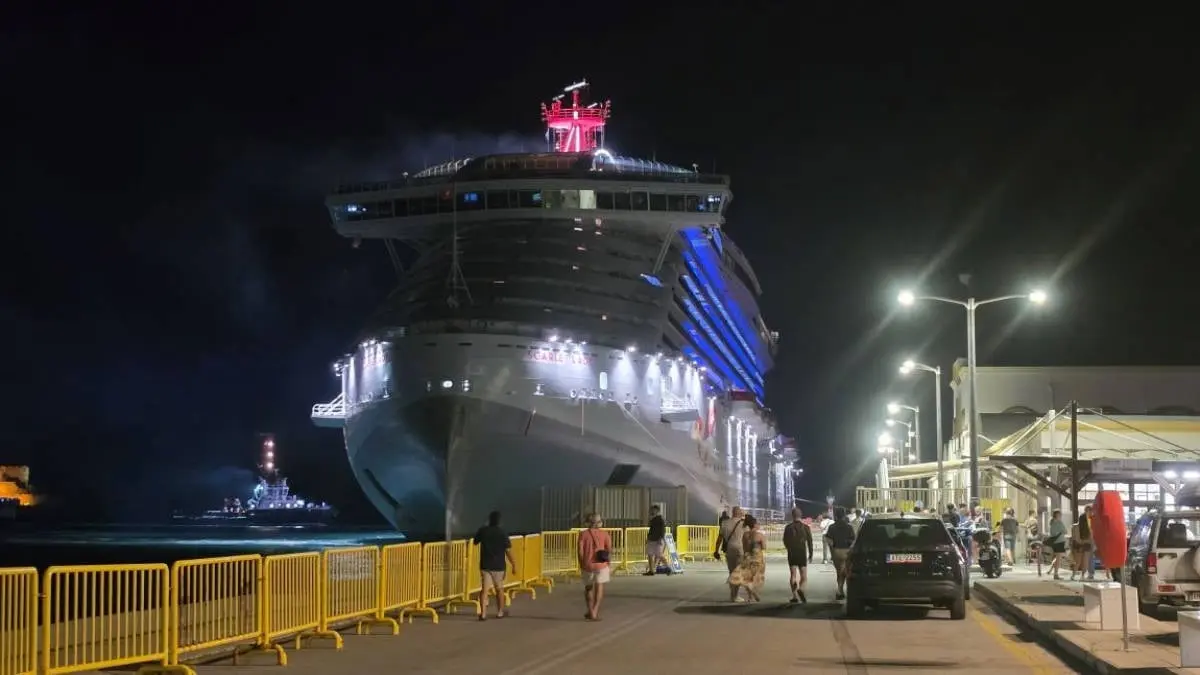
In the fast-paced, high-amenities world of modern luxury cruising, the safety and structural security of a vessel at berth are paramount. However, Mother Nature occasionally asserts her dominance over even the most advanced maritime engineering. On the evening of Wednesday, September 30, 2026, Virgin Voyages’ vibrant and distinctive cruise ship, the Scarlet Lady, became the focal point of a dramatic maritime incident at the Port of Rhodes, Greece.
Buffeted by severe weather systems, exceptionally strong waves, and heavy swells battering the Aegean coast, the massive 110,000-gross-ton vessel broke free from her moorings. The sudden snapping of the ship’s heavy-duty lines sent the 2,770-guest floating resort drifting away from the dock toward the outer edge of the harbor. During the brief drift, the cruise ship made contact with a nearby catamaran and two smaller vessels, creating a tense atmosphere for onlookers ashore and individuals aboard.
Despite the inherent dangers of a massive cruise ship drifting untethered in a restricted harbor, quick thinking by local port authorities, combined with the vessel’s propulsion capabilities, prevented a full-scale maritime disaster. No injuries were reported among passengers or crew, and an initial assessment revealed no significant structural damage to either the Scarlet Lady or the smaller craft involved.
The incident was the direct result of a weather-forced itinerary modification that kept the ship in Rhodes longer than originally scheduled. While broken mooring lines are an infrequent occurrence in the cruising industry, this event highlights the vulnerability of mega-ships to sudden meteorological shifts and reinforces the critical nature of robust port safety protocols.
Detailed Chronology of Events
The Setup: An Evening of Rising Tensions
By the evening of September 30, 2026, the Greek island of Rhodes was already experiencing adverse weather conditions. Gale-force winds and turbulent sea states had been plaguing parts of the Aegean Sea for days, forcing regional port authorities to maintain high-alert statuses.
The Scarlet Lady, which was docked at the Port of Rhodes as part of an extended stay, was bearing the brunt of the heavy swells. While Virgin Voyages is widely celebrated for its signature "Scarlet Night"—a high-energy, crimson-themed party onboard—the phrase took on an entirely different, literal meaning for passengers and crew that night as turbulent waters tested the ship’s physical restraints.
The Breakaway
Precise timestamps regarding the exact moment the disaster began vary slightly depending on local accounts. Some harbor reports indicate that the stress on the heavy mooring lines reached a critical threshold just after 8:15 p.m., while other maritime observers place the incident closer to 9:15 p.m.

Regardless of the exact minute, the outcome was immediate and severe. Under the relentless assault of strong waves and heavy undertow swells, several heavy-duty mooring lines snapped. The loud, sharp reports of the breaking lines echoed across the harbor.
Freed from its physical connection to the pier, the 110,000-gross-ton mega-ship—acting like a massive sail against the high winds—began to pull away from the dock, slowly drifting toward the periphery of the harbor. Video footage captured by bystanders on the shore quickly circulated on social media platforms like X (formerly Twitter), showcasing the eerie scale of the drifting vessel as local onlookers watched in astonishment.
The Collisions and Immediate Response
As the Scarlet Lady drifted toward the harbor’s edge, its sheer mass brought it into contact with a local catamaran and two smaller watercraft moored nearby. Given the size differential between a 2,770-passenger cruise ship and localized pleasure craft, the potential for catastrophic crushing damage was exceptionally high. Fortunately, the momentum was relatively slow, and the contact was cushioned by the surrounding waters and fendering systems.
Realizing the gravity of the situation, the Port of Rhodes activated its emergency response protocols instantaneously. Local tugboats were immediately put on standby, revving their engines to deploy and assist the drifting giant if necessary.
However, the capabilities of the Scarlet Lady’s advanced bridge and propulsion systems ultimately saved the day. Operating under her own power, the ship’s master and bridge officers successfully utilized the vessel’s thrusters and engines to maneuver the ship away from further hazards and guide her safely back to a stable mooring position against the pier.
Supporting Context & Metrics
Vessel Profile: Scarlet Lady
To understand the kinetic forces involved in the Rhodes incident, one must look closely at the specifications of the ship itself:
- Gross Tonnage: Approximately 110,000 GT
- Passenger Capacity: 2,770 guests (double occupancy)
- Crew Members: Roughly 1,160 international crew
- Length: 278 meters (912 feet)
- Beam (Width): 38 meters (125 feet)
- Propulsion: Diesel-electric, equipped with state-of-the-art azipod thrusters enabling high-precision harbor maneuvering.
When a vessel of this scale is subjected to sustained high winds and shifting wave action, the lateral windage area acts as a giant sail, placing immense, multi-directional stress on the mooring lines. Even industrial-grade synthetic and wire ropes can fail when cyclical wave loading creates harmonic resonance and sudden peak tension loads.
The Weather-Driven Itinerary Pivot
The only reason the Scarlet Lady was exposed to the hazards of Rhodes at that specific hour was due to a proactive, weather-induced itinerary change executed days prior.
The ship had originally embarked on a 7-night Greek Isles voyage from Piraeus (Athens) on Sunday, September 27, 2026. The initial schedule was designed to be an idyllic tour of the Aegean, featuring stops in:
- Bodrum, Turkey: Tuesday (8:00 AM – 8:00 PM)
- Rhodes, Greece: Wednesday (9:00 AM – 6:00 PM)
- Mykonos, Greece: Thursday to Friday (Overnight stay)
- Santorini, Greece: Saturday (7:00 AM – 7:00 PM)
However, meteorologists tracking regional depressions warned Virgin Voyages operations of deteriorating conditions in the northern Cyclades. Specifically, high winds rendered the Port of Mykonos unsafe for docking or tender operations.
Faced with these closures, Virgin Voyages management made the executive decision to alter the route to ensure passenger safety and comfort. On Tuesday, September 29, guests received an official notification:
"Due to high winds, the Port of Mykonos has closed so we’ve had to adjust our itinerary. Instead of calling in Mykonos on Thursday and Friday, we’re extending our stay in Rhodes with an overnight."
Under this revised schedule, the ship arrived in Rhodes as planned on Wednesday morning, September 30, but was scheduled to remain docked overnight through Thursday afternoon, October 1. A substitute call to Chania (Crete) was hurriedly added for Friday, October 2, to maintain the vacation experience.
Had it not been for this weather diversion, the Scarlet Lady would have safely departed Rhodes at its original scheduled time of 6:00 p.m. on Wednesday—well before the most destructive wind gusts and sea swells peaked in the harbor. Following the incident and the completion of its makeshift itinerary, automated Automatic Identification System (AIS) tracking confirmed the ship safely transited to Chania and continued on toward Santorini.
Official Statements and Industry Perspective
Line-Snap Incidents Across the Global Cruise Industry
While dramatic, the snapping of mooring lines during severe weather is an acknowledged, albeit rare, operational hazard within the global cruise industry. When unexpected squalls, microbursts, or heavy harbor surges occur, ports can rapidly transform from safe havens into hostile environments.
Recent maritime history underscores that the Scarlet Lady incident is part of a broader pattern of weather-related pier escapes in 2026:
- January 18, 2026 – Port Canaveral, Florida: A sudden, violent burst of high winds caught the Norwegian Prima off guard, snapping her mooring lines and causing the ship to drift away from the dock before tugs intervened.
- February 5, 2026 – Ocean Cay MSC Marine Reserve, Bahamas: High seasonal winds exerted extraordinary pressure on the pier at MSC Cruises’ private island, causing the MSC Seaside to break free from its moorings.
- September 8, 2026 – Le Havre, France: In an incident bearing striking similarities to the Rhodes event, the AIDAperla broke free from the quay due to severe gales. That incident resulted in a temporary port closure, a two-hour delay for neighboring maritime traffic, and the cancellation of a subsequent port call in Zeebrugge so the ship could undergo mandatory structural integrity inspections.
Maritime safety experts point out that while modern cruise ships feature advanced dynamic positioning and powerful bow and stern thrusters, the physical interface between the ship and the concrete pier—the lines and bollards—remains vulnerable to extreme kinetic energy spikes caused by rogue swells.
The Human Element: Reassuring Guests and Crew
Following the Rhodes incident, Virgin Voyages’ onboard management team and corporate communications quickly moved to reassure both passengers and the traveling public.
In official statements released shortly after the vessel was secured, representatives confirmed:
- There were zero injuries reported among the nearly 2,700 guests onboard.
- There were zero injuries among the over 1,000 crew members.
- Initial underwater and surface inspections conducted by ship engineers revealed no breach of hull integrity or structural damage that would impede the continuation of the voyage.
- Port authorities in Rhodes cleared the vessel to resume its voyage after verifying that the harbor infrastructure and the ship itself remained sound.
Guests onboard took to social media to share that while the sudden lurching of the ship was startling, the crew handled the situation with remarkable poise, keeping passengers informed through regular public address announcements and maintaining onboard services without interruption.
Future Outlook and Operational Takeaways
As the cruise industry continues to navigate an era marked by increasingly volatile weather patterns driven by shifting global climate dynamics, incidents like the one involving the Scarlet Lady serve as crucial learning opportunities for port authorities, cruise lines, and maritime regulators.
1. Enhanced Weather Forecasting and Port Infrastructure
Ports across the Mediterranean—particularly historic harbors like Rhodes that were never originally engineered to accommodate modern 110,000-ton mega-ships—face unique infrastructural challenges. Moving forward, port authorities are expected to accelerate investments in high-load, quick-release hook systems, advanced telemetry to monitor line tension in real time, and upgraded breakwaters designed to mitigate long-period swells inside harbors.
2. Algorithmic Itinerary Flexibility
Cruise lines are increasingly relying on predictive meteorological modeling software to make proactive, rather than reactive, itinerary changes. While bypassing popular islands like Mykonos or extending stays in ports like Rhodes is disruptive to vacation planning, the alternative—risking structural collisions or groundings during unexpected squalls—far outweighs the temporary inconvenience to passengers.
3. The Resiliency of Modern Mega-Ships
Ultimately, the Scarlet Lady incident underscores the supreme capability of modern maritime engineering. The fact that a floating metropolis carrying thousands of people can suffer a catastrophic failure of its physical tethers, drift into foreign vessels, and yet safely recover its position entirely under its own power is a testament to modern ship design, rigorous crew training, and effective bridge resource management.
As the Scarlet Lady continues to sail through the azure waters of the Mediterranean, the events of September 30, 2026, will serve as a stark reminder of the unpredictable power of the sea—and a masterclass in how professional seamanship can turn a potential disaster into a safe, albeit unforgettable, chapter in a voyage.