Executive Overview
While the dramatic, postcard-worthy cliffs of Cornwall and the rolling downs of the Jurassic Coast command a lion’s share of domestic and international tourism, England’s northern reaches harbor secrets of equal, if not superior, maritime allure. Nestled within the county of Tyne and Wear (historically known as Tyneside) lies Whitley Bay: a vibrant, cosmopolitan coastal town that effortlessly bridges its gritty industrial heritage with a resurgent Victorian-era seaside charm.
Long overshadowed by its bustling neighbor, Newcastle upon Tyne, just 10 miles to the southwest, Whitley Bay remains a pristine anomaly along the British coastline. It offers unrestricted water access, miles of pristine golden sands, award-winning surf breaks, and an architectural landscape characterized by grand facades and innovative modern restorations. Yet, despite holding a reputation among surfers, families, and discerning travelers as a top-tier weekend retreat, it has largely avoided the suffocating commercialization that plagues better-known southern hotspots.
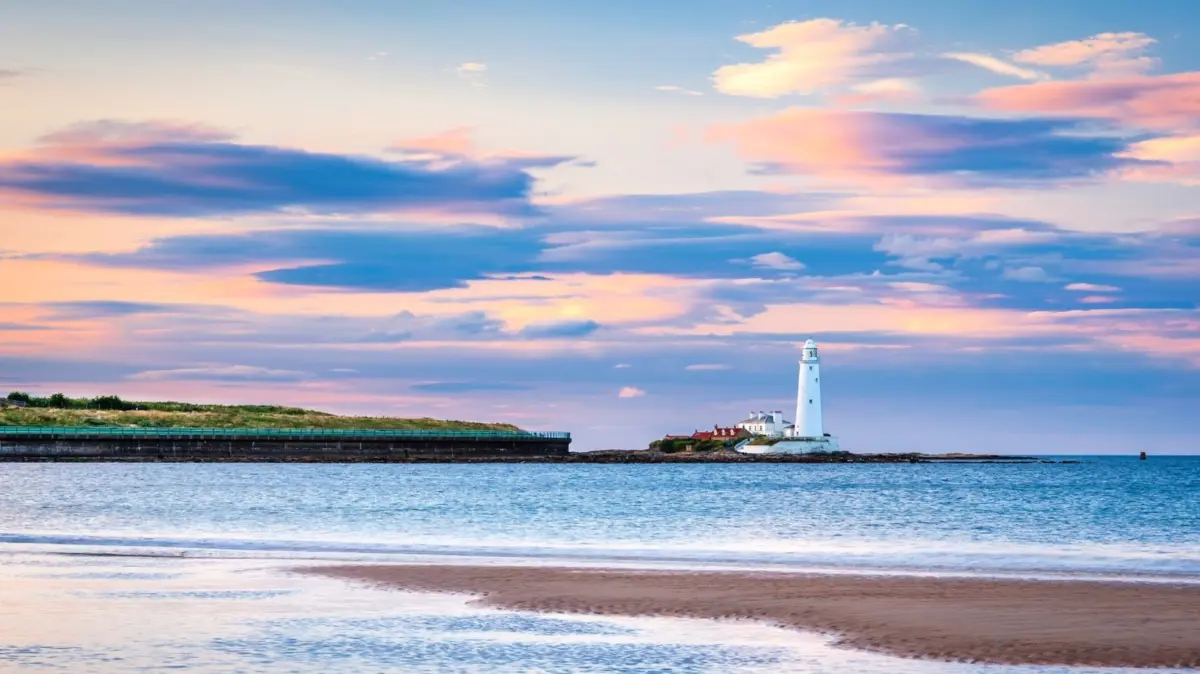
From the shifting sands of its Blue Flag beach to the geological wonder of St. Mary’s Lighthouse—an operational Victorian beacon that transforms into an isolated island twice daily—Whitley Bay presents a compelling case study in modern coastal regeneration. Driven by a burgeoning culinary scene celebrating sustainably sourced North Sea seafood, a burgeoning retail market powered by independent artisans, and seamless public transit connectivity, this Tyneside sanctuary is shedding its working-class industrial past to emerge as one of northeast England’s most enticing destinations.

Detailed Chronology and Historical Evolution
To truly appreciate Whitley Bay’s current renaissance, one must examine the socio-economic arc that transformed it from a modest rural township into a bustling coal-mining hub, and ultimately, into a flourishing Victorian and Edwardian resort town.
The Industrial Roots and Victorian Expansion
For centuries, the land enveloping Whitley Bay was defined by agriculture and extraction. Operating primarily as a small agricultural settlement tied to the larger parish of Tynemouth, the area experienced a seismic shift with the Industrial Revolution. The discovery and extraction of coal throughout Tyneside turned the surrounding landscape into a hive of mining activity. Collieries dotted the region, and rudimentary rail systems were laid out to transport coal toward the River Tyne for global export.
However, by the mid-to-late 19th century, the undeniable scenic value of the coastline began to overshadow its industrial output. With the arrival of the North Eastern Railway, the region experienced an accessibility boom. Working-class families from Newcastle and industrial barons alike began looking toward the coast for respite from the soot and grime of city life. Whitley Bay rapidly transitioned from a quiet mining and farming community into a premier Victorian seaside resort.
Grand hotels, boarding houses, and entertainment pavilions sprang up overnight. The construction of promenades and the expansion of transport links solidified the town’s identity as a place of leisure. The legacy of this golden era remains etched into the urban fabric today, visible in the sweeping Victorian and Edwardian architecture that lines the avenues, framing views of the North Sea.

The 20th Century and the Spanish City Phenomenon
As the 20th century dawned, Whitley Bay sought to cement its status as a destination of national renown. The crown jewel of this ambition opened in 1910: the Spanish City complex. Designed to rival the grand entertainment palaces of continental Europe, Spanish City featured a magnificent concert hall, theatres, restaurants, and a sprawling funfair that would eventually be immortalized in popular culture, notably referenced in Dire Straits’ 1980 hit single "Romeo and Juliet."
For decades, Spanish City served as the social epicenter of the Northeast. Generations of families flocked to its iconic dome to dance, dine, and experience the thrill of the seaside amusement park. However, like many British seaside resorts, the latter half of the 20th century brought structural decline. Cheaper commercial aviation made Mediterranean holidays accessible, and domestic seaside tourism suffered a prolonged slump. The Spanish City dome fell into disrepair, shuttered, and stood as a melancholy reminder of past glories for years.
The Modern Regeneration
The 21st century has marked a triumphant chapter of renewal for Whitley Bay. Spearheaded by local authority investments and community-led revitalization projects, the town has systematically reclaimed its identity. The crowning achievement of this modern era was the multi-million-pound restoration of the Spanish City dome, which reopened its doors to the public in 2018, breathing new life into the local economy and setting a high standard for architectural preservation.
Today, the town operates as a dynamic ecosystem where industrial heritage meets contemporary cool. Surfers share the waves where Victorian bathers once dipped, and independent coffee roasters and artisan boutiques occupy spaces that once served the heavy-industry trade.
Supporting Context and Metrics: Geography, Infrastructure, and Attractions
Understanding Whitley Bay’s accessibility and spatial layout is vital for any traveler looking to bypass the tourist traps of southern England in favor of authentic northern hospitality.
Strategic Location and Transit Infrastructure
Whitley Bay’s geographical advantage lies in its proximity to major transit corridors while retaining a secluded feel. Situated precisely 10 miles northeast of Newcastle upon Tyne, the town functions as a natural extension of the region’s commuter network without sacrificing its distinct identity.
- Air Travel: The nearest major aviation hub is Newcastle International Airport (NCL), located approximately 12 to 14 miles southwest of the town center. Travelers can transition from the airport terminal to the heart of Whitley Bay in under 30 minutes by car, or via the region’s Tyne and Wear Metro system in under an hour.
- Public Transit: Unlike many remote coastal destinations where car rentals are mandatory, Whitley Bay is exceptionally walkable and deeply integrated into the local public transport grid. Frequent bus services and the Tyne and Wear Metro connect the town directly to Newcastle, making car-free travel entirely viable and stress-free.
The Natural and Architectural Landscape
Whitley Bay Beach and Recreational Watersports
At the heart of the town’s appeal is Whitley Bay Beach, a pristine, 2-mile stretch of golden coastline that has consistently earned prestigious Blue Flag recognition for its environmental standards, water quality, and safety provisions.
- Surfing and Water Sports: The North Sea off the coast of Tyneside is increasingly recognized as one of the UK’s hidden surfing frontiers. Consistent swells make Whitley Bay a haven for surfers, paddleboarders, kayakers, and canoeists. Local surf schools operate year-round, catering to both novices and seasoned wave-riders.
- Community Engagement: The beach is famous for its annual sandcastle-building competitions, drawing families from across northern England. According to regional tourism data and traveler metrics aggregated on platforms like Google Maps, the beach maintains high satisfaction ratings, frequently praised for its cleanliness, expansive horizon, and unmatched sunrise views over the North Sea.
St. Mary’s Lighthouse: The Tidal Sentinel
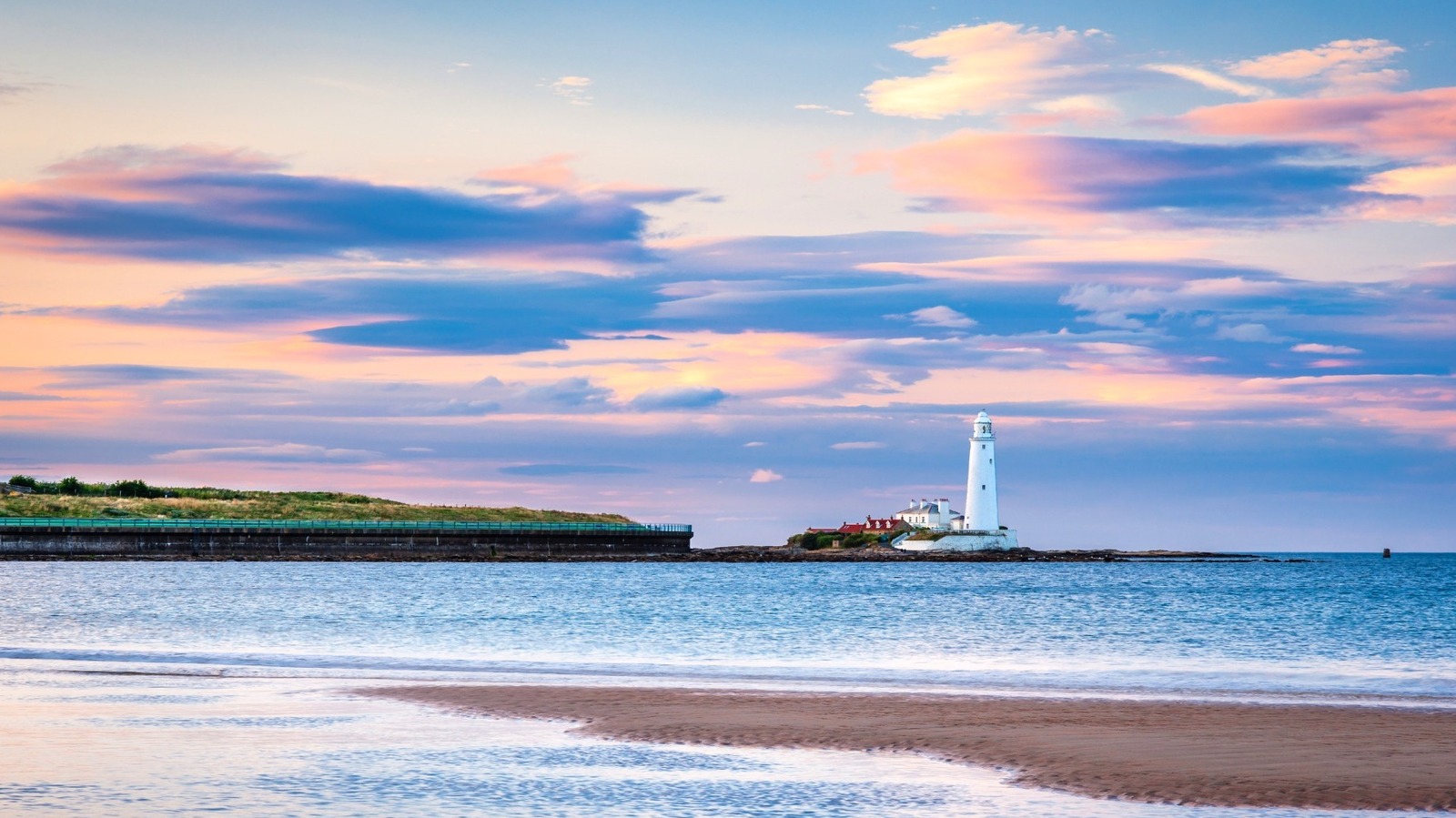
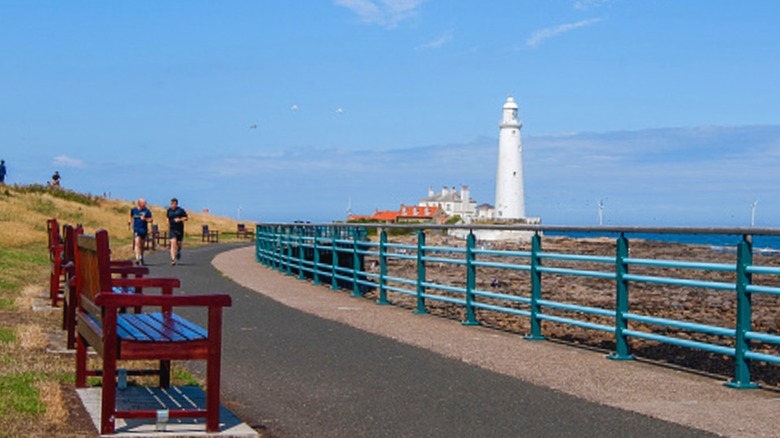
Located half a mile north of the main beach’s boundary sits St. Mary’s Lighthouse, constructed in 1898 on a small rocky tidal island.
- The Tidal Phenomenon: The defining feature of St. Mary’s is its isolation. Twice daily, as high tide rolls in, the concrete causeway connecting the island to the mainland is completely submerged, temporarily cutting the lighthouse off from the British mainland. Visitors are strictly advised to consult local tide tables before crossing to avoid becoming stranded.
- The Visitor Experience: Now operated primarily as a museum, the lighthouse invites intrepid visitors to ascend its 137 spiral steps for panoramic views of the North Sea and the North Tyneside coastline. For those unable to manage the physical climb, a closed-circuit video feed transmits the top-deck views to ground-level displays. The site also features a heritage center, an exhibition room, and a gift shop.
Culinary Excellence: Fresh Seafood and Historic Dining
The gastronomic landscape of Whitley Bay has undergone a quiet revolution, pivoting from traditional seaside fish-and-chip shacks to a sophisticated culinary scene that honors its maritime positioning while catering to modern dietary requirements.
Fisherman’s Bay: Sustainable Coastal Fare
A staple of the town’s dining scene is Fisherman’s Bay, situated to maximize views of the coastline. The establishment has built its reputation on strict sustainability metrics, exclusively sourcing cod from responsibly managed fisheries and pairing it with locally farmed British potatoes.
Recognizing shifts in modern dietary consciousness, Fisherman’s Bay has transcended the traditional chippy model by offering comprehensive gluten-free and vegan alternatives for its classic fish and chips, ensuring that inclusivity matches the quality of its culinary output.
The 1910 Restaurant at Spanish City
For diners seeking a more formal culinary experience infused with architectural history, the 1910 Restaurant stands out as the premier destination. Housed within the restored Spanish City complex, the restaurant pays homage to the building’s 100-plus-year heritage.
- Menu and Offerings: The kitchen specializes in a fusion of classic British coastal fare and contemporary gastronomy. Past menu rotations have featured elevated dishes such as locally caught sea bream, delicate salmon fish cakes, and rich regional fish soups.
- Afternoon Tea: The restaurant’s traditional afternoon tea service has become a regional institution, requiring advanced reservations weeks ahead of time. Diners enjoy tiered trays of finger sandwiches, freshly baked scones, and patisserie while looking out through large windows toward the North Sea.
Retail and Community Craftsmanship
Whitley Bay’s economic resilience is heavily supported by a thriving ecosystem of independent, mom-and-pop retailers, offering an alternative to the homogenized high streets found across much of the United Kingdom.
Artisanal Hubs: Just Canny
Beyond traditional retail spaces like the Park View Shopping Centre, independent stores define the town’s character. Just Canny serves as a cooperative retail space dedicated exclusively to handmade goods crafted entirely within the United Kingdom by independent artists and makers. The inventory spans handcrafted jewelry, original fine art, bespoke homewares, and sustainable accessories. Store owners and resident artisans frequently engage directly with visitors, offering deep insights into the North East’s creative community.
Keel Row Books: A Bibliophile’s Sanctuary
For literature enthusiasts, Keel Row Books represents an essential pilgrimage. Specializing in antiquarian, rare, and collectible editions, the independent bookshop draws collectors from across the UK. Alongside priceless antique volumes, the shop maintains a robust inventory of new publications, rare maps, historical photographs of Tyneside, and fine leather-bound bindings detailing the industrial and social history of northern England.
Official Statements and Expert Perspectives
Regional tourism authorities and heritage preservationists have increasingly cast a spotlight on Whitley Bay as a model for sustainable coastal development.
Jane Henderson, Director of Regional Development for North Tyneside, commented on the town’s trajectory:
"Whitley Bay embodies the very best of northern resilience. For too long, industrial towns struggled to redefine their identities once their primary economic engines shifted. What we have witnessed here is not a corporate-driven gentrification, but an organic, community-led revival. By fiercely protecting our natural assets—such as our Blue Flag beaches and St. Mary’s Lighthouse—while investing heavily in architectural restorations like Spanish City, we have created a destination that honors its past while eagerly embracing the future."
Local historian and cultural preservation advocate Marcus Thorne emphasized the unique geographical and social fabric of the area:
"You cannot separate Whitley Bay from the broader tapestry of Tyneside. The grit, the warmth of the locals, and the architectural ambition of the Victorian era are woven into every street corner. When visitors walk across the causeway to St. Mary’s as the tide rises, they aren’t just visiting a museum; they are engaging with a living landscape that has weathered centuries of social and economic change without losing its soul."
Future Outlook
As the domestic travel market across the United Kingdom continues to prioritize sustainable, uncrowded, and culturally rich destinations, Whitley Bay is well-positioned for measured, strategic growth.
Economic and Tourism Projections
Local municipal planners have outlined continuous investments in green infrastructure, pedestrian-friendly urban planning, and coastal preservation over the next decade. The integration of enhanced cycle paths connecting Whitley Bay to adjacent heritage sites—such as Tynemouth Priory and the ancient paths of Hadrian’s Wall country further inland—aims to capture the burgeoning adventure-tourism demographic.
Furthermore, as international travelers increasingly seek out authentic regional experiences away from London and the southern tourist hubs, Newcastle International Airport’s proximity ensures that Whitley Bay can effortlessly absorb an influx of curious global explorers.
Preservation vs. Progress
The primary challenge facing Whitley Bay in the years ahead will be balancing commercial expansion with the preservation of its small-town, independent charm. Local business associations, community land trusts, and municipal councils remain steadfast in their commitment to prioritizing local, independent traders over corporate chains.
Ultimately, Whitley Bay’s future looks as bright and restorative as the sunrises breaking over its golden sands. By remaining faithful to its industrial heritage, its Victorian architectural splendor, and its deep-rooted community spirit, this northern coastal town has proven that undiscovered gems still exist for those willing to look beyond the well-trodden path.