











Executive Overview
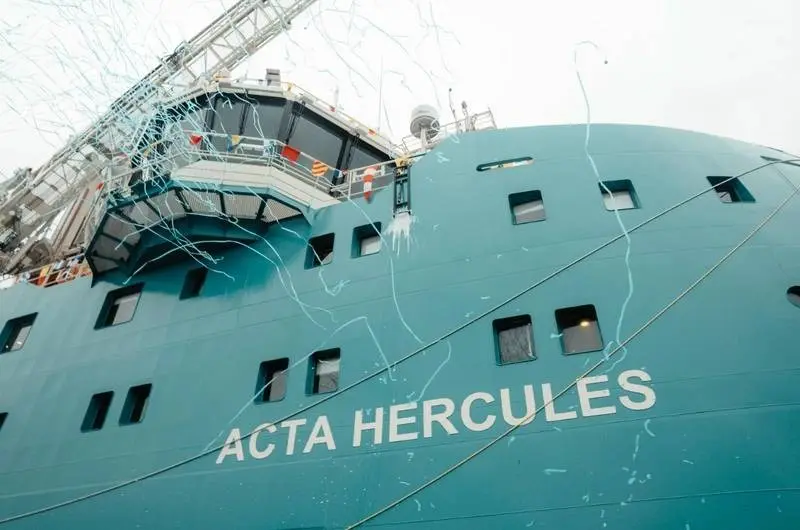
In a ceremony that underscores the rapid technological evolution and tightening supply chain dynamics of the European offshore wind sector, Dutch marine contractor Acta Marine has formally christened its state-of-the-art Commissioning Service Operation Vessel (CSOV), Acta Hercules. Held in the strategic Dutch offshore energy hub of IJmuiden, the event marks a pivotal milestone in the company’s ambitious asset-renewal strategy.
As the second vessel delivered under Acta Marine’s pioneering four-vessel newbuild program, the Acta Hercules represents the vanguard of next-generation, low-emission offshore support vessels. Already fully operational and deployed under a lucrative, long-term charter with Danish wind turbine manufacturing giant Vestas, the vessel is actively supporting critical construction and maintenance campaigns in the North Sea.
The Acta Hercules is engineered to address two of the offshore wind industry’s most pressing contemporary challenges: the urgent need for highly stable, high-capacity accommodation and walk-to-work (W2W) platforms in increasingly deep waters, and the maritime sector’s mandated transition toward decarbonization. Outfitted with a cutting-edge hybrid propulsion system—featuring methanol dual-fuel engines integrated with an advanced battery energy storage system (BESS)—the vessel serves as a operational proof-of-concept for low-carbon maritime logistics.

This commissioning comes at a critical juncture for the European offshore wind sector. As developers race to meet the European Union’s expanded renewable energy targets for 2030, demand for specialized marine assets has surged, triggering a supply squeeze for high-specification CSOVs. By executing this asset expansion, Acta Marine is positioning itself as a dominant player in the European Walk-to-Work and offshore construction services market, with its dedicated fleet set to reach seven specialized vessels by 2026.
Detailed Chronology: The Road to the Four-Vessel Newbuild Program
The christening of the Acta Hercules in IJmuiden is the culmination of a multi-year capital expenditure program designed to transition Acta Marine’s fleet away from conventional diesel-mechanical propulsion toward highly flexible, future-proofed hybrid platforms.
[Late 2021 / 2022]  --->  [Early 2024]         --->  [Mid 2024]            --->  [Late 2026 (Est.)]
Program Initiated         Acta Pegasus Delivered     Acta Hercules &       Acta Aquarius Delivery
& Orders Placed           & Deployed                 Gemini Deployed       Completes 7-Vessel Fleet
The Genesis of the Fleet Renewal
The conceptualization of the four-vessel CSOV program began during the post-pandemic market recalibration, when offshore wind developers began demanding longer-term vessel commitments to secure capacity for massive utility-scale projects. Recognizing that older, less efficient vessels would face both regulatory headwinds (such as the IMO’s Carbon Intensity Indicator and the EU Emissions Trading System) and commercial obsolescence, Acta Marine partnered with renowned Norwegian ship designer Ulstein Design & Solutions AS and construction yards to develop the SX216 design template.
Delivery and Deployment Timeline
The rollout of the four-vessel newbuild program has progressed systematically, demonstrating robust project management despite global shipyard supply chain bottlenecks:

- Acta Pegasus (First-in-Class): Delivered in early 2024, this vessel set the operational benchmark for the series, immediately entering service to support offshore commissioning activities in European waters.
- Acta Hercules (Second-in-Class): Delivered in the second quarter of 2024, the vessel bypassed immediate ceremonial duties to fulfill urgent operational requirements for its charterer, Vestas. It was successfully integrated into active offshore wind farm operations prior to its formal christening.
- Acta Gemini (Third-in-Class): Following closely behind its sister ships, the third vessel was delivered and commissioned in late 2024, further expanding Acta Marine’s active market share.
- Acta Aquarius (Fourth-in-Class): Currently under construction, the final vessel in this specific newbuild program is scheduled for delivery in late 2026.
The formal christening of the Acta Hercules in IJmuiden served not only as a ceremonial milestone but as a operational pause to celebrate the successful deployment of the vessel. The selection of Marina van Oord as the vessel’s godmother highlights the deep-rooted connections within the Dutch maritime cluster. The Van Oord family holding company, MerweOord, has historically maintained a foundational stake in Acta Marine, illustrating the intergenerational continuity of Dutch offshore engineering expertise.
Supporting Context & Technical Metrics
The Acta Hercules is not merely an incremental addition to the European offshore fleet; it represents a major technological leap forward in vessel design, marine engineering, and environmental compliance.
+-----------------------------------------------------------------------------+
|                         ACTA HERCULES: KEY METRICS                          |
+-----------------------------------------------------------------------------+
| Vessel Design        | Ulstein SX216 (TWIN X-STERN® Hull Form)             |
+----------------------+------------------------------------------------------+
| Propulsion System    | Methanol Dual-Fuel Engines + Battery Storage (BESS)  |
+----------------------+------------------------------------------------------+
| Dynamic Positioning  | DP2 Advanced Station-Keeping                         |
+----------------------+------------------------------------------------------+
| Logistics Assets     | Motion-Compensated Gangway & 3D Crane System         |
+----------------------+------------------------------------------------------+
| Primary Charterer    | Vestas (Long-term offshore wind support)            |
+----------------------+------------------------------------------------------+
| Port of Registry     | Rotterdam, Netherlands                               |
+----------------------+------------------------------------------------------+
The SX216 Design and TWIN X-STERN® Hull Form
The vessel is built to the specialized Ulstein SX216 design, which incorporates the innovative TWIN X-STERN® hull shape. This design features pointed bow and stern profiles, coupled with main propellers at both ends.
For Dynamic Positioning (DP) operations, this hull geometry offers profound advantages:
- Reduced Power Demand: The vessel can operate with either end facing the weather, drastically reducing the thruster power required to maintain station-keeping in harsh North Sea environments.
- Enhanced Comfort: By minimizing slamming and pitch motions, the hull design significantly improves onboard comfort, reducing seasickness among the embarked technicians—a critical factor in maintaining labor productivity during multi-week offshore rotations.
- Fuel Efficiency: In typical DP operational profiles, the TWIN X-STERN® can yield fuel savings of up to 20% compared to conventional transom-stern vessels.
Hybrid Propulsion and Decarbonization Pathways
At the heart of the Acta Hercules’ environmental profile is its hybrid power plant. The vessel is equipped with dual-fuel engines capable of running on green methanol, supplemented by a high-capacity battery energy storage system (BESS).
- Methanol Dual-Fuel Capabilities: Green methanol (e-methanol or biomethanol) offers a viable pathway to near-carbon-neutral operations. When running on green methanol, the vessel’s net carbon dioxide emissions are reduced by up to 90% compared to marine gas oil (MGO). It also virtually eliminates sulfur oxides ($SO_x$) and particulate matter emissions.
- Battery Energy Storage System (BESS): The onboard battery pack serves multiple roles. It acts as a spinning reserve during DP operations, allowing the vessel to run fewer combustion engines at higher, more efficient load profiles. Furthermore, the BESS provides peak-shaving capabilities, absorbing load spikes during crane operations or heavy thruster adjustments, thereby preventing transient engine inefficiencies.
Specialized Walk-to-Work (W2W) Infrastructure
To serve its primary role as a CSOV, the vessel features an integrated logistics suite designed for the safe and efficient transfer of personnel and cargo from the ship to offshore wind turbine foundations and substations:
- Motion-Compensated Gangway: The vessel is outfitted with an advanced, height-adjustable, motion-compensated gangway system. This system utilizes real-time sensor data and hydraulic actuators to counteract the vessel’s six degrees of freedom, ensuring a stable, bridge-like walkway for technicians even in significant wave heights ($H_s$) exceeding 2.5 meters.
- 3D Motion-Compensated Crane: For cargo transfer, a specialized 3D crane compensates for pitch, roll, and heave, allowing precision placement of spare parts and equipment onto turbine platforms.
- Optimized Internal Logistics: The vessel’s internal layout is optimized for "stepless" cargo flow, enabling technicians to move tools and parts via elevators directly from storage areas to the gangway level without manual lifting.
Official Statements and Leadership Perspectives
The christening ceremony in IJmuiden brought together key stakeholders from across the European maritime and renewable energy sectors, providing a platform for leadership to contextualize the vessel’s role in the broader energy transition.
Rob Boer, Chief Executive Officer of Acta Marine, emphasized the collective effort required to bring such a highly complex asset to operational readiness:
“Today marks a proud milestone for everyone at Acta Marine. Although Acta Hercules is already successfully supporting our client Vestas, this christening provides an opportunity to recognize the many people, partners and organizations who contributed to her development, construction and delivery. Acta Hercules strengthens our ability to support clients in the rapidly growing offshore wind market.”
Boer’s comments highlight a key trend in the modern offshore sector: the shift from purely transactional vessel charters to deeply integrated, long-term partnerships. By aligning with Vestas, Acta Marine secures predictable, long-term cash flows that justify the high capital expenditure associated with dual-fuel, hybrid newbuilds. Conversely, Vestas secures a premium, future-proofed asset that insulates its installation and maintenance campaigns from the volatility of the spot charter market.
The role of Marina van Oord as godmother also carries significant symbolic weight. It reinforces the collaborative ecosystem of the Dutch maritime cluster, where family-backed capital, engineering expertise, and operational experience converge to drive maritime innovation on a global scale.
Future Outlook: Toward a Seven-Vessel Fleet in 2026
The trajectory for Acta Marine is clear: scaling operations to meet the unprecedented demand of the European offshore wind pipeline. Once the fourth vessel of the current newbuild program, the Acta Aquarius, is delivered in late 2026, the company’s dedicated fleet of Walk-to-Work and Construction Service Operation Vessels will stand at seven units.
Acta Marine Dedicated W2W & CSOV Fleet Growth (2024 - 2026)

  7 |                                                 [7 Vessels]
    |                                                 - Acta Pegasus
  6 |                                                 - Acta Hercules
    |                                                 - Acta Gemini
  5 |                                                 - Acta Aquarius
    |                         [5 Vessels]             - Legacy W2W Fleet
  4 |                         - Acta Pegasus          (Acta Auriga, etc.)
    |                         - Acta Hercules
  3 |                         - Acta Gemini
    |                         - Legacy W2W Fleet
  0 +-------------------------+-----------------------+------------------
             2024                      2025                  2026
Market Context: The European Offshore Wind Squeeze
The expansion of Acta Marine’s fleet coincides with an aggressive build-out of offshore wind capacity in the North Sea, Baltic Sea, and Celtic Sea. Under the Esbjerg Declaration and subsequent multinational agreements, North Sea countries have targeted at least 120 GW of offshore wind capacity by 2030, rising to 300 GW by 2050.
To install and maintain the thousands of new turbines required to meet these goals, the industry requires a massive expansion of the supporting marine logistics chain. According to industry analysts, the global supply of high-specification CSOVs is projected to remain highly constrained through the end of the decade. Shipyards are facing high backlog volumes, inflationary pressures on steel and marine components, and high interest rates, which collectively act as barriers to speculative newbuild orders. By securing its newbuild slots early and executing its program systematically, Acta Marine has achieved a distinct competitive advantage.
The Methanol Infrastructure Challenge
While the Acta Hercules is technically capable of operating on green methanol today, its long-term operational footprint will depend heavily on the development of regional green fuel bunkering infrastructure. Currently, the supply of commercial-scale green methanol remains limited and highly localized.
Over the next three to five years, as European ports—including Rotterdam, Amsterdam, and various North Sea wind hubs—invest in alternative fuel bunkering infrastructure, the Acta Hercules and its sister ships will be uniquely positioned to transition seamlessly from conventional fuels to 100% renewable e-methanol. This adaptability ensures that Acta Marine’s fleet will remain fully compliant with tightening environmental regulations throughout its 25-year operational lifespan, protecting the assets from the risk of premature stranded asset depreciation.
Conclusion
The christening of the Acta Hercules is more than a celebratory event for Acta Marine; it is a microcosm of the broader evolution occurring within the marine contracting sector. Through strategic design choices, early commitment to alternative fuel technologies, and long-term commercial alignment with industry leaders like Vestas, Acta Marine is demonstrating how maritime operators can successfully navigate the dual demands of capital-intensive fleet expansion and aggressive carbon reduction. As the company marches toward its goal of a seven-vessel dedicated fleet by 2026, the Acta Hercules will stand as a key operational pillar of its maritime strategy.


