To find true alien life, humankind does not necessarily need to look millions of miles into the cold expanse of the cosmos. Instead, we can simply peer into our own blue planet. Far beneath the sunlit surface of the world’s oceans—where sunlight vanishes entirely, hydrostatic pressure skyrockets to crushing extremes, and temperatures plunge to near-freezing levels—evolution has forged some of the most bizarre, resilient, and otherworldly organisms on Earth.
The deep sea remains the largest and least explored habitat on our planet. Marine biologists and oceanographers estimate that upwards of one million deep-sea species remain entirely undiscovered, cataloged only as phantom shapes on sonar or captured fleetingly by robotic submersibles. Many known deep-sea creatures have been witnessed by human eyes only a handful of times. In these crushing, pitch-black environments, animals do not survive in spite of the extreme conditions; they thrive because of them, developing anatomical adaptations—such as transparent skulls, biological neon lights, extendable jaws, and anti-crush physiologies—that rival the most imaginative works of science fiction.
As modern marine research institutions—including the National Oceanic and Atmospheric Administration (NOAA) and the Monterey Bay Aquarium Research Institute (MBARI)—continue to deploy advanced remotely operated vehicles (ROVs) into the abyss, our understanding of these strange organisms is deepening. Yet, far from being mere biological curiosities, these creatures are essential custodians of vast, interconnected ecosystems. This report explores seven remarkable deep-sea animals that shatter conventional definitions of biology, illustrating why the preservation of our planet’s deep waters is as vital as the exploration of outer space.
Detailed Chronology: Unlocking the Mysteries of the Abyss
Humanity’s relationship with the deep ocean has evolved from centuries of fearful superstition to precise, technologically driven scientific exploration. For most of human history, the abyssal zone was considered a barren, lifeless desert incapable of supporting complex life.
The Mid-19th Century (The Azoic Hypothesis): Prominent scientists of the era, including Edward Forbes, championed the "Azoic Hypothesis," asserting that no life could exist below 300 fathoms (1,800 feet) due to the lack of light and intense pressure. This dogma was shattered in the 1860s and 1870s when deep-sea telegraph cables retrieved from thousands of feet down were found encrusted with living organisms.
The HMS Challenger Expedition (1872–1876): Often considered the birth of modern oceanography, this global expedition definitively proved that life existed in the deep sea, dredging up hundreds of previously unknown species and laying the foundation for modern marine biology.
The Bathyscaphe Trieste Dive (1960): Oceanographer Jacques Piccard and Lieutenant Don Walsh descended to the bottom of the Challenger Deep in the Mariana Trench—nearly 35,800 feet down—proving that even at the most extreme pressures on Earth, complex life forms, such as flatfish and amphipods, could endure.
The Rise of ROVs and Advanced Imaging (Late 20th Century to Present): Institutions like MBARI and NOAA Ocean Exploration transitioned reliance away from nets—which often damaged delicate, gelatinous deep-sea specimens—to high-definition robotic submersibles. This technological leap allowed researchers to finally observe creatures like the barreleye fish and the vampire squid alive in their native, uncompressed habitats, rewriting decades of zoological assumptions.
Supporting Context & Metrics: The Realm of Extremes
To comprehend the strangeness of deep-sea fauna, one must understand the hostile environment they inhabit. The deep ocean is generally divided into several zones, starting with the twilight zone (mesopelagic, 650 to 3,300 feet) down to the midnight zone (bathypelagic, 3,300 to 13,100 feet) and the abyssal zone (13,100 to 19,600 feet).
Pressure Metrics: At sea level, humans experience atmospheric pressure of about 14.7 pounds per square inch (psi). In the deep sea, pressure increases by one atmosphere for every 33 feet of depth. In the abyssal zone, creatures endure pressures exceeding 8,000 to over 16,000 psi—enough to crush standard steel submersibles instantly. Deep-sea animals survive this by lacking air cavities (like lungs or swim bladders) and possessing specialized cell membranes rich in fluid-preserving molecules called piezolytes.
The Food Web of the Deep: Because sunlight cannot penetrate below the photic zone, photosynthesis is impossible. The deep-sea ecosystem relies almost entirely on "marine snow"—a continuous shower of organic detritus, fecal matter, and dead plankton drifting down from the sunlit upper layers. Specialized scavengers and filter-feeders have evolved extraordinary patience and metabolic slowdowns to survive on this sparse caloric rainfall.
The Magnificent Seven: Denizens of the Deep
1. The Vampire Squid (Vampirella infernalis)
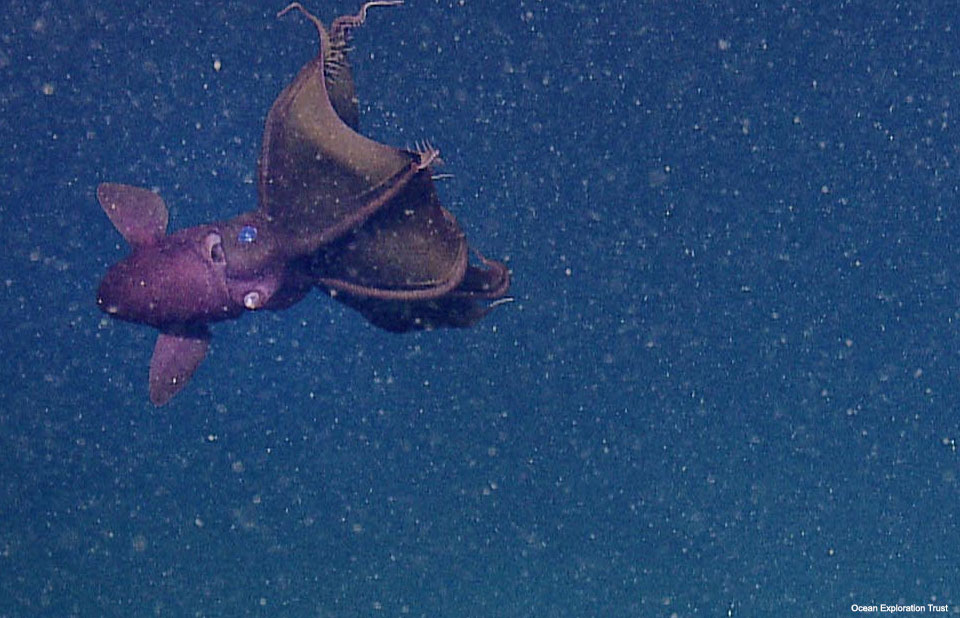
Despite its gothic moniker, the vampire squid is entirely harmless to humans and does not consume blood. This cephalopod earned its eerie reputation from its dark, inky coloration, bright red eyes, and a thick, cloak-like web of skin connecting its eight arms.
Unlike predatory squids that actively hunt fish, the vampire squid is a passive detritivore. It uses two long, thread-like filaments to capture "marine snow" drifting through the water column. To conserve energy in an oxygen-poor environment, it can adjust its internal density to match seawater, allowing it to hover weightlessly. When threatened, it turns its cloak inside out, exposing spine-like cirri, and emits clouds of glowing, bioluminescent mucus from its arm tips to blind and confuse predators.
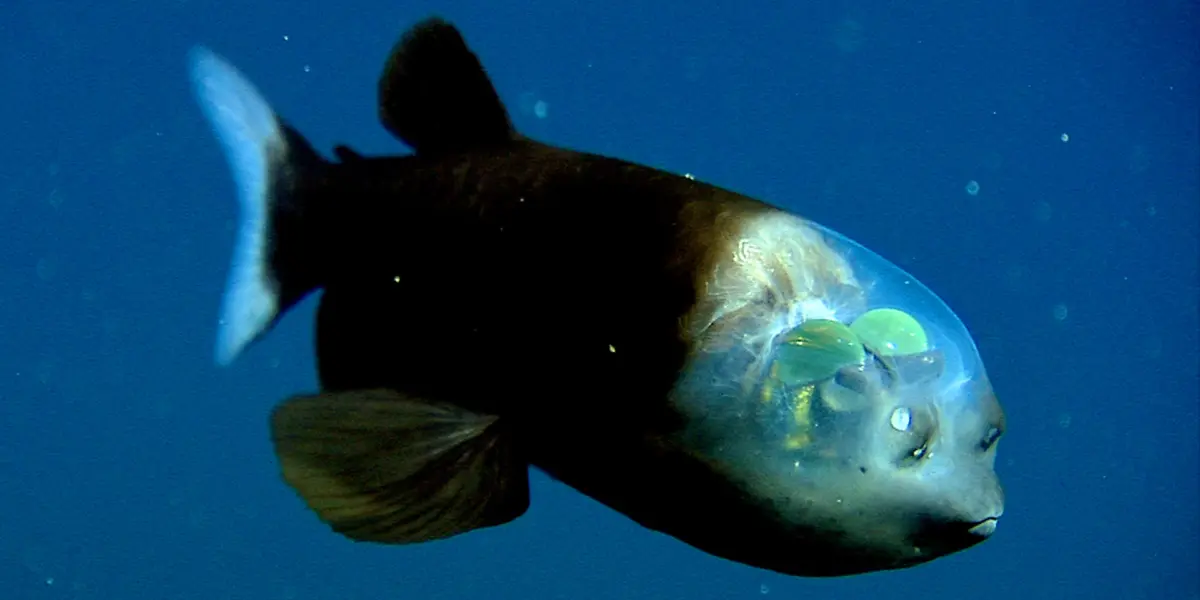
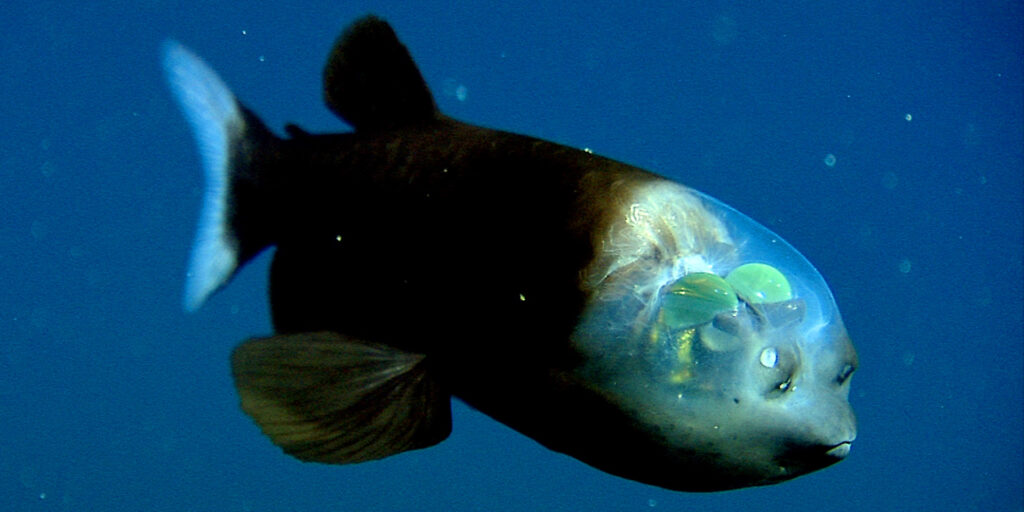
Looking like an aquatic creature engineered by science-fiction filmmakers, the barreleye fish features a completely transparent, fluid-filled dome on its head. Through this translucent shield, scientists can clearly observe its bright green, barrel-shaped eyes rotating within its skull.
For decades, captured barreleye specimens appeared ordinary because the fragile, transparent head shield ruptured during ascent. It was only through the lens of advanced MBARI ROVs that scientists observed the fish alive: its tubular eyes typically point upward to scan for the silhouettes of prey against faint surface light, but can rotate forward when the fish maneuvers to feed.
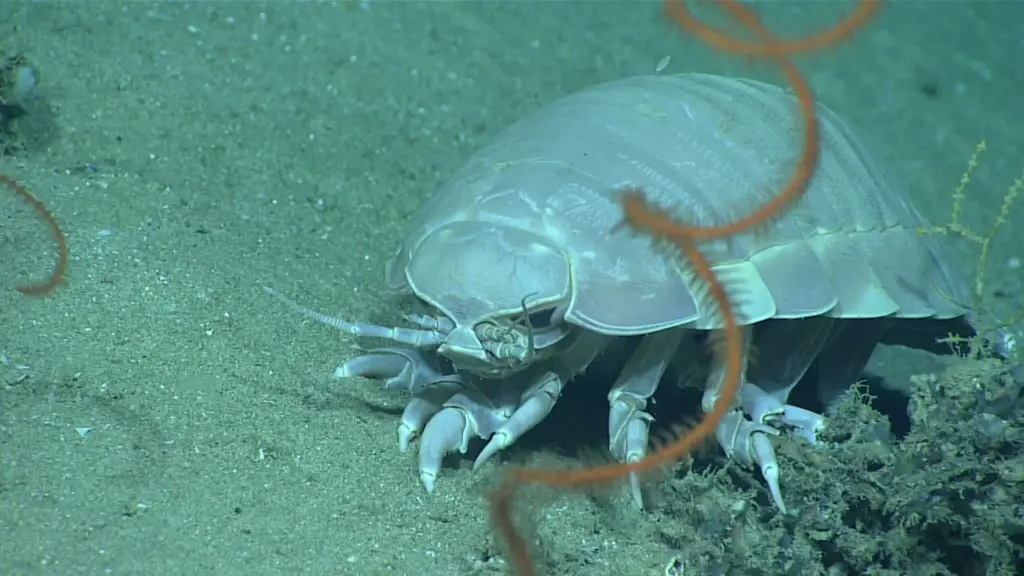
3. The Giant Isopod (Bathynomus giganteus)
Imagine a terrestrial roly-poly (pill bug) scaled up to the size of a house cat, and you have the giant isopod. Growing up to a foot or more in length, these heavily armored crustaceans crawl along the ocean floor at depths reaching 7,000 feet.
As distant relatives of crabs and shrimp, giant isopods showcase a prehistoric body plan that has remained largely unchanged for over 300 million years. Because food is exceptionally scarce in the abyssal zone, these creatures have evolved remarkably slow metabolisms. In laboratory settings, giant isopods have demonstrated the ability to survive for over five years without eating, subsisting on rare windfall meals like sunken whale carcasses.
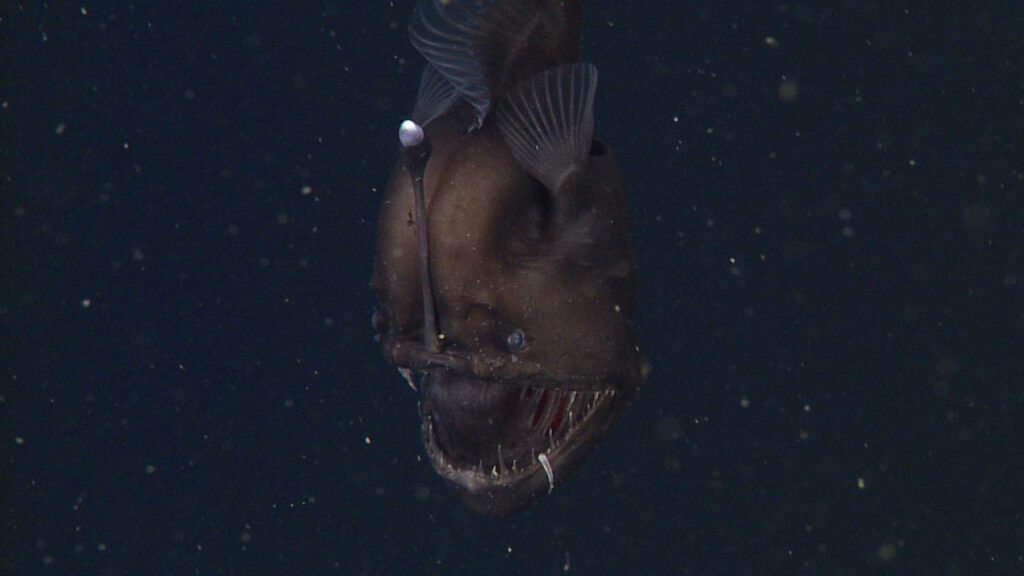
4. The Anglerfish (Order Lophiiformes)
Few animals embody the terrifying allure of the deep quite like the anglerfish. Females of this species feature a modified dorsal spine tipped with a glowing, bioluminescent lure (the esca) powered by symbiotic bacteria. Dangling this light in the pitch-black void, the anglerfish entices curious prey straight toward its cavernous mouth lined with needle-like, hinged teeth and an expandable stomach capable of swallowing prey larger than itself.
The anglerfish also exhibits one of the most bizarre reproductive strategies in nature: sexual parasitism. In some species, tiny, poorly developed males find a female and fuse permanently to her body, dissolving their skin and circulatory systems into hers until they become little more than sperm-producing appendages.
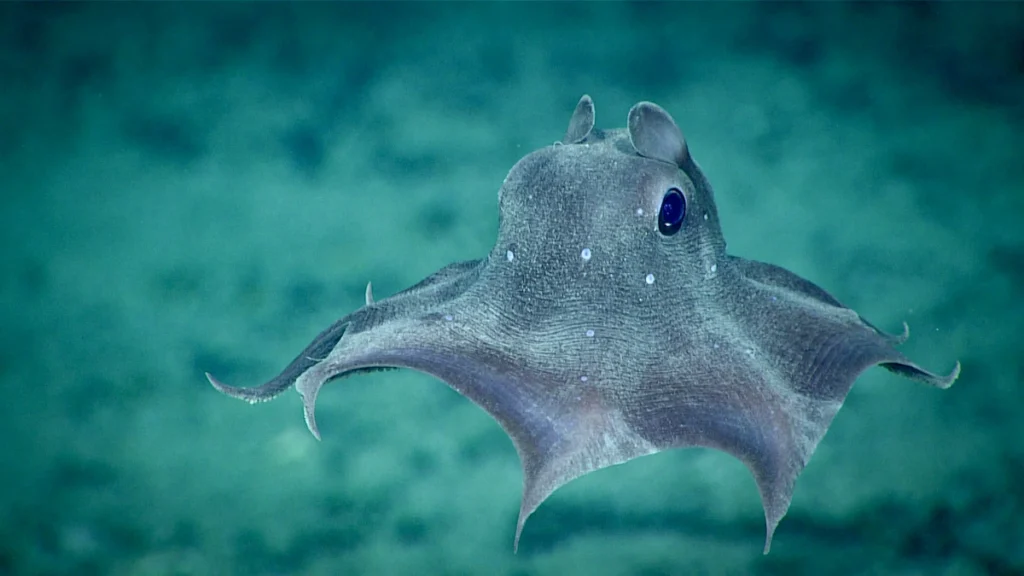
5. The Dumbo Octopus (Grimpoteuthis)
Named after Walt Disney’s flying elephant due to the prominent, ear-like fins protruding from the sides of its head, the dumbo octopus is perhaps the most endearing resident of the abyss. Typically measuring between 8 and 12 inches long, these cephalopods dwell at extreme depths ranging from 1,000 to 13,000 feet, making them the deepest-living of all known octopus species.
Unlike shallow-water octopuses, dumbo octopuses lack an ink sac and possess no defensive camouflage capabilities; at 13,000 feet down in absolute darkness, such traits are unnecessary. Instead, they gracefully flap their "ears" to glide above the seafloor, searching for polychaete worms and copepods.
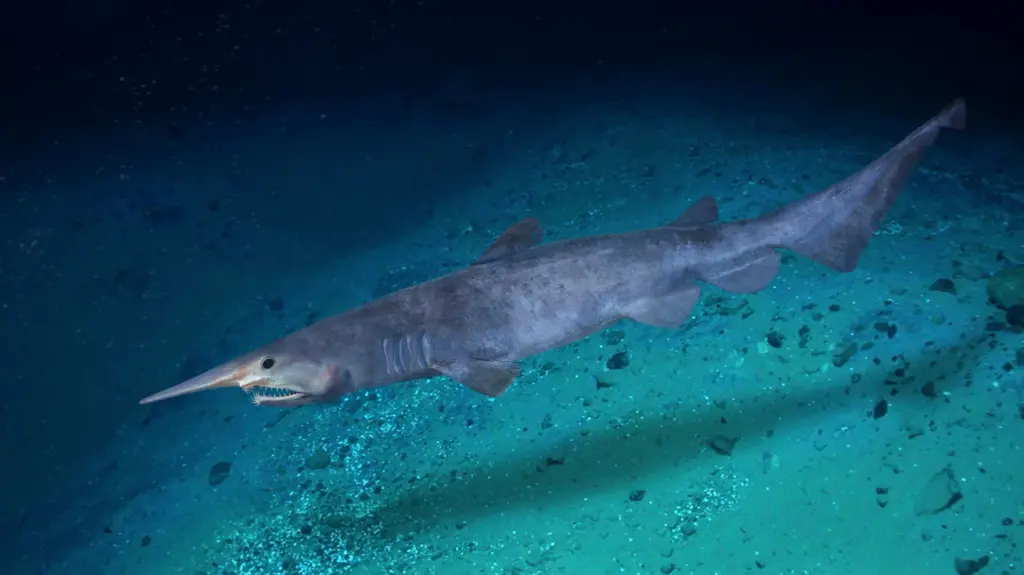
6. The Goblin Shark (Mitsukurina owstoni)
Often hailed as a "living fossil," the goblin shark is the sole surviving member of the Mitsukurinidae family, a lineage dating back roughly 125 million years. This rare shark features semi-translucent, pinkish-gray skin (derived from visible blood vessels beneath the surface) and an elongated, flattened snout packed with electrosensitive ampullae of Lorenzini.
Its most defining feature is its jaw mechanism: while resting, its jaws remain tucked beneath its snout, but when prey comes within range, specialized ligaments allow the jaws to rapidly snap forward like a spring-loaded trap to snatch fish and squid before retracting. Encounters with humans are exceedingly rare, maintaining the creature’s mysterious aura.
7. Gelatinous Deep-Sea Organisms (Siphonophores, Jellies, and Ctenophores)
Some of the most ethereal residents of the deep are not solid at all. Gelatinous animals—including deep-sea medusae, comb jellies (ctenophores), and colonial siphonophores—consist of over 95% water. Lacking bones, brains, hearts, or blood, these organisms drift effortlessly through the water column.
Many possess sophisticated bioluminescent capabilities, flashing neon blues, greens, and purples to communicate, lure prey, or startle attackers. Some siphonophores, such as those belonging to the genus Apolemia, can grow into colonial organisms stretching longer than a blue whale, operating as a unified network of specialized polyps drifting through the midnight zone.
Official Statements and Scientific Perspective
The ongoing exploration of the deep sea continues to reshape marine conservation policy and scientific paradigms. Leading organizations emphasize that our understanding of these organisms is intimately linked to the health of the entire biosphere.
Dr. Jonathan Smith, a deep-sea marine ecologist, noted in a recent symposium briefing:
"Every time we send a submersible into the bathypelagic and abyssal zones, we are reminded of how little we truly understand about Earth’s biosphere. These organisms are not isolated novelties; they are active participants in global nutrient cycling and carbon sequestration. Protecting their habitats is not merely an act of wildlife preservation—it is a planetary necessity."
Representatives from the Ocean Conservancy echo this sentiment, stressing that human-induced pressures—such as deep-sea mining, climate-driven ocean acidification, and plastic pollution—now threaten environments that have remained stable for millions of years.
"The deep ocean regulates our climate, stores immense amounts of carbon, and supports a staggering array of biodiversity," stated an Ocean Conservancy program director. "We are committed to defending these hidden ecosystems. The fact that some of the most awe-inspiring, alien-like creatures on our planet are still waiting to be discovered in the dark proves that our planet is worth fighting for."
Future Outlook: Protecting the Last Great Wilderness
As commercial pressures mount to exploit the mineral-rich abyssal plains for rare earth metals and deep-sea mining, the window to protect these pristine, fragile ecosystems is narrowing rapidly. International bodies, scientists, and conservationists are currently locked in intense policy debates regarding the governance of the high seas and the establishment of marine protected areas (MPAs) in international waters.
The future of deep-sea research relies heavily on technological innovation. The integration of artificial intelligence in analyzing underwater video feeds, autonomous underwater vehicles (AUVs) capable of mapping the seafloor without tethers, and environmental DNA (eDNA) sampling techniques will soon allow scientists to detect the presence of rare deep-sea species without even laying eyes on them.
Ultimately, these seven strange and magnificent creatures serve as ambassadors for a hidden world. They challenge our terrestrial biases, reminding us that Earth is a dynamic, multi-layered living system. As we look upward toward the stars in search of extraterrestrial life, we must remember that some of the most extraordinary, alien wonders on our universe are quietly drifting just beneath the waves of our own backyard.