







Executive Overview
The geopolitical landscape of the Middle East is undergoing a profound structural realignment. As the devastating fallout from the Iran conflict reverberates across the globe, the traditional maritime trade routes that once anchored the wealth of the Gulf Cooperation Council (GCC) are being aggressively redrawn. At the center of this seismic shift is the virtual blockade of the Strait of Hormuz—a vital maritime artery that historically facilitated the transit of over 20% of the world’s petroleum liquids.
Faced with unprecedented disruptions, sovereign wealth funds and state-backed enterprises in Saudi Arabia, the United Arab Emirates (UAE), Qatar, and Kuwait are abandoning decades of logistical complacency. The conflict has exposed the extreme vulnerability of relying on a single, easily contested chokepoint, forcing Gulf governments to rapidly overhaul their investment playbooks.
Instead of speculative foreign acquisitions and soft-power vanity projects, the region’s massive capital reserves are being repatriated and funneled into critical domestic and regional infrastructure. Billions of dollars are being deployed to construct overland pipelines, expand deep-water ports on alternative coastlines, and lay the tracks for cross-continental railway networks. This investigative report explores how the Iran war has shattered the Gulf’s "safe haven" status, the severe macroeconomic toll of the shipping blockade, and the massive, multi-front engineering push to build a logistics network immune to Iranian hostility.
Detailed Chronology: The Collapse of the Hormuz Transit and the Regional Fallout
For decades, the Strait of Hormuz was viewed as a geopolitical pressure point—frequently threatened by Tehran but rarely closed for extended periods. However, the escalation of the Iran conflict over the past six months has transformed these historical threats into a grinding, economically paralyzing reality.
[Strait of Hormuz Blockade]
       │
       ├──► 66% Drop in UAE Container Port Volumes (Q2)
       ├──► Severe Damage to Qatari LNG Facilities
       └──► Shaken "Safe Haven" Status for Regional Investment
The virtual closure of the strait has systematically choked off the flow of goods into and out of the Persian Gulf. The crisis began with sporadic shipping harassment, which quickly escalated into full-scale maritime interdictions, drone strikes, and sophisticated mining of shipping lanes. The impact was immediate: insurance premiums for commercial vessels skyrocketed to prohibitive levels, prompting major international shipping lines to bypass the Persian Gulf entirely.
The crisis is not confined to the sea. The conflict has spilled over onto the mainland, with targeted strikes disabling critical industrial infrastructure across the Gulf. Refineries, aluminum smelters, and high-tech data centers—the very cornerstones of the region’s economic diversification efforts—have sustained significant damage. Furthermore, commercial airspace restrictions have kept air traffic far below pre-war levels, crippling the tourism and business travel sectors that hubs like Dubai and Doha spent billions to cultivate.
This multi-dimensional vulnerability has shattered the long-held perception of the Gulf hubs as secure oases of stability in a turbulent region. For the first time in a generation, international investors are pricing in systemic sovereign risk across the GCC, forcing local governments to act with unprecedented speed to secure their economic lifelines.

Supporting Context & Metrics: The Economic Toll of the Blockade
The macroeconomic data emerging from the region underscores the severity of the crisis. The halting of trade through the Strait of Hormuz has triggered a sharp economic contraction among states most dependent on the waterway.
Macroeconomic Contractions and Growth Forecasts
According to recent macroeconomic polling, the divergence between states with alternative coastal access and those entirely locked within the Persian Gulf is stark:
| Country | Projected GDP Growth (Current Year) | Previous Benchmark / Comparison | Key Structural Vulnerability |
|---|---|---|---|
| Qatar | -8.0% | Prior leader in LNG export growth | 100% reliance on Hormuz for maritime LNG shipments; severe facility damage. |
| Kuwait | -8.0% | Highly dependent on crude exports | Landlocked within the Gulf; lack of direct pipeline access to open ocean. |
| Saudi Arabia | +1.4% | Down from 4.5% projected for 2025 | Partially insulated by Red Sea ports, but suffering from regional industrial disruptions. |
The Crisis in Port Throughput
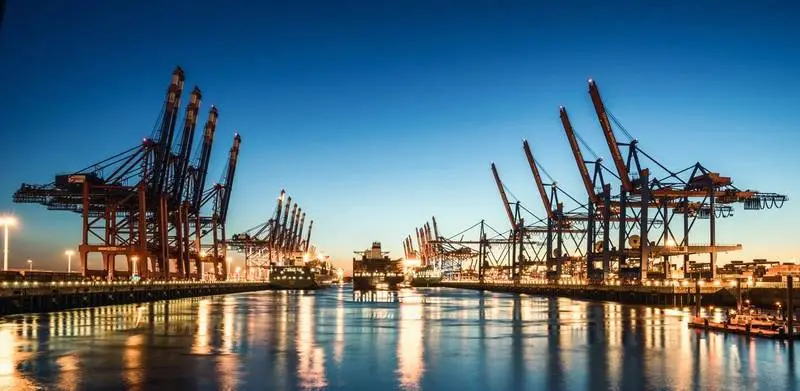
The maritime logistics sector has borne the brunt of the blockade. Abu Dhabi’s flagship logistics entity, AD Ports (ADPORTS.AD), reported that its UAE container throughput, bulk cargo, and general cargo volumes collapsed by approximately two-thirds (66%) in the second quarter of the year. Company executives characterized the period as the most significant operational challenge in its 20-year history.
Similarly, Dubai’s DP World, one of the largest port operators globally, recorded sharp declines in cargo volumes across its Persian Gulf terminals during the first half of the year, highlighting the limits of even the most sophisticated logistics networks when access is physically restricted.
AD Ports Q2 Cargo Volumes (UAE Terminals):
┌────────────────────────────────────────┐ 100% (Pre-War)
│████████████                            │ ~33% (Current)
└────────────────────────────────────────┘
*Volume drop of approximately two-thirds due to shipping disruptions.
Strategic Re-routing: "Ports, Ports, Ports" and the Pipeline Push
To survive the blockade, Gulf states are executing a massive geographical pivot, shifting their logistical focus away from the Persian Gulf toward the Red Sea and the Arabian Sea.
The Saudi Red Sea Expansion
Saudi Arabia has fast-tracked multi-billion-dollar emergency plans to expand its East-West Crude Pipeline. This critical artery is being upgraded to transport significantly higher volumes of crude from the eastern oil fields directly to the port city of Yanbu on the Red Sea, bypassing the Strait of Hormuz entirely.
Furthermore, Riyadh is directing vast sums of capital toward its western maritime infrastructure. As one industry insider noted:
"If two years ago sports was the big buzz thing, I think for the time being, next year or two, they’re going to say ports, ports, ports."
      [Eastern Oil Fields (Saudi Arabia)]
                       │
             (East-West Pipeline)
                       ▼
         [Red Sea Coast / Yanbu Port]  ◄─── Bypasses Hormuz
The UAE’s Fujairah Lifeline
The UAE is capitalizing on the strategic positioning of Fujairah, its only emirate located outside the Strait of Hormuz on the Gulf of Oman. DP World is currently developing two major container terminals in Fujairah to handle cargo diverted from the Persian Gulf.
Concurrently, Abu Dhabi is accelerating construction on a new oil pipeline designed to double the crude transport capacity to Fujairah’s export terminals. Once fully operational next year, this pipeline will allow the UAE to export the vast majority of its daily production directly into the Indian Ocean. To support this overland shift, DP World is also constructing a network of inland container depots to streamline truck-to-port logistics.
Kuwait and Iraq’s Search for Alternative Outlets
For countries geographically trapped deep inside the Persian Gulf, the situation is even more critical:
- Kuwait: Kuwait Petroleum Corporation (KPC) is currently locked in high-level negotiations with Saudi Arabia and the UAE. The goal is to secure access to their southern neighbors’ pipeline networks, allowing Kuwaiti crude to be pumped overland to terminals on the Red Sea or the Arabian Sea.
- Iraq: Baghdad is aggressively working to revive and expand its northern and western export corridors. Iraq is currently rehabilitating pipelines to Turkey’s Ceyhan port, while simultaneously negotiating the construction of new transit lines through Jordan’s port of Aqaba and Syria’s Mediterranean terminal at Baniyas.
Official Statements and Stakeholder Perspectives
The financial mechanics of this infrastructure sprint rely heavily on the region’s formidable sovereign wealth funds. With international direct investment targets under pressure due to the conflict, local sovereign capital is being mobilized to underwrite these high-cost projects.
In a telling strategic move, Abu Dhabi’s sovereign wealth fund, L’IMAD, announced a complete buyout of the remaining publicly traded shares of AD Ports. The privatization is intended to allow L’IMAD to radically restructure the company’s long-term strategy, prioritizing national security infrastructure over short-term commercial profitability.
Zin Bekkali, Chief Executive of the UK-based investment management firm Silk Invest, emphasizes that the Gulf’s accumulated capital reserves are uniquely suited for this crisis:
"Gulf governments have the capital to fund some or most of this accelerated investment in infrastructure internally. Infrastructure is definitely an area which we think is going to benefit from this strategic reallocation of capital."
However, experts warn that these emergency bypass routes, while geopolitically necessary, represent an incredibly expensive departure from optimal trade economics. Afaq Hussain, a former senior fellow at the Middle East Initiative at the Atlantic Council, remarked on the permanent shift in risk assessment:
"The recent Strait of Hormuz crisis has given us a very important lesson that these vulnerabilities are real… and they can happen anytime at any chokepoint. Backup trade and transport routes are needed even when they may initially appear uneconomical."
Future Outlook: The New Logistics Architecture of the Middle East
Even if diplomatic efforts yield a temporary cooling of hostilities between Washington and Tehran, the structural changes initiated during this conflict are irreversible. The Strait of Hormuz is no longer viewed by Gulf planners as a viable long-term conduit for the region’s primary source of wealth.
       [Turkey / European Rail Network]
                     ▲
                     │ (Proposed 3-4 Year Railway Project)
                     ▼
       [Syria] ──► [Jordan] ──► [Saudi Arabia & Gulf States]
The future of Middle Eastern trade lies in highly integrated, overland corridors. Chief among these is a highly ambitious regional rail project. In June, Turkey’s Minister of Transport confirmed advanced plans to construct a massive railway network linking Turkey, Syria, Jordan, and Saudi Arabia within the next three to four years, with other GCC states slated to connect to the grid shortly thereafter. This network will allow goods to flow seamlessly from the factories of Europe and Asia directly into the heart of the Arabian Peninsula via land, completely bypassing vulnerable maritime shipping lanes.
The era of cheap, concentrated shipping through the Persian Gulf has given way to a highly diversified, resilient, and capital-intensive logistical reality. While the costs of building this new infrastructure will run into hundreds of billions of dollars, the price of inaction—complete economic strangulation at the gates of Hormuz—is one the Gulf nations are no longer willing to risk.