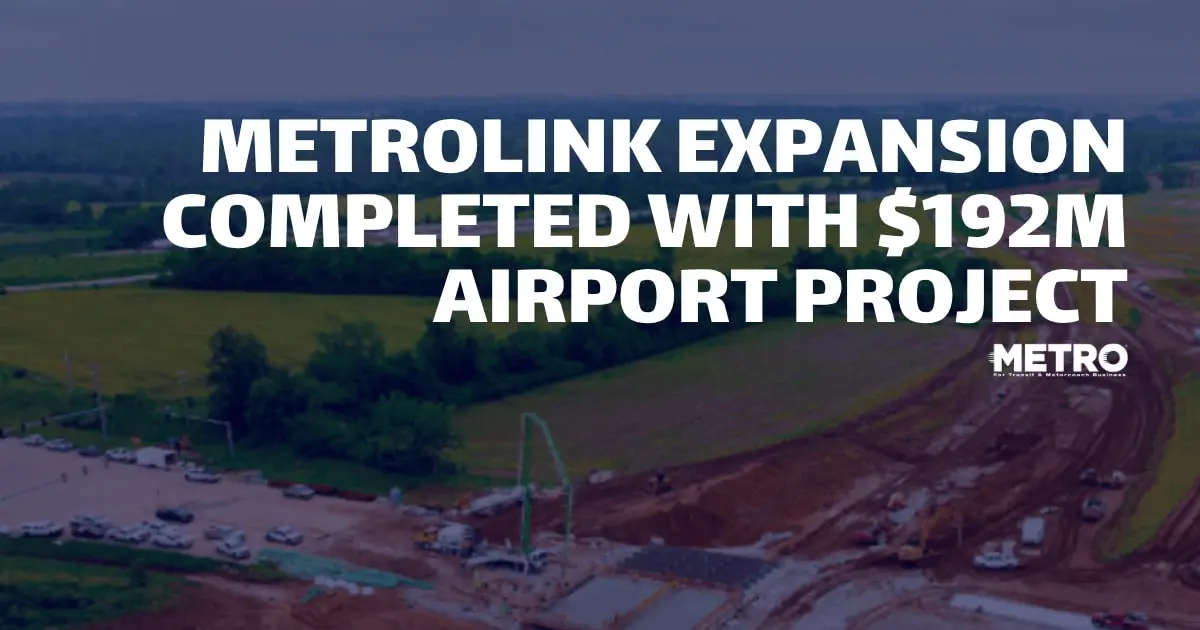
ST. LOUIS — In a landmark achievement for Midwestern infrastructure, regional transit leaders, state officials, and community stakeholders gathered to celebrate the official construction completion of the MetroLink light rail extension to MidAmerica St. Louis Airport. The milestone represents the culmination of a visionary $192 million multimodal initiative designed to fundamentally reshape regional mobility, bolster local commerce, and bridge crucial transportation gaps throughout St. Clair County and the broader St. Louis metropolitan area.
The celebratory event drew more than 100 dignitaries, transit advocates, and community members to the brand-new MidAmerica St. Louis Airport MetroLink Station. Following formal addresses by a coalition of state and local leaders, attendees participated in a ceremonial ribbon-cutting before boarding an inaugural passenger run along the freshly laid tracks. With construction officially finalized, the project has entered an intensive phase of systems testing and operational integration, setting the stage for full passenger revenue service in the coming months.
Executive Overview: A Transformative Regional Investment
The completion of the MetroLink extension to MidAmerica St. Louis Airport is far more than a routine public works project; it is a structural reinforcement of the bi-state region’s economic and logistical backbone. By establishing a direct, seamless rail connection between MidAmerica St. Louis Airport and St. Louis Lambert International Airport across a sprawling 43-mile light rail network, the project creates an integrated aviation and transit corridor unique to the American Midwest.
Beyond the sleek, steel tracks of the light rail system, the $192 million investment encompasses a comprehensive suite of infrastructural enhancements. The project has successfully deployed critical roadway expansions and active transportation corridors—including dedicated bike paths—that weave together residential neighborhoods, commercial hubs, and vital military installations.
Most notably, the entire undertaking was executed under a strict fiscal framework. Funded through a unique state-local partnership without relying on federal grants, the project was delivered on time, within budget, and completely free of additional taxpayer debt. As revenue service approaches, this newly minted transit artery—designated as MetroLink’s 39th station—promises to redefine commuting, commerce, and connectivity for generations to come.
Detailed Chronology & Project Genesis: From Concept to Completion
The realization of the MidAmerica St. Louis Airport MetroLink extension is the result of years of meticulous planning, inter-agency coordination, and engineering ingenuity. While the ribbon-cutting marks the finish line, the project’s timeline is characterized by rigorous milestones that overcame distinct geographical, regulatory, and logistical hurdles.
Strategic Planning and Inter-Agency Alignment
The genesis of the project lay in recognizing a critical vulnerability in regional mobility: while MidAmerica St. Louis Airport was experiencing steady growth as a commercial passenger and cargo hub, and Scott Air Force Base remained one of the region’s largest and most vital employment centers, public transit access lagged behind. The St. Clair County Transit District (SCCTD), in close partnership with Bi-State Development (Metro Transit) and the Illinois Department of Transportation (IDOT), formulated a comprehensive blueprint to bridge this gap.

Navigating Environmental and Cultural Compliance
Before heavy machinery could break ground, project planners and engineering firms—notably Gonzalez Companies—undertook extensive environmental evaluations. This phase included critical coordination with Native American tribes and exhaustive archaeological surveys across the alignment. These measures ensured that culturally and historically significant resources along the corridor were meticulously identified, documented, and preserved, balancing modernization with historic stewardship.
Construction Execution and Multimodal Integration
The execution phase was divided into three primary components, engineered to maximize utility across various modes of transit:
- The Light Rail Alignment: The core of the project features the physical extension of the MetroLink system, bringing light rail service directly to the doorstep of MidAmerica St. Louis Airport.
- Roadway Enhancements: To alleviate congestion and streamline vehicular flow, engineers constructed a new 2.4-mile access roadway stretching from Rieder Road to Airport Boulevard. This artery links directly to Interstate 64, establishing a modern, highly efficient entryway into the airport. Additionally, a crucial 1/3-mile extension of Rieder Road was built from Wherry Road to the Cardinal Creek Gate at Scott Air Force Base, providing more direct, secure access for military personnel and defense contractors.
- Active Transportation Corridors: Recognizing the shift toward sustainable, non-motorized commuting, the project laid the groundwork for bike trail connectivity. A subsequent task order has already been approved by the SCCTD to extend the MetroBikeLink Trail the final 0.7 miles directly to the new station, with full construction slated for completion within the next year.
Supporting Context & Financial Metrics: A Masterclass in Fiscal Discipline
In an era where major infrastructure projects are frequently plagued by nine-figure budget overruns, years of schedule delays, and heavy reliance on federal debt financing, the MetroLink extension stands out as a model of fiscal responsibility and efficient project management.
A Unique Funding Partnership
The $192 million price tag was financed entirely through a synergistic state-and-local funding coalition, completely bypassing federal funding streams. The financial breakdown reflects a profound commitment from Illinois leadership and local stakeholders:
- $127 million was allocated from the State of Illinois via the ambitious Rebuild Illinois Capital Program.
- $65 million was contributed directly by the St. Clair County Transit District (SCCTD).
Because the project was insulated from federal bureaucratic delays and stringent federal procurement red tape, project managers maintained strict budgetary control. The resulting infrastructure was delivered on time and with zero additional debt burden or tax hikes imposed on local residents.
Economic Impact and Local Workforce Reinvestment
Beyond its physical infrastructure, the project served as a powerful engine for local economic stimulus. Agency reports indicate that the vast majority of project contracts were awarded to local firms, ensuring that millions of dollars were immediately reinvested into the regional economy.
The construction phase heavily engaged:
- Local general contractors and specialized subcontractors.
- Highly skilled union labor, guaranteeing safety and quality craftsmanship.
- Disadvantaged Business Enterprises (DBEs), fostering inclusivity and equitable economic participation within the regional construction sector.
This localized approach builds directly upon the SCCTD’s already formidable baseline economic footprint, which generates an estimated $129.5 million in annual economic impact throughout St. Clair County. Furthermore, the corridor was strategically designed with infill development potential in mind. Unlocking land parcels adjacent to the alignment creates prime opportunities for future commercial, industrial, and residential developments, transforming previously underutilized acreage into high-yield economic zones.
Official Statements: Perspectives from Regional Leaders
The significance of the MetroLink expansion was underscored by the enthusiastic remarks of the leaders who spearheaded its realization. During the dedication ceremony, key stakeholders emphasized the project’s transformative potential for both civilian and military sectors.
Mark Kern, St. Clair County Chairman:
"This project is much more than a transit expansion. It is an investment in our communities, workforce, and future. By connecting MidAmerica St. Louis Airport, Scott Air Force Base, employers, and neighborhoods to the region’s transit network, we are creating new opportunities for residents while positioning St. Clair County for continued economic growth."
Ken Sharkey, Managing Director of the St. Clair County Transit District:
"This project demonstrates what can happen when a bold vision is backed by strong partnerships and a commitment to follow through. A tremendous amount of planning, coordination, and hard work went into making this extension a reality. We have delivered a world-class asset that honors our taxpayers and elevates our entire bi-state transportation network."
State leaders similarly lauded the project as a crown jewel of the Rebuild Illinois initiative, highlighting how strategic investments in mass transit pay dividends by attracting aerospace industries, logistics firms, and defense contractors to the region.
Future Outlook: The Next Horizon for Bi-State Mobility
As the newly constructed extension transitions from the testing phase to full passenger revenue service in the coming months, transit planners are already looking ahead to maximize the utility of the new corridor.
Expanding the Active Transit Network
With the main rail line and roadway components operational, immediate future efforts will focus on active transportation integration. The pending final 0.7-mile extension of the MetroBikeLink Trail—expected to reach completion within the year—will complete a continuous, multi-use pathway that allows cyclists and pedestrians to travel safely from surrounding communities straight to the airport terminal and Scott Air Force Base perimeter.
Strengthening National Defense and Commercial Aviation
The convergence of light rail, high-capacity roadways, and active transportation trails directly adjacent to Scott Air Force Base and MidAmerica St. Louis Airport creates a uniquely resilient logistics hub. Scott Air Force Base is a premier Department of Defense installation, housing global mobility commands and thousands of service members and civilian personnel. Providing these workers—alongside commercial air travelers flying out of MidAmerica—with a reliable, high-speed rail alternative to highway driving significantly enhances regional emergency preparedness, reduces traffic congestion on Interstate 64, and lowers the carbon footprint of commuter travel.
Aesthetic and Cultural Integration
Reflecting the cultural identity of the region, the new station also features public art designed to inspire travelers. Prominently displayed at the entrance is "Taking Flight," a striking, large-scale sculpture created by renowned Massachusetts artist Dale Rogers. Composed of five dynamic, 12-foot gulls in mid-flight, the artwork serves as a visual metaphor for progress, mobility, and the soaring ambitions of the St. Clair County community.
Conclusion
The completion of the MetroLink Extension to MidAmerica St. Louis Airport marks a watershed moment for Midwestern public transportation. By uniting state vision, local fiscal discipline, and multi-agency collaboration, St. Clair County has successfully built a modern, debt-free multimodal corridor. As the first trains prepare to welcome revenue passengers, the region stands fully equipped to meet the economic, logistical, and environmental challenges of the 21st century.