Executive Overview
Unpredictable and extreme meteorological phenomena continue to test the operational resilience of the global cruise industry. In recent weeks, shifting weather systems have forced itinerary changes, disrupted port calls, and complicated turnarounds across major international cruising hubs.
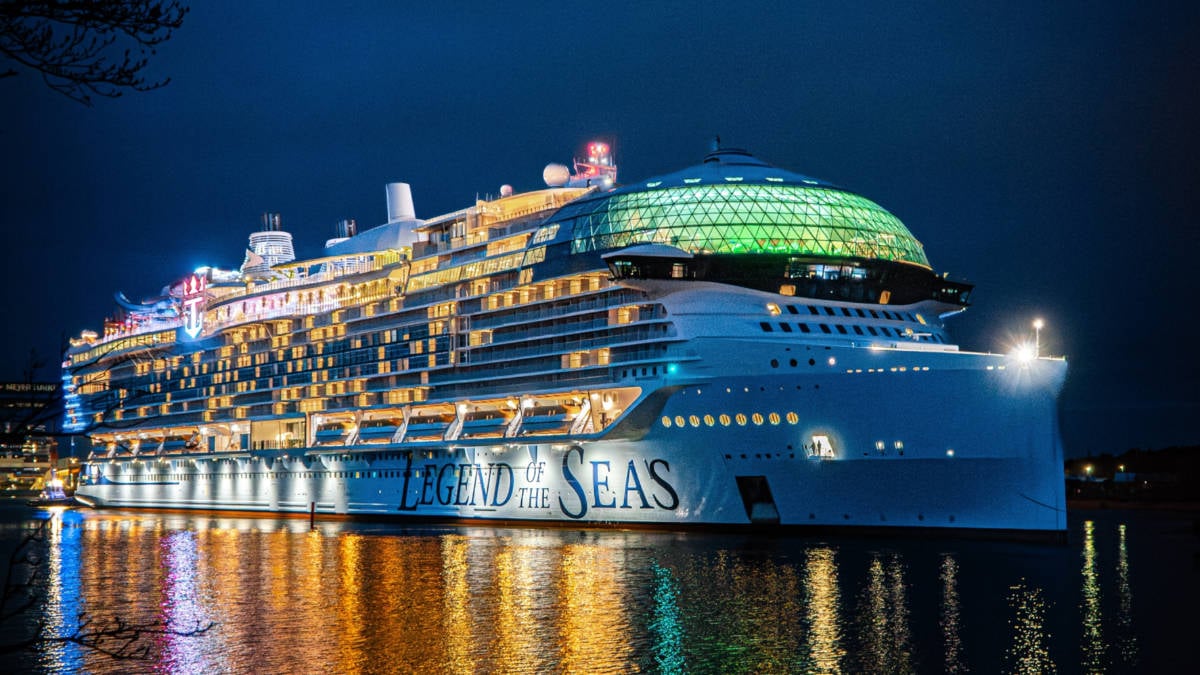
The latest high-profile vessel to feel the brunt of Mother Nature’s fury is Royal Caribbean International’s Legend of the Seas. One of the newest and most gargantuan additions to the global cruise fleet, this Icon-class behemoth encountered severe maritime and meteorological challenges while attempting to complete its return transit to Barcelona, Spain, at the conclusion of a previous voyage.
Passengers booked on the Sunday, October 4, 2026, departure received urgent notifications late Saturday evening detailing a mandatory two-hour delay to embarkation operations. The disruption stems directly from treacherous sea conditions and localized tempest warnings affecting the Catalan coastline.
While the delay is operationally necessary to guarantee vessel and passenger safety, it underscores the vulnerability of even the most technologically advanced mega-ships to severe weather events.
This report provides a comprehensive examination of the incident, analyzing the revised timelines, the localized meteorological threats battering Barcelona, the logistical hurdles faced by travelers, and the broader safety implications for modern mega-ship operations.
Detailed Chronology of the Disruption
The chain of events leading to the embarkation delay began unfolding late into the previous sailing as Legend of the Seas made its scheduled return journey toward its Spanish homeport of Barcelona. As the ship approached the western Mediterranean basin, it ran headlong into a rapidly intensifying weather system characterized by torrential downpours, severe squalls, and heavy coastal swells.
The Saturday Evening Notification
Recognizing that the vessel’s approach and subsequent mooring procedures would be compromised by the adverse conditions, Royal Caribbean’s shore-side management and shipboard leadership acted swiftly.

On Saturday, October 3, 2026, at approximately 7:00 PM local time, an automated and direct notification was dispatched via email to all passengers scheduled to board the ship the following morning.
The communication explicitly stated:
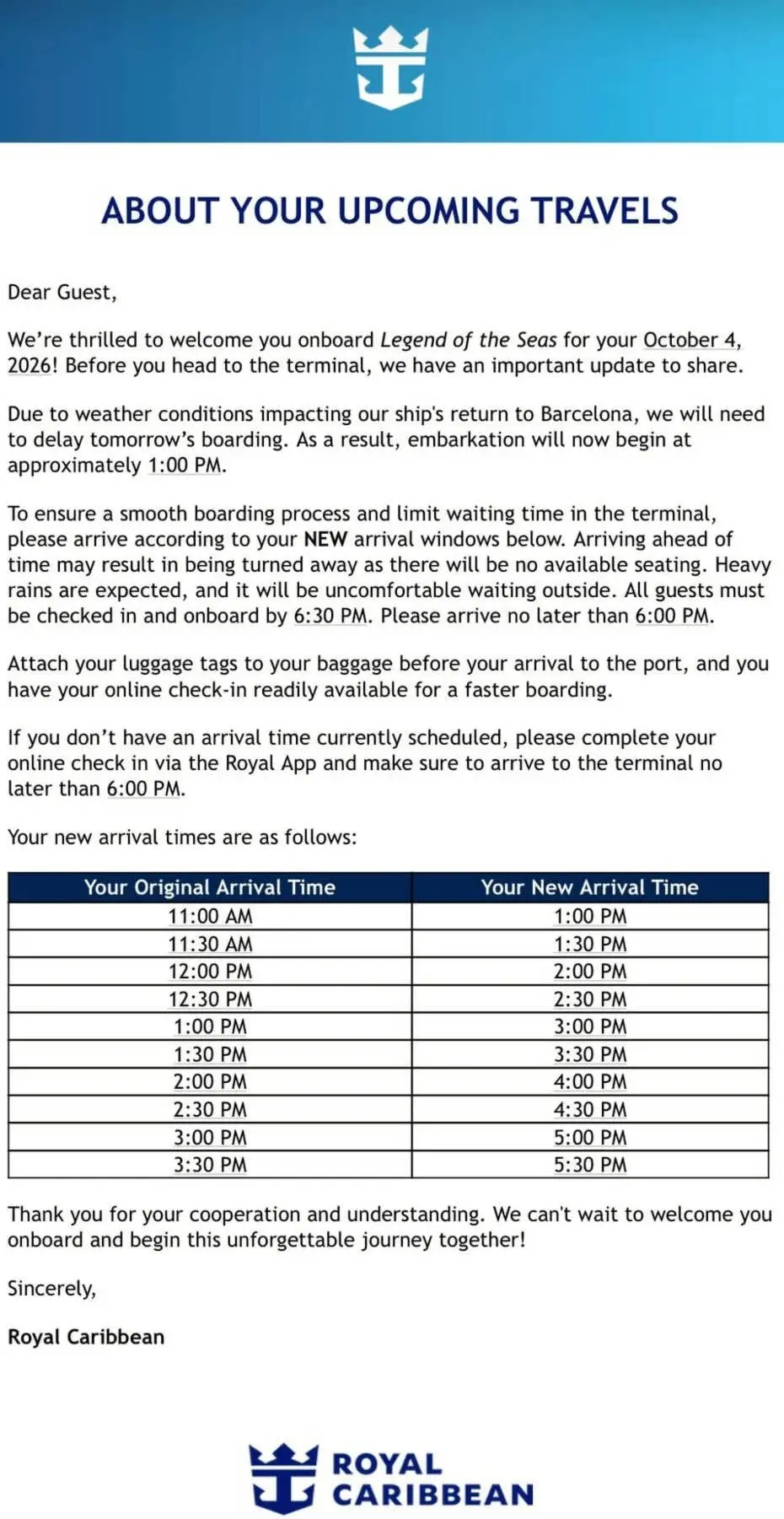
“Due to weather conditions impacting our ship’s return to Barcelona, we will need to delay tomorrow’s boarding. As a result, embarkation will now begin at approximately 1:00 PM.”
Shift in Terminal Operations and Arrival Windows
Prior to the weather-related adjustment, embarkation for the 5,610-guest Icon-class masterpiece was slated to commence at 11:00 AM. Under the revised schedule, the entire boarding architecture was pushed back by a mandatory two hours.
- Original Boarding Start: 11:00 AM
- Revised Boarding Start: 1:00 PM
- Original Latest Arrival Time: 3:30 PM
- Revised Latest Arrival Time: 5:30 PM
- Terminal Hard Cutoff: 6:00 PM
- All-Aboard Time: 6:30 PM
Cruise line operators emphasized that these windows are rigid. To maintain the revised departure schedule and avoid secondary delays, all guests must complete their mandatory check-in at the cruise terminal no later than 6:00 PM. Furthermore, passengers must cross the gangway and be physically onboard no later than 6:30 PM.
Supporting Context, Metrics, and Logistical Guidelines
Managing the turn-around operations of a massive floating resort with a maximum capacity exceeding 5,000 guests is a monumental logistical undertaking under normal conditions. When combined with severe weather warnings, crowd control and terminal management become high-stakes challenges.
Mitigating Terminal Congestion and Safety Risks
Royal Caribbean issued stern warnings to impatient travelers attempting to arrive early to beat the rush. Because the terminal facilities are restricted from opening prior to the adjusted schedules, early arrivals are explicitly prohibited.
The cruise line noted in its communications:
“Arriving ahead of time may result in being turned away as there will be no available seating. Heavy rains are expected, and it will be uncomfortable waiting outside.”
Exposing thousands of passengers to torrential rain and dangerous wind gusts outside a closed terminal creates preventable medical and logistical risks. To streamline the eventual processing queue once the terminal doors opened at 1:00 PM, the cruise line urged passengers to complete several preparatory steps prior to arrival:
- Digital Documentation: Ensuring all online check-in forms, health questionnaires, and boarding passes are accessible via mobile devices or printed out.
- Luggage Tag Security: Verifying that official Royal Caribbean luggage tags are firmly and securely affixed to all bags destined for stateroom delivery.
The Itinerary at a Glance
Despite the delayed departure from Barcelona, the 7-night Western Mediterranean itinerary remains largely intact as of press time, with no confirmed alterations to subsequent port calls. The planned route encompasses some of Europe’s most vibrant cultural and historical destinations:
- Sunday, October 4: Embarkation in Barcelona, Spain (Departure at 6:30 PM)
- Monday, October 5: Palma de Mallorca, Spain (8:00 AM – 4:00 PM)
- Tuesday, October 6: Marseille, France (9:00 AM – 4:30 PM)
- Wednesday, October 7: La Spezia, Italy (6:30 AM – 8:00 PM)
- Thursday, October 8: Civitavecchia (Rome), Italy (7:00 AM – 8:00 PM)
- Friday, October 9: Naples, Italy (7:00 AM – 7:00 PM)
- Saturday, October 10: Day at Sea (Transiting the Western Mediterranean)
- Sunday, October 11: Debarkation in Barcelona, Spain
Official Statements and Meteorological Analysis
To fully understand why Royal Caribbean altered its embarkation schedule, one must examine the official meteorological data issued for the Catalan region during the affected window.
The State Meteorological Agency Warnings
According to Spain’s State Meteorological Agency (AEMET), the Barcelona region was placed under an “extreme risk” (nivel rojo/naranja) weather warning. The hazard alert spanned from 9:00 PM on Saturday, October 3, through 11:59 AM on Sunday, October 4. This temporal window directly coincided with the final maritime approach, docking, and clearance procedures of Legend of the Seas.
The meteorological forecasts warned of severe precipitation rates:
- Hourly Rainfall Intensity: Up to 3 to 4 inches of rain per hour in localized cloudbursts.
- Cumulative Totals: Expected accumulations of 7 to 8 inches over a concentrated six-hour period.
- Wind Dynamics: Destructive wind gusts ranging from 90 to 120 kilometers per hour (approximately 55 to 75 mph).
- Additional Hazards: High probability of coastal storm surges, severe maritime swells, and localized hail events.
The Physics of Port Safety: Why Mega-Ships Break Away
To the uninitiated traveler, a two-hour delay due to rain might seem overly cautious. However, maritime safety experts emphasize that heavy rainfall and high winds create compounding hazards for large vessels while moored or maneuvering in port.
When gale-force winds strike the colossal flat surfaces of a modern Icon-class vessel—which acts effectively as a massive vertical sail—immense lateral pressure is exerted on the ship’s mooring lines. If winds exceed safe thresholds or shift unpredictably during torrential squalls, lines can snap under tension, causing the vessel to drift away from the pier.
This is not a theoretical risk. Just days prior to this incident, the cruise industry was reminded of the destructive potential of sudden squalls. On September 30, 2026, Virgin Voyages’ Scarlet Lady broke free from her moorings in Rhodes, Greece, during unexpected high winds. The drifting ship collided with three smaller boats before harbor authorities and crew could regain control. Fortunately, that incident resulted in no reported injuries and minimal material damage, but it served as a stark wake-up call to port authorities and cruise operators worldwide.
Consequently, harbor pilots and cruise captains exercise extreme caution, delaying docking maneuvers or embarkation windows until wind speeds subside and sea states normalize to acceptable safety parameters.
Future Outlook: Operational Resilience in an Era of Climate Volatility
As the cruise industry continues to scale up vessel sizes—introducing massive floating cities capable of carrying upwards of 7,000 passengers and crew—the operational complexities of managing weather disruptions grow exponentially.
Incidents like the Legend of the Seas embarkation delay highlight several key takeaways for the future of commercial cruising:
- Agile Communication Channels: Cruise lines have significantly improved their direct-to-consumer messaging systems. The ability to deploy timely email, SMS, and app-based alerts prevents terminal overcrowding and empowers passengers to adjust their travel plans before leaving their hotels or airports.
- Enhanced Port Infrastructure: As extreme weather events become more frequent due to shifting global climate patterns, ports across the Mediterranean and Caribbean will need to invest in more robust mooring infrastructure, automated tension-monitoring winches, and sheltered passenger staging areas.
- Passenger Preparedness: Travelers must increasingly adopt a flexible mindset. Modern cruising is subject to maritime realities, and itinerary adjustments or turnaround delays are safety-critical measures rather than mere inconveniences.
As Legend of the Seas successfully clears the Barcelona terminal and pushes out into the Mediterranean for its 7-night Western Mediterranean voyage, passengers will undoubtedly enjoy the world-class amenities of Royal Caribbean’s flagship-tier vessel. However, the initial hours of their vacation serve as a vivid reminder that beneath the glitz, glamour, and technological marvel of modern cruising, the ancient laws of the sea still hold ultimate authority.