







Executive Overview
When the conversation turns to microplastic pollution, the modern imagination typically conjures vivid, distressing imagery: brightly colored fragments of degraded water bottles, brittle packaging flaking away in coastal sunlight, or the microscopic, spaghetti-like synthetic fibers shed from our clothing during a standard laundry cycle. For decades, these visible and heavily publicized vectors have dominated environmental campaigns, regulatory frameworks, and public awareness initiatives. However, a far more insidious and prolific source of microplastic contamination has been hiding in plain sight—quite literally under our feet.
Tire wear particles (TWPs), generated continuously through the mechanical friction of automotive tires rolling over asphalt and concrete, represent one of the most pervasive yet under-acknowledged environmental threats of the 21st century. As vehicles accelerate, brake, and navigate roadways, billions of microscopic synthetic rubber crumbs are sheared off into the environment. These particles do not simply vanish; they drift as airborne dust or accumulate on road surfaces until rainstorms wash them into storm drains, directly polluting municipal watersheds, rivers, and ultimately the global ocean.
To address this crisis, researchers, environmental scientists, and policymakers are pivoting toward innovative, near-term interventions. Chief among these is green infrastructure—engineered natural systems such as bioswales, rain gardens, roadside vegetative buffers, and permeable pavements. By harnessing natural filtration processes, these systems intercept and treat urban stormwater runoff before it reaches sensitive aquatic habitats.

This article explores the mechanics of tire wear particle pollution, examines groundbreaking ongoing research into urban green infrastructure by organizations like the Ocean Conservancy and the University of Toronto, and outlines a comprehensive pathway toward mitigating one of modern transportation’s most toxic hidden footprints.
Detailed Chronology: Unmasking the Tire Wear Crisis
To understand how tire wear particles became a dominant environmental concern, it is necessary to trace the evolution of scientific inquiry into microplastics and the compounding growth of global transportation.
Phase 1: The Blind Spot of Early Microplastic Research (Pre-2010s)
In the nascent stages of microplastic research, analytical methodologies were heavily optimized for rigid polymers (polyethylene, polypropylene, and polystyrene) and textile fibers (polyester, nylon, and acrylic). Tire wear particles, due to their complex chemical composition—a tightly bound matrix of natural and synthetic rubber mixed with vulcanizing agents, heavy metals, and chemical plasticizers—evaded standard identification protocols. To conventional spectrometry and microscopy, TWPs often resembled organic debris or complex road dust, rendering them invisible in early environmental censuses.
Phase 2: The Emergence of the Chemical Threat (2020–2021)
A monumental shift occurred in late 2020 when a landmark study published in Science identified a chemical compound derived from a common tire preservative, 6PPD, as the primary culprit behind "urban runoff mortality syndrome" in coho salmon along the Pacific Northwest coast. When 6PPD reacts with ozone in the atmosphere, it transforms into 6PPD-quinone (6PPD-Q). Washed into waterways via road runoff, this derivative proved lethal to vulnerable fish populations even at extraordinarily low concentrations. This discovery elevated tire particles from a generalized mechanical nuisance to a targeted, highly toxic chemical vector.

Phase 3: Scaling the Invisible Footprint (2022–2025)
As analytical chemistry advanced, researchers began quantifying the sheer volume of particulate shedding. Studies revealed staggering metrics: a single vehicle can emit upwards of two trillion particles per mile driven, translating to nearly two pounds of tire dust generated per person annually. Recognizing that millions of kilometers of global roadways act as diffuse conduits for this pollution, the scientific community began pushing for structural interventions that could capture particles at the source.
Phase 4: Fieldwork and Municipal Integration (2026 and Beyond)
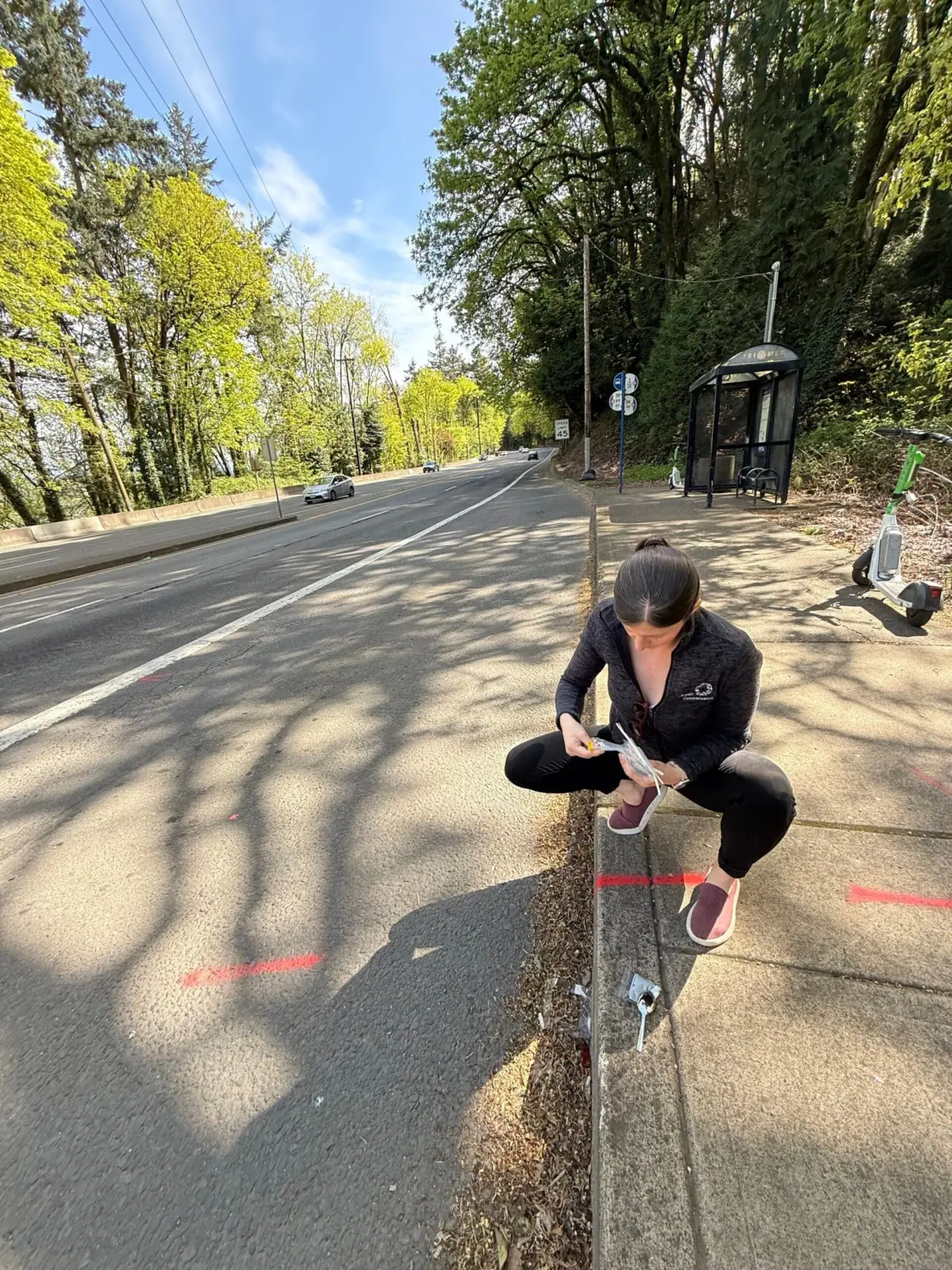
Today, environmental research has moved from laboratory identification to field-level municipal testing. Conservation groups, including the Ocean Conservancy’s plastics science and policy teams, have partnered with academic institutions like the University of Toronto—with backing from initiatives such as the Tire Industry Project—to evaluate the cost-effectiveness of scaling green infrastructure at the city level. Field scientists can now be found sampling roadside soils in cities like Portland, Oregon, meticulously quantifying how effectively engineered natural barriers can intercept TWPs before they breach aquatic ecosystems.
Supporting Context & Metrics: The Scale of the Problem
The statistics surrounding tire wear particles underscore an environmental challenge of planetary proportions. Unlike exhaust emissions, which have faced decades of increasingly stringent regulatory caps, non-exhaust emissions—principally from brakes and tires—remain largely unregulated across most global jurisdictions.
| Environmental Metric | Estimated Value | Ecological Implication |
|---|---|---|
| Particle Generation Rate | ~2 trillion particles per mile per vehicle | High volume of microscopic debris entering the urban airshed and watershed. |
| Per Capita Annual Output | Nearly 2 pounds (approx. 0.9 kg) per person/year | Widespread, cumulative environmental loading tied directly to modern mobility. |
| Lifespan Replacement Interval | Every ~60,000 miles | Highlights the continuous structural degradation of rubber composites on global fleets. |
| Toxicity Thresholds | Lethal to coho salmon at parts-per-trillion levels (6PPD-Q) | Demonstrates that even trace concentrations of tire additives can trigger catastrophic local ecology collapses. |
The Dual Pathway of Distribution
Once shed from a tire, particles follow two primary environmental pathways:
- Atmospheric Transport: Lighter, finer particles become airborne dust, contributing to urban particulate matter pollution (PM2.5 and PM10) that poses documented inhalation risks to human respiratory and cardiovascular systems.
- Hydrological Transport: Heavier particles settle on road shoulders and asphalt surfaces. During precipitation events, stormwater sweeps these accumulated polymer fragments into municipal drainage systems. Traditional stormwater infrastructure is designed to route water away from cities as rapidly as possible, acting as a direct conveyor belt dumping untreated microplastics directly into local streams, rivers, estuaries, and oceans.
Official Statements and Expert Insights
The invisible nature of tire wear pollution has necessitated clear, authoritative communication from environmental scientists and policy directors who are working to shift public perception and drive institutional action.
Dr. Britta Baechler, Director of Ocean Plastics Research, offered a sobering perspective on the mechanics of tire degradation in an interview with Eos magazine:
"Driving a car or even riding in a bus is a bit like dragging an eraser across the planet, except the crumbs are microplastics. Toxic microplastics."
Dr. Baechler emphasizes that the structural reality of modern transport makes complete avoidance impossible in the near term. Society cannot simply halt driving overnight; the global economy is structurally reliant on rubber-tired mobility for commerce, logistics, and daily commuting.
Complementing this perspective, Dr. Anja Brandon, Director of Plastics Policy, notes the critical policy disconnect that researchers are attempting to bridge:
"While long-term solutions must involve reforming tire chemistry and exploring alternative materials, we cannot afford to wait for the entire global vehicle fleet to be overhauled. We need immediate, structural defenses that intercept these particles right where they leave the asphalt."
This sentiment highlights the pragmatic justification for turning toward urban planning and civil engineering—specifically, green infrastructure—as the most viable near-term line of defense.
Future Outlook: Engineering Solutions from the Ground Up
If reforming global tire manufacturing is a long-term horizon project, what can cities do today to safeguard local watersheds? The answer lies in transforming how urban landscapes manage stormwater runoff.
The Mechanism of Green Infrastructure
Green infrastructure fundamentally reimagines the interface between the paved roadway and the natural environment. Instead of relying on concrete gutters and subterranean pipes that accelerate runoff, green infrastructure utilizes engineered natural systems:
- Bioswales and Rain Gardens: Vegetated, depressed landscape features designed to capture, hold, and filter runoff water.
- Roadside Buffers: Native root systems and specialized soil matrices that stabilize roadside earth while trapping particulate matter.
- Permeable Pavements: Porous surface materials that allow rainwater and surface dust to percolate downward rather than washing laterally into storm grates.
As contaminated stormwater flows through these natural filtration media, physical entrapment, biological breakdown, and adsorption occur. Soil microbes, root structures, and specialized filter layers capture microplastic particles—including tire wear debris—preventing them from migrating further downstream into marine ecosystems.
The Path Forward: Science-Backed Policy
Transitioning from small-scale pilot projects to city-wide municipal implementation requires rigorous economic and environmental cost-benefit analysis. Current research partnerships, such as those between the Ocean Conservancy and the University of Toronto, are actively evaluating how cities can deploy green infrastructure strategically to maximize microplastic capture efficiency per dollar invested.
By pairing empirical field science with actionable municipal policy guidance, researchers are helping local governments move past the paralysis of a seemingly insurmountable problem. Through targeted investments in urban green spaces, roadside bioswales, and modern stormwater management, society can build a tangible, effective defense against the hidden microplastic tide—protecting wildlife, preserving aquatic biodiversity, and securing a cleaner future for our global ocean, one roadway at a time.