









By Megan Bennett | Senior Manager, Digital Outreach
Published by Ocean Conservancy
Executive Overview
While the global ocean is frequently visualized as a singular, homogenous expanse of blue, it is in reality a turbulent mosaic of extreme and volatile thermal gradients. Temperatures range from the sub-zero, needle-sharp brines of the Antarctic abyss to blistering hydrothermal plumes surging past 600°F along tectonic boundaries. For human beings, surviving these catastrophic temperature deviations is a matter of technology: insulated gear, climate-controlled vessels, and artificial HVAC systems. For marine life, however, adaptation is not a convenience—it is an absolute evolutionary imperative.
Thermoregulation, the physiological process by which organisms control their internal body temperatures, represents the razor-thin margin between life and death across the world’s oceans. Over millions of years of evolution, marine species have engineered extraordinary biological mechanisms—ranging from countercurrent vascular networks and biological antifreeze proteins to the complete evolutionary abandonment of red blood cells—to conquer environments that should theoretically be completely uninhabitable.
Yet, as human-induced climate change accelerates, driving unprecedented marine heatwaves, intensifying hurricanes, and triggering catastrophic coral bleaching, these ancient physiological marvels are being pushed to their absolute biological limits. Understanding how marine species naturally regulate their temperatures offers critical insights not only into the resilience of ocean ecosystems, but also into the urgent necessity of global climate action.
Detailed Chronology: Milestones in Marine Thermal Adaptation
To appreciate how marine life navigates thermal stress today, it is instructive to examine the historical timeline of discovery regarding how these creatures evolved to outsmart extreme temperatures:
- 1928 – The Discovery of the Pale Abyssal: Marine biologists first document Antarctic icefish (Channichthyidae), unearthing vertebrate organisms possessing milky-white blood completely devoid of red blood cells and hemoglobin—a radical adaptation made possible by the hyper-oxygenated, freezing polar waters.
- Late 20th Century – Unveiling the "Wonderful Net": Ichthyologists and physiologists map the rete mirabile in apex pelagic predators like the bluefin tuna, discovering how regionally endothermic fish harness a complex, countercurrent blood vessel matrix to isolate metabolic heat in critical swimming muscles and the brain.
- 1977 – Venturing into the Abyss: The discovery of hydrothermal vents along the Galápagos Rift by deep-sea submersibles reveals entire ecosystems thriving in scalding, mineral-rich, toxic fluids. Scientists subsequently identify Riftia pachyptila (giant tube worms) and their specialized symbiotic relationships with chemosynthetic bacteria, redefining the boundaries of thermal survivability.
- 2000s–2010s – Decoding Biological Antifreeze: Molecular biologists isolate and synthesize Antifreeze Glycoproteins (AFGPs) found in Antarctic notothenioids and northern cod, mapping how these proteins structurally bind to nascent ice crystals to halt cellular destruction in sub-zero polar zones.
- 2025 – Genomic Loss as an Evolutionary Strategy: Cutting-edge genetic sequencing reveals that Asian noodlefishes have completely lost their myoglobin and hemoglobin genes, demonstrating that evolutionary reductionism continues to be a viable survival strategy in specialized thermal niches.
- Present Day – The Anthropocene Thermal Crisis: As ocean heat content reaches record highs year after year, marine scientists race against the clock to study these ancient thermal adaptations before rapidly warming waters surpass the evolutionary limits of even the most resilient species.
Supporting Context & Metrics: The Physics of Ocean Temperature
The ocean acts as the Earth’s primary heat sink, absorbing over 90% of the excess heat generated by anthropogenic greenhouse gas emissions. However, this heat is distributed with extreme spatial and temporal heterogeneity:
- Polar Latitudes: Antarctic and Arctic waters frequently hover around -1.8°C (28.8°F), the freezing point of seawater, which is saltier than freshwater. Without specialized anti-crystallization agents, the cellular fluids of unprotected fish would instantly turn to ice, puncturing cell membranes and causing fatal systemic failure.
- Tropical Shallows: Intertidal zones, coral reef flats, and shallow coastal bays routinely experience temperatures exceeding 100°F (37.8°C) during peak summer months, pushing ectothermic organisms into metabolic overdrive.
- Hydrothermal Vents: Superheated mineral waters roaring out of deep-sea crustal fissures can reach up to 660°F (350°C). Water remains liquid at these extreme temperatures only because of the immense hydrostatic pressure of the deep ocean (often exceeding 3,000 pounds per square inch).
- Pelagic Migrations: Apex predators such as the leatherback sea turtle (Dermochelys coriacea) traverse thousands of miles, migrating from tropical nesting beaches to sub-polar foraging grounds rich in sea jellies, exposing themselves to shifts of dozens of degrees in a matter of weeks.
Physiological Marvels: How Marine Animals Defy the Elements
1. Leatherback Sea Turtles and Countercurrent Heat Exchange
Sea turtles are classically classified as ectothermic (cold-blooded), relying entirely on external environmental heat sources to regulate their physiological processes. When reptiles bask on sun-drenched rocks or fish seek thermal refugia at the bottom of frozen lakes, they are surrendering control of their internal temperature to nature.

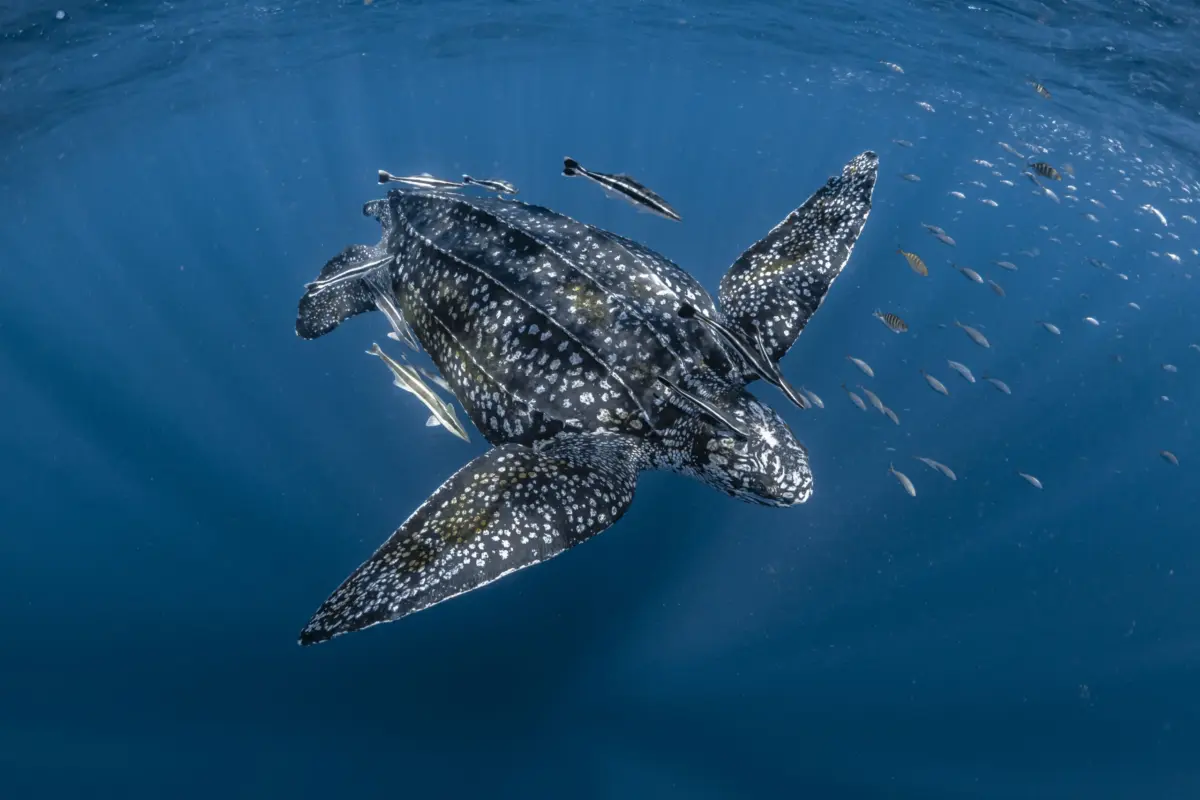
Yet the leatherback sea turtle routinely defies this biological restriction. By following its primary prey—sea jellies—into near-freezing northern waters, the leatherback faces a lethal drop in core body temperature. To combat this, leatherbacks utilize an intricate physiological system known as countercurrent heat exchange.
Arteries carrying warm blood outward from the heart are positioned directly adjacent to veins returning chilled blood from the flippers. The thermal energy from the arterial blood is transferred directly to the incoming venous blood, warming it before it reaches the core organs. This ingenious biological radiator can be reversed when the turtle migrates back to warmer tropical waters for nesting. Furthermore, as the largest sea turtle species on Earth, leatherbacks exhibit gigantothermy: their immense body mass, combined with thick layers of oily, insulating subcutaneous fat and a specialized leathery shell, traps metabolic heat and minimizes thermal loss to the surrounding water.
2. Bluefin Tuna: The Endothermic Speedsters
While the vast majority of fish are ectothermic, a select group of pelagic predators have evolved regional endothermy. The bluefin tuna is a prime example. These hydrodynamic powerhouses are capable of conserving metabolic heat in vital regions of the body—including swimming muscles, viscera, the eyes, and the brain—while allowing their heart to remain cool to preserve metabolic efficiency.
This localized warming is achieved through the rete mirabile (Latin for "wonderful net"), an extraordinary, densely intertwined network of microscopic arteries and veins. By routing blood through this countercurrent heat exchanger, the tuna traps metabolic heat produced by muscle contraction, preventing it from being washed away by the cold gill blood flow. This elevated tissue temperature grants bluefin tuna exceptional cruising speeds, explosive hunting reflexes, and enhanced visual acuity in cold, deep waters, cementing their status as apex marine predators.
3. Antarctic Fish: Antifreeze Proteins and Hemoglobinless Wonder
In the freezing waters of the Southern Ocean, survival requires defying the basic laws of physics. Certain Antarctic fish—such as notothenioids, the Antarctic toothfish, dragonfish, and icefish—produce specialized Antifreeze Glycoproteins (AFGPs). Much like automotive antifreeze disrupts ice crystal formation in an engine block, AFGPs circulate through the bloodstream, physically attaching to microscopic ice crystals and preventing them from growing and rupturing cellular structures.
Perhaps even more astonishing are the Antarctic icefish, the only known vertebrates on Earth with zero red blood cells or hemoglobin, giving their blood a translucent, milky-white appearance. Discovered in 1928, these fish rely on an alternative respiratory strategy: they absorb oxygen directly from cold, highly oxygenated polar water via diffusion through their skin and gills, dissolving it directly into their blood plasma. Combined with oversized hearts and widened blood vessels that pump watery blood with minimal resistance, these creatures represent the absolute pinnacle of evolutionary adaptation. Recent genetic discoveries in 2025 confirm that Asian noodlefishes have similarly shed their myoglobin and hemoglobin genes, proving that evolutionary reduction can be just as powerful as physiological complexity.
4. Deep-Sea Hydrothermal Vent Communities
At the opposite end of the thermal spectrum lie the abyssal hydrothermal vents. Driven by tectonic activity and volcanic fissures, these deep-sea geysers spew mineral-laden water at scorching temperatures. In this zone of extreme contrasts—where ambient water fluctuates from near-freezing to over 600°F—thrive giant tube worms (Riftia pachyptila).
Growing up to eight feet long, Riftia anchor themselves in narrow thermal gradients mere inches from superheated vent fluids. They possess a symbiotic relationship with chemosynthetic bacteria housed inside a specialized organ called a trophosome. Using a bright red, highly vascularized plume, the tubeworm absorbs oxygen and hydrogen sulfide from the water, delivering them to the bacteria. In return, the bacteria convert these toxic compounds into organic nutrients that feed the worm. Alongside zoarcid fish, deep-sea mussels, and specialized octopuses, these organisms prove that life can not only survive but dominate environments that defy conventional biology.
Future Outlook: The Anthropological Threat to Marine Thermoregulation
The remarkable physiological adaptations detailed above are testaments to the power of natural selection over millions of years. However, evolution operates on geological timescales—generations upon generations of gradual genetic refinement. The modern climate crisis, driven by anthropogenic greenhouse gas emissions, is unfolding at an unprecedented, exponential velocity.
Marine heatwaves are increasing in frequency, intensity, and duration, pushing ectothermic and stenothermal (temperature-sensitive) species past their upper thermal thresholds. When water temperatures spike beyond historical norms, metabolic rates soar, oxygen solubility in water drops, and cellular machinery—including critical heat-shock proteins—begins to fail. This is acutely visible in mass coral bleaching events, widespread kelp forest die-offs, and behavioral disruptions in commercially vital fish stocks.
The Call to Action
The resilience of marine life is not infinite. While organisms have spent epochs mastering the art of thermoregulation, they cannot outpace an ocean that is warming faster than at any point in modern human history. The climate crisis is no longer a distant theoretical threat; its impacts are actively reshaping marine ecosystems worldwide.
Safeguarding the future of our oceans requires immediate, decisive policy intervention. Mitigating climate change demands a global transition away from fossil fuels, aggressive protection of critical marine habitats, and adherence to international emissions-reduction targets.
The climate crisis is here, and it will only worsen without immediate action. Join us in calling for our elected leaders to take action to mitigate climate change now.