










Executive Overview
Just fifty miles north of Chicago’s bustling downtown and a mere stone’s throw from the Wisconsin state line lies a landscape that completely defies the urbanized sprawl of Northern Illinois. Situated in the laid-back lakeside village of Antioch, the Pine Dunes Forest Preserve spans an impressive 956 acres of fiercely protected, highly revitalized land. Managed by the Lake County Forest Preserves (LCFP), this sprawling sanctuary is characterized by a rich mosaic of rolling oak-hickory forests, expansive open meadows, restored savannas, and intricate wetland ecosystems.
While modern-day visitors flock to Pine Dunes for its pristine tranquility, immersive hiking trails, and world-class birdwatching, the land tells a deeper, more layered story. Decades before conservationists reclaimed the acreage, these very hills bore witness to agricultural cultivation by 19th-century Irish immigrants—who affectionately dubbed the region the "Irish Hills"—and later served as a mid-20th-century racetrack for whippet dogs.
Today, following a monumental $9.3 million acquisition and ecological restoration effort initiated in 2010, Pine Dunes stands as a testament to successful land reclamation. It serves as a vital ecological corridor, bridging local waterways, housing over 200 species of birds, and offering a low-impact outdoor recreation space for hikers, cyclists, equestrians, and cross-country skiers. This report provides an exhaustive, authoritative examination of Pine Dunes Forest Preserve, detailing its historical evolution, ecological significance, structural layout, and its role in the broader network of Northern Illinois conservation projects.
Detailed Chronology: The Evolution of Pine Dunes
To truly understand the ecological and cultural weight of Pine Dunes Forest Preserve, one must trace its journey through distinct eras of human utilization and eventual environmental redemption. The landscape has undergone profound transformations, shifting from indigenous wild spaces to agricultural plots, commercial recreational grounds, and, finally, a sanctuary for native flora and fauna.
The Pre-Settlement and Agricultural Era
Long before the advent of modern cartography, the rolling terrain straddling the borderlands of Lake County was shaped by glacial activity, carving out the kettle lakes, marshes, and rolling hills that define the region today. With European settlement in the 19th century, the land’s economic value was quickly recognized by immigrants seeking new opportunities in the American Midwest.
During the mid-to-late 19th century, a wave of Irish immigrants settled in the northern stretches of Antioch Township. Finding the undulating hills and fertile pockets reminiscent of parts of their homeland, they established agrarian homesteads. Though they lacked the heavy mechanized equipment of later eras, these settlers cleared portions of the dense hardwood forests, planted crops, and grazed livestock. Among the local populace, the distinct topography earned the moniker the "Irish Hills"—a historical footnote that preserves the memory of those early farming pioneers.
The Mid-20th Century: The Whippet Racing Era
As the decades progressed, the agricultural viability of the rocky, rolling hills waned, paving the way for alternative, highly unconventional uses. In the mid-to-late 20th century, the property took on a distinctly commercial and sporting character. The land was converted into a specialized racetrack facility engineered specifically for whippets—a breed of medium-sized sighthounds renowned for their explosive acceleration and high-speed racing capabilities.

During this era, the property operated outside the public eye, serving as a regional hub for dog-racing enthusiasts. Temporary grandstands, training tracks, and kennel facilities altered the footprint of the historic farmlands. Though this chapter of the land’s history was relatively short-lived compared to its agricultural past, it remains a fascinating cultural anomaly in the local lore of Antioch, contrasting sharply with the profound stillness that defines the preserve today.
The McClure Era and Modern Acquisition
By the latter decades of the 20th century, the whippet tracks fell silent, and the property transitioned into a private rural estate. For approximately thirty-three years, the land was owned and stewarded by the McClure family, who maintained its rural, pastoral aesthetic while allowing nature to gradually reclaim the former agricultural and racing grounds.
As urban and suburban development rapidly encroached upon Northern Illinois throughout the 2000s, the Lake County Forest Preserves identified the McClure property as a high-priority acquisition target. The goal was twofold: to protect vital headwaters and wetlands from impending commercial development and to create an unbroken ecological corridor connecting existing natural areas near the Wisconsin border.
In 2010, following extensive negotiations, the LCFP successfully purchased the 956-acre parcel. Backed by a substantial $9.3 million capital investment, the district initiated one of the most ambitious ecological restoration projects in the county’s history. The objectives were clear: dismantle obsolete human infrastructure, eradicate aggressive invasive plant species, re-establish native hydrological flows, and reintroduce indigenous prairie, forest, and wetland plant communities.
Supporting Context & Metrics
The transformation of Pine Dunes from a privately held family estate and defunct racetrack into a thriving public sanctuary is best quantified through its ecological metrics, geographical positioning, and infrastructure parameters.
Geographical and Infrastructural Overview
- Total Acreage: 956 protected acres.
- Location: Antioch, Illinois (positioned strategically between Chicago, Illinois, and Milwaukee, Wisconsin).
- Operating Hours: Open daily from 6:30 a.m. to sundown.
- Trail System: Approximately 3 miles of primary looping trails (featuring the popular Yellow Loop Trail), seamlessly connecting to the adjacent 31-mile Des Plaines River Trail.
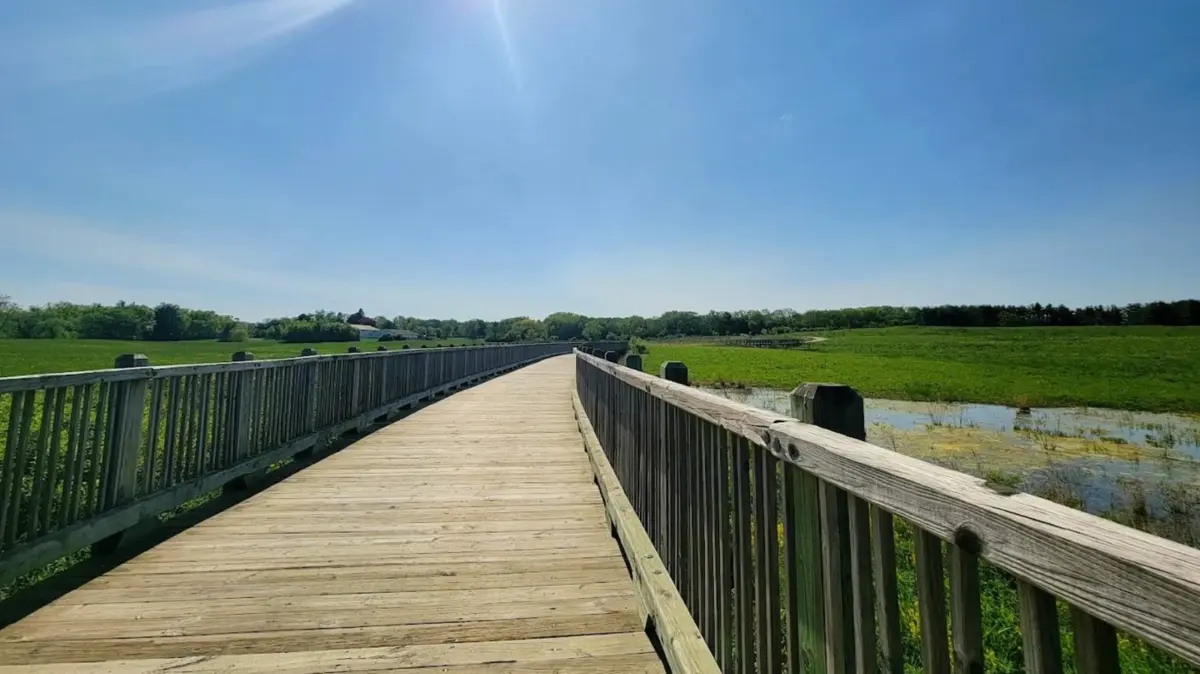
- Surface Composition: A hybrid network of raised wooden boardwalks and compacted gravel pathways designed to minimize human footprint while maximizing accessibility.
- Amenities: Three elevated scenic overlooks, multiple resting benches, restroom facilities, and potable drinking water stations.
- Permitted Activities: Hiking, trail running, bicycling, horseback riding, and cross-country skiing. (Note: Camping, swimming, and fishing are strictly prohibited to preserve local wildlife habitats).
Ecological Metrics and Biodiversity
Pine Dunes is not merely a recreational park; it functions as a complex, highly functioning ecological machine. Wetlands, seasonal ponds, streams, and marshes account for roughly 30 percent of the preserve’s total landmass. This high concentration of aquatic and semi-aquatic terrain creates an optimal ecosystem for amphibians, reptiles, mammals, and avian species.
According to data compiled on citizen-science platforms such as eBird, more than 200 distinct bird species have been documented within the boundaries of Pine Dunes. The mosaic of oak-hickory woodlands, restored tallgrass prairies, and saturated wetlands supports critical populations of neo-tropical migratory birds, raptors, waterfowl, and rare state-listed species. Local field naturalists and ornithologists routinely log significant sightings at the preserve’s three designated elevated overlooks, making it one of the premier birding hotspots in the greater Chicago metropolitan area.
Official Statements and Conservation Philosophy
The success and ongoing management of Pine Dunes Forest Preserve reflect a broader philosophy of aggressive ecological restoration championed by Lake County land managers.
In public briefings regarding the acquisition and subsequent development of Pine Dunes, LCFP representatives have consistently emphasized the necessity of proactive habitat management over passive preservation. When the district secured the land in 2010, the ecosystem was suffering from decades of fragmentation, agricultural runoff, and the unchecked proliferation of invasive species such as buckthorn and reed canary grass.
"Purchasing the land is merely the first step in our mandate," notes an ecological restoration specialist with the Lake County Forest Preserves. "In landscapes that have experienced intensive human intervention—whether through farming, structural development, or commercial use—nature rarely heals itself quickly or completely. Our $9.3 million investment was targeted directly at healing the hydrology of the site. By restoring natural water retention in the wetlands and replanting native oak-savanna and prairie seeds, we are rebuilding the foundation of the local food web."
Conservation leadership also highlights the importance of connectivity in combating biodiversity loss. By designing Pine Dunes with direct access points to the Des Plaines River Trail, LCFP ensured that the preserve does not exist as an isolated ecological island. Instead, it functions as a critical stepping stone within a regional green infrastructure network, allowing wildlife to migrate safely across county lines and genetic diversity within plant and animal populations to flourish.
Future Outlook: Preservation, Climate Resilience, and Public Access
As Pine Dunes Forest Preserve looks toward the coming decades, its management trajectory is shaped by the dual imperatives of increasing public demand for passive outdoor recreation and the pressing realities of regional climate change.
Enhancing Climate Resilience
Northern Illinois faces shifting precipitation patterns, characterized by heavier, more erratic rainfall events interspersed with periods of drought. The extensive wetlands and restored hydrological systems at Pine Dunes serve as natural sponges, mitigating downstream flood risks in the Des Plaines River watershed while recharging local aquifers. Future management plans include ongoing adaptive management strategies, such as continuous monitoring of invasive species, prescribed burns to maintain the health of the oak-hickory savannas and prairies, and the expansion of native tree plantings to sequester carbon and provide thermal refuge for wildlife.
Balancing Public Access and Ecological Integrity
With urban centers like Chicago and Milwaukee continuing to expand outward, the demand for quiet, natural retreats is at an all-time high. Visitor numbers at Pine Dunes have steadily climbed as regional residents seek alternatives to more crowded state parks and urban green spaces.
Park administrators remain committed to maintaining the low-impact ethos of the preserve. There are no plans to introduce high-impact commercial amenities, campgrounds, or motorized vehicle trails. Instead, future capital improvements will focus on infrastructure maintenance—such as boardwalk reinforcement, trail resurfacing, and educational signage that interprets the rich cultural and natural history of the site.
For the modern visitor, Pine Dunes offers an increasingly rare commodity: space, silence, and authenticity. Whether navigating the gravel loops in the crisp air of a winter morning on cross-country skis, scanning the marshes for trumpeter swans through a pair of binoculars in the spring, or tracing the footsteps of the 19th-century Irish homesteaders along the hillside trails, Pine Dunes stands as a shining example of how degraded landscapes can be successfully resurrected into enduring natural sanctuaries.