









Executive Overview
The global ocean is frequently visualized as a singular, homogeneous body of water, yet it is a dynamic mosaic of extreme thermal environments. Spanning from the sub-zero brine pools of the Antarctic abyss—where temperatures drop below freezing—to the blistering shallows of tropical coasts exceeding 100°F, and ultimately to the superheated zones of deep-sea hydrothermal vents reaching upwards of 660°F, marine ecosystems present a masterclass in biological adaptation.
Unlike terrestrial mammals, which can alter their microclimates or behaviors instantly to escape thermal stress, marine organisms face a profound physical constraint. Water has a high thermal conductivity, draining body heat nearly instantaneously. To survive, marine species have evolved sophisticated physiological mechanisms of thermoregulation—the process of maintaining internal body temperatures within tolerable limits.
As anthropogenic climate change accelerates—triggering historic marine heatwaves, intensifying hurricanes, and driving unprecedented coral bleaching events—understanding these survival strategies is no longer merely an academic pursuit. It is a critical baseline for predicting how marine biodiversity will fare in an increasingly volatile ocean. This report examines the extraordinary evolutionary adaptations that allow marine creatures to conquer thermal extremes, the physiological costs of their survival, and the urgent call to action required to preserve these delicate biological systems.

Detailed Chronology of Discovery & Evolutionary Adaptation
The history of scientific inquiry into marine thermoregulation is marked by paradigm shifts, beginning with the long-held assumption that all sea creatures were simply victims of their surrounding water temperatures.
1928: The Discovery of Bloodless Wonders
Early marine biologists operated under the strict physiological rule that all vertebrates required hemoglobin-rich red blood cells to transport oxygen. That dogma was shattered in 1928 with the discovery of Antarctic icefish (Chaenocephalidae). These ethereal, milky-white creatures operate in sub-zero polar waters without a single red blood cell or functional hemoglobin gene. Scientists subsequently uncovered their reliance on an evolutionary marvel: high-volume circulation driven by oversized hearts, wide blood vessels, and direct oxygen absorption via skin and gills, paired with antifreeze glycoproteins (AFGPs) that prevent cellular crystallization.
The Late 20th Century: Unlocking Endothermy in Pelagic Predators
For decades, fish were universally categorized as ectothermic ("cold-blooded"). However, physiological studies in the late 20th century revealed that apex pelagic predators like the Atlantic and Pacific bluefin tuna break this mold. Through the discovery of the rete mirabile—a dense, intertwined "wonderful net" of blood vessels—researchers realized these fish could regionally warm specific muscle groups, viscera, eyes, and brains, maintaining high metabolic and predatory efficiency while plunging into cold, deep-sea waters.
1977–Present: Hydrothermal Vents and Extreme Heat Tolerance
The discovery of deep-sea hydrothermal vents in 1977 introduced science to ecosystems operating entirely independent of solar energy. Here, marine life faced the inverse problem of the polar regions: extreme heat rather than freezing cold. Researchers chronicled how giant tubeworms (Riftia pachyptila) and specialized extremophiles adapted to fluctuating thermal gradients, utilizing chemosynthetic symbioses to thrive mere inches from volcanic vents spewing superheated, mineral-rich water.

Supporting Context & Metrics: The Mechanics of Marine Thermal Defense
To appreciate how marine species survive environments that would prove instantly fatal to humans, one must examine the specific biophysical adaptations they employ.
1. Countercurrent Heat Exchange and Gigantothermy
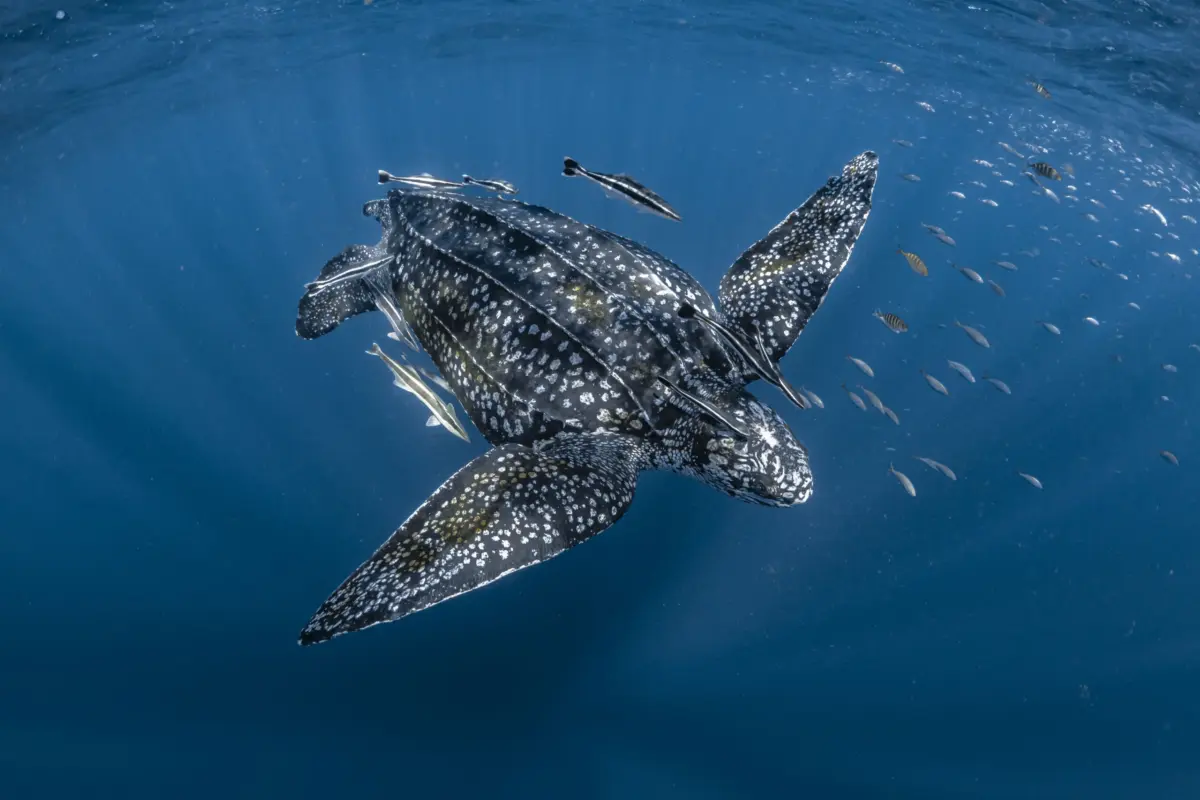
Leatherback sea turtles (Dermochelys coriacea) traverse global oceans, feeding on jellyfish in near-freezing sub-polar currents while nesting on tropical beaches. They achieve this thermal range through two distinct mechanisms:
- Countercurrent Heat Exchange: Arteries carrying warm blood from the heart run parallel to veins returning cold blood from the flippers. Heat is transferred inward before the cold blood reaches the core, preventing systemic thermal shock.
- Gigantothermy: As the largest sea turtles on Earth, their massive volume-to-surface-area ratio, combined with thick layers of oily, insulating fat and a leathery, flexible shell, drastically reduces internal heat dissipation.
2. Antifreeze Glycoproteins (AFGPs)
In polar regions, water remains liquid at temperatures below 32°F (0°C) due to high salinity, often reaching -1.8°C. Antarctic notothenioids, dragonfish, and northern cod survive this through AFGPs. These specialized proteins circulate through the bloodstream, physically binding to fledgling ice crystals and disrupting their molecular lattice structure, effectively acting as biological antifreeze.
3. The Hydrothermal Gradient Strategy
At the other end of the spectrum, hydrothermal vent communities in the deep sea must navigate extreme heat. Giant tubeworms (Riftia pachyptila) grow up to eight feet long by positioning themselves precisely within mixed-temperature zones near tectonic fissures. Using a bright red plume to absorb oxygen and hydrogen sulfide, they feed symbiotic chemosynthetic bacteria, converting geothermal toxicity into life-sustaining energy.
Official Statements & Scientific Consensus
The scientific community agrees that while these evolutionary adaptations are breathtaking, they are operating near their biological thresholds due to rapid human-induced climate change.
"While our ocean may seem like one giant body of water, its temperatures fluctuate widely… Unlike humans, marine animals can’t just blast the air conditioning or put on a jacket when they get uncomfortable. Years of evolution have equipped these creatures with remarkable ways to regulate temperature, but those adaptations have biological limits."
— Ocean Conservancy Outreach Analysis
Marine biologists and conservation organizations emphasize that physiological buffering capacities—such as the tuna’s rete mirabile or the icefish’s metabolic rewiring—demand massive energy expenditures. When baseline ocean temperatures rise due to cumulative carbon emissions, the metabolic cost of thermoregulation skyrockets, leaving animals with fewer resources for growth, reproduction, and disease resistance.
Future Outlook: The Climate Crisis Beneath the Waves
The extreme thermal tolerances exhibited by leatherback turtles, bluefin tuna, icefish, and vent-dwelling tubeworms represent millions of years of evolutionary refinement. However, evolution operates on geological timescales, whereas anthropogenic warming is occurring on a decadal scale.
Recent genetic discoveries—such as the 2025 identification of Asian noodlefishes losing their myoglobin and hemoglobin genes—demonstrate that evolutionary experimentation is ongoing. Yet, these specialized traits make species acutely vulnerable to rapid habitat alteration. Historic marine heatwaves, intensified tropical storms driven by ocean heat storage, and catastrophic coral reef bleaching events signal an urgent warning: the climate crisis is already transforming marine ecosystems.
Without immediate, coordinated international action to mitigate greenhouse gas emissions and stabilize ocean temperatures, the resilience of marine thermoregulation will be pushed past its breaking point.
Take Action: The survival of these extraordinary ecosystems depends on policy interventions today. Conservation organizations and marine scientists urge the public to join campaigns calling on elected leaders to take decisive action to mitigate climate change now.