






Executive Overview
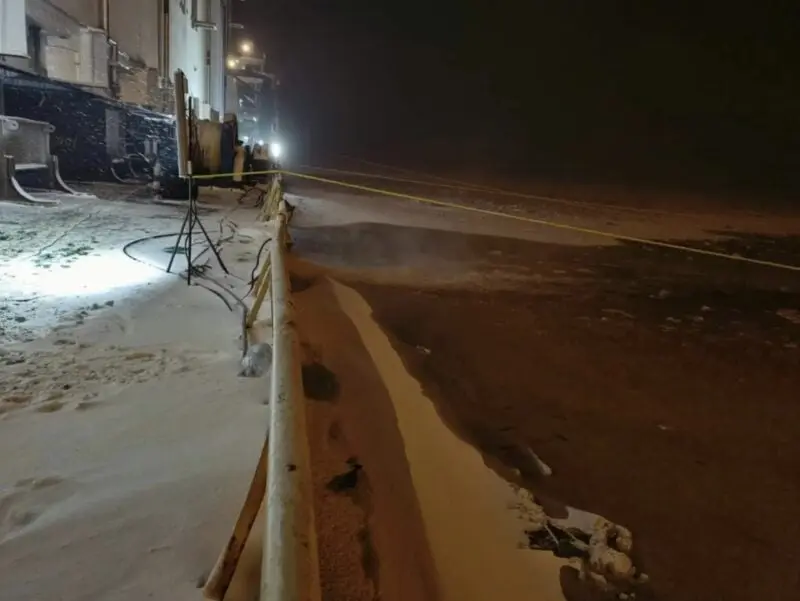
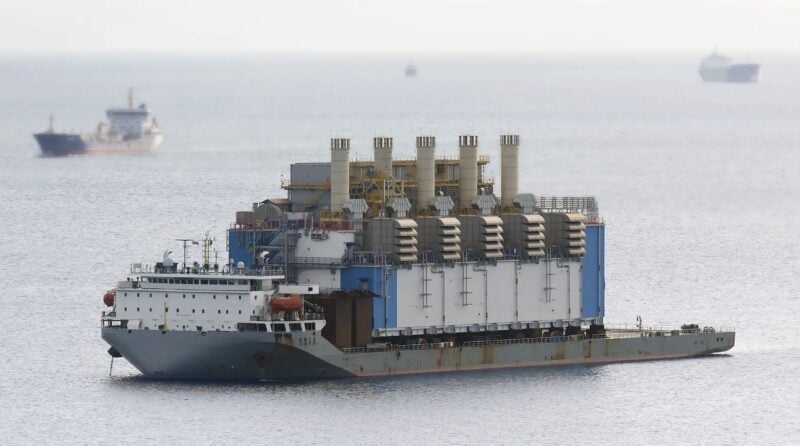
Despite an unprecedented campaign of Western sanctions designed to freeze Russia’s energy ambitions, a highly resilient, multi-layered supply chain between China and the Russian Arctic remains active. According to recent satellite imagery and automatic identification system (AIS) vessel-tracking data, two heavily sanctioned heavy-lift vessels, the Glory and the Bright, are currently transporting critical, large-scale power-generation modules from eastern China toward Russia’s beleaguered Arctic LNG 2 project.
This maritime transfer represents the latest flashpoint in a geopolitical cat-and-mouse game between the U.S. Department of State—which has blacklisted the vessels, the fabrication yards, and the intermediate logistics companies involved—and a determined Sino-Russian alliance. The cargo in transit consists of the final two onshore power plant modules required to complete the electrical infrastructure for the project’s second liquefaction train (Train 2).
For Novatek, Russia’s largest independent natural gas producer and the operator of Arctic LNG 2, the successful delivery of these modules is a critical milestone. Currently operating at roughly half of its designed capacity due to power constraints, Train 2 requires these specific modules to unlock its full output of 6.6 million metric tons per annum (mmtpa). The voyage underscores a stark reality: while Western sanctions have successfully delayed schedules and increased operational costs, they have failed to completely sever the technological and logistical arteries connecting Chinese heavy-industry manufacturing with Russia’s strategic energy developments.
Detailed Chronology: The Journey of PGM 2 and PGM 4
The journey of these massive modules—designated 2-PGM-002 and 2-PGM-004—reveals a sophisticated, multi-year logistical relay designed to bypass Western regulatory hurdles and shield key maritime assets from direct sanctions exposure.
+-----------------------------------------------------------------------------+
|                                  TIMELINE                                   |
+-----------------------------------------------------------------------------+
| Late 2024      | PGM 1 and PGM 3 delivered to Gydan Peninsula.              |
+----------------+------------------------------------------------------------+
| Jan 10, 2025   | U.S. sanctions Wison Zhoushan Yard for supporting project. |
+----------------+------------------------------------------------------------+
| April/May 2026 | Unsanctioned "Xin Xu Zhi Xing" moves PGM 2 & 4 to          |
|                | Zhangjiagang to bypass yard-level restrictions.            |
+----------------+------------------------------------------------------------+
| July 2026      | "Glory" and "Bright" deliver Train 3 modules to            |
|                | Belokamenka, establishing the summer Arctic corridor.      |
+----------------+------------------------------------------------------------+
| Sept 6-10, 2026| PGM 2 and PGM 4 loaded onto "Glory" and "Bright" at        |
|                | Zhangjiagang; vessels depart via Northern Sea Route.       |
+-----------------------------------------------------------------------------+
Phase 1: Fabrication and Initial Sanctions Blowback (2024–2025)
The power-generation modules were originally contracted to and fabricated by Wison Offshore & Marine (now Wison New Energies) at its specialized Zhoushan facility in eastern China. Designed as part of a post-sanctions redesign of Arctic LNG 2, these modules were engineered to support electrically driven liquefaction compressors after Western turbine manufacturers, such as Baker Hughes, exited the Russian market.
The first two modules of the set, PGM 1 and PGM 3, successfully departed Zhoushan in late 2024, navigating through challenging early-winter sea ice to reach the Utrenniy terminal on Russia’s Gydan Peninsula. This delivery prompted swift retaliation from Washington. On January 10, 2025, the Biden administration designated the Zhoushan Wison yard under executive sanctions, citing its direct role in supplying technology to the restricted Russian project. Under pressure, Wison announced intentions to divest its Zhoushan assets and distance itself from Russian contracts.
Phase 2: The Shell Game at Zhangjiagang (April–May 2026)
While the first pair of modules was already installed, the remaining PGM 2 and PGM 4 modules were stranded at the sanctioned Zhoushan facility for over a year. To resume their journey without immediately triggering further vessel arrests, operators utilized an unsanctioned intermediate vessel.

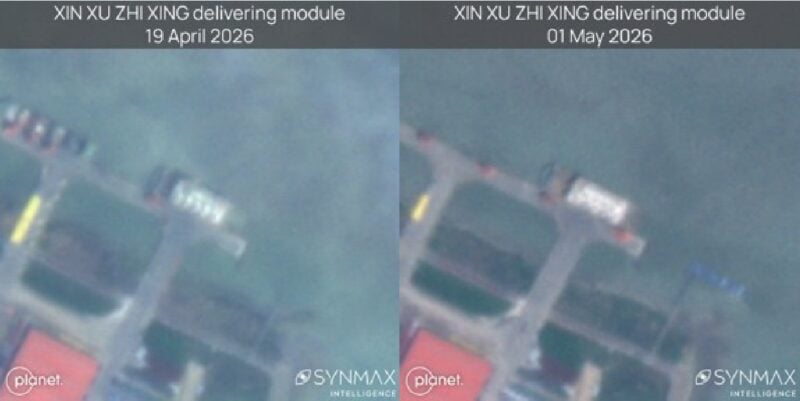
In the spring of 2026, the Chinese-flagged cargo vessel Xin Xu Zhi Xing (MMSI 413544670)—which was not under U.S. sanctions—made two quiet runs to the Zhoushan yard. On April 17 and April 26, the vessel loaded PGM 2 and PGM 4, delivering them to the port of Zhangjiagang on April 19 and May 1, respectively. Zhangjiagang, a bustling inland port on the Yangtze River, had previously served as a transshipment hub for Arctic LNG 2 equipment in 2024. By moving the modules to this neutral, high-volume port, the operators effectively decoupled the cargo from the sanctioned yard of origin, storing them in plain sight for several months.
Phase 3: The Summer Transshipment and September Departure (July–September 2026)
The final leg of the transit was initiated in September 2026 with the arrival of two heavy-lift vessels specifically adapted for Arctic operations: the Glory and the Bright.
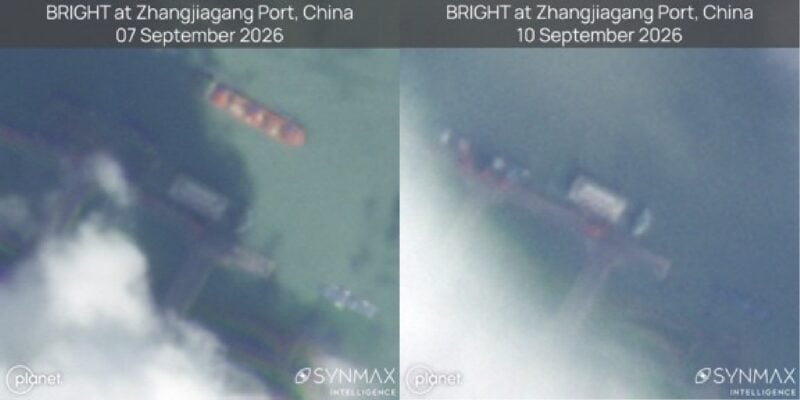
According to satellite imagery provided by maritime intelligence firm SynMax, the vessels arrived at Zhangjiagang in early September. Between September 6 and September 10, 2026, the modules were loaded aboard. High-resolution imagery captured the vessel Bright in port with one of the massive, block-like power modules secured to its deck. Immediately after loading, both ships updated their AIS destinations, heading north toward the Sea of Japan, with their trajectories pointing directly toward the Northern Sea Route (NSR) to capitalize on the late-summer ice-free window.
Supporting Context & Metrics: Technical and Maritime Specifications
To understand the high stakes of this voyage, it is necessary to examine both the technical requirements of the Arctic LNG 2 facility and the operational history of the vessels tasked with completing the delivery.
The Power Deficit of Train 2
Arctic LNG 2 is designed around three massive liquefaction trains, each built on concrete Gravity-Based Structures (GBS) and towed to the Gydan Peninsula. Each train has a design capacity of 6.6 mmtpa, bringing the total planned facility output to 19.8 mmtpa.
                    TRAIN 2 POWER PROFILE

   [Current Single-String Power]  -->  ~241 MW (Limited to 50% Capacity)
   [Required Full-Configuration]  -->  482 MW (Total 20 Gas Turbines)

   *Missing Link: Delivery of PGM 2 & PGM 4 modules to unlock remaining ~241 MW.
Following the withdrawal of Western engineering firms, Novatek modified the design of Train 2 to rely on a centralized onshore power plant composed of four power-generation modules.
- Total Power Demand: 482 Megawatts (MW) of generation capacity, provided by 20 heavy-duty gas turbines integrated across the four modules.
- Current Operational Status: Train 2 has been operating on a single-string configuration powered only by PGM 1 and PGM 3. Consequently, its liquefaction capacity has been bottlenecked at approximately 50% (~3.3 mmtpa).
- The Solution: The arrival and hookup of PGM 2 and PGM 4 will complete the electrical grid for Train 2, providing the necessary redundancy and power output to ramp the train toward its full 6.6 mmtpa design capacity.
Vessel Profiles: Glory and Bright
The two heavy-lift vessels carrying these critical components are veteran assets in Russia’s specialized "shadow fleet" for industrial cargo.
| Metric / Detail | Glory | Bright |
|---|---|---|
| IMO Number | 9934498 | 9830769 |
| Previous Names | Nan Feng Zhi Xing, Glory Ocean | Hunter Star, Bright Ocean |
| Flag State | Russian Federation (Reflagged 2026) | Russian Federation (Reflagged 2026) |
| Registered Owner | Eco Shipping LLC (Arkhangelsk, Russia) | Eco Shipping LLC (Arkhangelsk, Russia) |
| Sanctions Status | Designated by U.S. Department of State | Designated by U.S. Department of State |
These vessels are uniquely suited for the harsh conditions of the Northern Sea Route. Their ownership transfer to Eco Shipping LLC—a Russian firm heavily involved in Arctic logistics—and their subsequent reflagging to Russia earlier in 2026 were deliberate moves to insulate the vessels from international port detentions and foreign maritime law enforcement.
This is not the first high-profile Arctic run for the duo this year. In July 2026, the Glory and Bright successfully delivered two large industrial modules from China to Novatek’s primary assembly and construction center in Belokamenka, near Murmansk. Those modules were designated for Train 3, proving that the vessels had established a reliable, repeatable transit corridor prior to undertaking the Train 2 mission.
Official Statements and Sanctions Efficacy
The ongoing shipments highlight the limits of unilateral and multilateral sanctions when confronted with determined state-backed actors.
The U.S. Department of State and the Office of Foreign Assets Control (OFAC) have repeatedly stated that their objective is to "systematically starve" the Arctic LNG 2 project of both technology and shipping capacity. In its January 2025 sanctions declaration against the Wison Zhoushan yard, the State Department emphasized:
"The United States will continue to impose costs on any entities providing material support to Russia’s priority energy projects. We are committed to disrupting the procurement networks and deceptive maritime practices that seek to bring Russian LNG online."
Despite these warnings, the logistics chain has merely adapted rather than collapsed. When Wison New Energies announced its formal exit from Russian projects in early 2025 to protect its broader international business, the physical assets—the modules and the shipyard infrastructure—remained in place. The subsequent sale of the Zhoushan yard and the use of the unsanctioned Xin Xu Zhi Xing to move the cargo to Zhangjiagang demonstrate how easily ownership and operational structures can be reshuffled to bypass legal barriers.
At the time of reporting, Novatek, Wison New Energies, and Eco Shipping LLC have not responded to formal requests for comment regarding the cargo, the ownership of the modules, or the destination of the vessels.
Future Outlook: The Battle for Arctic Energy Dominance
The successful transit of PGM 2 and PGM 4 through the Northern Sea Route will be a major operational victory for Novatek, but it does not guarantee smooth sailing for the Arctic LNG 2 project as a whole.
                      LOGISTICAL CORRIDOR

  [Zhoushan Yard]
         │  (April/May 2026 via unsanctioned "Xin Xu Zhi Xing")
         ▼
  [Zhangjiagang Port] (Intermediate storage)
         │  (Sept 2026 via sanctioned "Glory" & "Bright")
         ▼
  [Northern Sea Route]
         │
         ▼
  [Gydan Peninsula] (Arctic LNG 2 - Train 2 Site)
Technical and Operational Hurdles
Even if the modules arrive safely at the Utrenniy terminal before the winter ice closes the NSR completely, integrating them into GBS Train 2 is a complex engineering task. Commissioning large-scale, electrically driven compression trains in sub-zero Arctic environments requires specialized technical expertise.
Train 2 has reportedly suffered from persistent startup issues and mechanical instability. Resolving these engineering challenges without direct support from Western original equipment manufacturers (OEMs) will test the limits of Russian and Chinese engineering workarounds.
The Broader Geopolitical Implications
For the global LNG market, the completion of Train 2 would signal that Russia is capable of bringing world-scale LNG projects online despite being locked out of Western capital markets and technology suites. It also reinforces the strategic importance of the Northern Sea Route as an East-West transit corridor beyond the reach of Western naval choke points or regulatory jurisdictions.
As the Glory and the Bright continue their journey north, maritime analysts and Western governments will be watching closely. The voyage serves as definitive proof that the supply chains feeding Russia’s Arctic ambitions have not been broken—they have simply gone dark, utilizing a sophisticated network of reflagged ships, shadow shipowners, and cooperative Chinese ports to deliver the hardware of energy dominance.