











Executive Overview
For decades, retirees casting their sights on the historic Northeast have gravitated toward the predictable beacons of coastal living: the bustling, history-laden streets of Boston, the sprawling, ocean-breezed estates of Cape Cod, or the upscale, maritime enclaves of coastal Maine. Yet, hidden in plain sight just 61 miles south of Boston, tucked snugly between the vibrant arts community of Rhode Island and the iconic hook of Cape Cod, lies a historic seaport that is quietly redefining the golden years for a growing segment of the American population.
New Bedford, Massachusetts—a city of approximately 100,000 residents—offers an intoxicating blend of rich maritime heritage, European architectural charm, exceptional coastal walkability, and financial sanity that stands in stark contrast to its northern neighbor. While Boston commands median home prices hovering around $775,000 and average monthly rents touching $3,300, New Bedford presents a much gentler financial landscape. Here, the median home value sits near $442,000, and average rents rest at a manageable $1,717.
Beyond the bottom line, New Bedford has captured the attention of both the AARP and the World Health Organization (WHO), which have formally designated it an age-friendly city. With roughly 30% of its population already over the age of 50, the municipality has deliberately cultivated an infrastructure that champions active living, accessible healthcare, social participation, and vibrant cultural engagement. For retirees seeking a walkable, culturally rich, and economically forgiving New England lifestyle without the crushing crowds of Cape Cod or the dizzying expenses of Boston, New Bedford emerges not merely as an alternative, but as a destination of choice.
Detailed Chronology: From Global Whaling Capital to Modern Cultural Haven
To truly understand the fabric of New Bedford, one must look backward through the centuries to grasp how its unique physical layout and architectural identity came to be. The story of New Bedford is a sweeping narrative of industrial dominance, architectural preservation, and artistic renaissance.
The Colonial Foundation and the Golden Age of Whaling
The area’s recorded history began in earnest when colonists from Plymouth first laid roots in the region in 1652. Benefiting from a deep-water harbor that provided seamless access to the Atlantic Ocean, the southern Massachusetts settlement transformed over the next two centuries. By 1820, New Bedford had achieved global renown, rapidly rising to become one of the most prosperous whaling ports on earth. Herman Melville famously immortalized the city’s seafaring grit in Moby-Dick, writing of its forest of masts and the global reach of its mariners.

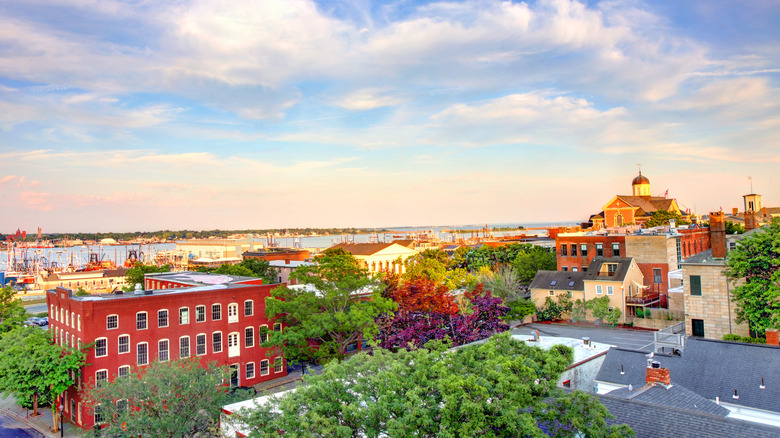
The immense wealth generated during this whaling epoch was poured directly into the city’s physical infrastructure. Fortunes were forged, and merchants and ship captains erected grand federal-style homes, cobblestone thoroughfares, and sturdy brick commercial warehouses that still anchor the downtown district today. Unlike many modern cities that paved over their past, New Bedford preserved it. Walking through the historic downtown today feels akin to stepping onto a living movie set of the early 19th century—a feature that now acts as a magnetic draw for retirees who value historical authenticity and aesthetic charm.
The Industrial Shift and the Immigrant Wave
As the whaling industry inevitably waned with the discovery of petroleum in the mid-19th century, New Bedford seamlessly pivoted. The city transformed into a powerhouse of textile manufacturing, drawing waves of European immigrants seeking opportunity in the New World.

Chief among these demographic shifts was the arrival of a massive Portuguese population. Today, New Bedford proudly boasts the second-highest concentration of residents of Portuguese heritage in the United States. This deep-rooted cultural legacy infused the city with a distinct European flavor—manifested today in bustling bakeries, authentic neighborhood groceries, world-class seafood grills, and vibrant annual cultural festivals that celebrate both Guatemalan and Portuguese traditions. The city’s history is not locked away behind glass museum cases; it is lived, tasted, and celebrated daily in its neighborhoods.
The Artistic Renaissance
In the 20th and 21st centuries, New Bedford’s scenic harbor views, dramatic maritime light, and historic streetscapes attracted a different kind of settler: artists and creators. Once home to renowned American painters like Albert Bierstadt and William Bradford, the city earned formal recognition as one of "America’s Most Artistic Cities." The establishment of the Seaport Cultural District cemented this identity, turning the walkable downtown into a canvas of performing arts venues, independent galleries, and visual installations like the annual Seaport Art Walk and exhibits at the New Bedford Art Museum.
Supporting Context & Metrics: Livability, Healthcare, and the Economic Reality
For retirees evaluating a potential relocation, aesthetic charm and historical legacy must be balanced against hard data regarding cost of living, healthcare access, and physical infrastructure. On all counts, New Bedford presents a compelling case.

Financial Viability and Tax Structures
Fixed-income management is a primary concern for retirees, and New Bedford offers significant economic relief compared to major metropolitan centers in the Northeast.
- Real Estate Comparison: While Boston’s red-hot housing market pushes median home prices to roughly $775,000, New Bedford homes maintain a much more accessible median price of approximately $442,000. Renters face a similar disparity, with Boston apartments averaging $3,300 per month compared to New Bedford’s $1,717 monthly average.
- Tax Advantages: Beyond lower baseline housing costs, Massachusetts offers favorable tax treatments for retirees. Crucially, Social Security benefits and state-funded pensions are not taxed by the commonwealth, allowing seniors to retain a significantly higher percentage of their retirement income.
- Assisted Living & Care Facilities: For those anticipating future care needs, New Bedford features multiple assisted living facilities, with average monthly costs hovering around $6,396 as of recent data, aligning closely with state averages while remaining well below the exorbitant figures found in Boston proper.
Healthcare Infrastructure
Access to top-tier medical care is a non-negotiable requirement for senior living. New Bedford is well-served by the Southcoast Hospitals Group, which has routinely been ranked among the top medical providers in the state by U.S. News & World Report. Offering comprehensive cardiovascular care, advanced diagnostics, and specialized elder-care services, the local health network ensures that world-class medical attention is never more than a short drive away.
Walkability and the Built Environment
A cornerstone of New Bedford’s designation as an age-friendly city by the AARP and the WHO is its exceptional walkability. Urban planners and gerontologists increasingly emphasize the physical and mental health benefits of walkable communities.
- The North End: Boasting an impressive Walk Score of 81 (the highest of any neighborhood in the city), the North End allows residents to run daily errands, visit local markets, and dine at renowned establishments like Antonio’s or Inner Bay Café and Grille entirely on foot.
- The West End: Centered around the sprawling, verdant Buttonwood Park, the West End offers shaded pathways beneath a mature tree canopy, passing historic Victorian, Colonial, and Queen Anne architecture, and leading directly to the Buttonwood Park Zoo.
- Downtown and the Seaport: The historic downtown core places the New Bedford Whaling Museum, boutique shops, art galleries, and the ferry terminal—providing direct day-trip access to Martha’s Vineyard—within comfortable walking distance of one another.
Official Statements and Civic Initiatives
The transformation of New Bedford into an exemplary retirement destination is not an accident of geography; it is the result of deliberate municipal policy and community-driven initiatives.
City planners and local leadership have leaned heavily into the "Age-Friendly" framework developed by the World Health Organization. This framework commits the city to continually assessing and improving eight domains of urban life: outdoor spaces and buildings, transportation, housing, social participation, respect and social inclusion, civic participation and employment, communication and information, and community support and health services.
The New Bedford Council On Aging serves as the vanguard of these efforts, offering a robust suite of services tailored specifically to residents approaching or navigating their senior years. In official briefings, council representatives have emphasized the expansion of specialized programming, including:
- Subsidized and coordinated transportation networks designed to assist seniors with medical appointments and daily errands.
- Comprehensive daytime social gatherings and travel programs engineered to combat social isolation—a critical factor in long-term senior health and longevity.
- Direct assistance navigating federal and state benefits, ensuring that fixed-income retirees maximize their purchasing power.
Furthermore, local environmental and parks departments have invested heavily in the maintenance and safety of outdoor recreational assets. The New Bedford Harborwalk and the Fort Rodman Loop trail systems have received widespread acclaim from residents and reviewers alike for their pristine maintenance, clear lighting, and unobstructed panoramic vistas of the Atlantic.
Future Outlook: The Next Horizon for New Bedford
As demographic shifts continue to reshape the American landscape, secondary and tertiary cities with rich cultural identities and favorable economic metrics are experiencing a renaissance. New Bedford stands at the absolute vanguard of this movement in New England.
Looking ahead, municipal investments in transportation infrastructure are poised to make the city even more accessible. Ongoing efforts to expand commuter rail connectivity between southeastern Massachusetts and Greater Boston promise to bridge the gap between small-city tranquility and big-city access even further, allowing retirees to easily visit family, attend metropolitan cultural events, or access specialized medical specialists in Boston without the headache of daily urban living.
For the modern retiree, the traditional narrative that equates quality of life with high-cost coastal hubs is rapidly dissolving. New Bedford offers a compelling counter-narrative: a place where history breathes through cobblestone streets, where the ocean dictates a slower, healthier pace of life, where community is actively fostered rather than left to chance, and where financial peace of mind is still an attainable reality. For those willing to look beyond the well-worn paths of Boston and Cape Cod, New Bedford represents not just a place to live, but a premier destination to truly thrive.