







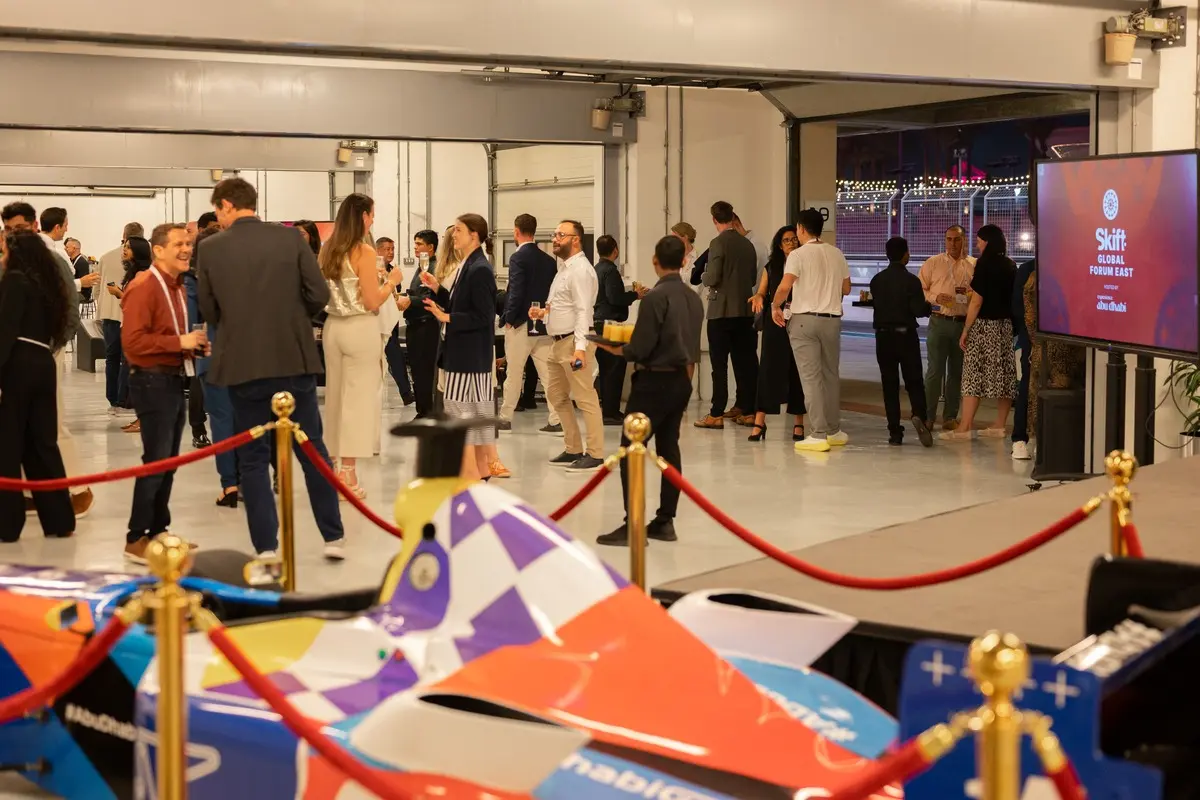
NEW YORK — On September 22, behind the closed, guarded doors of a private venue in New York City, an exclusive cohort of the world’s most influential power brokers will assemble to dissect, direct, and redefine the future of live tourism.
The people who decide where millions of consumers direct their discretionary spending, where massive live infrastructure is anchored, and how global entertainment assets are commercialized are converging for the Skift Live Tourism Summit, presented by Live Nation.
The stakes could not be higher. Live events are no longer ancillary economic boosters for cities; they are the primary engines driving modern tourism, hospitality, aviation, and urban real estate development. Yet, despite the staggering capital flowing through the sector, the live tourism ecosystem remains fragmented. A concert booked by a promoter in Los Angeles triggers a routing decision in London, a strain on hotel inventory in Singapore, an aviation capacity challenge in Tokyo, and a municipal readiness crisis—and rarely do all the stakeholders see the entire value chain at once.
The Skift Live Tourism Summit aims to change that. By placing the masterminds of Las Vegas’s economic transformation, the executives steering Live Nation’s global routing apparatus, and leaders from aviation, hospitality, and sports into a single, curated room, the summit acts as a stress test for the industry.
Can the fragmented giants of live entertainment and destination management forge a unified playbook? Or will the friction points of capacity, sustainability, and distribution continue to fracture the market?
Executive Overview: The Convergence of Live Entertainment and Destination Economics
The traditional boundaries separating travel, hospitality, and live entertainment have effectively dissolved. For decades, tourism boards marketed static assets—museums, beaches, historic monuments, and pleasant climates. Today, destinations are judged on their dynamic programming: the residency of a global pop superstar, the residency of a Formula 1 grand prix, the exclusivity of a culinary festival, or the immersive draw of a next-generation entertainment venue like the Sphere in Las Vegas.
This shift has created a new economic reality. Consumers are prioritizing experiences over material goods, channeling billions of dollars into live events. However, this demand explosion has exposed structural vulnerabilities across the travel ecosystem.
[Global Promoter / Live Nation]
       ↓ (Routing Decision)
[Destination Readiness & Infrastructure]
       ↓ (Aviation & Hospitality Capacity)
[Booking Platforms & Consumer Access]
When a mega-tour is announced, it sets off a chain reaction across global supply chains:
- Promoter Routing: Live Nation and independent promoters determine regional tour stops based on venue availability, demographic density, and corporate sponsorships.
- Destination Readiness: Municipalities must scale up public transit, security, and sanitation to absorb tens of thousands of temporary visitors.
- Hospitality & Aviation Surge: Hotels experience instantaneous demand spikes, often leading to algorithmic price surges, while airlines adjust capacity on key trunk routes.
- Economic Yield: Local economies capture windfall revenues, but destination management organizations (DMOs) must weigh short-term tourism spikes against long-term resident sentiment and infrastructure wear-and-tear.
The Skift Live Tourism Summit is designed to address this complex interdependence. By gathering the chief architects of live demand in a single, capacity-constrained room, the event seeks to bridge the gap between entertainment conglomerates that control the content and destination leaders who manage the physical capacity.
Detailed Chronology: How Live Tourism Became the Apex Predator of Travel
To understand the urgency of the September 22 summit, one must trace the rapid evolution of live tourism from a niche marketing strategy into the dominant force shaping global travel patterns.
Phase 1: The Post-Pandemic Rebound and the "Revenge Travel" Phenomenon (2021–2022)
As global travel restrictions lifted, consumer behavior underwent a permanent psychological shift. Trapped indoors for nearly two years, consumers reevaluated their disposable income. Spending shifted away from retail goods and toward experiential travel.
Initially, this manifested as broad-based leisure travel to traditional vacation hotspots. However, as supply chains normalized, consumers sought higher-intensity experiences. The appetite for live music, immersive arts, and major sporting events skyrocketed.
Phase 2: The Megatour Era (2023–2024)
The live tourism economy hit escape velocity with the arrival of generational global tours—most notably Taylor Swift’s Eras Tour and Beyoncé’s Renaissance World Tour. These were not merely concerts; they were macroeconomic events.
Cities across the globe reported record-breaking hotel occupancy rates, unprecedented restaurant spending, and immediate boosts to municipal tax revenues. Economists coined terms like "Swiftonomics" to describe how a single artist could measurably alter a nation’s GDP or inflation metrics for a given quarter.
During this phase, destination marketing organizations (DMOs) realized they could no longer rely on passive marketing campaigns. They had to aggressively bid for, partner with, and accommodate major live entertainment properties to remain competitive.
Phase 3: Institutionalization and Infrastructure Overhaul (2025 and Beyond)
Today, live tourism has entered its institutional phase. Destinations are actively designing their economic infrastructure around live events.
The transformation of Las Vegas serves as the gold standard. Once dependent primarily on gaming and convention traffic, Las Vegas systematically repositioned itself as the live entertainment capital of the world. Through strategic investments in mega-venues (such as Allegiant Stadium and the Sphere), permanent artist residencies, and high-profile sports franchises (Formula 1, Super Bowl LVIII, the Las Vegas Raiders), the city engineered an economic model that thrives independently of traditional gaming cycles.
The Skift Live Tourism Summit on September 22 captures this exact inflection point. The event brings together the pioneers of the Las Vegas model, the executives routing global stadium tours at Live Nation, and the hospitality leaders tasked with housing the crowds, all within a high-stakes, closed-door format designed to produce actionable industry alignment.
Supporting Context & Metrics: The Numbers Driving the Live Economy
The economic gravity of live tourism is underscored by staggering metrics across entertainment, hospitality, and aviation. The summit’s agenda is underpinned by exclusive forthcoming data from Skift Research, which maps out precisely where value is captured—and where it leaks—within the modern travel ecosystem.
The Financial Scale of Live Entertainment
- Market Valuation: The global live music industry, encompassing ticketing, sponsorship, merchandise, and touring, continues to break historical records, with live music revenues alone projected to surpass $30 billion globally.
- The Multiplier Effect: According to economic impact studies from major metropolitan markets, every dollar spent on a concert ticket generates an estimated $3.50 to $4.50 in secondary spending across local hospitality, dining, retail, and transportation sectors.
- Aviation Correlations: Major tour announcements routinely trigger surges in flight searches and bookings. Airlines that possess agile network-planning capabilities can capitalize on these demand spikes by deploying wide-body aircraft or increasing frequencies to secondary and tertiary markets hosting tour stops.
The Friction Points
Despite these impressive figures, the live tourism value chain suffers from severe structural inefficiencies:
- Infrastructure Bottlenecks: Many destinations lack the transit capacity, hotel inventory, or venue infrastructure to support mega-events without severely degrading the local resident experience (leading to anti-tourism backlashes in European and North American urban centers).
- Fragmentation: Promoters optimize for ticket sales and artist payouts; airlines optimize for yield management; hotels optimize for RevPAR (Revenue Per Available Room); and municipalities optimize for tax generation. Rarely do these key performance indicators align harmoniously.
- Data Asymmetry: DMOs often learn about major tour routing decisions too late to adequately prepare municipal infrastructure, leading to bottlenecks, inflated pricing, and compromised consumer experiences.
Official Statements and Industry Perspectives
While the guest list for the Skift Live Tourism Summit is heavily curated and capped to ensure high-level discourse, industry leaders have increasingly spoken out about the urgent need to bridge the gap between entertainment and destination management.
"Live tourism has no single owner. A concert booked by a promoter becomes a routing decision, then a destination’s readiness problem, then a booking on a platform, and no one player sees the whole chain. This agenda puts that chain on one stage, and each session is a call the industry has yet to close."
— Skift Editorial & Research Consensus
Industry analysts note that traditional tourism conferences often focus on broad macroeconomic trends or superficial marketing tactics. By contrast, the Skift Live Tourism Summit—backed by Live Nation—takes a hyper-operational approach.
Senior executives from hospitality giants, aviation networks, and municipal tourism boards are being asked fundamental questions about the future of their businesses:
- How can destinations future-proof their infrastructure against the volatile scheduling of global touring acts?
- What models of public-private partnership are required to fund next-generation entertainment venues without placing undue tax burdens on local residents?
- How can ticketing platforms, hospitality providers, and airlines share real-time demand data to eliminate friction and enhance the traveler journey?
Future Outlook: What Happens After the Doors Close?
The exclusivity of the September 22 summit in New York is deliberate. By capping the room and restricting attendance to senior leaders who directly shape travel, destination development, aviation, sports, entertainment, and public policy, Skift and Live Nation have engineered a pressure cooker for industry innovation.
The real test of the summit will not be what is said behind closed doors, but what reverberates across the global travel economy in the months that follow.
As destinations compete more aggressively for finite entertainment assets, and as consumers demand ever-more seamless, integrated travel experiences, the traditional silos between entertainment and tourism must crumble. Promoters can no longer operate in a vacuum detached from municipal realities, and destinations can no longer market themselves as passive backdrops for active consumers.
For those inside the room on September 22, the summit represents an opportunity to draft the operational playbook for the next decade of tourism. For those on the outside, the results of this closed-door convergence will dictate the market conditions, pricing models, and destination strategies they will be forced to navigate in the years ahead.
The seat is the constraint, but the stakes belong to the entire global travel economy.