








Executive Overview
In an ambitious move to redefine public transportation across the Garden State, NJ TRANSIT President and CEO Kris Kolluri has unveiled a sweeping, technology-driven modernization initiative. Centered on upgrading the agency’s extensive bus fleet with state-of-the-art computer hardware, advanced GPS antennas, and complimentary high-speed public Wi-Fi, the program represents a quantum leap forward for one of the nation’s largest statewide transit systems.
For decades, public transit riders have battled the uncertainties of delayed schedules, imprecise tracking data, and digital isolation during their daily commutes. NJ TRANSIT’s latest multi-faceted upgrade directly addresses these systemic pain points. By combining precision location technology with robust internet connectivity, the agency is not merely updating its vehicles—it is fundamentally transforming the way millions of residents experience daily transit.
The initiative is already yielding measurable results. Real-time bus arrival predictions—long a source of frustration for commuters relying on mobile applications—have seen a dramatic surge in accuracy, climbing from 74 percent to an impressive 86 percent system-wide. Concurrently, free Wi-Fi is actively transforming the daily commute from dead time into a productive window for work, study, and communication. Funded in significant part by a vital $15 million federal grant from the U.S. Department of the Treasury, this modernization effort underscores a broader commitment to bridging the digital divide, boosting operational transparency, and delivering world-class customer service. As NJ TRANSIT marches toward its goal of a fully modernized fleet by 2031, this initiative serves as a shining blueprint for how public infrastructure can successfully harness modern technology to meet the evolving needs of its constituents.
Detailed Chronology of the Modernization Initiative
The rollout of NJ TRANSIT’s high-tech bus fleet is the result of years of meticulous strategic planning, equipment procurement, and phased implementation. Understanding the trajectory of this transformation requires a close examination of how the agency reached this milestone.
Phase 1: Laying the Technical Groundwork
The foundation of the current modernization wave began with recognizing that legacy onboard systems were no longer sufficient to meet the demands of modern commuters. NJ TRANSIT initiated a comprehensive fleet assessment, determining that a dual-pronged approach was necessary: equipping incoming buses directly from the manufacturers and systematically retrofitting the existing active fleet.
Behind the scenes, the agency partnered with transit data specialists, including Swiftly, to overhaul its backend processing capabilities. Upgraded GPS hardware and high-gain antennas were sourced to capture pinpoint location data, replacing older, erratic tracking units. This critical hardware upgrade served as the prerequisite for everything that followed, ensuring that raw positional data could be fed reliably into predictive algorithms.
Phase 2: The Retrofit Wave and Fleet Integration
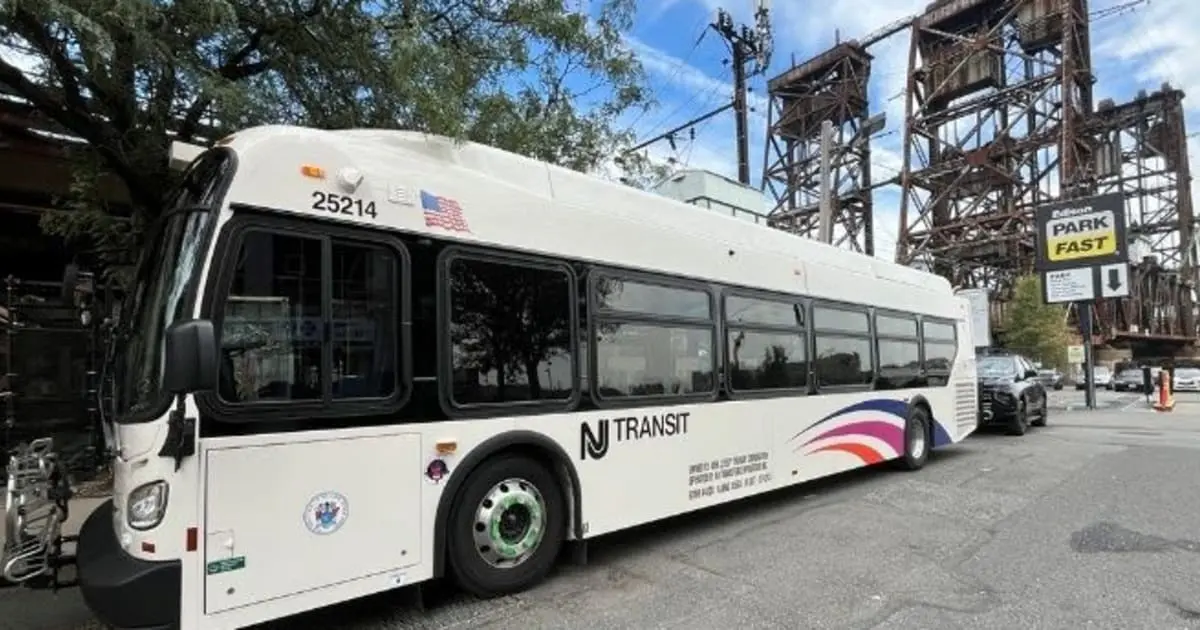
With the hardware selected, NJ TRANSIT mobilized its maintenance and engineering teams to begin retrofitting the active fleet. More than 1,300 legacy buses have already been outfitted with the new computer equipment, antennas, and Wi-Fi routers. Simultaneously, every newly manufactured bus entering the fleet has arrived factory-equipped with these advanced components.

As of late 2024, more than 1,500 buses statewide feature the complete technology package. The agency’s rigorous scheduling ensures that retrofitting continues at a rapid pace. By the end of 2026, this number is projected to surpass 1,900 buses, representing more than 80 percent of NJ TRANSIT’s total active fleet of 2,373 vehicles. The remaining legacy buses, which are presently marked for scheduled retirement, will be phased out systematically. As each older bus is decommissioned, its replacement will step into service with the technology already fully integrated.
Phase 3: Enhancing Digital Touchpoints and Smart Stops
As the onboard technology expanded, NJ TRANSIT turned its attention to passenger touchpoints outside the bus itself. Beginning in October, riders began experiencing enhanced, highly accurate arrival predictions seamlessly integrated across the official NJ TRANSIT website, the mobile ticketing application, digital station signage, and a wide array of third-party transit applications.
In parallel, the agency launched a high-tech smart bus stop pilot program. Eschewing traditional paper schedules that frequently fall victim to weather and vandalism, NJ TRANSIT installed cutting-edge digital e-paper signs at eight strategic locations across Hudson, Monmouth, and surrounding counties. Partnering with infrastructure specialists BusPas and Urban Solar, the agency deployed solar-powered displays that offer real-time arrival updates, detour warnings, delay notifications, and bus occupancy levels. These installations represent a crucial milestone in blending sustainability with commuter convenience, setting the stage for broader deployments in the years to come.
Supporting Context & Metrics: Data-Driven Transformation
The success of NJ TRANSIT’s modernization initiative cannot be measured by hardware installations alone; it is best understood through the profound impact these systems have on daily operational metrics and socio-economic equity.
Measurable Improvements in Real-Time Accuracy
For transit agencies, credibility is inextricably linked to the reliability of arrival predictions. For years, fluctuating GPS signals and delayed data transmissions resulted in "ghost buses"—vehicles that appeared on tracking apps only to vanish or run significantly off-schedule.
According to Kris Kolluri, the integration of advanced computer equipment and precision antennas has fundamentally corrected this flaw. System-wide arrival prediction accuracy has surged from 74 percent to an impressive 86 percent. This 12 percentage point increase translates to millions of commuter journeys made smoother, eliminating unnecessary wait times at street corners and empowering riders to plan their days with absolute confidence.
Bridging the Broadband Gap
Beyond simple convenience, the deployment of free onboard Wi-Fi addresses a critical socio-economic challenge: digital equity. Extensive research indicates that reliable broadband access is essential for modern educational, professional, and economic participation. However, significant disparities in home internet access persist across New Jersey communities.
Recognizing that public transit may represent the only reliable, consistent, and practical environment for many residents to access high-speed internet, NJ TRANSIT designed its Wi-Fi network to provide robust bandwidth capable of supporting general web browsing, remote learning, and professional correspondence for all passengers simultaneously. Buses equipped with this capability are clearly identifiable via a designated sticker placed near the vehicle’s entrance.
Financial backing and Resource Allocation
This multi-layered technological leap was made possible through strategic financial planning and federal support. The initiative is heavily bolstered by a $15 million federal grant awarded by the U.S. Department of the Treasury under the Capital Projects Fund. This funding underscores the federal government’s confidence in NJ TRANSIT’s vision and provides the fiscal runway necessary to execute complex hardware installations, software integrations, and pilot programs without placing an undue financial burden on local taxpayers.
Official Statements and Leadership Perspectives
The sweeping nature of the modernization initiative has drawn praise from transit advocates, public officials, and agency leadership alike. At the core of this communication is a unified message: the rider experience is paramount.
Addressing the media and the public, NJ TRANSIT President and CEO Kris Kolluri emphasized the human element behind the engineering metrics:
"Customers want to know where their bus is and when it will arrive, and arrival predictions in our app have improved from 74 percent to 86 percent accuracy. With the introduction of free Wi-Fi on more than 1,500 buses today, and nearly 2,000 by the end of the year, we’re also delivering a ride that becomes more productive for our bus customers."
Kolluri’s remarks highlight a dual victory for the agency: solving the perennial informational anxiety of the commute while simultaneously converting transit time into productive personal or professional space.
Industry partners have similarly lauded the agency’s forward-thinking approach. Representatives from Swiftly, the transit data platform powering NJ TRANSIT’s enhanced real-time predictions, have repeatedly pointed to the Garden State as a premier example of how legacy agencies can successfully ingest, process, and distribute high-fidelity transit data at scale.
Furthermore, local municipal leaders participating in the smart bus stop pilot programs have expressed immense enthusiasm. Officials in Hudson, Manalapan, and Howell townships have noted that the deployment of solar-powered, ADA-compliant e-paper displays not only modernizes the aesthetic of municipal streetscapes but also provides vulnerable populations—including seniors and individuals with visual impairments—with vital, accessible transit information through integrated text-to-speech capabilities and automated nighttime safety lighting.
Future Outlook: The Road to 2031
While the milestones achieved thus far represent a dramatic modernization of New Jersey’s transit landscape, NJ TRANSIT’s leadership views these achievements merely as stepping stones toward a grander vision.
Expanding Fleet Penetration by 2026
Over the next twenty-four months, the agency’s immediate focus remains locked on execution and expansion. With over 1,500 buses already upgraded, the explicit mandate is to push that figure past 1,900 vehicles by the close of 2026. This threshold will secure technology integration across more than 80 percent of the active fleet. As older, high-maintenance buses are systematically retired, the incoming replacements will seamlessly absorb the technological standard established by this initiative, ensuring zero regression in service quality or connectivity.
Scaling Smart Infrastructure and E-Paper Pilots
The ongoing pilot programs featuring solar-powered, e-paper bus stop signs will undergo rigorous evaluation throughout the coming year. By analyzing user feedback, durability data in extreme New Jersey weather conditions, and maintenance costs, NJ TRANSIT plans to refine the technology for a potential wider rollout. If successful, these intelligent displays could become a standard feature at high-volume transit hubs, major transfer points, and suburban corridors across the state.
The Ultimate Horizon: Fleet Modernization by 2031
All current technological upgrades, real-time tracking enhancements, and connectivity initiatives feed directly into NJ TRANSIT’s overarching Bus Fleet Modernization Initiative. This long-term strategic roadmap establishes a definitive target: a fully modernized, highly reliable, and technologically advanced bus fleet by the year 2031.
By prioritizing cutting-edge customer service tools, sustainable infrastructure, uncompromising accessibility, and unwavering operational transparency, NJ TRANSIT is setting a new national standard for public transportation. As the agency continues to bridge the gap between physical transit and digital empowerment, commuters across New Jersey can look forward to a future where getting from point A to point B is not just a daily necessity, but a seamless, connected, and dignified experience.