










Executive Overview
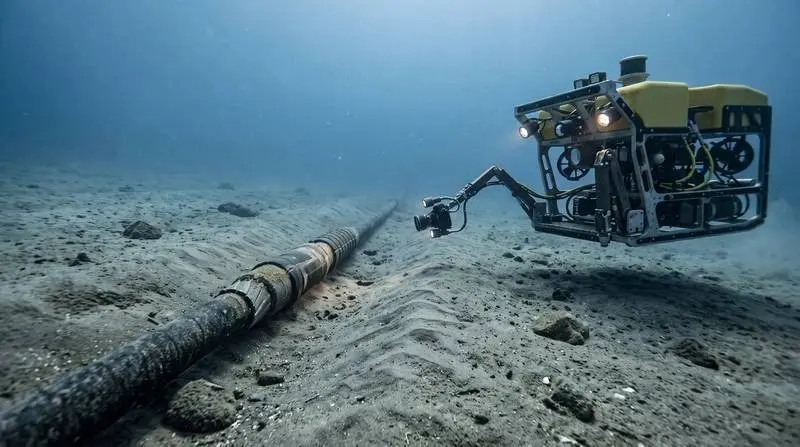
Deep within the freezing, pitch-black waters of the Arctic Ocean, a silent conflict is unfolding that could dictate the future of global security. This spring, in the remote maritime territory surrounding the Svalbard archipelago, a high-stakes, joint naval operation involving the United States, Great Britain, and Norway successfully intercepted and disrupted a clandestine Russian military exercise. The mission’s target was not a conventional submarine, but rather a highly specialized undersea warfare unit training to deploy a sophisticated, newly developed secret weapon designed to sever critical fiber-optic telecommunications cables without leaving a traceable physical footprint.
According to Western intelligence officials, the operation was orchestrated by Moscow’s Main Directorate of Deep-Sea Research, known by its Russian acronym GUGI. Operating under the cover of the Arctic’s extreme environment, GUGI utilized advanced deep-sea submersibles to simulate the deployment of this unattributable sabotage technology. Had the exercise succeeded, it would have validated a capability allowing the Kremlin to plunge Western nations into digital darkness, crippling financial markets, military communications, and global internet connectivity, all while maintaining plausible deniability.
This encounter represents a critical escalation in what defense analysts term "gray-zone warfare"—hostile actions kept just below the threshold of open military conflict to avoid triggering collective defense agreements. As land forces remain locked in a static war of attrition in Ukraine, Western intelligence agencies increasingly fear that Russian President Vladimir Putin is shifting his focus toward hybrid warfare in Europe. Specifically, there is growing concern among U.S. intelligence analysts that Russia may seek to test the limits of NATO’s mutual defense pact, known as Article 5, by targeting the highly vulnerable and strategically vital networks of cables lying exposed on the ocean floor.
Detailed Chronology
The confrontation in the Arctic was the culmination of months of intense intelligence gathering, culminating in a rapid, coordinated maritime interception and a series of high-level diplomatic warnings.
[Spring 2024] -------------------> [April 2024] -------------> [August 2024] --------------> [August 2024]
NATO intercepts GUGI               UK & Norway expose         CIA Director Warns            Joint Forces Deploy
submersibles near Svalbard         covert Arctic operations   Moscow Counterparts           to Jan Mayen Island
The Spring Interception
In the spring of this year, acoustic sensors and maritime patrol assets operated by the tri-nation coalition of the U.S., the UK, and Norway detected unusual undersea activity near the Svalbard archipelago. GUGI submersibles, launched from specialized mother ships, had descended into the ultra-deep waters of the Arctic.
A joint task force was quickly assembled to track, shadow, and ultimately confront the Russian vessels. Utilizing advanced anti-submarine warfare (ASW) capabilities, the allied forces cornered the Russian vessels at sea. Confronted by the unified and highly visible presence of NATO assets, the Russian submersibles were prevented from completing their simulation and were forced to abandon the exercise, eventually retreating back toward their bases on the Kola Peninsula.
The Diplomatic Demarche
Following the physical interception at sea, British and Norwegian officials took a highly unusual and confrontational step. Armed with precise intelligence and physical telemetry of the GUGI operations, Western officials traveled to Moscow.

In closed-door meetings, they presented their findings directly to Russian defense and intelligence authorities. The objective of this diplomatic demarche was twofold: to demonstrate unequivocally that NATO possessed the technology to detect and track Russia’s most secretive undersea assets, and to establish a clear deterrent against any future deployment of the fingerprint-less cable-cutting weapon.
The Intelligence Backchannel
The maritime standoff was followed by high-level intelligence maneuvers. In August, then-Central Intelligence Agency Director John Ratcliffe made an unannounced visit to Moscow to meet with his intelligence counterparts.
While the Kremlin has remained tight-lipped about the specifics of these discussions, sources familiar with the matter confirmed that a primary objective of Ratcliffe’s visit was to deliver a stern, face-to-face warning to Moscow regarding its escalating campaign of sabotage across Europe, which includes both terrestrial arson and deep-sea espionage.
The Battle for the Bear Gap
Recognizing that physical deterrence on the water was temporary, NATO allies rapidly moved to reinforce the strategic maritime corridor known as the "Bear Gap." Spanning approximately 400 miles between the southern tip of Svalbard and mainland Norway, this stretch of water is the gateway through which Russian nuclear submarines based in the Kola Peninsula must pass to access the wider Atlantic Ocean.
In August, British, Norwegian, and U.S. forces deployed to Jan Mayen, a remote, volcanic Norwegian island situated southwest of Svalbard. The joint forces conducted highly specialized exercises designed to project power in the High North and signal to Moscow that any attempt to close or disrupt the Bear Gap would be met with overwhelming, unified resistance.
Supporting Context & Metrics
To understand the gravity of the Svalbard incident, one must examine the extreme vulnerability of the infrastructure at risk and the dramatic rise in hostile maritime surveillance.
The Vulnerability of the Svalbard Cables
The Svalbard archipelago is connected to mainland Norway by two parallel, 1,400-kilometer-long fiber-optic cables. Resting on the seabed at depths reaching up to 2,700 meters, these cables are barely thicker than a standard garden hose. Despite their modest physical profile, they carry immense strategic value.
The cables transmit vast streams of data from the Svalbard Satellite Station (SvalSat), the largest satellite ground station in the world. Due to its unique high-latitude location, SvalSat is the only commercial facility capable of downloading data from polar-orbiting satellites on every single pass. It is a critical node in NASA’s Near Space Network and is indispensable for global weather forecasting, environmental monitoring, and Western military reconnaissance. Severing these cables would effectively blind critical space-based observation systems.
| Cable System | Length | Max Depth | Primary Function | Strategic Importance |
|---|---|---|---|---|
| Svalbard-Norway Fiber Link | 1,400 km | 2,700 meters | Data transmission for SvalSat ground station | NASA Near Space Network node; military & weather satellite telemetry |
| Proposed Jan Mayen Link | Under development (2028) | Variable | Redundancy for Arctic communications | Reinforcing NATO communications and tracking in the Bear Gap |
The Rise of "Drifting" and Undersea Mapping
Security experts have warned that Russia, often in coordination with commercial and scientific vessels from other non-NATO states, has systematically mapped the precise coordinates of Western undersea pipelines, power grids, and telecommunications cables. This practice, known as "drifting," involves vessels sailing at abnormally slow speeds over sensitive infrastructure, utilizing multi-beam sonar and electromagnetic sensors to log coordinates for future targeting.
According to data compiled by maritime risk analytics firm Windward:
- North Sea Drifting: In 2023, suspicious drifting activity in the North Sea surged by 52%, rising to 13,079 unique vessel incidents compared to the previous year.
- South China Sea Drifting: In the Indo-Pacific region, suspicious drifting rose by 88%, reaching 18,401 vessels, highlighting a global trend in undersea infrastructure reconnaissance by revisionist powers.
- The Baltic Sea Precedent: Between October 2023 and the end of 2024, at least 11 subsea cables were confirmed damaged or severed in the Baltic Sea alone, prompting the deployment of NATO’s Baltic Sentry monitoring initiative.
Suspicious "Drifting" Activity (Year-over-Year Increase)
=========================================================
North Sea:       [██████████████████████ 52%]
South China Sea: [████████████████████████████████████ 88%]
Official Statements and Geopolitical Fallout
The revelation of the GUGI operation has sparked sharp warnings from European defense officials, contrasted by the expected denials from Moscow.
Norway’s Defence Minister, Tore Sandvik, issued a direct statement emphasizing the success of the joint allied interception:
"Through our joint operation, we sent a clear message to Russia that they cannot operate covertly. We have made it unequivocally clear to Russian authorities that any attempt to target our critical infrastructure will be detected and met with consequences. It is in no one’s interest to escalate tensions in the High North."
The British Ministry of Defence echoed this stance, pointing to previous declassified intelligence from April 9 that exposed GUGI’s attempts to conduct covert operations in close proximity to British and Norwegian territorial waters. Both London and Washington have previously levied heavy sanctions against GUGI and its leadership, labeling the directorate a primary threat to global transatlantic connectivity.
When pressed for comment, the Russian Defence Ministry did not respond, while the Kremlin issued its standard refutation, denying any involvement in sabotage operations within NATO territories and accusing the West of fabricating threats to justify military expansion in the Arctic.
However, the reality on the ground tells a different story. The undersea confrontation coincides with a visible surge in Russian hybrid attacks across mainland Europe. Countries including Poland, Lithuania, and Romania have documented multiple airspace violations and suspected state-sponsored arson.
In August, a thwarted drone attack targeting Germany’s Leipzig/Halle Airport—believed to be orchestrated by Russian operatives—prompted Berlin to shut down a Russian consulate in Bonn and a cultural center in Berlin. These events suggest that Moscow is actively testing Western resilience across multiple domains simultaneously.
Future Outlook
The deep-sea face-off in the Arctic highlights a glaring vulnerability in the West’s security architecture. For decades, European nations expanded their reliance on the seabed for internet traffic, financial transactions, and green energy transmission, while simultaneously cutting back on the naval assets required to patrol these vast, silent expanses.
"In the last 25 years, Europe did two things simultaneously," notes Bruce Jones, a senior fellow with the Brookings Institution. "It dramatically expanded the extent to which it relies on seabed infrastructure, and it dramatically shrunk its capacity to protect that infrastructure. It’s belatedly rebuilding now, in the face of a burgeoning Russian threat."
The Undersea Vulnerability Paradox
┌────────────────────────────────────────────────────────┐
│  ▲ Rapidly Growing Reliance on Seabed Infrastructure   │
│  │ (Fiber optics, power grids, offshore wind)          │
├────────────────────────────────────────────────────────┤
│  ▼ Shrinking Naval Patrol & ASW Capacity               │
│  │ (Post-Cold War defense budget cuts)                 │
└────────────────────────────────────────────────────────┘
In response to this vulnerability, NATO is racing to implement new defensive measures:
- Infrastructure Redundancy: Norway has accelerated plans to build a new fiber-optic cable linking Svalbard and Jan Mayen to the mainland, scheduled for completion by 2028, to ensure data redundancy if the primary cables are compromised.
- Enhanced Patrol Initiatives: Joint maritime patrols under programs like the UK-led "Nordic Warden" and NATO’s "Baltic Sentry" are deploying unmanned underwater vehicles (UUVs) and AI-driven predictive modeling to monitor critical maritime zones in real-time.
- Legal and Doctrinal Shifts: NATO planners are actively debating how to define an attack on undersea infrastructure under Article 5. Because the GUGI weapon is designed to mimic natural wear-and-tear or accidental commercial anchor drags, establishing clear attribution is vital to deterring future gray-zone strikes.
As the global economy becomes increasingly reliant on cloud computing, artificial intelligence, and rapid data transfer, the ocean floor has emerged as a primary front line of geopolitical competition. The successful NATO interception near Svalbard proved that the West can detect and disrupt Russia’s most secretive undersea assets. However, as Moscow refines its technology and continues to map the vulnerabilities of the global network, the silent war beneath the ice is only just beginning.