




Executive Overview
The global maritime industry is undergoing an unprecedented double transition: navigating the stringent decarbonization and environmental compliance mandates of the International Maritime Organization (IMO) while simultaneously executing a rapid digital transformation. At the intersection of these two forces lies the critical need for operational reliability in onboard environmental systems. Chief among these is the Ballast Water Management System (BWMS), a mandatory technology designed to prevent the ecological devastation caused by the transfer of invasive aquatic species across global shipping lanes.
Recognizing that hardware reliability is increasingly dependent on software intelligence, Techcross, a global pioneer in electrolysis-based BWMS technology, has announced a comprehensive overhaul of its flagship digital service, the Smart Platform.
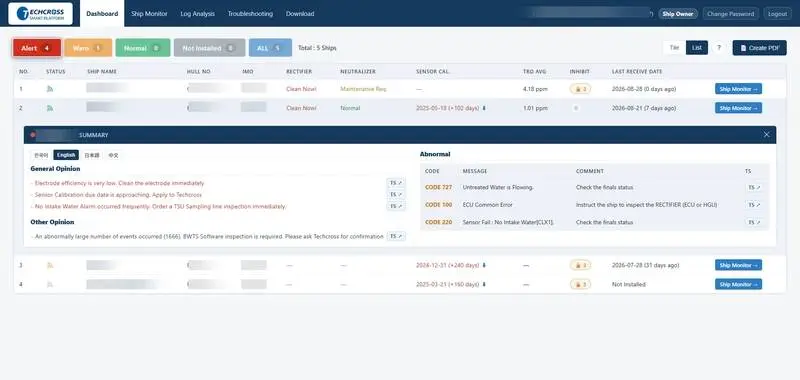
Originally designed as a web-based repository for logging operational data, the newly renewed Smart Platform marks a paradigm shift in how shipowners, fleet managers, and onboard crews interact with environmental hardware. By moving beyond passive data aggregation, Techcross has transformed the system into an active, AI-driven decision-support tool.
The core philosophy behind this renewal is cognitive offloading and predictive action. Rather than forcing shore-based superintendents to download, compile, and manually analyze complex, fragmented log files, the platform leverages advanced machine learning algorithms to evaluate equipment health in real time. It categorizes fleet status into intuitive risk levels, reorganizes operational workflows into a streamlined five-menu interface, and translates raw electrochemical telemetry into actionable, natural-language maintenance recommendations.
As shipowners face acute crew shortages, high turnover, and escalating operational costs, Techcross’s revamped digital ecosystem aims to dramatically reduce equipment downtime, optimize chemical consumables, and ensure uninterrupted compliance with global port state controls.
Detailed Chronology: The Evolution of Techcross’s Digital Ecosystem
To understand the significance of the Smart Platform’s renewal, it is necessary to examine the technological trajectory of Techcross and the broader ballast water treatment market over the last two decades.
+---------------------------------------------------------------------------------+
|                               DEVELOPMENT TIMELINE                              |
+---------------------------------------------------------------------------------+
|                                                                                 |
|  [2000s - 2010s]                                                                |
|  THE HARDWARE EPOCH                                                             |
|  Focus on physical electrolysis, basic programmable logic controllers (PLCs),   |
|  and manual USB data logging to satisfy basic IMO D-2 compliance.               |
|                                        |                                        |
|                                        v                                        |
|  [2015 - 2020]                                                                  |
|  THE CONNECTIVITY & REGULATORY PUSH                                             |
|  Implementation of mandatory satellite-linked log transfers (VSAT) as USCG and  |
|  IMO regulations tighten. Launch of the first-generation Smart Platform.        |
|                                        |                                        |
|                                        v                                        |
|  [2021 - 2023]                                                                  |
|  THE DATA OVERLOAD CHALLENGE                                                    |
|  Fleet managers are inundated with raw telemetry. Techcross identifies the      |
|  need to transition from "descriptive" to "prescriptive" analytics.             |
|                                        |                                        |
|                                        v                                        |
|  [2024 - Present]                                                               |
|  THE INTELLIGENT ADVISORY ERA                                                   |
|  Launch of the renewed Smart Platform. Integration of AI diagnostics,           |
|  three-tier risk matrix, streamlined 5-menu UX, and automated multilingual alerts.|
|                                                                                 |
+---------------------------------------------------------------------------------+
1. The Hardware Epoch (2000s–2010s)
In the early years of BWMS implementation, following the adoption of the IMO’s International Convention for the Control and Management of Ships’ Ballast Water and Sediments, the industry’s focus was almost entirely mechanical. Techcross established its market leadership through its Electro-Cleen™ System (ECS), which uses direct electrolysis to disinfect ballast water. During this period, digital integration was rudimentary. Systems relied on basic programmable logic controllers (PLCs) on board, and data logging was primarily used to prove compliance to Port State Control (PSC) officers via manual USB data extractions.
2. The Connectivity & Regulatory Push (2015–2020)
As satellite communications (VSAT) became standard across merchant fleets, the demand for real-time remote monitoring grew. Shipowners no longer wanted to wait for a vessel to make port to discover that a BWMS component had failed. Techcross responded by introducing the first iteration of its Smart Platform. This initial version successfully established a continuous pipeline of data from the ship’s PLC to Techcross’s shore-based servers, giving technical superintendents visibility into operational logs.
3. The Data Overload Challenge (2021–2023)
While the first-generation platform solved the connectivity problem, it introduced a new bottleneck: data overload. Fleet managers supervising dozens of vessels were inundated with thousands of data points—ranging from current (A) and voltage (V) values in the electrolysis chambers to Total Residual Oxidant (TRO) concentrations and flow rates. Without dedicated data analysts, critical warning signs of equipment degradation went unnoticed until a catastrophic failure occurred, leading to costly delays at port.
4. The Intelligent Advisory Era (Present Day)
Recognizing these operational friction points, Techcross initiated a comprehensive software re-engineering project. The goal was to pivot from a descriptive digital service (explaining "what happened") to a prescriptive and predictive digital service (explaining "what is happening, why, and how to fix it"). The result is the renewed Smart Platform, which transitions the software from a static database into an active, intelligent maritime advisor.
Supporting Context & Technical Metrics
The renewed Smart Platform’s architecture is built on three pillars: simplified user experience (UX), predictive machine learning models, and automated localized communication protocols.
                     +---------------------------------------+
                     |       ONBOARD BWMS SENSORS & PLC      |
                     +---------------------------------------+
                                         |
                                         | (VSAT Real-Time Telemetry)
                                         v
                     +---------------------------------------+
                     |     TECHCROSS SMART PLATFORM ENGINE   |
                     +---------------------------------------+
                                         |
                +------------------------+------------------------+
                |                                                 |
                v                                                 v
+-------------------------------+                 +-------------------------------+
|     AI DIAGNOSTIC ENGINE      |                 |       UX & WORKFLOW LAYER     |
| - Electrode Degradation Model |                 | - 3-Tier Fleet Status Matrix  |
| - TRO vs. Neutralizer Balance |                 | - 5 Core Operational Menus    |
| - Predictive CIP Scheduling   |                 | - Multilingual Alert Dispatch |
+-------------------------------+                 +-------------------------------+
                |                                                 |
                +------------------------+------------------------+
                                         |
                                         v
                     +---------------------------------------+
                     |      SHORE-BASED TECHNICAL TEAMS       |
                     |  - Targeted Maintenance Decisions     |
                     |  - Reduced Downtime & Optimized OPEX  |
                     +---------------------------------------+
The Three-Tier Fleet Status Matrix
To protect fleet managers from alert fatigue, the platform implements a triage system that instantly categorizes the health of every vessel in a fleet into three distinct tiers:
| Status Tier | Operational Meaning | System Trigger Criteria | Required Action |
|---|---|---|---|
| Normal | The system is operating within nominal engineering parameters. | Voltage, current, TRO levels, and flow rates match designed baseline curves. | No action required; routine logging continues. |
| Warn | Early signs of efficiency loss or minor anomalies detected. | Slight deviation in electrode voltage-to-current ratio; minor chemical consumption imbalance. | Schedule non-urgent inspection or routine maintenance (e.g., scheduled cleaning) at the next convenient port. |
| Alert | Critical operational anomaly detected that threatens system failure or compliance breach. | Severe electrode degradation; failure of TRO sensors; inadequate neutralizing agent dosing during discharge. | Immediate intervention required. Technical superintendents are provided with targeted troubleshooting protocols. |
The Five-Menu Architecture
To eliminate the friction of navigating multiple web pages, Techcross has consolidated all system functionalities into five primary menus:
- Fleet Overview: A high-level geographic and status map showing the real-time operational health of all vessels under management.
- Equipment Analysis: Deep-dive diagnostic panels that display historical trends, sensor readings, and comparative system performance.
- Maintenance Planning: A predictive scheduling portal that calculates the remaining useful life (RUL) of consumables and key wear parts.
- Troubleshooting Support: An interactive portal linking real-time alerts to step-by-step guides and digital instructional manuals.
- System Administration: Customizable settings for account-based vessel allocation, display preferences, and reporting parameters.
AI-Powered Predictive Maintenance Diagnostics
The core differentiator of the renewed platform is its application of artificial intelligence to physical chemistry. In an electro-chlorination BWMS, the electrolysis electrodes are the most critical—and expensive—components. Over time, these electrodes experience scaling (mineral deposits such as calcium and magnesium) and active coating wear, which reduces their disinfection efficiency.
Instead of waiting for the system to trip a low-chlorine alarm, the Smart Platform’s AI continuously monitors the relationship between current, voltage, salinity, and water temperature. By analyzing these multi-variable trends, the platform can detect declining electrode efficiency long before it impacts operation.
[Electrode Voltage/Current Anomaly]
               │
               ▼
[AI Multi-Variable Regression Model] ──► Analyzes Salinity, Temp, & Flow Rate
               │
               ▼
[Diagnostic Output Generated]
"Electrode efficiency decreased by 14% over 30 days due to scaling."
               │
               ▼
[Prescriptive Action Recommendation]
"Initiate Clean-In-Place (CIP) acid wash. Click here for Manual Section 4.2."
When an anomaly is identified, the platform does not simply display an error code. Instead, it generates a natural-language diagnostic:
"The electrode efficiency of Vessel A has decreased by 14% over the past 30 days, indicating accelerated calcium scaling. Recommendation: Initiate a Clean-In-Place (CIP) acid wash cycle within the next 50 operating hours to prevent permanent coating damage. [Click here to open CIP Procedure Manual, Section 4.2]."
Chemical Optimization Metrics
During ballast water discharge, any residual chlorine (measured as TRO) must be neutralized using chemical agents (typically sodium thiosulfate) to prevent toxic chemicals from entering local marine ecosystems. Over-dosing these neutralizing agents leads to unnecessary chemical expenses, while under-dosing risks severe regulatory fines.
The renewed Smart Platform solves this by correlating average TRO concentrations with neutralizing agent pump stroke rates and chemical consumption metrics. By analyzing these data streams, the platform determines whether the vessel’s crew is dosing chemicals efficiently. If the system detects excessive consumption, it alerts the shore manager, enabling them to guide the crew on recalibrating the dosing pumps and potentially saving thousands of dollars in annual chemical costs.
Localization & Communication Protocol
Recognizing that maritime commerce is globally decentralized, Techcross has integrated comprehensive localization features. The platform fully supports four major maritime languages: Korean, English, Japanese, and Chinese.
Furthermore, users do not need to constantly log into the web portal to stay informed. The platform automatically generates and dispatches:
- Real-time Push Notifications: Sent via email immediately when an "Alert" status is triggered on any vessel.
- Monthly Alert Digests: Comprehensive PDF summaries detailing fleet-wide anomalies, maintenance trends, and recommended actions, delivered directly to managers’ inboxes.
Official Statements
The release of the renewed Smart Platform has been met with positive feedback from both Techcross’s internal engineering teams and external maritime industry analysts.
A senior representative from Techcross’s Digital R&D Division commented on the strategic focus of the update:
"For years, the maritime industry has collected data for data’s sake. Shipowners are tired of looking at endless graphs and spreadsheets that require specialized engineering knowledge to interpret. With this renewal, we have shifted our focus entirely toward the user. We wanted to build a platform that speaks the language of a busy superintendent. By combining AI-driven predictive insights with clear, direct, and localized instructions, we are not just pointing out problems—we are providing the solutions. This platform is a vital partner that actively helps shipowners protect their capital investments and maintain uninterrupted compliance."
An executive technical superintendent from a major East Asian container shipping line, who participated in the beta testing phase of the renewed platform, shared their operational perspective:
"Managing a fleet of over fifty vessels means our technical teams are constantly fighting fires. We do not have the time to download log files from individual ships to check if their ballast water systems are scaled up. During the trial of Techcross’s new platform, the three-tier status matrix allowed our superintendents to identify and resolve a failing TRO sensor on a vessel transiting the Pacific before it arrived in California—where a failure would have prevented cargo discharge and cost us thousands of dollars in demurrage. Having step-by-step troubleshooting manuals linked directly to the alert saved our crew hours of diagnostic work."
Future Outlook: The Smart Shipping Horizon
Looking ahead, the renewal of Techcross’s Smart Platform is not an isolated update; it represents a foundational step toward the future of autonomous shipping and holistic vessel performance optimization.
+---------------------------------------------------------------------------------+
|                         THE FUTURE OF SMART SHIPPING                            |
+---------------------------------------------------------------------------------+
|                                                                                 |
|  +-----------------------------------+   +-----------------------------------+  |
|  |       AUTONOMOUS INTEGRATION      |   |       HOLISTIC DECARBONIZATION    |  |
|  | API-driven machine-to-machine     |   | Integrating BWMS operational data |  |
|  | communication with central vessel |   | with broader ship performance and |  |
|  | management computers.             |   | fuel efficiency metrics.          |  |
|  +-----------------------------------+   +-----------------------------------+  |
|                                           /                                    |
|                                          /                                     |
|                                      v   v                                      |
|  +---------------------------------------------------------------------------+  |
|  |                       NEXT-GEN DIGITAL TWIN ECOSYSTEM                     |  |
|  |  Virtual, real-time replicas of physical BWMS units running on land-based  |  |
|  |  servers to run predictive stress-testing and simulation models.          |  |
|  +---------------------------------------------------------------------------+  |
|                                                                                 |
+---------------------------------------------------------------------------------+
1. Integration with Autonomous Vessel Systems
As the industry moves closer to deploying autonomous and semi-autonomous merchant vessels, the demand for self-diagnosing machinery will become non-negotiable. Techcross is positioning its Smart Platform to integrate directly with centralized vessel management systems via secure APIs. In this future operational model, the Smart Platform will not only alert shore-side operators of an issue but will communicate directly with the ship’s central computer to initiate automated corrective actions—such as triggering an backwash cycle or adjusting flow rates—without requiring human intervention.
2. Synergies with Carbon Capture and Green Tech
Techcross is actively expanding its product portfolio beyond ballast water management into other green maritime technologies, including exhaust gas cleaning systems (scrubbers) and onboard carbon capture and storage (OCCS) systems. The architecture of the renewed Smart Platform has been designed to scale. In the future, shipowners will be able to monitor their entire environmental compliance suite—water treatment, emissions monitoring, and carbon capture—through a single, unified digital interface.
3. Digital Twins and Advanced Simulation
The next major milestone on Techcross’s digital roadmap is the integration of "Digital Twin" technology. By creating virtual, real-time replicas of physical BWMS units on land-based servers, Techcross engineers will be able to run predictive stress tests and simulation models based on the actual water conditions (such as turbidity, salinity, and temperature) a vessel is expected to encounter on its upcoming route. This will allow crews to preemptively adjust system settings before the vessel even arrives at its port of call.
Conclusion
As maritime regulations tighten and the industry’s digital divide widens, solutions like Techcross’s renewed Smart Platform demonstrate that the future of shipping lies in software-enabled hardware. By transforming complex telemetry into clear, actionable, and localized operational intelligence, Techcross is helping shipowners navigate regulatory hurdles and protect both their bottom lines and the marine environments they traverse.