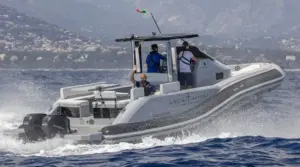
The recreational marine industry is undergoing a generational shift, pivoting away from fossil fuels toward sustainable, high-performance electric propulsion. At the forefront of this transformation is Flux Marine, a pioneering Rhode Island-based clean-tech firm whose flagship FM115 electric outboard has officially secured European Union (EU) certification. This regulatory milestone marks a pivotal chapter in the company’s expansion, clearing the path for European deployment aboard the cutting-edge iRIB-7 hull from Austrian boatbuilder i-RIB.
Simultaneously, Flux Marine is aggressively fortifying its domestic footprint. Recognizing that the United States market is primed for widespread electrification—accelerated by volatile gasoline prices and expanding renewable energy infrastructure—the company has appointed marine propulsion veteran Chris Ponnwitz as its new Senior Field Sales Manager.
By simultaneously conquering European regulatory compliance and bringing seasoned commercial leadership on board in North America, Flux Marine is strategically positioning itself to dominate both sides of the Atlantic. This dual-pronged strategy addresses the unique regional dynamics of the global recreational boating market: Europe’s advanced, regulation-driven ecosystem and America’s vast, emerging potential for clean-energy marine adoption.
Detailed Chronology: From Concept to Transatlantic Commercialization
The journey of the FM115 from a clean-sheet concept to a certified, globally deployable commercial asset highlights a meticulous path of engineering validation and strategic market timing.
The Blank-Sheet Engineering Philosophy
When Flux Marine’s engineering team first set out to design the FM115, they deliberately avoided retrofitting traditional internal combustion engine (ICE) layouts with electric components. Instead, they asked a fundamental, unconstrained question: What would a marine propulsion system look like if it were built exclusively for electric power from the ground up?
The resulting architecture is a purpose-built, high-horsepower drop-in replacement for a traditional 115-horsepower (86 kW) gasoline outboard. Designed to mount seamlessly onto a standard boat transom, the FM115 utilizes existing steering and rigging hardware. Furthermore, it integrates fluidly with familiar Garmin chartplotter displays through a proprietary, native Flux interface, minimizing the learning curve for recreational boaters.
Real-World Testing and Validation
Before seeking formal international certifications, Flux Marine subjected the FM115 to rigorous endurance testing. Over the past four years, the motor has accumulated more than 50,000 kilometers of real-world usage across diverse marine environments, spanning both harsh saltwater conditions and freshwater systems.
This extensive data collection included thousands of hours of beta-motor testing throughout 2023 and 2024, followed by two full, uninterrupted commercial seasons. According to company metrics, this rigorous field validation makes the FM115 the leading high-horsepower all-electric outboard in North America measured by units successfully delivered and operated.
The European Breakthrough via Austria
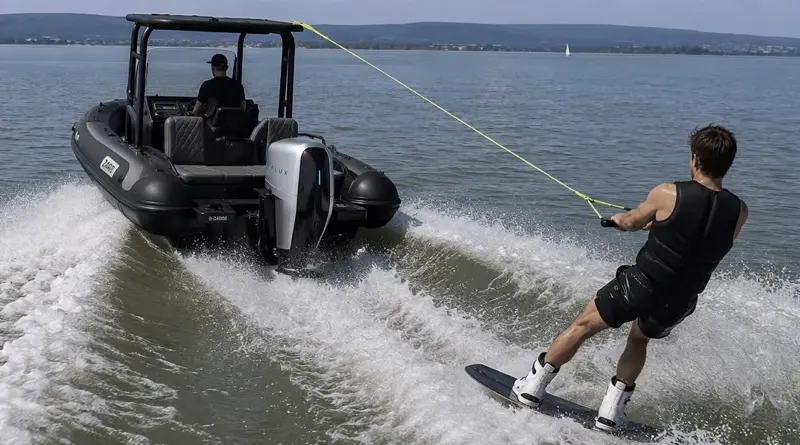
The culmination of this engineering and testing regimen laid the groundwork for EU compliance. The FM115’s European debut is taking place in partnership with Austrian boatyard i-RIB, founded by industry innovators Thomas and Michael Salzl. The motor is paired with Flux Marine’s submersion-proof, IP67-rated 28 kWh modular battery packs. Depending on consumer or commercial needs, the i-RIB can integrate two or three of these packs, delivering a total energy storage capacity of either 56 kWh or 84 kWh.
While the Salzl brothers were immediately captivated by the power, efficiency, and economics of the FM115, navigating the complex regulatory frameworks required to introduce a North American electric motor into the German-speaking European market initially proved daunting. Recognizing that traditional boatbuilders are manufacturers rather than electric propulsion compliance experts, Flux Marine stepped in to shoulder the bureaucratic burden. By leveraging its extensive real-world usage data, the company successfully secured EU certification, proving that the FM115 is a mature, battle-tested system rather than an unproven prototype.
Supporting Context & Metrics: The Tale of Two Markets
To fully appreciate Flux Marine’s transatlantic strategy, one must examine the starkly contrasting landscapes of the European and North American recreational marine sectors.
Europe: The Advanced Electrification Pioneer
Europe stands undisputedly as the world’s most advanced market for recreational marine electrification. This leadership position is driven by a unique confluence of cultural boating styles and stringent environmental regulations, some of which trace their roots back to the 1980s.
Across the continent, thousands of inland lakes, protected natural reserves, and intricate canal networks have enacted total bans on fossil-fuel-powered engines or severely restricted their operation to specific hours and zones. A prime example is Lake Neusiedl—the picturesque setting for the i-RIB integration—where environmental safeguards strictly limit emissions. For European boaters, electric propulsion is not merely a lifestyle choice or a nod to sustainability; it is frequently the only legal mechanism to access premier waterways. Consequently, the supporting infrastructure, consumer awareness, and regulatory pathways for electric boats are decades ahead of the Western Hemisphere.
North America: The Ripe Frontier
Conversely, the North American market is characterized by vast expanses of open water, a deeply ingrained petrol-powered boating culture, and historically lower fuel cost barriers—though recent volatility in gasoline prices is rapidly shifting consumer calculus. Furthermore, the rapid expansion of solar and wind generation capacity across the United States is creating a cleaner regional grid, making the life-cycle carbon footprint of electric boats increasingly compelling.
Despite these tailwinds, the North American e-boat market faces distinct hurdles, chief among them consumer awareness and access to tactile, hands-on experiences. Many recreational boaters remain hesitant to abandon traditional gas-guzzling outboards due to perceived anxieties surrounding range, charging infrastructure, and maintenance reliability.
Flux Marine’s FM115 directly dismantles these psychological barriers. By eliminating the archaic rituals of traditional marine maintenance—there is no oil to change, no impellers to replace, no carburetors to clog, and no complex winterization protocols required—the motor offers a friction-free transition. Boaters plug in their vessels much like an electric vehicle, saving thousands of dollars annually in fuel and servicing costs while enjoying a virtually silent, torque-rich on-water experience.
Official Statements: Leadership Perspectives
The strategic alignment of engineering excellence and commercial scaling is underscored by key leadership insights from both Flux Marine executives and its newly appointed sales strategist.
Ben Sorkin, co-founder and CEO of Flux Marine, highlighted the company’s customer-centric approach to market expansion, particularly regarding the hurdles faced by traditional boatbuilders:
"Boatbuilders don’t want to become electric propulsion specialists," Sorkin remarked. "They want to give their customers an electric option without rebuilding their business around it. We did the engineering and the compliance for the EU paperwork, which was relatively simple because the 115 isn’t a prototype—it’s a proven system."
Daylin Frantin, co-founder, CFO, and COO of Flux Marine, emphasized the critical importance of strengthening the company’s commercial leadership infrastructure to capture the ripe US market:
"Building out our sales organization is one of our highest priorities, and Chris’s proven track record in marine electric propulsion makes him the perfect fit for Flux Marine," Frantin stated. "Chris has spent a decade leading commercial strategy in this industry, and he’s the right person to introduce our products to customers, dealers, and marine industry partners."
Chris Ponnwitz, stepping into his new role as Senior Field Sales Manager after a storied career at century-old marine distributor Mack Boring—where he most recently served as Chief Commercial Officer for Mack Sustainable Energy—shared his enthusiasm for joining the clean-tech vanguard:
"I’ve been following Flux Marine closely for the past few years and watching their electric outboards develop from a concept into a proven commercial option," said Ponnwitz. "This technology gives us a real edge, and we’re on the verge of rapid growth. I look forward to working with the passionate Flux team and giving more customers the opportunity to switch to electric propulsion."
Future Outlook: Scaling the Transatlantic Horizon
As Flux Marine looks toward the horizon, the convergence of EU certification and seasoned US sales leadership sets the stage for exponential growth. Ponnwitz’s appointment is designed to immediately accelerate revenue generation across multiple verticals, including strategic boatbuilder partnerships, independent dealer network expansion, and direct commercial sales channels.
In North America, Ponnwitz’s leadership will be instrumental in spearheading Flux Marine’s presence at major industry events and boat shows, turning abstract curiosity into hands-on conversions. By placing the FM115 into the hands of influential dealers and progressive boat builders—such as their celebrated integrations with hulls like the Scout 215 XSF—Flux Marine is systematically dismantling the hesitation that has historically slowed adoption in the US.
Simultaneously, the successful European market entry via the i-RIB partnership serves as a scalable template for further international expansion. As more European waterways tighten emissions regulations and as global energy grids transition toward decentralization and renewables, the demand for high-horsepower, zero-emission marine propulsion will only intensify.
Ultimately, Flux Marine is no longer a promising startup testing the waters of clean technology. With over 50,000 verified kilometers of real-world endurance, an airtight compliance portfolio in Europe, and a heavy-hitting sales executive steering its domestic charge, the company has transformed itself into a formidable transatlantic player. The future of recreational boating is electric, and the infrastructure to support it is finally catching up to the vision.