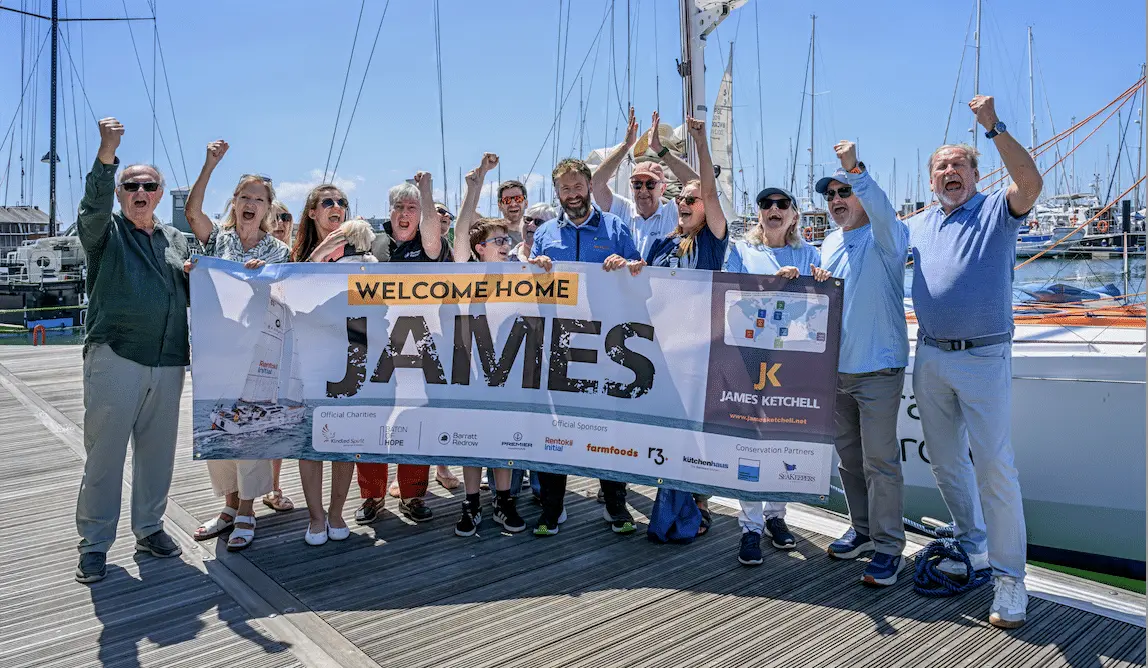
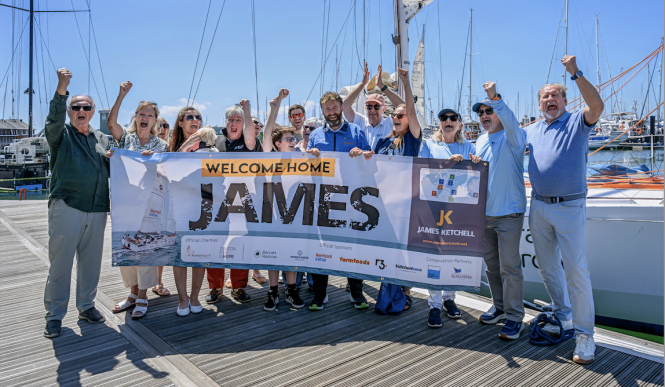
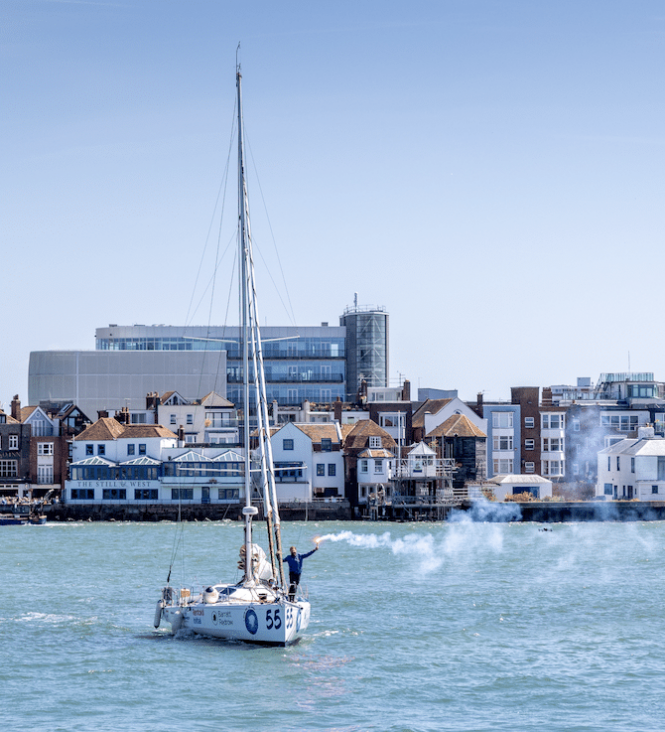
On June 13, 2026, British adventurer and endurance icon James Ketchell steered his sailing vessel, Mindset, back into the harbor at Gosport, United Kingdom, bringing a definitive close to a monumental chapter in global exploration. With this triumphant arrival, Ketchell cemented his status in the annals of exploration history by becoming the first person ever to circumnavigate the globe by land, air, and sea.
Yet, this achievement represents far more than a physical endurance record. Unlike traditional expeditions driven solely by the pursuit of geographical milestones, Ketchell’s latest voyage was deeply intertwined with environmental stewardship. Operating as an Ambassador for the UK’s prestigious National Oceanography Centre (NOC) and partnering with The International SeaKeepers Society’s DISCOVERY Programme, Ketchell transformed his 30,000-nautical-mile maritime odyssey into a floating scientific laboratory.
Over nearly a year at sea, the British explorer collected critical oceanographic data, deployed autonomous monitoring technology in remote waters, and gathered vital microplastic samples to aid global research institutions. Coupled with educational outreach to thousands of students worldwide and significant fundraising for mental health and human trafficking charities, Ketchell’s historic journey redefines the modern explorer: part extreme athlete, part conservationist, and part scientific courier.
Detailed Chronology of an Unprecedented Global Quest
To fully grasp the magnitude of James Ketchell’s June 2026 homecoming, one must look back at a multi-decade pursuit of the planet’s most formidable physical challenges. Ketchell is no stranger to the extreme; his resume includes rowing solo across the Atlantic Ocean and successfully summiting Mount Everest. However, his defining framework has been a systematic, multi-modal circumnavigation of the globe.
The Foundation: Land and Air
2013 – The Global Cycle: Ketchell laid the groundwork for his comprehensive global traverse by cycling completely around the world. The grueling overland journey tested his endurance, mechanical resourcefulness, and psychological resilience across continents, setting a high benchmark for future physical feats.
2019 – The Gyrocopter Flight: Six years after conquering the world by bicycle, Ketchell took to the skies. In a daring and mechanically complex endeavor, he successfully flew a gyrocopter around the globe. Navigating volatile weather patterns, bureaucratic airspace restrictions, and vast geographical expanses, this aerial feat completed the second pillar of his grand trilogy—leaving only the world’s oceans to conquer.
The Sea: The Final Frontier (July 2025 – June 2026)
The maritime final act of Ketchell’s grand design commenced in July 2025. Aboard his trusty sailing vessel, Mindset, Ketchell set out on an arduous 30,000-nautical-mile voyage designed to test both man and machine against the harshest marine environments on Earth.
The Route: The expedition traced an unforgiving path across the globe’s major bodies of water. Departing the UK, Ketchell’s initial legs took him southward via Lanzarote and the Cape Verde archipelago, before crossing the equatorial Atlantic to the shores of Brazil.
Southern Ocean Extremes: From South America, the voyage demanded entry into some of the most treacherous waters on the planet. Ketchell navigated the historic and perilous route past Cape Town, onward across the vast expanses of the Indian Ocean toward Hobart, Australia, and finally faced the ultimate test of seamanship: rounding the legendary Cape Horn at the tip of South America.
The Homecoming: Following months of battling towering swells, unpredictable weather systems, and total isolation, Ketchell completed his loop, returning triumphantly to Gosport on June 13, 2026. This final leg marked not only the end of his sailing journey but the historic completion of the world’s first land-air-sea global circumnavigation.
Supporting Context & Metrics: Science on the High Seas
While the nautical mileage and isolation of the voyage would have satisfied most adventurers, Ketchell’s mission was fundamentally collaborative. Through his alliance with The International SeaKeepers Society and the National Oceanography Centre (NOC), Mindset functioned as an active data-gathering platform, proving that the global yachting community can play an indispensable role in marine research.
Empowering Global Oceanography
The world’s oceans cover over 70 percent of the Earth’s surface, yet vast expanses—particularly in the Southern Hemisphere and deep-ocean basins—remain chronically under-sampled. Traditional research vessels are expensive to operate and limited in number, creating massive data gaps for climate scientists and oceanographers. Ketchell’s expedition leveraged his independent vessel to bridge these gaps through three primary scientific initiatives under the SeaKeepers DISCOVERY Programme:
Deploying Argo Floats: During his transit of the remote Indian Ocean, Ketchell successfully deployed an Argo float. This autonomous, battery-powered profiling device joins a global array of more than 4,000 active instruments that drift with ocean currents, diving up to 2,000 meters below the surface. These floats continuously measure temperature, salinity, and current velocity, transmitting real-time profiles via satellite to international meteorological and oceanographic databases used by researchers worldwide.
Microplastic Sampling: In collaboration with the NOC and SeaKeepers, Ketchell systematically gathered microplastic samples along his 30,000-nautical-mile route. As plastic pollution increasingly chokes marine ecosystems, these samples provide scientists with granular data regarding the concentration, distribution, and composition of microplastics in remote oceanic regions far removed from urban centers.
Mapping the Seabed (Seabed 2030): Ketchell also contributed vital bathymetric data to the Nippon Foundation-GEBCO Seabed 2030 Project. This collaborative international initiative aims to compile all bathymetric data to produce the definitive map of the world ocean floor by 2030. Understanding the topography of the seafloor is crucial for modeling ocean circulation, predicting tsunami behavior, managing fisheries, and understanding underwater geological hazards.
Educational Outreach and Philanthropy
Beyond ocean science, Ketchell utilized his platform to drive social impact. Throughout the expedition, he engaged the next generation of global citizens through live virtual link-ups broadcast directly from Mindset. By providing educational worksheets and hosting virtual Q&A sessions with schools in ports along his route, he inspired thousands of students to look closer at geography, marine science, and environmental protection.
Furthermore, the voyage served as a high-profile fundraising platform for two vital charitable organizations:
Baton of Hope: A leading UK initiative dedicated to suicide awareness, prevention, and breaking the stigma surrounding mental health struggles.
Kindled Spirit: An international charity focused on rehabilitating and supporting vulnerable victims of human trafficking and modern slavery.
Official Statements and Industry Perspectives
The convergence of elite endurance sports and academic marine research has drawn high praise from environmental organizations, industry leaders, and Ketchell himself.
Gill Rodrigues, Director of International Relations at The International SeaKeepers Society, commended the explorer’s seamless integration of exploration and research:
"James has shown how adventure and science can sail side by side. We couldn’t be prouder to welcome him home."
Reflecting upon the completion of his monumental life’s work, James Ketchell shared his gratitude and a touch of disbelief at having exhausted the planet’s ultimate exploratory categories:
"I am extremely grateful to all my partners that have supported me over so many years and continue to do so for this challenge. After rowing oceans, climbing Everest, cycling, flying and sailing around the world, I’m not sure what challenge is left on this planet."
From the perspective of maritime stakeholders, such as CharterWorld—proud partners of The International SeaKeepers Society—Ketchell’s journey serves as a powerful testament to the untapped potential of private vessels. By demonstrating that solo adventurers and private yacht owners can easily integrate scientific data collection into their ordinary cruising itineraries, the voyage highlights a scalable model for grassroots environmental monitoring.
Future Outlook: The Role of Citizen Science in Ocean Conservation
As human pressures on the marine environment intensify—ranging from warming temperatures and acidification to plastic saturation and overfishing—traditional institutional science alone cannot keep pace with the sheer scale of the crisis. The solutions increasingly demand decentralized, collaborative approaches.
James Ketchell’s historic circumnavigation underscores the expanding paradigm of citizen science within the maritime and yachting communities. Initiatives like the SeaKeepers DISCOVERY Programme are proving that private vessels, superyachts, and independent adventurers can act as force multipliers for institutional research. By equipping travelers with standardized, user-friendly scientific deployment tools—such as Argo floats, surface drifters, and water-sampling kits—the global maritime community can systematically survey vast, remote ocean sectors that would otherwise remain opaque to science.
Looking ahead, the success of Ketchell’s voyage is expected to inspire a new wave of eco-explorers and yacht owners to leverage their time on the water for environmental good. As the global network of SeaKeepers vessel owners, captains, and academic researchers continues to expand, the intersection of adventure, marine education, and rigorous scientific data collection will remain a vital frontier in safeguarding the future of our global oceans.