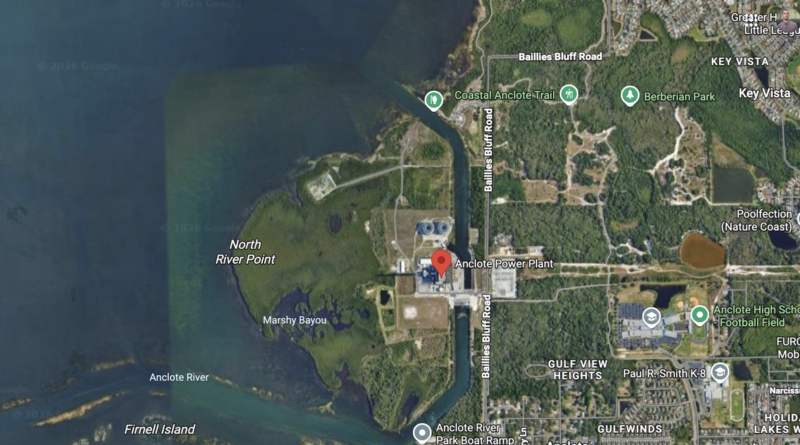
TAMPA, Florida — On August 20, an industrial accident at Duke Energy’s Anclote Power Plant in Holiday, Florida, released approximately 3,200 gallons of sodium bisulfite onto the surrounding soil and asphalt. While preliminary assessments from both Duke Energy and the Florida Department of Environmental Protection (FDEP) indicate that the hazardous chemical mixture was contained on-site and did not breach the adjacent Anclote River, the incident has immediately reignited intense public scrutiny over the safety, operational integrity, and climate vulnerability of aging fossil fuel infrastructure across the Sunshine State.
Sodium bisulfite is a potent chemical commonly used in industrial power generation for oxygen scavenging and water treatment, but it is also recognized as a severe irritant capable of causing acute damage to human skin, eyes, and respiratory tissues upon contact. The accidental release serves as a stark reminder of the localized hazards routinely shouldered by fence-line communities situated near heavy thermal power generation facilities.
Environmental advocacy groups, energy policy experts, and local stakeholders have seized upon the event to underscore a broader systemic critique: that Florida’s heavy reliance on fossil fuels—accounting for roughly 90% of Duke Energy Florida’s generation portfolio—poses unacceptable threats not only to public health and safety, but also to the state’s pristine natural ecosystems and tourism-driven economy. As climate change increases operational pressures on coastal industrial sites, critics argue that the Anclote spill is not an isolated mishap, but rather a symptom of an outdated, high-risk energy paradigm that demands an immediate acceleration toward decentralized, renewable alternatives.
The sequence of events leading up to, during, and immediately following the chemical containment effort remains under active review by state regulators and utility operators.
Initial Release and Emergency Response
The spill occurred on the grounds of the Anclote Power Plant, located in the coastal community of Holiday within Pasco County, just north of the Tampa Bay metropolitan area. According to regulatory disclosures submitted to the Florida Department of Environmental Protection, the containment failure involved a volume of approximately 3,200 gallons of sodium bisulfite.
The chemical agent, typically stored in high-volume tanks to treat boiler feedwater and control dissolved oxygen levels that cause catastrophic corrosion in high-pressure steam turbines, breached its primary holding or transfer mechanisms. Instead of routing safely through containment safeguards, the caustic liquid pooled across surrounding industrial asphalt and seeped into adjacent soil matrices within the plant’s operational footprint.
Containment and Remediation Measures
Upon detecting the loss of containment, plant operators initiated facility emergency protocols. Emergency response teams mobilized to neutralize and vacuum up the chemical pooling before it could migrate off-site.
Because the Anclote Power Plant sits directly on the coastal waterways feeding the greater Tampa Bay ecosystem—with the Anclote River serving as a vital marine habitat and local recreational artery—preventing a hydrological breach was the primary objective of local responders. Initial inspections by state environmental officers confirmed that emergency berms and soil absorption successfully halted the plume before reaching the riverbanks. Subsequent environmental testing and soil remediation protocols were established to scrape away contaminated earth and neutralize residual chemical traces on the asphalt, though the long-term ecological monitoring of the immediate subsurface soil remains ongoing.
Supporting Context & Metrics: The Hidden Toll of Fossil Fuel Dependence
To fully contextualize the gravity of the Anclote Power Plant spill, energy analysts and environmental watchdogs point to a vast array of intersecting vulnerabilities associated with maintaining legacy thermal generation plants in a rapidly changing coastal environment.
The Anatomy of Sodium Bisulfite Hazards
From a chemical standpoint, sodium bisulfite ($NaHSO_3$) is an inorganic salt widely utilized in industrial chemistry. When dissolved in water, it releases sulfur dioxide gas and acts as a strong reducing agent. Occupational safety guidelines dictate strict handling protocols; direct exposure to concentrated sodium bisulfite can cause severe skin burns, permanent eye damage upon contact, and acute irritation of the mucous membranes and respiratory tract if aerosols or dusts are inhaled. While the chemical degrades relatively quickly in the presence of oxygen and moisture, an uncontrolled release of 3,200 gallons represents a significant localized toxicity event that poses immediate risks to plant personnel and cleanup crews.
Florida’s Energy Mix and Fossil Dominance
The incident highlights the deep entrenchment of fossil fuels within Florida’s current utility matrix. Duke Energy Florida, one of the state’s investor-owned utilities serving nearly two million retail customers, continues to rely heavily on natural gas, oil, and legacy coal assets to meet baseline and peak power demands.
Industry data demonstrates that approximately 90% of Duke Energy Florida’s total generation capacity is derived from these polluting, combustible sources. Despite significant strides in utility-scale solar deployment over recent years, the sheer volume of fossil fuel infrastructure—including high-pressure pipelines, massive storage reservoirs for industrial chemicals, and complex cooling water intake and discharge canals—keeps local communities tethered to continuous industrial risk profiles.
Compounding Risks: Air, Water, and Climate Vulnerability
Fence-line communities living in the shadow of facilities like the Anclote plant face a cumulative burden of environmental hazards. Beyond sudden, accidental chemical spills, these populations contend with:
Air Quality Degradation: Routine combustion emissions containing nitrogen oxides ($NO_x$), sulfur dioxide ($SO2$), particulate matter ($PM2.5$), and greenhouse gases.
Coal Ash and Heavy Metal Contamination: Legacy management of toxic coal combustion residuals containing arsenic, lead, mercury, and selenium, which risk leaching into local aquifers and surface waters.
Industrial Wastewater Discharges: Thermal pollution and chemical treatment residues flushed continuously into local estuaries, altering marine ecosystems.
Climate Change Multipliers: Situated squarely on vulnerable coastlines, Florida’s power plants face escalating threats from intensifying hurricanes, storm surge flooding, sea-level rise, and extreme heatwaves, which strain cooling systems and heighten the probability of catastrophic structural failures.
Official Statements and Stakeholder Reactions
The Anclote Power Plant spill has triggered sharp rebukes from environmental organizations and public policy advocates who are demanding greater accountability and an accelerated transition away from centralized fossil fuel reliance.
Sierra Club Florida’s Perspective
Susannah Randolph, Sierra Club Florida Chapter Director, emphasized the unfair burden placed on local residents who bear the physical risks of maintaining the grid without enjoying adequate safety guarantees.
"People living near Duke Energy’s facility shouldn’t have to wonder whether the next spill will threaten their health or their community," stated Randolph. "This incident is a stark reminder that fossil fuel infrastructure comes with real risks. No Florida family, regardless of zip code, should have to accept these risks in order to keep the lights on. There are cleaner, safer options available. Sierra Club Florida calls for transparency about the Duke spill, including its cause, full environmental impacts, and what steps are being taken to prevent future incidents."
The CLEO Institute’s Economic and Environmental Warning
Susan Glickman, Vice President of Policy and Partnerships for The CLEO Institute, approached the incident through the lens of Florida’s unique economic architecture, noting the direct threat that environmental degradation poses to the state’s multi-billion-dollar tourism industry.
"As this chemical spill demonstrates, the costs for fossil fuel-based energy systems are many," Glickman remarked. "With 90% of Duke Energy Florida’s generation mix coming from these polluting sources, it’s yet another proof point that we must transition to cheaper, cleaner energy solutions to both protect our pocketbooks and our health. With tourism being the pillar of the state’s economy, we cannot risk spills like this, which tarnish the natural environment."
Future Outlook: The Urgency of Systemic Transition
As state regulators finalize their investigative findings regarding the exact mechanical or operational failure that precipitated the Anclote spill, the broader conversation has shifted inexorably toward the future of Florida’s energy landscape.
Regulatory Accountability and Transparency
Public interest groups are pressing the Florida Department of Environmental Protection (FDEP) to levy appropriate accountability measures against Duke Energy, demanding full public disclosure of the root-cause analysis report. Questions remain regarding the age and maintenance history of the chemical storage and transfer infrastructure at Anclote, prompting calls for comprehensive integrity audits across all utility-owned industrial facilities in the state.
The Economic and Environmental Imperative for Renewables
The economic argument for transitioning away from fossil fuel dependency has never been more compelling. As renewable energy technologies—specifically solar photovoltaic generation coupled with utility-scale battery energy storage systems (BESS)—continue to plummet in cost, maintaining capital-intensive, high-risk thermal power plants becomes increasingly difficult to justify on either economic or ethical grounds.
Unlike traditional fossil fuel plants, which require continuous shipments of hazardous chemicals, explosive gas pipelines, and constant fuel extraction, renewable energy installations operate with zero fuel-cost volatility and virtually eliminate the risk of toxic chemical spills or catastrophic industrial explosions. Furthermore, transitioning to decentralized renewable grids strengthens grid resiliency against the increasing fury of climate-driven extreme weather events.
Conclusion
The August 20 chemical spill at the Anclote Power Plant is much more than a localized environmental near-miss; it is a glaring symptom of an energy system out of step with the ecological and economic realities of the 21st century. For the residents of Holiday, for the broader communities living adjacent to Florida’s sprawling industrial energy corridors, and for an economy inextricably tied to the health of its natural environment, the incident underscores an urgent imperative. The transition toward clean, safe, renewable energy is no longer merely an environmental preference—it is an absolute prerequisite for public safety and sustainable prosperity in the Sunshine State.