Executive Overview
For years, the global transition to zero-emission public transit has been framed as a neck-and-neck horse race between two competing technologies: battery-electric buses (BEBs) and hydrogen fuel-cell electric buses (FCEBs). Policy makers, municipal leaders, and transit authorities have often treated the two systems as parallel pathways, waiting for the market, technological breakthroughs, or cost parity to declare a definitive winner.
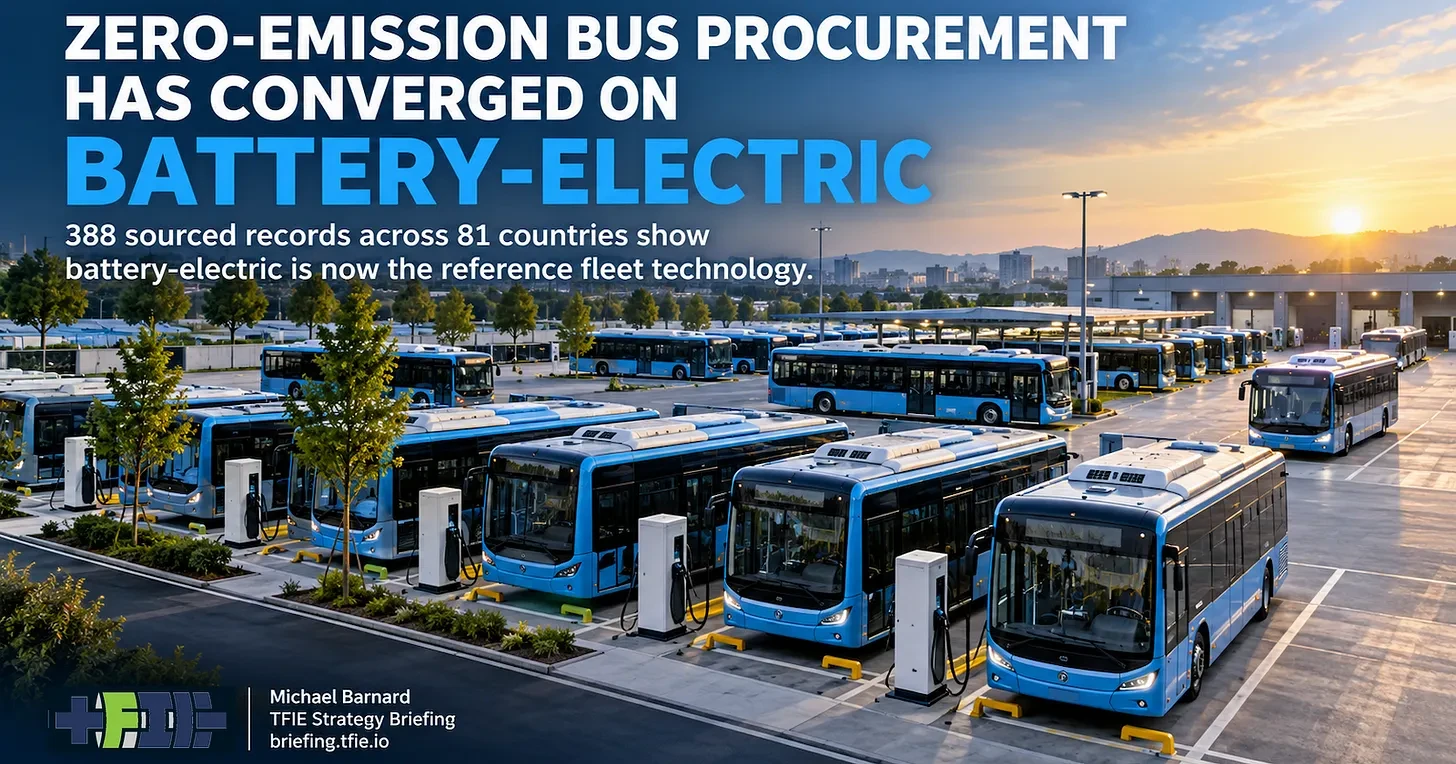
However, a sweeping new global procurement analysis shatters this paradigm. According to a comprehensive register of 388 sourced procurement records spanning 81 countries, battery-electric technology has decisively captured the market, emerging not merely as a contender, but as the universal reference standard for zero-emission bus fleets.
The numbers are stark and unequivocal. Out of 13,230 total firm vehicle acquisitions captured in the conservative data set, 13,165 are battery-electric buses, while only 65 are hydrogen fuel-cell buses. This amounts to a staggering 200-to-1 ratio, with battery-electric technology representing approximately 99.5% of all verified firm orders. More telling than the vehicle count is the breadth of adoption: battery-electric orders are distributed across 55 distinct purchasing bodies globally, whereas the entire global fleet of 65 hydrogen buses stems from just two isolated buyers.

This deep dive examines how the transit market reached this inflection point, analyzing the underlying procurement data, exploring the rare exceptions where hydrogen still finds a foothold, and outlining the urgent operational challenges—such as grid capacity and depot architecture—that now demand the attention of transit agencies worldwide.
Detailed Chronology: From Experimental Pilots to Commercial Dominance
To understand how battery-electric buses achieved total market supremacy, it is necessary to retrace the evolutionary timeline of zero-emission mass transit over the past two decades.
Phase 1: The Era of Fragmented Experimentation (2010–2018)
In the early days of transit decarbonization, municipalities were cautious. Cities faced aging diesel fleets and escalating emissions regulations, prompting local governments to turn to pilot programs. During this phase, both battery-electric and hydrogen technologies were heavily subsidized by national and regional governments.
Hydrogen was frequently touted for its rapid refuelling times and range capabilities, which closely mirrored traditional diesel operations. Battery-electric buses, meanwhile, wrestled with early battery degradation, limited range, and heavy vehicle weights. Transit agencies often purchased small cohorts of 3 to 10 vehicles of each type to run comparative trials, maintaining the illusion of an ongoing technology race.
Phase 2: The Scaling Divide and Real-World Friction (2019–2023)
As transit agencies moved from pilot projects to fleet-scale deployments, the operational realities of both technologies began to diverge sharply. Battery-electric technology benefited from rapid, consumer-driven advancements in lithium-ion battery chemistry, falling manufacturing costs, and a rapidly expanding global supply chain anchored heavily by mass production in China and expanding manufacturing footprints in Europe and North America.
Conversely, hydrogen programs frequently encountered the stubborn economic and logistical friction of the "hydrogen value chain." Operators discovered that maintaining localized hydrogen refuelling stations required specialized engineering, high energy inputs for compression and storage, and fragile supply chains vulnerable to price volatility. While battery-electric buses could be charged overnight at existing or retrofitted depots using standard grid electricity, hydrogen buses often relied on dedicated delivery trucks transporting fuel long distances, introducing efficiency losses and operational vulnerabilities.

Phase 3: The Definitive Commercial Divergence (2024–Present)
Today, the transit sector has moved past the phase of theoretical comparisons. Years of operating both technologies, rebuilding depots, training maintenance technicians, and managing daily route scheduling have provided transit operators with undeniable empirical data.
Current procurement records demonstrate that transit agencies are no longer experimenting; they are making scaled, repetitive purchasing decisions. Tenders and forward-looking procurement pipelines are heavily skewed toward battery-electric ecosystems. The market has rendered its verdict: for standard municipal transit, battery-electric is the default baseline, while hydrogen has retreated into a specialized niche.
Supporting Context & Metrics: Deconstructing the Global Procurement Data
Analyzing public transit procurement data requires rigorous methodology. Public announcements routinely inflate numbers by conflating early-stage tenders, non-binding options, multi-year framework quantities, and funding announcements with actual, legally binding purchase orders.
To cut through the noise, strategic research compiled a conservative global procurement register containing 388 sourced records across 81 countries, strictly separating firm orders and awards from speculative announcements.
The Numbers at a Glance
- Total Verified Firm Acquisitions: 13,230 vehicles
- Battery-Electric Bus (BEB) Firm Orders: 13,165 units (99.5%)
- Hydrogen Fuel-Cell Bus (FCEB) Firm Orders: 65 units (0.5%)
- Geographic/Institutional Spread (BEB): 55 distinct purchasing bodies
- Geographic/Institutional Spread (Hydrogen): Exactly 2 purchasing bodies
+-------------------------------------------------------------+
|         GLOBAL ZERO-EMISSION BUS FIRM ACQUISITIONS          |
+-------------------------------------------------------------+
| Battery-Electric Buses (13,165 units)                       |
| [██████████████████████████████████████████████████████████] |
|                                                             |
| Hydrogen Fuel-Cell Buses (65 units)                         |
| [░]                                                         |
+-------------------------------------------------------------+
The Hydrogen Exception: Why Did Those Two Buyers Bite?
Fairness and thoroughness demand a close look at the two entities that did purchase hydrogen buses, as they illustrate the narrow conditions under which the technology can still make economic or strategic sense:
- Qingyang, China: This municipal authority is deliberately constructing a localized, closed-loop hydrogen ecosystem. Rather than treating the bus purchase as a standalone transit decision, Qingyang is coordinating municipal buses, localized hydrogen production, and refuelling infrastructure as part of an integrated regional industrial development program.
- Krefeld, Germany: A commercial counterexample where a municipal transit operator already had operational experience with hydrogen buses. Having maintained and run small-scale FCEBs in daily service, the operator made a conscious choice to execute a repeat purchase based on their specific local operational parameters.
Crucially, however, these two isolated cases highlight the core issue: replication failure. After years of heavy global subsidization, promotional campaigns, and manufacturer marketing, the entire global firm procurement record for hydrogen reduces to one Chinese municipal ecosystem project and one German repeat operator.
The Critique of Missing Data
Skeptics might argue that regional data gaps—particularly within massive transit markets like China, where domestic procurement data does not always mirror Western transparency standards—could obscure a thriving underground hydrogen bus market.
However, industry analysts point out the logical impossibility of this hypothesis. To erase a 13,165-to-65 procurement gap, a shadow market of tens of thousands of hydrogen buses would have had to escape public record entirely, while battery-electric purchases remained brightly visible across dozens of regulatory environments, climates, and political regimes. No evidence of such a parallel hydrogen boom exists.
Official Statements & Industry Perspectives
Industry leaders, transit executives, and strategic analysts have increasingly voiced the reality that pretending battery-electric and hydrogen are neck-and-neck competitors is no longer productive for municipal budget planning.

"Zero-emission bus procurement has moved beyond the stage where battery-electric and hydrogen fuel-cell buses should be treated as two parallel technologies waiting for the market to decide between them," notes a recent market intelligence briefing from TFIE Strategy. "Both technologies can move passengers without tailpipe emissions. The more useful evidence now comes from what agencies are prepared to buy repeatedly and at fleet scale."
Transit authorities managing large-scale depot transitions emphasize that the debate must shift from which propulsion technology to choose to how to solve the complex infrastructure hurdles of the chosen technology.
"For normal urban and suburban bus procurement, battery-electric should now be the default reference technology," industry strategists advise. "Technology neutrality means applying the same service, reliability, emissions, and cost requirements; it does not require pretending that technologies with radically different commercial reference classes present equal risk."
Future Outlook: Navigating the Real Challenges Ahead
With the propulsion debate effectively settled by the global marketplace, public policy and transit investments must pivot away from endless comparative demonstrations and focus squarely on implementation.
Converting an entire municipal fleet to battery-electric power is far from trivial. Transit agencies face monumental engineering and operational bottlenecks that require active intervention from governments, utilities, and technology providers:
- Grid Interconnection and Depot Power: Transitioning a depot housing hundreds of buses requires multi-megawatt electrical connections and localized substation upgrades. Utility interconnection queues can stretch for years, representing the single largest bottleneck in fleet electrification.
- Charging Reliability and Software: Fleets require robust charging management software, automated plug-in or overhead pantograph systems, and dynamic load-balancing to ensure every bus is fully charged and ready to roll out on schedule every morning.
- Workforce Upskilling: Maintenance garages must be retrofitted for high-voltage safety, and mechanics must be retrained to service electric drivetrains, thermal management systems, and battery packs.
- Financing and Capital Expenditure: Upfront capital costs for vehicles and charging infrastructure remain high, necessitating innovative public-private financing models and federal grant structures.
A New Strategic Framework for Hydrogen
Under this updated market reality, hydrogen fuel-cell buses should no longer be treated as a mainstream alternative to be evaluated on an equal footing by default. Instead, hydrogen must prove its case as a specialized exception.
A transit agency should only consider a hydrogen procurement proposal if it successfully clears a rigorous four-part hurdle:
- Constraint Identification: Demonstrate a material duty-cycle, extreme climate, or depot-power constraint that battery-electric vehicles and smart charging cannot solve economically.
- Whole-System Cost Validation: Prove that hydrogen solves the specific constraint at an acceptable total cost of ownership across the entire system.
- Credible Fuel Supply: Establish a secure, long-term, cost-effective hydrogen fuel supply chain.
- Infrastructure Justification: Show that the operational advantages outweigh the immense capital and operational overhead of dedicated compression, storage, transport, and dispensing infrastructure.
Conclusion
The global transition of public transit to zero-emission fleets is accelerating, but the path forward is no longer clouded by ambiguity. With nearly 99.5% of firm global acquisitions favoring battery-electric technology, transit agencies can now abandon costly, redundant technological indecision.
The time, capital, and political will previously wasted on comparative trials must now be redirected toward solving the very real engineering, grid, and operational challenges of scaling battery-electric bus fleets worldwide. The race is over, and the electric bus has won the road.