






Executive Overview
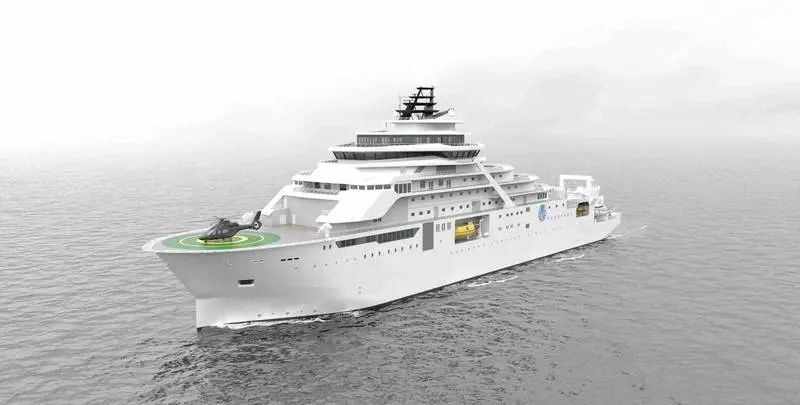
In a move set to redefine the engineering paradigms of modern oceanographic vessels, international shipbuilding giant VARD has awarded a landmark contract to Hoyer VMS Group. Under the terms of the agreement, Hoyer VMS Group will supply six custom-engineered, state-of-the-art generator sets for the highly anticipated 164-meter research vessel, currently designated "Project RV11000." Under construction for the marine research organization Inkfish, this vessel is poised to become one of the most technologically advanced and ecologically conscious scientific platforms ever launched.
At the heart of this milestone contract is a shift away from traditional emission-abatement technologies. Rather than relying on standard Selective Catalytic Reduction (SCR) systems and chemical consumables like urea to meet environmental mandates, the new vessel will utilize Wabtec’s Marine Diesel Engine (MDC) platform. Engineered with integrated Exhaust Gas Recirculation (EGR) technology, these generator sets achieve simultaneous compliance with both the International Maritime Organization’s (IMO) Tier III regulations and the United States Environmental Protection Agency’s (EPA) stringent Tier 4 emissions standards.
By eliminating bulky external aftertreatment systems, this propulsion and power-generation architecture yields unprecedented spatial and weight savings. The design freedom gained from this footprint reduction directly benefits the vessel’s scientific mission, allowing naval architects to allocate critical internal volume to sophisticated laboratories, advanced marine instrumentation, and what is projected to be the largest battery energy storage system ever installed on a scientific research vessel.
Detailed Chronology and Project Evolution
The genesis of Project RV11000 lies in the ambitious vision of Inkfish, a specialized research organization dedicated to exploring the ocean’s most remote and least understood ecosystems. To realize a vessel capable of operating safely, quietly, and sustainably in ecologically sensitive waters, Inkfish commissioned VARD—a subsidiary of the Fincantieri Group renowned for constructing complex, highly specialized offshore and research vessels.
[Project Inception: Inkfish Vision]
                │
                ▼
[VARD Design & Engineering Phase] ──► (Challenge: High emissions compliance vs. Space limitations)
                │
                ▼
[Vendor Evaluation: Hoyer VMS Group Selected]
                │
                ▼
[Integration of Wabtec MDC Platform with EGR]
                │
                ▼
[System Delivery & Construction of "Project RV11000"]
The engineering phase presented a multi-layered challenge: design a 164-meter vessel packed with heavy scientific equipment, deep-sea exploration tools, and extensive laboratory facilities, while adhering to the strictest global emission standards. Standard marine diesel setups capable of meeting EPA Tier 4 require massive SCR catalyst chambers and thousands of liters of urea storage, which threaten to crowd out scientific payloads and compromise the vessel’s stability and range.
Recognizing these constraints, VARD initiated a comprehensive global sourcing process for an alternative power generation solution. In mid-2023, discussions matured between VARD’s engineering teams and Hoyer VMS Group. Hoyer proposed an integrated package utilizing Wabtec’s medium-speed MDC engine platform. Unlike high-speed engines that rely on aggressive aftertreatment, the medium-speed Wabtec platform utilizes in-cylinder emission controls via EGR.
Following rigorous design reviews, technical simulations, and space-optimization studies, VARD officially selected Hoyer VMS Group to design, package, and deliver the six complete generator sets. Currently, construction of the vessel is progressing across VARD’s international shipbuilding network, with Hoyer VMS Group actively managing the integration, testing, and factory acceptance phases of the generator packages ahead of their scheduled shipyard installation.
Supporting Context and Technical Metrics
To appreciate the significance of the Hoyer VMS Group solution, it is necessary to examine the engineering differences between conventional emission-reduction methods and the integrated EGR approach.
The Engineering Duel: EGR vs. SCR
For vessels operating in Emission Control Areas (ECAs), compliance with IMO Tier III and EPA Tier 4 is mandatory. Traditionally, shipbuilders have achieved this through Selective Catalytic Reduction (SCR).
CONVENTIONAL SCR SYSTEM:
[Engine] ──► [Exhaust Pipe] ──► [Urea Injection] ──► [Bulky SCR Reactor] ──► [Silencer] ──► Clean Exhaust
                                       ▲
                               [Massive Urea Tank]

INTEGRATED EGR SYSTEM (Wabtec MDC):
[Engine w/ Built-in EGR] ──────────────────────────────────────────────────► [Compact Silencer] ──► Clean Exhaust
(In-cylinder NOx reduction; NO external reactors or chemical storage required)
While effective at reducing nitrogen oxides ($textNO_x$), SCR systems present major drawbacks for specialized research vessels:
- Spatial Penalty: SCR reactors require significant vertical and horizontal space within the engine casing, limiting the layout of upper decks.
- Logistical Complexity: Operating an SCR system requires carrying large volumes of aqueous urea (often branded as AdBlue). For a 164-meter vessel on multi-month polar or deep-ocean expeditions, urea storage tanks can displace tens of thousands of liters of fuel or scientific storage.
- Weight Distribution: SCR reactors and associated piping are typically located high in the vessel’s exhaust stacks, raising the vessel’s center of gravity and potentially impacting stability in rough seas.
By contrast, the Exhaust Gas Recirculation (EGR) system integrated into the Wabtec MDC engines works by recirculating a portion of the exhaust gas back into the engine cylinders. This process lowers the oxygen concentration in the combustion chamber and absorbs combustion heat, reducing peak combustion temperatures. Because $textNO_x$ formation is highly temperature-dependent, this in-cylinder modification prevents the creation of $textNO_x$ at the source.
| Parameter | Conventional SCR + Urea System | Integrated EGR System (Hoyer/Wabtec) |
|---|---|---|
| Consumables Required | Fuel + Urea (Diesel Exhaust Fluid) | Fuel Only |
| Exhaust System Footprint | Extremely High (Requires catalyst chambers) | Minimal (Standard piping & silencer) |
| Weight Profile | High (Heavy reactors mounted high in casing) | Low (Engine-mounted components) |
| Maintenance Demands | High (Sensor calibration, catalyst cleaning) | Low (Standard mechanical maintenance) |
| EPA Tier 4 Compliance | Yes (With fine-tuned dosing) | Yes (Inherent in-cylinder control) |
| Particulate Matter (PM) | Requires separate DPF or high-temp tuning | Optimized via high-pressure fuel injection |
Unlocking the "Largest Battery Installation"
By eliminating the space-consuming SCR infrastructure and urea tanks, VARD’s naval architects freed up critical volume within the lower decks of Project RV11000. This newly available space has been reallocated to house what is projected to be the largest battery energy storage system (BESS) ever installed on a scientific research vessel.
This massive battery installation serves several critical operational functions:
- Peak Shaving: The battery pack absorbs transient load spikes, allowing the Hoyer generator sets to run at their most efficient, steady-state operating points, further reducing fuel consumption and greenhouse gas emissions.
- Zero-Emission Operations: The vessel can operate purely on battery power when traversing sensitive marine sanctuaries or conducting delicate acoustic measurements where engine noise and vibration must be entirely eliminated.
- Spinning Reserve: The BESS provides immediate backup power, reducing the need to run multiple generators simultaneously for safety margins during dynamic positioning (DP) maneuvers near reefs or scientific equipment.
Official Statements and Industry Perspectives
The collaboration between VARD, Inkfish, Hoyer VMS Group, and Wabtec represents a major milestone in marine engineering.
A representative from VARD highlighted the strategic design advantages of the system:
"Project RV11000 is engineered to push the boundaries of what a research vessel can achieve. By removing traditional SCR installations, the integrated EGR solution gives our naval architects far greater freedom to optimize the vessel’s layout for its primary scientific mission. We are not forcing our design to accommodate bulky emissions equipment; instead, we are maximizing the space dedicated to laboratories, scientific instrumentation, and hybrid battery storage. This translates directly into enhanced operational capabilities for Inkfish."
Hoyer VMS Group emphasized the highly customized nature of the engineering package:
"We did not just supply engines; we engineered a complete, highly integrated generator package. This includes the Wabtec engine, high-efficiency generators, advanced control systems, custom vibration isolation, and optimized acoustic performance tailored specifically to the rigorous noise-reduction requirements of a world-class research vessel. The result is a cleaner, quieter, and highly reliable power plant that delivers maximum performance with minimal environmental footprint."
Industry analysts point out that the integration of EPA Tier 4 compliance without SCR aftertreatment represents a major step forward for the global research fleet. Many research vessels operate in remote regions, such as the Arctic and Antarctic, where the logistics of sourcing and storing high-purity urea are highly challenging. Eliminating this requirement simplifies supply chains and ensures the vessel can operate autonomously for extended periods.
Future Outlook and Industry Implications
The construction of Project RV11000 comes at a time of accelerating decarbonization and regulatory tightening across the global maritime industry. As the IMO targets net-zero greenhouse gas emissions from international shipping by or around 2050, and localized jurisdictions enforce increasingly strict "zero-emission" zones, the demand for highly efficient, hybrid power plants is growing rapidly.
[Vessel Space Saved by EGR]
        │
        ├─► [Expanded Laboratories & Scientific Tooling]
        ├─► [Installation of Record-Breaking Battery Storage (BESS)]
        └─► [Reduced Structural Weight & Lower Center of Gravity]
Project RV11000 is poised to serve as a blueprint for the future of specialized vessel design. The successful integration of Hoyer VMS Group’s EGR-based generator sets demonstrates that shipbuilders do not have to choose between strict environmental compliance and optimal deck space. This technological approach is expected to influence several related maritime sectors:
- Expedition Cruise Ships: Vessels carrying passengers to pristine environments like Antarctica or the Galapagos will benefit from the quiet, low-emission, and compact nature of EGR-based hybrid power systems.
- Offshore Support Vessels (OSVs): Multi-purpose vessels requiring high dynamic positioning capability can utilize this combination of compact generators and large battery banks to optimize fuel efficiency and deck space.
- Government and Hydrographic Survey Vessels: Low underwater radiated noise (URN) and minimized exhaust plumes are critical for accurate sonar mapping and atmospheric sampling—areas where the Hoyer-Wabtec package offers distinct advantages.
When Project RV11000 launches, it will carry more than just advanced laboratories and deep-sea ROVs; it will carry a highly optimized power generation system that proves sustainability and high-performance scientific capability can coexist. Through this partnership, VARD, Inkfish, and Hoyer VMS Group are setting a new standard for responsible ocean exploration.