Executive Overview
As the European Union strives to meet its ambitious climate neutrality targets, transport remains the continent’s most stubborn environmental hurdle. Unlike other sectors that have steadily reduced their carbon footprints over the decades, greenhouse gas emissions from European transport have continued to rise since 1990. While road transport accounts for the lion’s share of these emissions, aviation has aggressively emerged as the fastest-growing source of climate-warming pollution.
To turn the tide, the EU must aggressively champion its greenest mass-market transport mode: rail. Enter the EU Passenger Package—a landmark legislative initiative designed to drag European rail ticketing out of the stone age, safeguard consumer rights, and catalyze a massive modal shift away from high-emitting cars and airplanes.
However, according to a recent position paper and analysis by Transport & Environment (T&E), the current iteration of the EU Passenger Package falls dangerously short. While it represents a leap forward for passenger rights and digital modernization, its geographical limitations, rigid transaction frameworks, and restricted operator-agnostic rules threaten to undermine its own potential. If the European Union is serious about aligning this package with its broader climate targets and High Speed Rail Plan, systemic revisions are urgently required. Without them, international rail travel will remain an administrative headache, leaving Europe’s skies unnecessarily crowded.

Detailed Chronology: The Evolution of European Rail Reform
The Digital Dark Ages of European Ticketing
For decades, booking a cross-border train journey in Europe has been an unnecessarily convoluted experience. While budget airlines allow travelers to book multi-leg flights across the continent in a matter of clicks, European rail has remained fragmented along national borders.

Major domestic rail operators enjoy near-monopolistic control over ticket sales within their home markets. For instance, in France, approximately 90% of all rail tickets are sold through a single dominant platform: SNCF Connect. This market dominance makes it exceedingly difficult for alternative, green operators—such as Trenitalia or Ouigo—to gain visibility. In fact, public polling indicates that 55% of French travelers have never even heard of Trenitalia because they remain virtually invisible on the dominant booking interfaces.
The Rise of the Passenger Package
Recognizing that user experience is a primary deterrent to sustainable travel, the European Commission introduced the EU Passenger Package. The core objective was clear: simplify digital booking, mandate broader ticket visibility, and ensure that passengers booking multi-operator journeys enjoy robust, legally protected rights.
T&E-commissioned polling reveals the urgency of this digital overhaul, finding that 61% of respondents were deterred from taking long-distance rail journeys at least once simply because the booking process was deemed too complicated.

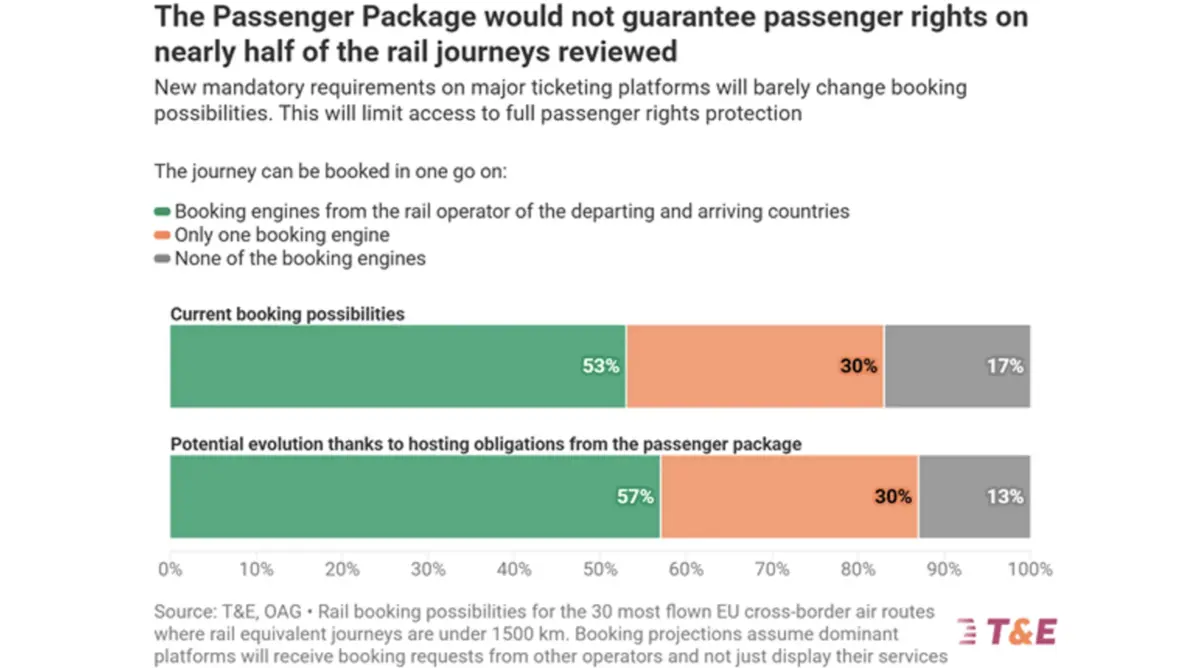
While the introduction of the Passenger Package was initially heralded as a major victory for consumers, subsequent analyses of its legal text exposed critical blind spots. Most notably, the geographical scope of the proposed "hosting obligation"—which forces major booking platforms to sell tickets from competing operators—is currently restricted primarily to neighboring countries. Consequently, the package fails to cover many of the natural rail equivalents of Europe’s most heavily flown routes, creating a regulatory patchwork that leaves nearly half of potential international routes without guaranteed passenger rights.

Supporting Context & Metrics: The Climate Imperative and Consumer Friction
To understand why the EU Passenger Package matters on a macro scale, one must examine the broader environmental and behavioral metrics governing European mobility.
The Transport Emissions Crisis
- The Largest Source: Transport remains the EU’s single largest source of greenhouse gas emissions.
- The Wrong Direction: Unlike power generation and industry, which have successfully decoupled economic growth from emissions, transport emissions have trended upward since 1990.
- Aviation’s Growth: Aviation represents the fastest-growing source of transport emissions in Europe. Every passenger diverted from a short-haul flight to a high-speed train yields an immediate, exponential reduction in carbon output.
- Road Dominance: Road transport still commands the absolute majority of ground emissions, reinforcing the need for seamless, door-to-door mass transit alternatives that integrate local, national, and international rail networks.
[EU TRANSPORT EMISSIONS BREAKDOWN]
 ├── Road Transport (Majority of emissions)
 ├── Aviation (Fastest-growing source of emissions)
 └── Maritime & Other Sectors
 └── Rail (Europe's greenest mass-market mode — The Solution)
The Booking Headache
Consumer psychology plays an undeniable role in modal shift. Environmental awareness is high, but human behavior is friction-averse. When travelers face an archaic, multi-step booking process involving different currency conversions, separate cancellation policies, and fragmented customer service channels, they default to aviation or private automobiles.
The T&E survey metric—showing that nearly two-thirds ($61%$) of long-distance travelers have abandoned rail plans due to ticketing complexity—underscores that digitization is not merely a convenience feature; it is an environmental imperative.
Key Policy Shortfalls and T&E Recommendations
The T&E position paper outlines three fundamental flaws in the current draft of the EU Passenger Package, accompanied by clear, actionable recommendations to fix them.

1. The Hosting Obligation: Expanding Beyond Immediate Neighbors
The Problem:
Major rail operator booking platforms must be legally mandated to sell tickets from other operators across a much wider geographic radius. Under the current proposal, the international scope of the hosting obligation is too narrow. It fails to capture key cross-border corridors that compete directly with high-frequency flight paths. As a result, many rail equivalents of Europe’s top-flown routes will lack single-ticket availability, stripping passengers of critical legal protections if delays occur.
The Solution:
The EU must harmonize the Passenger Package with its flagship High Speed Rail Plan. Specifically, policymakers must extend the hosting obligation to all capital cities under 1,500 kilometers apart, allowing for a maximum of two changes where a viable rail route exists.
- Example: A journey from Brussels to Madrid—involving multiple national operators like SNCB, SNCF, and Renfe—should be treated as a unified route. All major incumbent platforms along that corridor must be legally required to sell the complete journey.
2. Single Tickets via Single Platforms, Not Just Single Transactions
The Problem:
Rail operators release their ticketing inventories at vastly different times. Some operators open bookings six months in advance, while others release tickets mere weeks or months prior to departure. Under the current "single transaction" requirement, a passenger attempting to book a multi-leg journey across different operators’ networks often cannot do so simultaneously because one leg’s tickets are not yet on sale. If they wait, seats sell out or prices spike; if they book separately, they lose their unified passenger rights.
The Solution:
The regulation’s scope must be revised to protect passengers who build their journey on a single platform over time, rather than restricting rights strictly to instantaneous, single-transaction purchases.

- Example: If a traveler is journeying from Paris to Madrid, their SNCF ticket might be available six months in advance, whereas the Renfe connection from Barcelona to Madrid may not be released until five months prior. Passengers should be able to book the entire itinerary through an aggregator like Trainline, securely add the subsequent leg later on the same continuous platform, and retain their single-ticket status and associated passenger rights.
3. Unrestricted Journey Continuation: Hopping on the Next Available Train
The Problem:
If a passenger misses a connecting train due to a delay caused by the first operator, current proposals offer limited relief, often mirroring the restrictive Agreement on Journey Continuation (AJC). Frequently, the next available train to complete the journey is operated by a different railway undertaking that was not part of the original single-ticket bundle. Under current rules, passengers may be forced to wait hours—or even days—for a train operated by the specific company they booked with, rather than being allowed to board the very next physical train heading to their destination.
The Solution:
Passengers must be granted the right to hop on whichever suitable next train is available to finish their journey, regardless of the railway undertaking operating it.
- Example: If a traveler is journeying from Brussels to Milan, and the initial Brussels-to-Paris leg is delayed, causing them to miss their connection, they should be permitted to board an alternative Trenitalia France train to Milan immediately, rather than waiting hours for the next scheduled SNCF service.
- The Business Case: This reform not only dramatically improves the consumer experience but also shields rail operators from costly liabilities, such as being forced to pay for overnight hotel accommodations when passengers miss the final connection of the day.
Future Outlook: A Golden Window for European Rail
The European Union stands at a critical crossroads. The legislative framework surrounding the EU Passenger Package is not merely an administrative exercise in consumer protection; it is a foundational pillar of the European Green Deal.
If the European Parliament, the Council, and the European Commission heed the recommendations set forth by Transport & Environment, the Passenger Package can transform from a modest bureaucratic update into a powerful catalyst for modal shift. By expanding the hosting obligation to cover major long-distance European corridors (such as Brussels-to-Madrid), modernizing booking horizons to accommodate asynchronous ticket releases, and enforcing cross-operator journey continuation rights, the EU can finally create a rail network that rivals aviation in both convenience and reliability.

Europe has the infrastructure, the environmental imperative, and the public demand to make mass-market rail travel the default choice for long-distance mobility. Now, policymakers must ensure the legal framework matches that ambition—dragging European ticketing firmly into the 21st century and clearing the tracks for a truly sustainable future.