Executive Overview
At sea, passenger safety remains the paramount operational directive for cruise lines, superseding tight itineraries, port schedules, and logistical planning. On October 11, 2026, this reality came to the forefront once again when Royal Caribbean International’s mega-ship Oasis of the Seas experienced a critical medical emergency. The mid-cruise crisis necessitated an emergency debarkation, triggering a domino effect that delayed the vessel’s return to its homeport in Cape Liberty, New Jersey, impacted thousands of disembarking guests, pushed back embarkation for the subsequent voyage, and forced a compressed stop at its first scheduled port of call in Port Canaveral, Florida.
The incident underscores the complex operational challenges cruise operators face when balancing medical necessities with rigid schedules. While the disruption inconvenienced passengers across two consecutive sailings, Royal Caribbean moved swiftly to mitigate travel headaches, offering financial compensation for altered travel plans, adjusting excursion schedules, and issuing precise instructions to manage terminal congestion. However, the event also highlights a troubling pattern: this latest disruption follows closely on the heels of a strikingly similar medical evacuation event aboard the exact same vessel less than a month prior, drawing renewed attention to the frequency of emergency medical interventions on ultra-large cruise ships.
Detailed Chronology of Events
The sequence of events unfolded over the final days of a 7-night itinerary that had originally departed Cape Liberty, New Jersey, on October 4, 2026. The voyage, designed to offer guests a relaxing autumn escape to the Bahamas, was proceeding normally until a passenger onboard suffered a severe medical crisis requiring urgent, specialized intervention beyond the capabilities of the ship’s onboard medical facility.
While Royal Caribbean’s official communications to guests did not explicitly name the location of the emergency stop, independent passenger reports shared widely within cruising communities—specifically on dedicated social media platforms—indicated that the vessel diverted to Nassau, Bahamas, to facilitate the transfer.
The Return to Cape Liberty
The unscheduled medical stop cost the ship critical operational time. Consequently, the Oasis of the Seas was unable to maintain its scheduled arrival window at the Cape Liberty Cruise Port on Saturday, October 11, 2026. Rather than pulling into port at the scheduled time of 6:00 a.m., the massive 5,602-guest vessel did not dock until approximately 9:30 a.m.—a delay of three and a half hours.
This delay immediately rippled through the terminal operations. Disembarkation for the concluding cruise was pushed back significantly, which in turn severely restricted the turnaround window required to process the incoming wave of passengers for the subsequent 7-night voyage departing that same afternoon.
Impact on the Subsequent Sailing
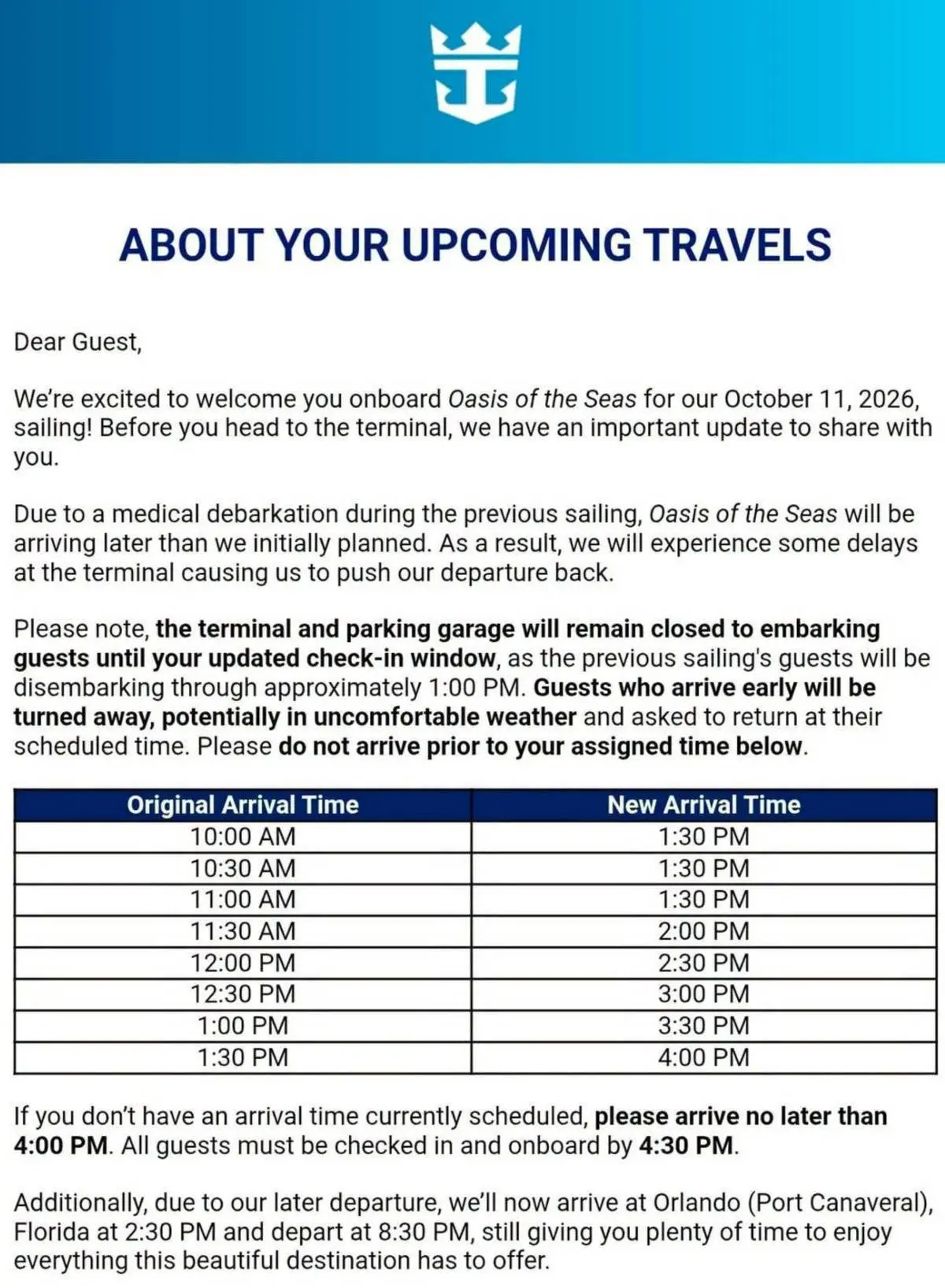
Recognizing the logistical bottleneck, Royal Caribbean’s operations team implemented immediate schedule adjustments for the embarking guests. To prevent massive crowding outside the terminal and parking garages, the cruise line issued urgent notifications instructing incoming passengers to strictly adhere to newly revised check-in times.

The terminal and parking facilities were kept strictly locked to arriving guests until the previous sailing’s passengers were completely cleared from the premises, a process that extended until approximately 1:00 p.m. Consequently, the earliest possible arrival time for incoming guests was pushed back by three and a half hours, moving from the standard 10:00 a.m. slot to 1:30 p.m. Later boarding groups were staggered through 4:00 p.m., while the ship’s actual departure time from New Jersey was delayed accordingly.
Port Canaveral Compression
The delayed departure from Cape Liberty cast a long shadow over the early days of the new itinerary. The Oasis of the Seas was forced to steam at an accelerated pace down the Atlantic coast to reach its first scheduled stop: Port Canaveral, Florida.
Despite the captain’s efforts to make up lost time at sea, the vessel’s arrival at Port Canaveral was postponed from 12:30 p.m. to 2:30 p.m., compressing the port call by a full two hours. Fortunately, port authorities and ship management coordinated to keep the evening departure on track, allowing the ship to leave Port Canaveral at its originally scheduled time of 8:30 p.m. and minimize any further cascading delays to the remainder of the voyage.
Supporting Context & Metrics: A Growing Trend
The October 11 incident is not an isolated anomaly within the Oasis of the Seas operational calendar. In fact, it highlights a concerning statistical frequency of acute medical events requiring emergency shoreside interventions on the vessel.
Just weeks prior, on September 20, 2026, Cruise Hive reported a nearly identical operational disruption involving the same ship. During that late-September sailing, two separate guests required urgent medical evacuations ashore, forcing the vessel to divert. That incident resulted in an extended delay of approximately eight hours upon arrival back at Cape Liberty, deeply impacting both the concluding guests and the embarkation window for the subsequent voyage.

Operational Metrics of the Oasis of the Seas
To understand the complexity of managing medical emergencies and turnarounds on this scale, one must examine the sheer size and capacity of the vessel:
- Passenger Capacity: Up to 5,602 guests (double occupancy) and over 6,700 at maximum capacity.
- Crew Members: Approximately 2,200 international crew members.
- Total Population Onboard: Frequently approaches nearly 9,000 souls at sea—a floating community equivalent in size to a small town, inherently prone to medical emergencies given the demographic profile of typical cruisers.
- Turnaround Logistics: Clearing nearly 6,000 departing guests and welcoming an equal number of embarking passengers within a compressed window of 4 to 5 hours requires military-grade precision. When a medical delay shaves hours off this window, shore-side traffic management, baggage handling, and security screening systems are pushed to their absolute limits.
Official Statements and Passenger Compensation
Recognizing the frustration and anxiety caused by disrupted travel plans, Royal Caribbean adopted a transparent and customer-centric approach, issuing clear apologies alongside tangible financial remedies for those impacted by the October 11 delay.
The Cruise Line’s Message
In communications distributed to guests aboard the concluding sailing, the company emphasized empathy and the primacy of human life over operational schedules:
"We successfully debarked our guest so they could receive additional medical care. As a result, we’ll now be delayed in our return to Cape Liberty," the official notice read. "We’re sorry for the inconvenience caused by this change, and we appreciate your understanding, knowing we’d do the same for you or a loved one in a similar situation."
Financial Relief for Travel Disruptions
Because the delayed arrival in New Jersey threw travel itineraries into disarray—particularly for guests who had booked independent flights or transportation home—Royal Caribbean established a clear reimbursement framework to alleviate financial losses:
- Flights by Royal Bookings: Guests who booked their air travel through the cruise line’s proprietary Flights by Royal program had their itineraries automatically adjusted and protected by the line’s operational guarantees.
- Independent Travelers: For guests who booked independently, Royal Caribbean instituted a reimbursement policy covering eligible flight and ground transportation change fees. The policy provides up to $200 per person for domestic travel and up to $400 per person for international travel, provided proper documentation and receipts are submitted.
Managing Port Canaveral Excursions
For the guests whose embarkation was delayed and whose port call in Port Canaveral was shortened by two hours, the cruise line outlined automatic protective measures regarding shore excursions:
- Rescheduling: Royal Caribbean’s shore excursion team automatically worked to reschedule affected tours where feasible to fit within the shortened 2.5-hour to 6:00 p.m. window.
- Cancellations and Refunds: Any pre-booked excursions that could not be accommodated due to the compressed timeline were automatically cancelled. Guests affected by these cancellations will receive a full refund issued as onboard credit, with any remaining unused refundable amounts credited directly back to the original payment card on file within 14 business days following final disembarkation.
Future Outlook: Navigating Medical Realities at Sea
As the Oasis of the Seas continues its deployment out of the Northeast before transitioning to future itineraries, the events of September and October 2026 serve as a stark reminder of the unpredictability inherent in modern maritime tourism.
Modern cruise ships like those in Royal Caribbean’s Oasis Class are floating marvels of engineering, equipped with state-of-the-art medical centers staffed by certified physicians and critical care nurses. However, when an acute medical crisis exceeds the scope of shipboard facilities—such as advanced cardiac events, severe neurological emergencies, or acute surgical needs—shoreside evacuation remains the only viable lifesaving recourse.
Potential Industry Adjustments
Moving forward, industry analysts suggest that cruise lines may need to refine contingency protocols specifically tailored to mega-ships. Key areas of focus could include:
- Buffer Time in Itineraries: Incorporating minor speed reserves or buffer hours into sea days following port-intensive legs to absorb unexpected medical diversions without impacting homeport turnarounds.
- Enhanced Port Coordination: Streamlining local port agent communications in Caribbean hubs like Nassau to expedite pilotage, launch services, and immigration clearances during emergency medevac operations.
- Communication Tech: Leveraging real-time app notifications to keep embarking guests instantly informed of terminal lockouts, thereby reducing congestion outside major homeports like Cape Liberty.
Despite these operational hurdles, passenger sentiment remains largely understanding. The universal ethos of the cruising community—underlined by Royal Caribbean’s messaging—acknowledges that saving a life on the high seas always takes precedence over keeping to the clock.
The Oasis of the Seas is currently scheduled to complete the remainder of its itinerary, featuring stops at Royal Caribbean’s private Bahamian island destination, Perfect Day at CocoCay, and Nassau, before ultimately returning to its Cape Liberty homeport on October 18, 2026.