











Executive Overview
In a milestone development for American infrastructure, the U.S. Department of Transportation’s Federal Railroad Administration (FRA), alongside the Florida Department of Transportation (FDOT), has officially broken ground on a sweeping, multi-faceted modernization campaign. Bolstered by a massive injection of $416 million in federal funding—supplemented by an additional $100 million in state matching funds—this half-billion-dollar initiative represents a foundational shift in how passenger rail, corridor safety, and regional connectivity are managed in the Sunshine State.
At the heart of this initiative is a dual-pronged strategy: first, a massive overhaul of rail safety infrastructure spanning more than 900 railroad crossings statewide; and second, the construction of a cutting-edge multimodal transportation station in the heart of Cocoa, located on Florida’s booming Space Coast. This investment is not merely an exercise in infrastructure maintenance; it is a strategic economic catalyst designed to accommodate explosive population growth, reduce vehicular-train conflicts, and usher in what federal officials are proudly terming the "Golden Age of Rail."
As rail travel experiences a post-pandemic renaissance across the United States, Florida has positioned itself at the epicenter of this national movement. With private high-speed rail operations like Brightline already redefining intercity travel between Miami and Orlando, public sector investments are now racing to match private innovation. By upgrading the safety parameters of vital transit corridors and embedding multimodal connectivity directly into the Space Coast’s urban fabric, this funding package addresses the immediate demands of public safety while laying the long-term track for sustainable, high-capacity regional mobility.
Detailed Chronology of the Investment Initiative
To fully understand the scope and scale of the Florida rail modernization project, one must examine the timeline of events, policy shifts, and legislative maneuvers that brought this massive financial package from conceptual policy to concrete reality.
The Genesis of the "Golden Age of Rail"
The trajectory of this funding package traces back to late summer, when the U.S. Department of Transportation, under the leadership of Transportation Secretary Sean P. Duffy, formally unveiled the ambitious "Golden Age of Rail" initiative. Designed as a direct response to aging national infrastructure, rising congestion on interstate highways, and persistent safety challenges at grade crossings, the package earmarked billions of dollars nationwide for targeted rail improvements.
While the national program set the macro-level framework, regional stakeholders in Florida immediately mobilized. FDOT officials, in coordination with metropolitan planning organizations across Central and South Florida, submitted comprehensive grant applications emphasizing the urgent need for grade-crossing mitigations along high-density corridors where passenger and freight trains share right-of-way.
Securing the Capital: The Federal-State Partnership
By late autumn, the Federal Railroad Administration finalized the allocation of $416 million specifically designated for Florida infrastructure projects. Recognizing the transformative potential of the federal grant, the Florida Legislature and the Governor’s office moved swiftly to appropriate an additional $100 million in state matching funds, bringing the total capital investment pool to a staggering $516 million.
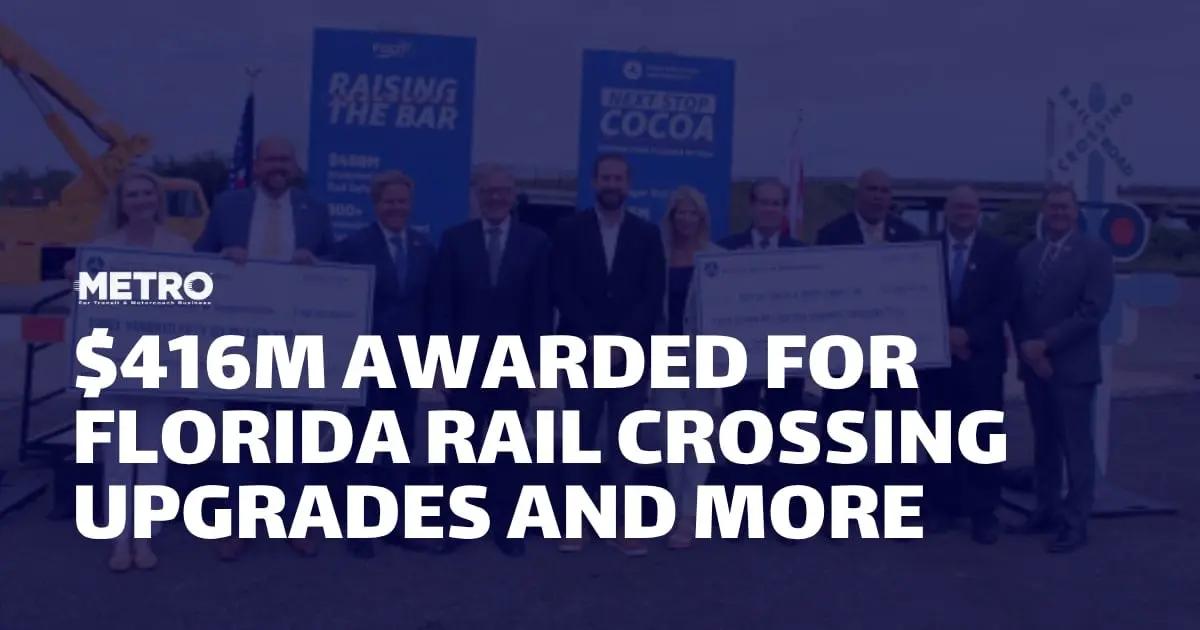
This financial fusion of federal largesse and state commitment was formally celebrated during a high-profile joint press event featuring leadership from the FRA, FDOT, local municipal leaders, and members of the U.S. Congress. During the event, officials detailed the allocation of the funds, dividing the capital cleanly between the statewide crossing safety enhancements ($356 million in federal support) and the development of the Cocoa multimodal station.
Groundbreaking and Phased Implementation
With the funding legally secured and administrative hurdles cleared, the initiative has entered its active implementation phase. The project timeline is structured around several critical phases:
- Phase I (Months 1–6): Environmental reviews, site surveys, and engineering design for the Cocoa multimodal station, alongside procurement contracts for automated warning devices and safety gate materials.
- Phase II (Months 6–18): Construction initiation on the Cocoa station, accompanied by the rollout of the first wave of rail crossing upgrades in high-priority Central Florida counties (Brevard, Orange, Osceola, Seminole, and Volusia).
- Phase III (Months 18–36): Execution of subsequent waves of crossing enhancements across the remaining regions of the state, testing of advanced signaling technologies, and structural completion of the multimodal facility.
- Phase IV (Months 36–48): Final systems integration, safety certifications, operational launch of the Cocoa station, and comprehensive post-project economic impact assessments.
Supporting Context & Metrics: Safety, Economics, and Infrastructure
The sheer breadth of the $516 million investment demands a rigorous examination of the underlying metrics. To evaluate the true value of this endeavor, analysts must look at the specific safety vulnerabilities being addressed and the projected economic dividends.
Mitigating Risk: Upgrading More Than 900 Crossings
Of the total federal package, $356 million is dedicated exclusively to safety enhancements at more than 900 railroad crossings throughout Florida. Grade crossings have historically been vulnerable points of contact between heavy rail traffic and civilian vehicular or pedestrian traffic. By systematically modernizing these intersections, the state aims to drastically reduce collision rates and save lives.
Geographically, the distribution of these improvements is heavily weighted toward Central Florida, where nearly a quarter of all targeted upgrades will take place. Specifically, the counties of Brevard, Orange, Osceola, Seminole, and Volusia—regions experiencing some of the highest population growth and vehicular congestion rates in the country—will see concentrated infrastructural interventions.
The technical specifications of the upgrades being deployed at these 900+ locations include:
- Advanced Active Warning Systems: Installation of synchronized LED flashing light signals, constant warning time circuitry, and high-decibel audible bells.
- Enhanced Barrier Infrastructure: Deployment of four-quadrant gate systems that completely block vehicular lanes, preventing erratic drivers from weaving around lowered gates.
- Interconnected Traffic Signals: Linking railroad warning systems directly to adjacent highway traffic lights to clear queued vehicles off the tracks automatically when an approaching train is detected.
- Obstruction Detection Technology: Implementation of radar and laser-based intrusion detection systems that alert locomotive engineers to vehicles or debris stalled on the tracks.
- Improved Track Geometry and Surface Materials: Upgrading the physical pavement and rubberized paneling at crossings to ensure smoother transitions for vehicles, thereby reducing the likelihood of stalls caused by rough tracks.
The Cocoa Multimodal Station: A Catalyst for the Space Coast
Beyond the linear safety upgrades along the tracks, a substantial portion of the capital is dedicated to building a brand-new multimodal station in Cocoa, Florida. A multimodal station is defined by its ability to seamlessly integrate various forms of transportation—connecting passenger rail services with local bus networks, rideshare zones, bicycle pathways, and parking facilities under one unified roof.
The economic projections associated with the Cocoa station are remarkably robust. Local and federal economic models project that the facility will generate up to a $350 million annual economic impact once fully operational. Furthermore, the construction and subsequent operational ecosystem are expected to support approximately 3,500 jobs, ranging from direct construction and engineering positions to hospitality, retail, and transit administration roles generated by increased passenger foot traffic.
Official Statements and Stakeholder Perspectives
The convergence of federal oversight, state-level execution, and local economic ambition has generated widespread commentary from key political and regulatory figures. The alignment of leadership across different levels of government has been cited as a primary driver behind the rapid approval and funding of the initiative.
Federal Leadership and the "Golden Age of Rail"
Federal Railroad Administrator David Fink underscored the national significance of the Florida investment, tying it directly to broader executive branch policies aimed at modernizing American transportation.
"By investing these dollars where they matter most, President Trump and Secretary Duffy are ushering in a Golden Age of Rail that will make Florida’s rail corridors safe, modern, and more efficient," FRA Administrator David Fink stated during the formal funding announcement.
Fink’s emphasis on efficiency and modernization reflects a growing consensus within the Department of Transportation that passenger rail must be elevated to a primary pillar of national infrastructure, capable of competing with air and highway travel in terms of both speed and safety.
Congressional Advocacy for the Space Coast
Locally, the project has been championed by federal lawmakers who represent the districts directly impacted by the infrastructural additions. U.S. Congressman Mike Haridopolos highlighted the transformative nature of the Cocoa station for his constituents on the Space Coast.
"Here on the Space Coast, we continue to build for the future," Congressman Mike Haridopolos remarked. "This new station will make it easier for people to travel to and from the Space Coast while supporting our growing community. It is expected to have up to a $350 million annual economic impact and support 3,500 jobs, bringing even more opportunity to our region."
Haridopolos’s remarks capture the dual appeal of the project: while transit advocates view the station through the lens of mobility and carbon-reduction, local business leaders view it as a powerful economic engine capable of drawing tourists, business travelers, and high-tech talent to Brevard County.
Future Outlook: What Lies Ahead for Florida Rail
As ground is broken and engineering teams deploy across the state, the long-term outlook for Florida’s rail network has fundamentally shifted. The injection of $516 million acts as a down payment on a much larger vision for intercity and regional transit within the state.
Scaling Up Connectivity
The inclusion of Cocoa as a major multimodal hub suggests that passenger rail services operating along the Florida East Coast corridor are preparing for expanded stops and denser service schedules. As commuter demand surges between Jacksonville, Orlando, the Space Coast, and South Florida, the new station will serve as a vital interchange point, alleviating pressure on regional highways such as Interstate 95 and State Road 528.
Technological Evolution and Autonomous Integration
Looking toward the horizon, the safety upgrades being installed at the 900+ crossings are designed to be future-proof. As the rail industry gradually explores the integration of positive train control (PTC), automated inspection drones, and eventually autonomous locomotive operations, the modernized signaling and gate infrastructure put in place today will serve as the digital and physical foundation for tomorrow’s smart rail network.
A Blueprint for National Infrastructure
Ultimately, the collaboration between the U.S. Department of Transportation, the Federal Railroad Administration, the Florida Department of Transportation, and local municipalities serves as a case study in effective infrastructure funding. By balancing macro-level safety mandates with hyper-localized economic development—exemplified by the Cocoa station—this initiative demonstrates how public capital can be deployed to simultaneously protect human life, stimulate regional economies, and modernize the American travel experience for generations to come.


