Executive Overview
The luxury power catamaran segment has experienced a profound shift in recent years, evolving from utilitarian, volume-driven platform designs into sleek, high-performance vessels that rival traditional monohulls in both aesthetics and velocity. Aquila Catamarans, a recognized industry leader in power multihulls, has officially cemented this design philosophy with the global introduction of the new Aquila 35 Sport. Unveiled to considerable industry acclaim at the prestigious Cannes Yachting Festival, the 35-foot power catamaran directly channels the aggressive styling, social-centric engineering, and blistering performance of its larger sibling, the flagship Aquila 45 Sport.
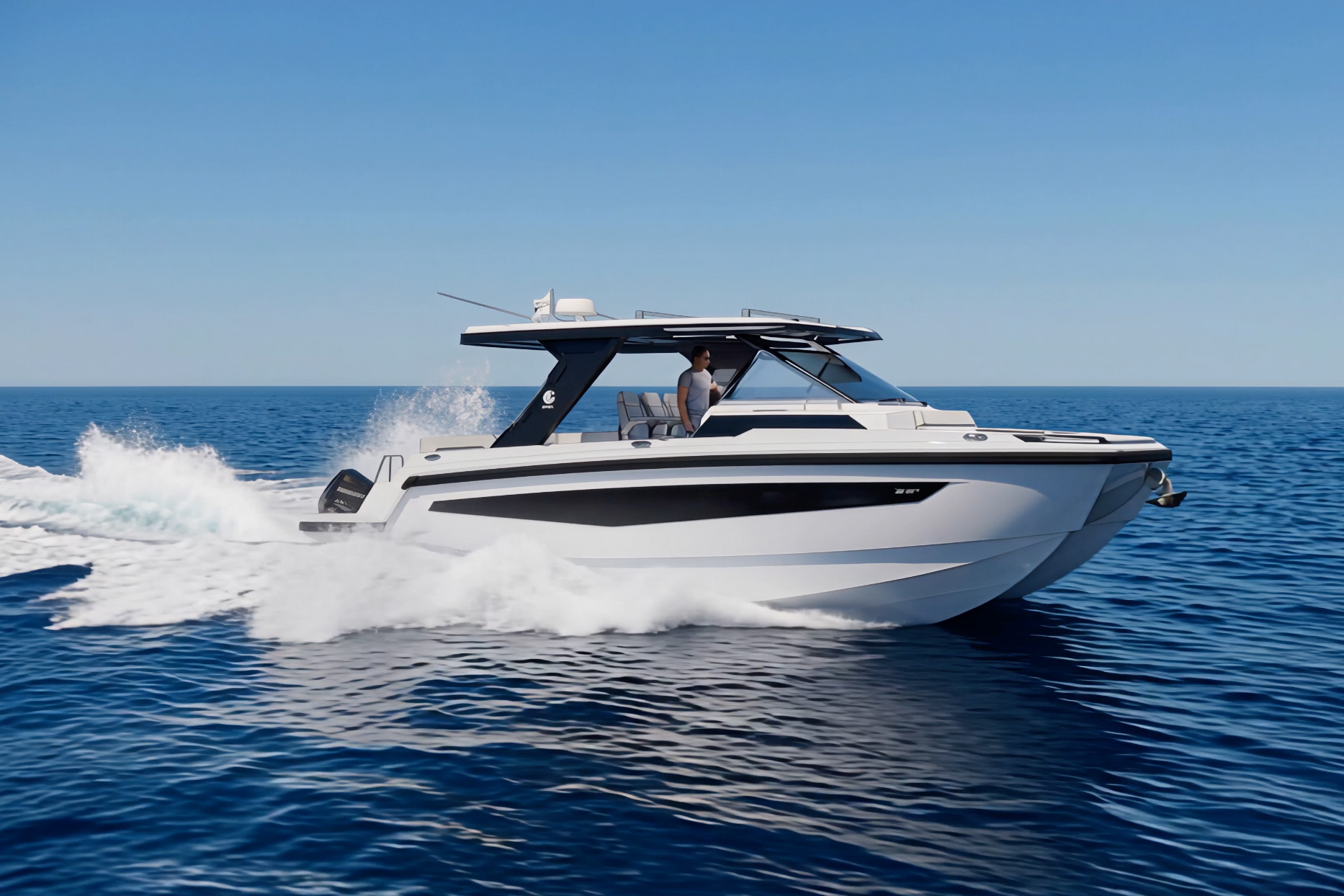
Designed for boaters who demand an uncompromising blend of adrenaline-fueled performance, modern luxury, and everyday versatility, the Aquila 35 Sport bridges the gap between open-cockpit day boats and capable coastal cruisers. At its core, the vessel pairs an advanced, hydrodynamically optimized double-stepped catamaran hull with potent Mercury outboard propulsion. This combination allows the craft to effortlessly approach speeds of up to 45 knots while maintaining the exceptional stability, lateral tracking, and shallow draft inherent to multihull configurations.
Beyond its raw performance capabilities, the 35 Sport introduces a thoughtfully curated layout focused on modern on-water socializing. Featuring three distinct, interconnected gathering zones at the bow, helm, and aft cockpit, alongside a surprisingly spacious and well-appointed overnight cabin belowdecks, the model redefines what owners can expect from a vessel of its footprint. This comprehensive overview examines the design lineage, technological innovations, layout specifics, and market implications of Aquila’s newest high-performance offering.
Detailed Chronology: From Concept to Global Debut
The genesis of the Aquila 35 Sport reflects a calculated response to shifting consumer preferences within the luxury marine sector. To fully understand the trajectory of this new model, one must examine the timeline of design evolution, engineering milestones, and public unveiling that brought the 35 Sport from a naval architect’s drawing board to the waters of the French Riviera.
The Success of the Flagship and the Call for a Compact Successor
The roadmap for the 35 Sport was fundamentally drawn by the market reception of the Aquila 45 Sport. When Aquila introduced its larger Sport series flagship, the builder proved that power catamarans could break away from the boxy, volume-heavy aesthetic of traditional cruising cats. The 45 Sport delivered aggressive lines, European styling touches, and sports-car-like handling that resonated deeply with performance-oriented yacht owners.
However, industry feedback quickly highlighted a distinct market demand: owners wanted the DNA, speed, and social layout of the 45 Sport scaled down into a more manageable, easily maneuverable, and economically accessible 35-foot platform. This insight initiated the engineering cycle for the 35 Sport, tasking the design team with retaining the flagship’s core performance attributes without compromising interior comfort or deck ergonomics in the smaller footprint.
Engineering and Hull Optimization
With the dimensional parameters set at approximately 35 feet, the engineering team faced the classic multihull challenge: maximizing interior volume and deck space while minimizing hydrodynamic drag. The solution lay in the development of a proprietary double-stepped hull form.

Unlike traditional displacement or semi-displacement catamaran sponsons, the double-stepped hull introduces strategically placed ventilation steps along the running surfaces. These steps draw air beneath the hull at speed, effectively breaking the suction between the water and the fiberglass, reducing wetted surface area, and unlocking significantly higher top-end speeds. Computational fluid dynamics (CFD) and rigorous tank testing preceded the physical prototyping phase, ensuring that the vessel would remain exceptionally stable and predictable through aggressive high-speed maneuvers, sharp turns, and heavy head-sea transits.
The Cannes Yachting Festival Global Premiere
The culmination of this rigorous development cycle occurred at the Cannes Yachting Festival, one of the most important stages in the global marine industry calendar. Positioned prominently among the world’s finest luxury yachts, the Aquila 35 Sport drew immediate attention from international marine journalists, prospective buyers, and industry competitors alike.
The debut showcased not only the vessel’s striking visual profile—characterized by angular hull glazing, sharp aerodynamic hardtop lines, and aggressive engine cowlings—but also its clever spatial configuration. Sea trials conducted in the Mediterranean following the exhibition validated the builder’s performance claims, confirming that the vessel’s engineering promises translated seamlessly into real-world handling characteristics.
Supporting Context & Metrics: Architecture, Propulsion, and Onboard Living
The Aquila 35 Sport is a masterclass in packaging high-end marine architecture into a versatile, user-friendly envelope. A granular analysis of its specifications reveals a vessel engineered to excel across multiple use cases, from weekend island-hopping to high-speed coastal commuting.
Propulsion and Performance Metrics
At the heart of the 35 Sport’s performance envelope is a pairing with high-output Mercury marine propulsion. In its standard configuration, the catamaran is powered by twin Mercury Verado V8 outboards, each generating 300 horsepower. For owners seeking an even more exhilarating throttle response and higher mid-range cruising speeds, Aquila offers an optional upgrade to twin 400-horsepower V10 outboards.
When paired with the aforementioned double-stepped hull, these powerplants propel the 35 Sport to top speeds approaching 45 knots, placing the vessel firmly in the high-performance day-boat category. Cruising efficiency is equally notable; the natural hydrodynamic lift provided by the twin sponsons allows the boat to plane at lower speeds and maintain efficient cruising velocities with minimal bow rise, ensuring unobstructed forward visibility for the helmsman at all times.
Deck Layout: The Three Social Zones
Naval architects structured the deck around a three-tier social layout designed to accommodate large groups without crowding.
- The Bow Lounge: Forward of the helm station, the bow area transforms into an intimate, secure conversational and sun-lounging space. High gunwales and robust stainless steel grab rails ensure safety when underway, while plush upholstery and ergonomic backrests provide comfort during long days at anchor.
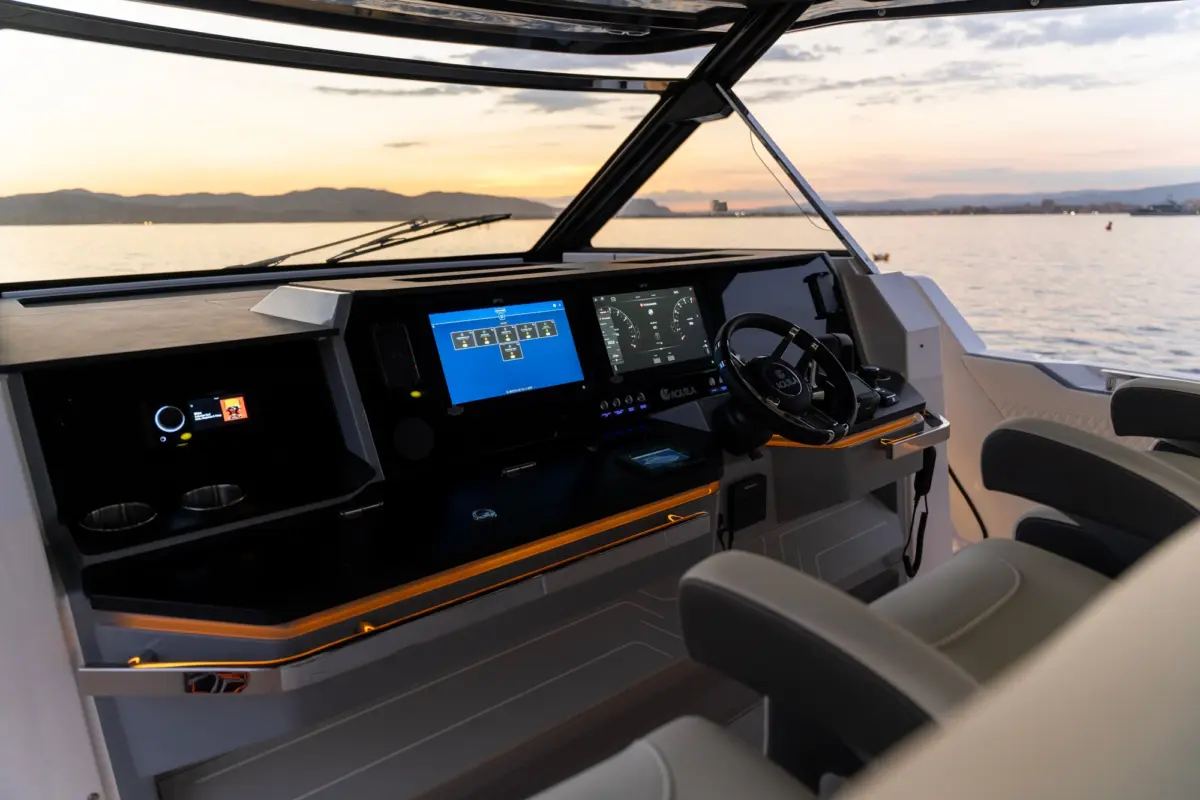
- The Command Helm Station: Moving aft, the helm acts as the operational nerve center of the vessel. It features a row of four individual, forward-facing seats complete with adjustable sliding positions, integrated armrests, and flip-down bolsters. This configuration allows the captain and three companions to sit comfortably side-by-side facing forward, sharing the thrill of high-speed navigation. The dashboard offers ample surface area for large glass-bridge multifunction displays (MFDs), digital switching modules, and joystick docking controls.
- The Aft Cockpit: The social hub of the vessel is located at the stern. A sprawling, U-shaped seating area dominates the aft cockpit, wrapping around a versatile dining or cocktail table. This entire assembly is engineered to convert effortlessly into a spacious sun lounger, adapting the space from a daytime dining area to a relaxed sun-bathing pad in a matter of seconds. Integrated directly into this zone is a fully equipped wet bar featuring a freshwater sink, dedicated storage, and optional refrigeration, ensuring refreshments are always close at hand.
Belowdecks Accommodation
Despite its performance-first profile and open-cockpit orientation, the Aquila 35 Sport refuses to compromise on overnight capabilities. Stepping down the companionway reveals a surprisingly voluminous and private cabin situated within the bridge deck structure.
The interior features a comfortable double berth capable of sleeping two adults in climate-controlled comfort. Crucially for extended day trips or weekend getaways, the layout incorporates a private head compartment complete with a dedicated shower. This inclusion elevates the 35 Sport from a pure day boat into a capable weekender, allowing owners to comfortably extend their time on the water without returning to shore facilities.
Multihull Advantages: Shallow Draft and Stability
As a catamaran, the 35 Sport inherits inherent physical advantages over monohull competitors of a similar length. The wide stance of the dual sponsons provides an exceptionally stable platform at rest, virtually eliminating the rolling motion commonly experienced by single-hull vessels in beam seas or boat wakes.
Furthermore, the multihull design yields a remarkably shallow draft, particularly when the outboards are trimmed up. This characteristic unlocks access to secluded anchorages, shallow sandbars, and waterfront establishments that deeper-draft vessels cannot safely approach, enhancing the yacht’s credentials as the ultimate coastal exploration vehicle.
Official Statements and Industry Perspectives
The introduction of the Aquila 35 Sport has sparked significant commentary from industry leaders, design engineers, and marine media figures, highlighting the strategic importance of the launch for the brand.
Aquila’s executive leadership emphasized during the Cannes debut that the 35 Sport was conceived to address a distinct evolution in buyer behavior. According to company representatives, modern luxury boaters increasingly reject the binary choice between comfortable cruising yachts and high-speed sport boats. Instead, the market demands vessels capable of seamlessly shifting personas—transitioning from an aggressive, high-speed coastal commuter in the morning to an elegant, relaxed entertaining platform by afternoon, and finally to a comfortable overnight cruiser by nightfall.
Marine architects involved in the project noted that the integration of the double-stepped hull on a 35-foot catamaran platform required unprecedented precision. Maintaining structural rigidity while introducing ventilation steps into twin slender sponsons demanded advanced composite engineering, utilizing vacuum-infused vinylester resins and structural foam cores to ensure maximum strength-to-weight ratios. The result, designers noted, is a hull that punches well above its weight class, delivering ride quality and dryness that typically characterize much larger vessels.
Industry analysts reviewing the debut at Cannes have also pointed out the strategic positioning of the 35 Sport. By mirroring the design language, finishes, and hardware quality of the flagship 45 Sport, Aquila has successfully created a cohesive "Sport" family of vessels. This allows current 45 Sport owners to downsize without compromising quality, while simultaneously providing an aspirational stepping stone for owners looking to enter the Aquila brand through a more manageable, highly dynamic platform.
Future Outlook: Market Impact and the Evolution of the Sport Catamaran
As the Aquila 35 Sport transitions from its global debut phase into full-scale global distribution, its arrival signals broader trends within the recreational boating market. The traditional dominance of the deep-V monohull in the high-speed day boat sector is being actively challenged by power catamarans that offer superior stability, expansive deck layouts, and greater usable square footage.
Redefining the 35-Foot Class
The 35 Sport establishes a new benchmark for what can be achieved in the mid-size power catamaran category. By proving that a multihull can achieve speeds up to 45 knots while retaining luxurious social spaces and genuine overnighting accommodations, Aquila has expanded the addressable market for catamarans. Buyers who were previously deterred by the conservative styling or limited performance of older multihull designs now have a compelling, high-performance alternative that aligns with contemporary aesthetic tastes.
Technological Integration and Future Iterations
Looking ahead, the platform architecture of the 35 Sport is well-positioned to incorporate emerging marine technologies. The dashboard layout and electrical infrastructure are fully prepared for advanced digital switching, cloud-based vessel monitoring systems, and sophisticated gyroscopic stabilization options if required, though the natural lateral stability of the catamaran hull largely negates the need for mechanical stabilizers.
Furthermore, as outboard engine manufacturers continue to push the boundaries of efficiency and alternative propulsion, the modular nature of the transom design ensures the 35 Sport can readily adapt to future propulsion advancements.
Conclusion
The Aquila 35 Sport is far more than a scaled-down variant of a larger yacht; it is a meticulously engineered, highly versatile high-performance power catamaran designed for the modern boating lifestyle. By fusing aggressive styling, a double-stepped hull, twin high-output Mercury outboards, and an ingenious three-zone social layout with comfortable overnight amenities, Aquila has delivered a vessel that excels across every performance and lifestyle metric. As it rolls out to international markets, the 35 Sport is poised to capture the imagination of discerning boaters worldwide, further solidifying Aquila’s dominance in the luxury power multihull sector.